Global Stationary Battery Storage Market Size, Share, Trends, Growth and Forecast 2032

Stationary Battery Storage Market By Battery Type (Lithium-Ion, Sodium Sulphur [NaS], Lead Acid, Flow Battery, and Others), By Application (Grid Services, Behind the Meter, and Off-Grid), By Energy Capacity (Up to 250 kWh, 251 kWh-1 MWh, 1.1-10 MWh, and Above 10-20 MWh), and By Region - Global and Regional Industry Overview, Market Intelligence, Comprehensive Analysis, Historical Data, and Forecasts 2024 - 2032
| Market Size in 2023 | Market Forecast in 2032 | CAGR (in %) | Base Year |
|---|---|---|---|
| USD 620.26 Million | USD 1030.26 Million | 5.8% | 2023 |
Stationary Battery Storage Market: Industry Perspective
What will be the global stationary battery storage market size during the forecast period?
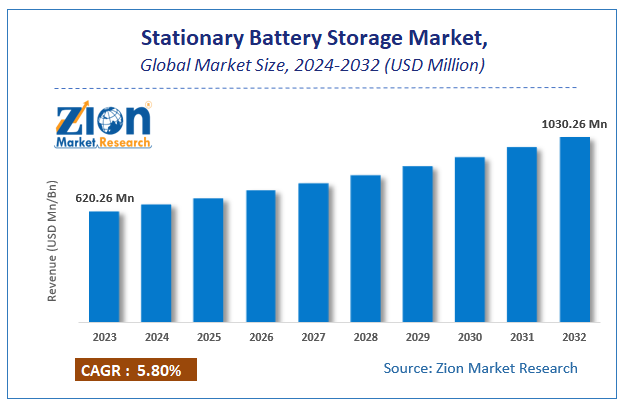
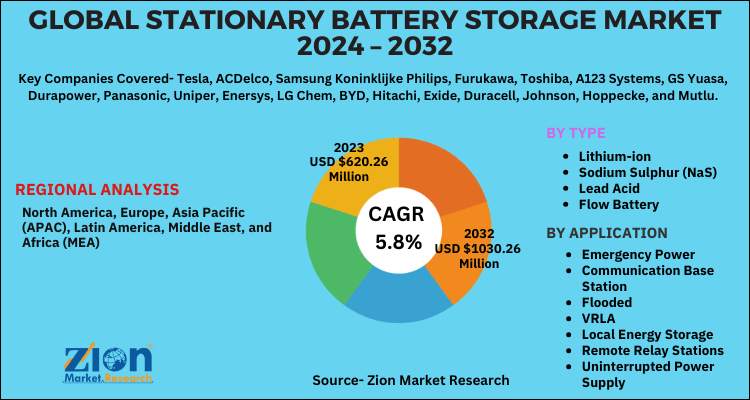
The global stationary battery storage market size was worth around USD 620.26 million in 2023 and is predicted to reach around USD 1030.26 million by 2032, with a compound annual growth rate (CAGR) of roughly 5.8% between 2024 and 2032.
This report provides a comprehensive analysis of the growth drivers, restraints, and challenges shaping demand across the global stationary battery storage market throughout the forecast period, while highlighting high-potential emerging opportunities within the industry.
Key Insights
- As per the analysis shared by our research analyst, the stationary battery storage market is estimated to grow annually at a CAGR of roughly 5.8% over the forecast period from 2024 to 2032.
- In terms of revenue, the global stationary battery storage market size was valued at around USD 620.26 million in 2023 and is projected to reach USD 1030.26 million by 2032.
- The stationary battery storage market is driven by escalating renewable energy integration, surging modernization of electric grid networks, and the vital necessity for continuous emergency backup power to prevent disruption during grid outages.
- Based on the battery type, the lithium-ion category accounted for the leading share of 45.6% in the global stationary battery storage market because high energy density, superior round-trip efficiency, declining manufacturing costs, and long cycle life make it ideal for utility and commercial installations.
- Based on the application, the grid services category accounted for the leading share of 48.2% in the global stationary battery storage market because electric transmission utilities require fast-responding stationary systems for frequency regulation, voltage stabilization, and peak shaving across major distribution corridors.
- Based on the energy capacity, the 1.1-10 MWh category accounted for the leading share of 41.5% in the global stationary battery storage market because it delivers the optimal capacity modularity required for utility-scale solar and wind hybridization projects as well as large industrial substation support.
- North America dominated the global stationary battery storage market with a revenue share of 39.4% because of extensive electric grid modernization programs, rapid deployment of utility-scale storage facilities, and robust federal clean energy tax incentives across the United States.
Stationary Battery Storage Market: Overview
Stationery battery storage plays a key role in generating a stable and incessant supply of power. The product finds gamut of applications in myriad industries as it provides exceptional storage capacity and outstanding connectivity. They are available in various designs and are utilized for emergency purpose. High capacity batteries are installed as a major source of backup for providing stability to the electric grid for providing incessant supply of power during power outages or power failure.
Stationary Battery Storage Market: Growth Drivers
What factors are primarily accelerating demand in the stationary battery storage market?
Rapid industrialization has enhanced the demand for power efficient sources of power and this will steer the market growth over the forecast period. Additionally, growing awareness pertaining to green environment will translate into huge demand for stationery battery storage over the coming years. Apparently, technological breakthroughs regarding grid network expansion will result in the market growth over the years ahead.
Furthermore, governments have introduced various schemes prompting the utilization of sustainable power sources and have enforced strict laws to ensure its use. This has culminated into rise in the production of stationery batteries, thereby favorably influencing the market progression in the recent years. Availability of raw materials at reduced costs and economies of scale will further drive the market trends. Rapid expansion of grid infrastructure & rampant acceptance of wireless systems will create a robust platform as well as strong base for the market to achieve sustainable growth in the coming decade.
Stationary Battery Storage Market: Restraints
What factors are limiting the expansion of the stationary battery storage market?
High upfront costs can constrain adoption in certain projects and regions. Raw material supply risks and safety concerns related to specific battery chemistries may also moderate the pace of deployment.
These factors require careful project planning, technology selection, and risk management by system integrators and end users.
Stationary Battery Storage Market: Opportunities
Where do significant growth opportunities lie for the stationary battery storage market?
Opportunities include renewable energy integration, grid stabilization, peak shaving, and declining battery costs. Expansion of solar and wind power supports broader adoption of stationary storage solutions.
Integration with smart grids and the need for reliable backup power in industrial, commercial, and communication applications create additional avenues for market expansion across grid services, behind-the-meter, and off-grid uses.
Stationary Battery Storage Market: Challenges
What key challenges confront participants in the stationary battery storage market?
Balancing performance, cost, and safety across different battery chemistries remains a key challenge. Ensuring long-term reliability and managing supply chain risks for critical materials further influence project economics.
Continuous innovation in chemistry, system design, and monitoring is required to meet evolving grid and end-user requirements.
Stationary Battery Storage Market: Report Scope
| Report Attributes | Report Details |
|---|---|
| Report Name | Stationary Battery Storage Market |
| Market Size in 2023 | USD 620.26 Million |
| Market Forecast in 2032 | USD 1030.26 Million |
| Growth Rate | CAGR of 5.8% |
| Number of Pages | 230 |
| Key Companies Covered | Tesla, ACDelco, Samsung, Koninklijke Philips, Furukawa, Toshiba, A123 Systems, GS Yuasa, Durapower, Panasonic, Uniper, Enersys, LG Chem, BYD, Hitachi, Exide, Duracell, Johnson, Hoppecke, and Mutlu |
| Segments Covered | By Battery Type, By Application, By Energy Capacity, and By Region |
| Regions Covered | North America, Europe, Asia Pacific (APAC), Latin America, Middle East, and Africa (MEA) |
| Base Year | 2023 |
| Historical Year | 2018 - 2022 |
| Forecast Year | 2024 - 2032 |
| Customization Scope | Avail customized purchase options to meet your exact research needs. Request For Customization |
Stationary Battery Storage Market: Segmentation
The stationary battery storage market is segmented by battery type, application, energy capacity, and region. All the segments of stationary battery storage market have been analyzed based on present and future trends and the market is estimated from 2024 to 2032.
Based on Battery Type Segment, the stationary battery storage market is divided into lithium-ion, sodium sulphur (NaS), lead acid, flow battery, and others. The lithium-ion category represents the most dominant division within this sector, commanding substantial market share due to its high energy density, compact footprint, exceptional round-trip energy efficiency exceeding 90%, and rapidly falling cell production costs achieved through massive economies of scale. Its proven track record and fast charge-discharge response times make it the premier choice for both utility-scale grid regulation and commercial on-site power backup, driving heavy volume procurement worldwide. Meanwhile, the lead acid category stands as the second most dominant division, capturing enduring commercial value across cost-sensitive telecommunication base stations, remote microgrids, and industrial UPS installations where its proven reliability, wide operational temperature tolerance, low upfront cost, and mature global recycling infrastructure maintain strong customer loyalty.
Based on Application Segment, the stationary battery storage market is divided into grid services, behind the meter, and off-grid. The grid services category represents the most dominant division, accounting for the highest market revenue driven by electric transmission utilities and independent power producers deploying utility-scale storage assets to support grid modernization. These multi-megawatt installations provide indispensable grid-firming capabilities, including fast frequency response, synthetic inertia, transmission deferral, and spinning reserves required to manage the intermittency of utility-scale solar and wind farms. The scale of these centralized utility contracts solidifies grid services as the primary volume anchor of the market. Concurrently, behind the meter represents the second most dominant division, flourishing on rapid commercial, industrial, and residential adoption aimed at cutting utility peak-demand surcharges, enhancing facility energy resilience, and optimizing rooftop solar self-consumption.
Based on Energy Capacity Segment, the stationary battery storage market is divided into up to 250 kWh, 251 kWh-1 MWh, 1.1-10 MWh, and above 10-20 MWh. The 1.1-10 MWh category represents the most dominant division, driven by the standard modular architecture adopted by utility developers and large industrial facilities seeking flexible, multi-megawatt-hour installations. Containerized battery enclosures designed within this capacity range offer optimal logistics, standardized fire-suppression integration, and plug-and-play installation capability for solar-plus-storage hybridization projects. Meanwhile, the 251 kWh-1 MWh category follows as the second most dominant division, maintaining robust commercial traction across commercial complexes, manufacturing plants, educational campuses, and microgrids requiring balanced energy reserves to power high-draw industrial machinery during utility peak tariff windows.
Stationary Battery Storage Market: Regional Analysis
Why will North America continue to dominate the global market during the projection period?
North America is expected to retain a dominant position over the forecast period. Escalating demand for stationary battery storage in the United States is a primary factor supporting regional leadership. Outstanding electric grid network facilities in countries such as the United States and Canada further drive market growth. This dominance contributes to overall market expansion by establishing strong demand for backup and grid-stability solutions, encouraging technology deployment, and supporting innovation in stationary storage systems that influence broader industry trends and capacity development.
Europe maintains steady demand linked to grid modernization and renewable integration efforts. Asia Pacific is advancing through industrialization and expanding power infrastructure. Latin America and the Middle East and Africa are progressing as energy reliability and backup requirements increase.
Recent Developments
-
In January 2024, Tesla Energy announced the expansion of its Megapack production capacity to satisfy surging international utility demand for grid-scale stationary battery storage installations designed for renewable capacity firming.
Stationary Battery Storage Market: Competitive Analysis
Key players influencing the market growth are
- Tesla
- ACDelco
- Samsung
- Koninklijke Philips
- Furukawa
- Toshiba
- A123 Systems
- GS Yuasa
- Durapower
- Panasonic
- Uniper
- Enersys
- LG Chem
- BYD
- Hitachi
- Exide
- Duracell
- Johnson
- Hoppecke
- Mutlu.
Stationary Battery Storage Market: Key Trends
What are the key trends in the stationary battery storage market?
Expansion of lithium-ion and alternative chemistries
Lithium-ion and other advanced chemistries continue to gain traction for stationary applications because of their energy density, efficiency, and improving cost profiles, supporting both grid-scale and backup uses.
Integration with renewables and smart grids
Growing integration of stationary storage with solar, wind, and smart grid systems is enhancing grid stability, enabling peak load management, and expanding the role of battery storage in energy transition strategies across grid services and behind-the-meter applications.
Segments Covered
The global stationary battery storage market is segmented as follows:
By Battery Type
- Lithium-Ion
- Sodium Sulphur (NaS)
- Lead Acid
- Flow Battery
- Others
By Application
- Grid Services
- Behind the Meter
- Off-Grid
By Energy Capacity
- Up to 250 kWh
- 251 kWh-1 MWh
- 1.1-10 MWh
- Above 10-20 MWh
By Region
- North America
- The U.S.
- Canada
- Mexico
- Europe
- France
- The UK
- Spain
- Germany
- Italy
- Rest of Europe
- Asia Pacific
- China
- Japan
- India
- Australia
- South Korea
- Rest of Asia Pacific
- The Middle East & Africa
- Saudi Arabia
- UAE
- Egypt
- Kuwait
- South Africa
- Rest of the Middle East & Africa
- Latin America
- Brazil
- Argentina
- Rest of Latin America
Table Of Content
Methodology
FrequentlyAsked Questions
Stationary battery storage stores electricity at fixed locations. It supports energy backup and grid stability
The global Stationary Battery Storage market is expected to be driven by the renewable energy integration, grid stability needs, and peak load management. Expansion of solar and wind power supports adoption.
According to study, the global Stationary Battery Storage market size was worth around USD 620.26 Million in 2023 and is predicted to grow to around USD 1030.26 Million By 2032.
The global Stationary Battery Storage market is expected to grow at a Compound Annual Growth Rate (CAGR) of around CAGR 5.8% during the forecast period from 2024-2032.
The global Stationary Battery Storage industry is projected to be challenged by high upfront costs, raw material supply risks, and safety concerns.
Renewable energy integration, grid stabilization, peak shaving, and declining battery costs will offer significant growth opportunities in the Stationary Battery Storage market.
Lithium-ion and alternative chemistries; grid-scale and behind-the-meter solutions; integration with renewables and smart grids are the emerging trends and innovations impacting the Stationary Battery Storage market.
The global Stationary Battery Storage market is expected to be led by North America during the forecast period.
Some of the prominent players operating in the global Stationary Battery Storage market are; Tesla, ACDelco, Samsung, Koninklijke Philips, Furukawa, Toshiba, A123 Systems, GS Yuasa, Durapower, Panasonic, Uniper, Enersys, LG Chem, BYD, Hitachi, Exide, Duracell, Johnson, Hoppecke, and Mutlu and others.
The report explores crucial aspects of the Stationary Battery Storage market, including a detailed discussion of existing growth factors and restraints, while also browsing future growth opportunities and challenges that impact the market.

HappyClients