
Global Soft Tissue Repair Market Size, Share, Trends, Growth 2032

Soft Tissue Repair Market By Product (Mesh/Tissue Patch, Soft Tissue Fixation Devices, Laparoscopic Instruments, and Others), By Application (Skin Repair, Orthopedic, Hernia Repair, Dental Reconstruction Repair, Breast Reconstruction Repair, and Others), and By Region - Global and Regional Industry Overview, Market Intelligence, Comprehensive Analysis, Historical Data, and Forecasts 2024 - 2032
| Market Size in 2023 | Market Forecast in 2032 | CAGR (in %) | Base Year |
|---|---|---|---|
| USD 14.69 Million | USD 29.47 Million | 8.04% | 2023 |
What is the soft tissue repair market size?
What will be the global soft tissue repair market size during the forecast period?
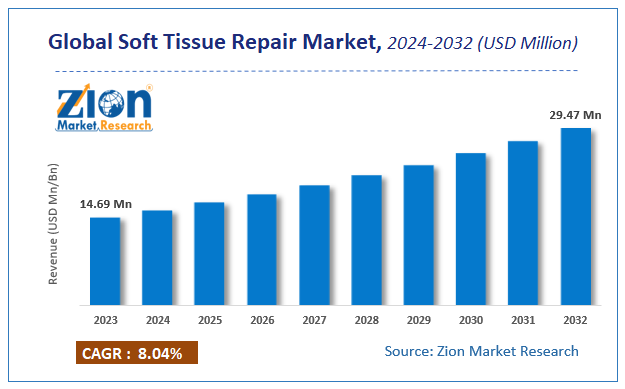
The global soft tissue repair market size was valued at around USD 14.69 million in 2023 and is predicted to reach around USD 29.47 million by 2032, with a compound annual growth rate (CAGR) of roughly 8.04% between 2024 and 2032.
This report provides a comprehensive analysis of the growth drivers, restraints, and challenges shaping demand across the global soft tissue repair market throughout the forecast period, while highlighting high-potential emerging opportunities within the industry.
Key Insights
- As per the analysis shared by our research analyst, the global soft tissue repair market is estimated to grow annually at a CAGR of around 8.04% over the forecast period (2024-2032).
- In terms of revenue, the global soft tissue repair market size was valued at around USD 14.69 million in 2023 and is projected to reach USD 29.47 million by 2032.
- The market is driven by a growing number of trauma patients and orthopedic surgeries, technological advancements, favorable rules and regulations, an increasing geriatric population, rising healthcare expenditure, and a significant increase in soft tissue injuries from sports activities.
- Based on the product, soft tissue fixation devices are expected to exhibit significant growth due to their ability to preserve tissues from decaying and increase the mechanical strength of the tissue.
- Based on the application, skin repair was the largest segment and is expected to witness the fastest growth owing to the skin’s ability to heal itself and help in generating new tissue, while orthopedic remains a leading category driven by sports-related soft tissue injuries.
- By region, North America held the most important market share and continues to lead due to advanced healthcare infrastructure, high procedure volumes, and strong presence of key industry players.
Soft Tissue Repair Market: Overview
Soft tissues within the body include ligaments, tendons, skin, and synovium, which support, connect, or surround other structures and organs of the body. Soft tissue injuries are segmented into time frames since the injury and therefore the healing processes that are occurring at that point. In repair, damaged tissue is replaced by granulation tissue, which matures to make connective tissue. Soft tissues are highly deformable, and their properties vary significantly from one person to another.
Soft tissue injuries are the most common injury in sports. A growing number of trauma patients and orthopedic surgeries is one of the key factors expected to drive revenue growth in the coming few years. Other major driving factors for increasing demand are an outsized number of technological advancements & favorable rules and regulations.
Soft Tissue Repair Market: Growth Drivers
What factors are accelerating demand for soft tissue repair?
The soft tissue repair market is expected to witness significant growth in the coming years owing to the increasing geriatric population coupled with rising healthcare expenditure. Moreover, with the popularity of sports like football, basketball, and tennis, there has been a significant increase in the number of soft tissue injuries arising from these games.
The increasing number of soft tissue injuries due to sports is further anticipated to fuel the market for soft tissue repair shortly. Also, the rising trend of minimally invasive procedures and technological advancement in orthopedic surgical products may open up new growth opportunities in the years to come.
Soft Tissue Repair Market: Restraints
What barriers are limiting market expansion?
Lack of experienced professionals and cost considerations represent major restraints that can limit expansion of the market. High procedural costs and limited access to specialized training in certain regions may slow adoption of advanced repair solutions.
Regulatory complexities and reimbursement variability can also influence the pace of new product uptake and market penetration in price-sensitive settings.
Soft Tissue Repair Market: Report Scope
| Report Attributes | Report Details |
|---|---|
| Report Name | Soft Tissue Repair Market |
| Market Size in 2023 | USD 14.69 Million |
| Market Forecast in 2032 | USD 29.47 Million |
| Growth Rate | CAGR of 8.04% |
| Number of Pages | 220 |
| Key Companies Covered | Smith and Nephew plc, Stryker Corporation, Integra LifeScience Corporation, LifeCell Corporation, Arthrex, Inc., Organogenesis, Covidien plc, Wright Medical Product, Johnson & Johnson, C.R. Bard, Inc., and American Medical Systems Inc |
| Segments Covered | By Product, By Application, and By Region |
| Regions Covered | North America, Europe, Asia Pacific (APAC), Latin America, Middle East, and Africa (MEA) |
| Base Year | 2023 |
| Historical Year | 2018 - 2022 |
| Forecast Year | 2024 - 2032 |
| Customization Scope | Avail customized purchase options to meet your exact research needs. Request For Customization |
Soft Tissue Repair Market: Segmentation
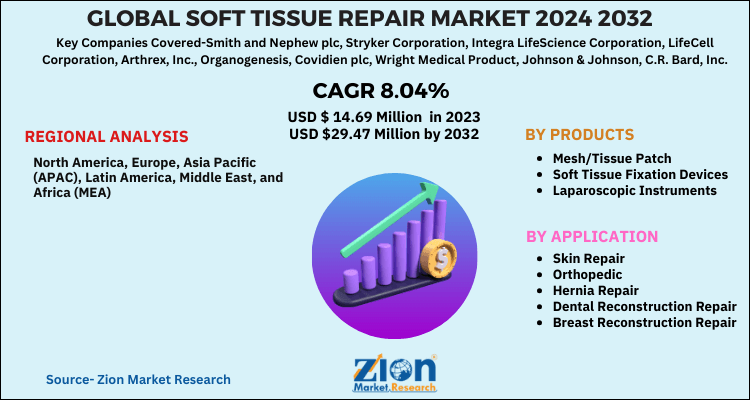
The soft tissue repair market is segmented by product, application, and region. All the segments of the soft tissue repair market have been analyzed based on present and future trends and the market is estimated from 2024 to 2032.
Based on Product, the soft tissue repair market is divided into mesh/tissue patch, soft tissue fixation devices, laparoscopic instruments, and others. Soft tissue fixation devices are expected to exhibit significant growth in the years to come on account of their ability to preserve tissues from decaying and increase the mechanical strength of the tissue. This performance advantage drives adoption in orthopedic and reconstructive procedures and supports overall market expansion. Mesh and tissue patches form a major complementary category widely used in hernia and soft tissue reinforcement, while laparoscopic instruments enable minimally invasive approaches that broaden procedural accessibility.
Based on Application, the soft tissue repair market is further segmented into skin repair, orthopedic, hernia repair, dental reconstruction repair, breast reconstruction repair, and others. In terms of revenue, skin repair was the largest segment in 2023. This growth is mainly due to the skin's ability to heal itself and help in generating new tissue. Skin repair is expected to witness the fastest growth in the coming years. Orthopedics was another leading segment in 2023 due to the significant increase in the number of soft tissue injuries arising from sports games such as basketball, soccer, etc.
Soft Tissue Repair Market: Regional Analysis
Why will North America continue to dominate the global market during the projection period?
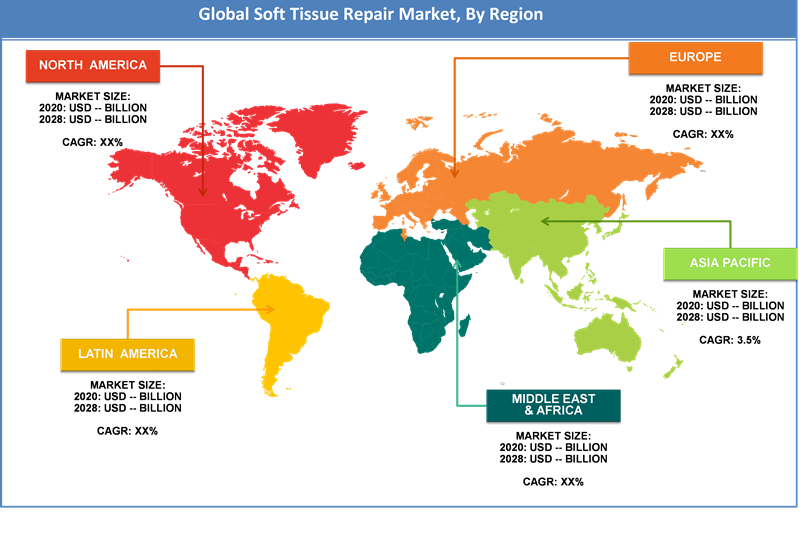
North America held the largest market share and continues to lead the soft tissue repair market. The region benefits from advanced healthcare infrastructure, high volumes of orthopedic and reconstructive procedures, and a strong presence of leading medical device companies. High awareness of sports-related injuries, favorable reimbursement environments, and continuous introduction of innovative repair technologies further reinforce adoption. These factors enable North America to drive overall market growth, set clinical standards, and accelerate development and commercialization of advanced soft tissue repair solutions.
Asia Pacific was the second-largest marketplace for medical device coating in 2023 and is predicted to be the fastest-growing revenue-contributing region in the Soft Tissue Repair market during the forecast period. Additionally, Latin America is also expected to show noticeable growth for this market in the years to come. With its population and advanced healthcare facilities are expected that the Asia-Pacific will witness the fastest growth in the soft tissue repair market shortly.
Soft Tissue Repair Market: Competitive Analysis
The global soft tissue repair market is dominated by players:
- Smith and Nephew plc
- Stryker Corporation
- Integra LifeScience Corporation
- LifeCell Corporation
- Arthrex, Inc
- Organogenesis
- Covidien plc
- Wright Medical Product
- Johnson & Johnson
- C.R. Bard, Inc
- American Medical Systems Inc
Segments Covered
The global soft tissue repair market is segmented as follows:
By Product
- Mesh/Tissue Patch
- Soft Tissue Fixation Devices
- Laparoscopic Instruments
- Others
By Application
- Skin Repair
- Orthopedic
- Hernia Repair
- Dental Reconstruction Repair
- Breast Reconstruction Repair
- Others
By Region
- North America
- The U.S.
- Canada
- Mexico
- Europe
- France
- The UK
- Spain
- Germany
- Italy
- Rest of Europe
- Asia Pacific
- China
- Japan
- India
- Australia
- South Korea
- Rest of Asia Pacific
- The Middle East & Africa
- Saudi Arabia
- UAE
- Egypt
- Kuwait
- South Africa
- Rest of the Middle East & Africa
- Latin America
- Brazil
- Argentina
- Rest of Latin America
Table Of Content
Methodology
FrequentlyAsked Questions
Soft tissue repair refers to the medical restoration of damaged ligaments, tendons, skin, synovium, and related structures that support, connect, or surround organs and other body structures. Repair processes replace damaged tissue with granulation that matures into connective tissue.
Key growth drivers include a growing number of trauma patients and orthopedic surgeries, technological advancements, favorable regulations, increasing geriatric population, rising healthcare expenditure, and a significant rise in soft tissue injuries associated with sports activities.
The global soft tissue repair market size was valued at approximately USD 14.69 million in 2023 and is projected to reach around USD 29.47 million by 2032.
The global soft tissue repair market is expected to grow at a compound annual growth rate (CAGR) of approximately 8.04% during the forecast period from 2024 to 2032.
North America is expected to contribute notably and lead the global soft tissue repair market, supported by advanced healthcare infrastructure, high procedure volumes, and strong industry presence.
Major players include Smith and Nephew plc, Stryker Corporation, Integra LifeScience Corporation, LifeCell Corporation, Arthrex, Inc., Organogenesis, Covidien plc, Wright Medical Product, Johnson & Johnson, C.R. Bard, Inc., and American Medical Systems Inc.
The report provides a detailed examination of growth drivers, restraints, opportunities, and challenges, along with comprehensive segmentation analysis, regional insights, competitive landscape, and forward-looking forecasts for the soft tissue repair market.

HappyClients

