
Global Sodium Cocoyl Glutamate Market Size, Share, Trends, Growth and Forecast 2032

Sodium Cocoyl Glutamate Market By Type (Powder, aqueous, solid SCG and others) and By Application (Skin care, Hair care and others): Global Industry Perspective, Comprehensive Analysis and Forecast, 2024 - 2032
| Market Size in 2023 | Market Forecast in 2032 | CAGR (in %) | Base Year |
|---|---|---|---|
| USD 178.78 Million | USD 254.46 Million | 4% | 2023 |
What is Sodium Cocoyl Glutamate Market Size?
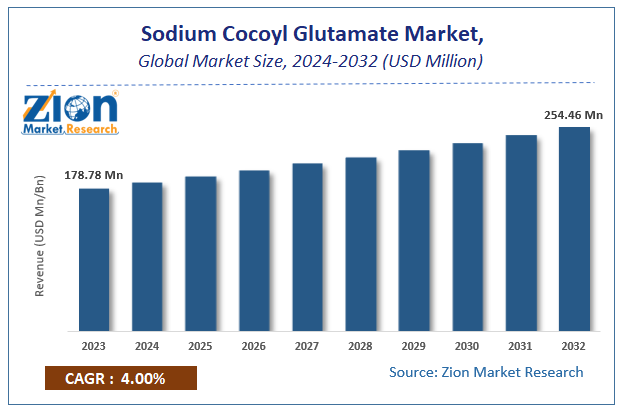
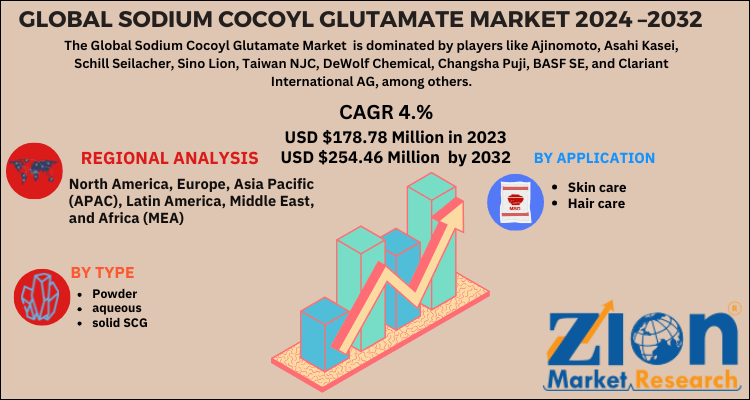
Zion Market Research has published a report on the global Sodium Cocoyl Glutamate Market, estimating its value at USD 178.78 Million in 2023, with projections indicating that it will reach USD 254.46 Million by 2032. The market is expected to expand at a compound annual growth rate (CAGR) of 4% over the forecast period 2024-2032.
The report explores the factors fueling market growth, the hitches that could hamper this expansion, and the opportunities that may arise in the Sodium Cocoyl Glutamate industry. Additionally, it offers a detailed analysis of how these elements will affect market demand dynamics and market performance throughout the forecast period.
Global Sodium Cocoyl Glutamate Market: Overview
Sodium Cocoyl Glutamate is a moderate surfactant or foaming product obtained from glucose isolated from coconut corn or palm kernel oil. The production of sodium cocoyl glutamate is simple, extracted from and combined with monosodium glutamate, a coconut / palm kernel oil produced by the fermentation of maize glucose. The innovative cleaning and foaming feature makes it ideal for use in personal goods. The human skin is preserved from drying and the moisture content is maintained. This mixture is mostly used to generate sulfate-free items. In skincare and hair care segments, such as shampoos, body wash, face wash, and cleansers, sodium cocoyl glutamate is primarily used.
Key Insights
- As per the analysis shared by our research analyst, the global Sodium Cocoyl Glutamate market is estimated to grow annually at a CAGR of around 4% over the forecast period (2024-2032).
- In terms of revenue, the global Sodium Cocoyl Glutamate market size was valued at around USD 178.78 Million in 2023 and is projected to reach USD 254.46 Million by 2032.
- The market is driven by growing demand for mild and natural surfactants in personal care products along with the shift toward sulfate-free and eco-friendly cosmetics.
- Based on the type segment, powder and aqueous forms hold significant positions due to their versatility in formulating solid and liquid personal care products that require gentle cleansing and good foaming performance.
- Based on the application segment, the hair care segment accounts for the largest share as sodium cocoyl glutamate is extensively used in shampoos and conditioners for its mildness and ability to support scalp and hair health without causing dryness.
- North America is expected to dominate the global market owing to substantial investments in research and development of natural and sulfate-free personal care ingredients and strong consumer demand for mild surfactants.
Sodium Cocoyl Glutamate Market Dynamics
Growth Drivers
What factors are primarily propelling the expansion of the Sodium Cocoyl Glutamate market?
Rising consumer preference for mild, sulfate-free, and naturally derived surfactants in personal care products is a major growth driver. Sodium cocoyl glutamate offers effective cleansing and foaming while helping maintain skin moisture and delivering a soft, comfortable feel, which aligns with demand for gentler alternatives to conventional surfactants such as sodium lauryl sulfate. Expanding use in hair care formulations including shampoos and conditioners, as well as skincare products such as soaps, shower gels, and facial cleansers, further supports volume growth. Significant investments by manufacturers in research and development of natural and sulfate-free product lines continue to accelerate adoption across both mass and premium segments.
Urbanization, higher disposable incomes, and changing lifestyles in both developed and emerging markets are increasing overall consumption of personal care goods. This creates sustained demand for high-performance mild ingredients that meet clean-label and eco-friendly expectations, reinforcing the long-term growth trajectory of the sodium cocoyl glutamate market.
Restraints
What challenges could limit the pace of market growth?
Complex manufacturing processes and relatively high production costs compared with conventional synthetic surfactants present notable restraints. These factors can limit price competitiveness and slow adoption, particularly among cost-sensitive formulators and in price-sensitive emerging markets. Supply constraints related to key natural raw materials may also affect consistent availability and cost stability.
Regulatory and formulation complexities associated with ensuring product stability, purity, and compatibility in diverse personal care systems can increase development timelines and costs for manufacturers, thereby moderating the overall growth rate in certain application areas.
Opportunities
Where do the most promising growth avenues lie?
Rapid urbanization, rising per capita spending on personal care, and evolving consumer lifestyles open substantial opportunities, especially for natural and sulfate-free formulations. Growing interest in clean-label, biodegradable, and mild surfactants creates room for expanded use beyond traditional hair and skin care into additional personal care and related applications. Continued innovation in product forms and synergistic blends with other natural ingredients can further broaden addressable markets.
Expansion into emerging economies, where personal care consumption is rising quickly, offers manufacturers the chance to capture new volume through localized production, partnerships, and tailored formulations that balance performance with cost efficiency.
Challenges
What obstacles must industry participants navigate?
Higher costs relative to traditional surfactants and potential supply-chain volatility for natural feedstocks remain key challenges. Manufacturers must continuously optimize processes and secure reliable raw-material sources to maintain competitiveness. Balancing mildness and performance while meeting increasingly stringent regulatory and sustainability requirements across different regions also demands ongoing investment in formulation science and quality systems.
Competition from alternative mild surfactants and the need to educate formulators and end-users on the benefits of sodium cocoyl glutamate can slow market penetration in certain segments until clear differentiation and proven efficacy are more widely recognized.
Sodium Cocoyl Glutamate Market: Report Scope
| Report Attributes | Report Details |
|---|---|
| Report Name | Sodium Cocoyl Glutamate Market |
| Market Size in 2023 | USD 178.78 Million |
| Market Forecast in 2032 | USD 254.46 Million |
| Growth Rate | CAGR of 4% |
| Number of Pages | 110 |
| Key Companies Covered | Ajinomoto, Asahi Kasei, Schill Seilacher, Sino Lion, Taiwan NJC, DeWolf Chemical, Changsha Puji, BASF SE, and Clariant International AG, among others |
| Segments Covered | By Form, By Application And By Region |
| Regions Covered | North America, Europe, Asia Pacific (APAC), Latin America, Middle East, and Africa (MEA) |
| Base Year | 2023 |
| Historical Year | 2018 - 2022 |
| Forecast Year | 2024 - 2032 |
| Customization Scope | Avail customized purchase options to meet your exact research needs. Request For Customization |
Sodium Cocoyl Glutamate Market Segmentation
The Sodium Cocoyl Glutamate market is segmented by type, application, and region.
Based on Type Segment, The Sodium Cocoyl Glutamate market is divided into powder, aqueous, solid SCG, and others. Powder and aqueous forms represent the most significant portions of the market. Powder is valued for its ease of handling, storage stability, and suitability for solid and powdered personal care formulations, while the aqueous form is preferred for liquid products such as shampoos, body washes, and cleansers because of its ready solubility and ease of incorporation. These forms help drive market growth by enabling formulators to create mild, sulfate-free products that deliver effective cleansing and foaming without compromising skin or hair condition. Their versatility supports broad adoption across both mass-market and premium personal care lines, reinforcing overall demand for sodium cocoyl glutamate.
Based on Application Segment, The Sodium Cocoyl Glutamate market is divided into skin care, hair care, and others. The hair care segment holds the largest share. Sodium cocoyl glutamate is extensively used in shampoos and conditioners because of its mild surfactant properties that cleanse effectively while helping to maintain scalp and hair moisture and reduce irritation. This dominance supports market growth by aligning with consumer demand for gentler hair care solutions that avoid the harshness associated with conventional sulfates. Skin care applications, including face washes, body washes, and cleansers, also contribute meaningfully as the ingredient preserves skin moisture and delivers a soft after-feel, further expanding the addressable market.
Sodium Cocoyl Glutamate Market: Regional Analysis
Why will North America continue to dominate the global market during the projection period?
North America is expected to maintain a leading position driven by strong consumer demand for mild, natural, and sulfate-free personal care products and substantial investments in research and development focused on innovative natural surfactants. The presence of major personal care brands and formulators that prioritize clean-label and gentle ingredients further reinforces regional leadership. Continued emphasis on product innovation and regulatory support for safer cosmetic ingredients sustains demand and supports overall market expansion.
Europe represents a mature and significant market supported by stringent regulations favoring mild and environmentally preferred ingredients, high consumer awareness of clean beauty, and established personal care manufacturing infrastructure. Leading countries within the region continue to drive formulation innovation and adoption of amino-acid-based surfactants such as sodium cocoyl glutamate.
Asia Pacific is witnessing rapid growth fueled by expanding personal care consumption, rising disposable incomes, urbanization, and increasing preference for mild and natural products, particularly in China, Japan, India, and Southeast Asian markets. Local manufacturing capacity and growing domestic brands are accelerating regional demand and contributing meaningfully to global market expansion.
Latin America and the Middle East & Africa are emerging opportunities characterized by growing middle-class populations, rising awareness of personal care quality, and gradual shifts toward milder formulations. While currently smaller in absolute size, these regions offer long-term growth potential as infrastructure and consumer spending continue to develop.
Recent Developments
- In recent years, leading producers have focused on expanding capacity and refining production processes for sodium cocoyl glutamate to meet rising demand for natural and sulfate-free surfactants in personal care applications.
- Companies continue to invest in research aimed at improving the performance and cost-efficiency of amino-acid-based mild surfactants, supporting broader formulation use in hair care and skin care products.
Sodium Cocoyl Glutamate Market: Competitive Players
Some main participants of the-
- Ajinomoto
- Asahi Kasei
- Schill Seilacher
- Sino Lion
- Taiwan NJC
- DeWolf Chemical
- Changsha Puji
- BASF SE
- Clariant International AG
- among others.
Sodium Cocoyl Glutamate market is segmented as follows:
By Type
- Powder
- Aqueous
- Solid SCG
- others
By Application
- Skin care
- Hair care
- Others
By Region
- North America
- The U.S.
- Canada
- Mexico
- Europe
- France
- The UK
- Spain
- Germany
- Italy
- Rest of Europe
- Asia Pacific
- China
- Japan
- India
- Australia
- South Korea
- Rest of Asia Pacific
- The Middle East & Africa
- Saudi Arabia
- UAE
- Egypt
- Kuwait
- South Africa
- Rest of the Middle East & Africa
- Latin America
- Brazil
- Argentina
- Rest of Latin America
Table Of Content
Methodology
FrequentlyAsked Questions
Sodium cocoyl glutamate is a mild surfactant derived from coconut oil. It is used in personal care products
The global Sodium Cocoyl Glutamate market is expected to be driven by the demand for mild and natural surfactants in personal care products. Growth in sulfate-free and eco-friendly cosmetics supports adoption.
According to study, the global Sodium Cocoyl Glutamate market size was worth around USD 178.78 Million in 2023 and is predicted to grow to around USD 254.46 Million By 2032.
The global Sodium Cocoyl Glutamate market is expected to grow at a Compound Annual Growth Rate (CAGR) of around CAGR 4% during the forecast period from 2024-2032.
The global Sodium Cocoyl Glutamate industry is projected to be challenged by Challenges include higher cost than conventional surfactants and supply constraints.
The Opportunities include demand for mild, natural personal care products, sulfate-free formulations, and clean-label cosmetics will offer significant growth opportunities in the Sodium Cocoyl Glutamate market.
Mild and biodegradable surfactant formulations; rising use in sulfate-free personal care; demand driven by natural cosmetics trends are the emerging trends and innovations impacting the Sodium Cocoyl Glutamate market.
The global Sodium Cocoyl Glutamate market is expected to be led by APAC during the forecast period.
Some of the prominent players operating in the global Sodium Cocoyl Glutamate market are; Ajinomoto, Asahi Kasei, Schill Seilacher, Sino Lion, Taiwan NJC, DeWolf Chemical, Changsha Puji, BASF SE, and Clariant International AG, among others and others.
The report explores crucial aspects of the Sodium Cocoyl Glutamate market, including a detailed discussion of existing growth factors and restraints, while also browsing future growth opportunities and challenges that impact the market.

HappyClients

