
Sodium Acid Pyrophosphate (SAPP) Market Size, Share Report 2034

Sodium Acid Pyrophosphate (SAPP) Market By Application (Food Industry, Pharmaceuticals, Industrial), By Sales Channel (Direct, Indirect), By End-User Industry (Food and Beverage, Leather, Petroleum), and By Region - Global and Regional Industry Overview, Market Intelligence, Comprehensive Analysis, Historical Data, and Forecasts 2025 - 2034
| Market Size in 2024 | Market Forecast in 2034 | CAGR (in %) | Base Year |
|---|---|---|---|
| USD 4.28 Billion | USD 5.90 Billion | 4.10% | 2024 |
Sodium Acid Pyrophosphate (SAPP) Industry Perspective:
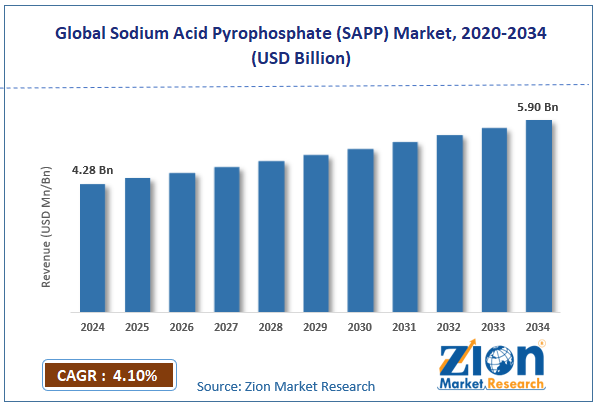
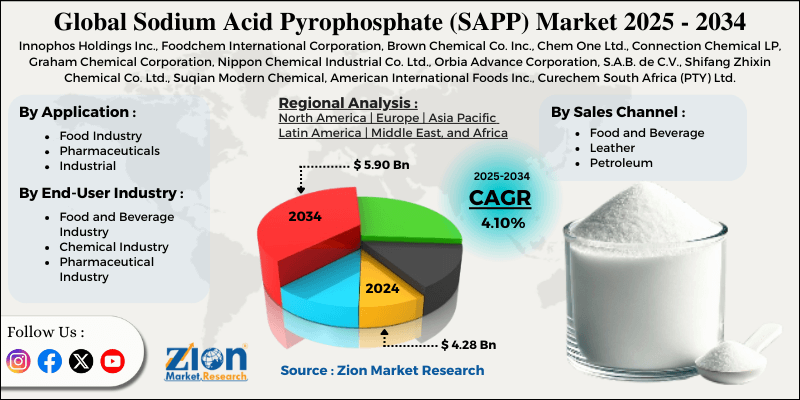
The global sodium acid pyrophosphate (SAPP) market size was approximately USD 4.28 billion in 2024 and is projected to reach USD 5.90 billion by 2034, with a compound annual growth rate (CAGR) of approximately 4.10% between 2025 and 2034.
Key Insights:
- As per the analysis shared by our research analyst, the global sodium acid pyrophosphate (SAPP) market is estimated to grow annually at a CAGR of around 4.10% over the forecast period (2025-2034)
- In terms of revenue, the global sodium acid pyrophosphate (SAPP) market size was valued at around USD 4.28 billion in 2024 and is projected to reach USD 5.90 billion by 2034.
- The sodium acid pyrophosphate (SAPP) market is projected to grow significantly owing to the growth of processed and convenience foods, use in meat & seafood processing, and pharmaceutical stabilizer demand.
- Based on application, the food industry segment is the dominating segment, while the industrial segment is projected to witness sizeable revenue over the forecast period.
- Based on sales channel, the indirect segment holds a leading market share, while the direct segment is expected to grow considerably in the coming years.
- Based on end-user industry, the food and beverage segment is expected to lead the market, followed by the chemical segment.
- Based on region, the Asia Pacific is projected to dominate the global market during the estimated period, followed by North America.
Sodium Acid Pyrophosphate (SAPP) Market: Overview
Sodium acid pyrophosphate (SAPP) is a water-soluble, white inorganic compound broadly used in food processing, mainly as a leavening acid in baked products. It reacts with baking soda to release carbon dioxide, helping dough rise at a controlled rate based on the SAPP grade. Beyond baking, it is used to stabilize color in processed potatoes, enhance texture in seafood and meats, and control pH. The global Sodium Acid Pyrophosphate (SAPP) market is poised for notable growth, driven by the expansion of the global bakery industry, growing use in seafood and meat processing, and rising applications in water treatment. The bakery industry heavily depends on consistent leavening performance, which SAPP delivers through controlled reaction rates. Its ability to enhance dough volume, handling, and texture makes it vital to industrial bakers. With bakery consumption growing worldwide, demand for SAPP is robustly supported.
Moreover, SAPP helps retain moisture, stabilize color, and enhance texture in processed seafood and meat. These functions are vital for maintaining product appeal during storage and transport. As protein-processing industries expand, the additive becomes increasingly paramount. Furthermore, SAPP’s chelating properties make it effective for preventing scale and controlling mineral levels in municipal and industrial water systems. Growing industrialization and concerns about water quality are driving its use. This widens the compound’s industry beyond food applications.
Nevertheless, the global market is constrained by factors such as volatile raw material costs and environmental concerns regarding phosphate use. SAPP depends on phosphate, sodium, and minerals, all of which are sensitive to supply fluctuations and energy prices. Instability in these inputs increases production costs and reduces manufacturers' margins. This instability can make alternative additives more appealing.
Likewise, phosphate-containing products are scrutinized for their potential ecological impact, particularly in water systems. Stringent environmental regulations may limit the use of chemicals in water treatment, detergents, and industrial discharges. These pressures encourage companies to explore greener substitutes.
Still, the global Sodium Acid Pyrophosphate (SAPP) industry benefits from several favorable factors, such as growth in industrial water treatment demand and the development of high-purity and specialty grades. Industrial facilities seek effective techniques to manage scale, water hardness, and corrosion. SAPP’s performance as a sequestering and chelating agent supports the need for more advanced water-treatment solutions. Rising environmental compliance augments adoption.
Additionally, producers can distinguish through food-grade, encapsulated, low-impurity, and controlled-release SAPP formulations. Specialty variants offer high margins and provide access to regulated industries such as personal care and pharmaceuticals. Advancement reinforces competitive ranking.
Sodium Acid Pyrophosphate (SAPP) Market Dynamics
Growth Drivers
How is the demand for consistency, quality, and extended shelf-life in food supply chains propelling the sodium acid pyrophosphate (SAPP) market?
Modern food supply chains, particularly global, large-scale operations, require uniform product quality and extended shelf life. SAPP helps maintain moisture, texture, and rise in baked goods, processed products, and frozen meals. It assures stability during long-distance transportation and storage under variable conditions. Manufacturers increasingly rely on additives to reduce batch-to-batch variation and waste. Meeting consumer expectations for quality and freshness improves brand loyalty. Large-scale food producers prioritize reliable and functional additives like SAPP. This growing need for consistent quality fuels sustained industry growth.
How are technological improvements in product formulation and R&D driving the sodium acid pyrophosphate (SAPP) market?
Ongoing R&D and process advancements have elevated SAPP’s performance, purity, and stability in applications. In food applications, this ensures consistent leavening, texture, and moisture retention, while in industrial applications, it improves detergent and water-treatment efficiency. Technological advancements allow producers to meet stringent quality standards and consumer expectations. New formulations may reduce phosphate content, supporting clean-label trends. Improved functionality drives adoption across both the non-food and food segments. Advancement also distinguishes manufacturers in competitive markets. Constant product development fuels sustained growth in the sodium acid pyrophosphate (SAPP) market.
Restraints
Competition from alternative leavening agents adversely impacts the market progress
Other leavening agents, such as monocalcium phosphate, baking soda, or natural raising agents, are steadily replacing SAPP in most applications. Clean-label trends are driving manufacturers to seek alternatives perceived as more natural or safer. This reduces SAPP’s industry share, particularly in the processed food and bakery segments. Alternatives may also offer cost advantages in small-scale production. Elevated R&D on multifunctional or natural additives increases substitution risk. Over time, competitive pressures may restrict SAPP’s growth in food applications. Manufacturers should innovate to maintain relevance and create a strong foothold.
Opportunities
How is the development of clean-label and eco-friendly grades creating promising avenues for the sodium acid pyrophosphate (SAPP) industry growth?
R&D into low-phosphate, eco-friendly SAPP or natural variants offers major potential for the sodium acid pyrophosphate (SAPP) industry. Clean-label and sustainability trends are influencing ingredient selection in food production. Advancements in environmentally friendly, safer formulations help overcome regulatory barriers and perceptions. Manufacturers can capitalize on this by promoting functional advantages alongside eco-compliance. These product advancements support global trends toward sustainability and transparency. They also create opportunities for differentiation in competitive regions. Investment in greener SAPP variants improves brand positioning and adoption.
Challenges
Supply chain disturbances restrict the market growth
SAPP production is heavily dependent on phosphate chemicals and rock inputs, which are susceptible to logistical, geopolitical, or environmental disturbances. Transportation delays, mining limitations, or import restrictions may impact availability. Supply scarcities can raise costs or create contractual risks for buyers. Manufacturers should implement strong inventory and contingency management strategies. Supply stability is vital for maintaining long-term customer relationships. Any disturbance can hamper industry growth and confidence. This makes supply chain management a consistent challenge.
Sodium Acid Pyrophosphate (SAPP) Market: Report Scope
| Report Attributes | Report Details |
|---|---|
| Report Name | Sodium Acid Pyrophosphate (SAPP) Market |
| Market Size in 2024 | USD 4.28 Billion |
| Market Forecast in 2034 | USD 5.90 Billion |
| Growth Rate | CAGR of 4.10% |
| Number of Pages | 212 |
| Key Companies Covered | Innophos Holdings Inc., Foodchem International Corporation, Brown Chemical Co. Inc., Chem One Ltd., Connection Chemical LP, Graham Chemical Corporation, Nippon Chemical Industrial Co. Ltd., Orbia Advance Corporation, S.A.B. de C.V., Shifang Zhixin Chemical Co. Ltd., Suqian Modern Chemical, American International Foods Inc., Curechem South Africa (PTY) Ltd., TNN Development Limited, Wego Chemical Group, Independent Chemical Corporation, and others. |
| Segments Covered | By Application, By Sales Channel, By End-User Industry, and By Region |
| Regions Covered | North America, Europe, Asia Pacific (APAC), Latin America, Middle East, and Africa (MEA) |
| Base Year | 2024 |
| Historical Year | 2019 to 2023 |
| Forecast Year | 2025 - 2034 |
| Customization Scope | Avail customized purchase options to meet your exact research needs. Request For Customization |
Sodium Acid Pyrophosphate (SAPP) Market: Segmentation
The global sodium acid pyrophosphate (SAPP) market is segmented based on application, end-user industry, and region.
Based on application, the global sodium acid pyrophosphate (SAPP) industry is divided into food industry, pharmaceuticals, and industrial. The food industry segment registers a dominating share of the market, mainly using it as a leavening moisture retention, color stability, and shelf life in processed meats, seafood, and ready-to-eat items. Its versatility, regulatory approval, and the growing demand for convenience foods continue to fuel the broader adoption.
Based on sales channel, the market is categorized as direct and indirect. The indirect segment holds a substantial share of the market because of its logistical convenience and wide distribution networks. It allows buyers to access sodium acid pyrophosphate in different quantities without managing complex supply chains. Its broad market reach and scalability keep it the leading sales segment.
Based on end-user industry, the global sodium acid pyrophosphate (SAPP) market is segmented into food and beverage, leather, and petroleum. The food and beverage industry dominates the market, using it broadly in bakery items, seafood, ready-to-eat meals, and processed meats. It improves color stability, leavening, shelf life, and moisture retention, assuring consistent product quality. Growing worldwide consumption of convenience and packaged foods continues to fuel strong demand in this segment.
Sodium Acid Pyrophosphate (SAPP) Market: Regional Analysis
Why is Asia Pacific outperforming other regions in the global Sodium Acid Pyrophosphate (SAPP) Market?
Asia Pacific is projected to maintain its dominant position in the global Sodium Acid Pyrophosphate (SAPP) market owing to a high share of global consumption and market value, rapid growth in additive demand and food processing, and a large population base and an expanding middle class. Asia-Pacific accounts for a leading share of the global market, indicating its dominance across all applications. The region’s consumption spans the industrial, food, and water-treatment industries, making it a substantial driver of global demand. Its volume and scale ensure that APAC consistently leads in market value.
Moreover, the expansion of processed and packaged foods and the convenience trend in APAC have created robust demand for functional additives like SAPP. Changing dietary patterns, urbanization, and rising food manufacturing capacity are driving its use in ready-to-eat, bakery, and processed meat products. This growth makes food processing a crucial contributor to the region’s SAPP consumption.
Additionally, the region’s large population provides a significant consumer base for convenience and processed foods that depend on SAPP for shelf life and quality. Rising urbanization and incomes further increase consumption, creating sustained demand for functional food additives. The demographic benefit highlights the region’s leadership in the industry.
North America maintains its position as the second-largest region in the global Sodium Acid Pyrophosphate (SAPP) industry due to a mature processed food market, high purchasing power, and lifestyle-driven demand. North America has a developed, high-volume convenience and processed food industry that largely depends on SAPP. It is broadly used in bakery products, processed meats, frozen meals, and ready-to-eat foods to assure consistent leavening, shelf life, and texture.
The region’s advanced food-processing infrastructure promises robust, sustained demand for SAPP. Fast-paced lifestyles and high disposable incomes in North America inspire frequent consumption of convenience and packaged foods. SAPP helps manufacturers maintain product texture, quality, and shelf stability to meet consumer expectations. This steady lifestyle-driven consumption assures ongoing demand in the food industry.
Furthermore, beyond food, North America’s municipal and industrial sectors widely use SAPP in detergents, water treatment, ceramic or metal processing, and cleaning formulations. Its chelating, pH-regulating, and dispersing characteristics make it vital for maintaining quality and efficiency. These different non-food applications strengthen the region’s total market.
Sodium Acid Pyrophosphate (SAPP) Market: Competitive Analysis
The leading players in the global sodium acid pyrophosphate (SAPP) market are:
- Innophos Holdings Inc.
- Foodchem International Corporation
- Brown Chemical Co. Inc.
- Chem One Ltd.
- Connection Chemical LP
- Graham Chemical Corporation
- Nippon Chemical Industrial Co. Ltd.
- Orbia Advance Corporation
- S.A.B. de C.V.
- Shifang Zhixin Chemical Co. Ltd.
- Suqian Modern Chemical
- American International Foods Inc.
- Curechem South Africa (PTY) Ltd.
- TNN Development Limited
- Wego Chemical Group
- Independent Chemical Corporation
Sodium Acid Pyrophosphate (SAPP) Market: Key Market Trends
Growth of non‑food applications:
Industrial users and manufacturers are steadily leveraging SAPP’s pH-regulating, chelating, and dispersant properties in cleaning agents, water treatment, industrial processing, and detergents. This diversification beyond food adds market elasticity and reduces reliance on food-industry demand cycles.
Innovation in specialty and purity grades:
Producers are developing high-purity, specialized SAPP grades for different end-consumers – for example, industrial-grade, ultra-pure food-grade for water treatment, or custom formulations for cleaning applications and detergents. This enables enhanced performance, regulatory compliance, and entry into precision-demanding new segments.
The global sodium acid pyrophosphate (SAPP) market is segmented as follows:
By Application
- Food Industry
- Pharmaceuticals
- Industrial
By Sales Channel
- Food and Beverage
- Leather
- Petroleum
By End-User Industry
- Food and Beverage Industry
- Chemical Industry
- Pharmaceutical Industry
By Region
- North America
- The U.S.
- Canada
- Europe
- France
- The UK
- Spain
- Germany
- Italy
- Rest of Europe
- Asia Pacific
- China
- Japan
- India
- South Korea
- Southeast Asia
- Rest of Asia Pacific
- Latin America
- Brazil
- Mexico
- Rest of Latin America
- Middle East & Africa
- GCC
- South Africa
- Rest of Middle East & Africa
Table Of Content
Methodology
FrequentlyAsked Questions

HappyClients

