
Signals Intelligence (SIGINT) Market Size, Share, Trends, Growth and Forecast 2032

Signals Intelligence (SIGINT) Market By end-user (commercial services, defense intelligence, navy, air force, army, and others), By component (communication intelligence and electronic intelligence), By platform (space, joint, naval, air, bone, and land), By application (transportation system, emergency services, routine operations, military critical infrastructure, homeland security & cyber protection, military commands, and others) And By Region: - Global And Regional Industry Overview, Market Intelligence, Comprehensive Analysis, Historical Data, And Forecasts, 2024-2032
| Market Size in 2023 | Market Forecast in 2032 | CAGR (in %) | Base Year |
|---|---|---|---|
| USD 15.95 Million | USD 23.61 Million | 4.45% | 2023 |
Description
What is the Signals Intelligence (SIGINT) Market Size?
According to the report published by Zion Market Research, the global Signals Intelligence (SIGINT) Market size was valued at USD 15.95 Million in 2023 and is predicted to reach USD 23.61 Million by the end of 2032. The market is expected to grow with a CAGR of 4.45% during the forecast period. The report analyzes the global Signals Intelligence (SIGINT) Market's growth drivers, restraints, and impact on demand during the forecast period. It will also help navigate and explore the arising opportunities in the Signals Intelligence (SIGINT) industry.
-market-size.png)
Global Signals Intelligence (SIGINT) Market: Overview
Signal intelligence is a process of extracting information by the analysis and collection of electronic signals and communication. It functions with the help of intelligence gathering via the intervention of signals. The signal can be from electronic signals or between people which is not utilized in communication sectors. It provides information to individuals or organizations in the decision process to gain a strategic advantage.
Global Signals Intelligence (SIGINT) Market: Growth Factors
Signal intelligence works on two main components one is communication intelligence (COMIT) that is extracted with the help of assessing communication among individuals and the second one is electronic intelligence (ELINT) which is extracted with the help of electronic sensors. It is extended to encompass the information extracted from several other types of interception of the signals. Electronic intelligence helps strategists to develop bits of knowledge to monitor activities in the question zone and many other critical sectors. It also monitors ground powers, mariners, and pilots regarding the danger they may foresee. Thus, such emerging scenarios propel the growth of the global signals intelligence (SIGINT) market.
Also, the growing usage of space command, smart city command, and control infrastructure applications are likely to propel the growth of the global signals intelligence (SIGINT) market significantly during the forecast period. Also, the dynamic and highly complex nature of missions in the military and defense sector is also transforming the way commanders engage in the execution and planning process traditionally. Initially, the commanders interrupt fixed battlefield variables like function, time, and geography. Nowadays, the battlefield takes up interrelated and multiple aspects. The prearranged decision-making process goes simultaneously with real-time sequential planning and collective capabilities coupled with efforts from multiple organizations in a highly structured, wholly organized, and planned signal intelligence to resolve higher complexity with self-pace and take instantaneous actions.
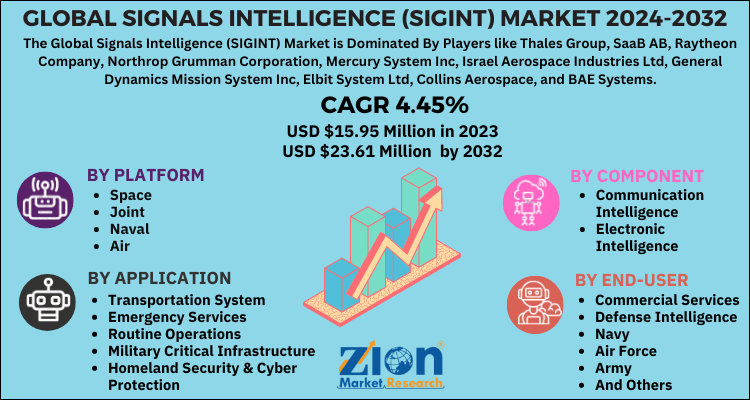
Global Signals Intelligence (SIGINT) Market: Segmentation
The global signals intelligence (SIGINT) market can be segmented into end-user, component, platform, application, and region.
By end-users, the market can be segmented into commercial services, defense intelligence, navy, air force, army, and others. The defense intelligence segment accounts for the largest share in the global signals intelligence (SIGINT) market due to the incorporation of intelligence rules like surveillance, information fusion, reconnaissance, data analytics, spectrum dominance, electronic warfare, cyber control system, next-gen communication, and many others.
By component, the market can be segmented into communication intelligence and electronic intelligence. The electronic intelligence segment holds the largest share in the global signals intelligence (SIGINT) market due to its high usage in managing the working operations in remote and disrupted areas by maintaining the ground forces, sailors, aviators, in a circle with the control center.
By platform, the market can be segmented into space, joint, naval, air, bone, and land.
By application, the market can be segmented into the transportation system, emergency services, routine operations, military critical infrastructure, homeland security & cyber protection, military commands, and others. The military command segment holds hegemony over others due to the availability of customized products along with premium usage of the signal intelligence solutions in the sectors.
Signals Intelligence (SIGINT) Market: Report Scope
| Report Attributes | Report Details |
|---|---|
| Report Name | Signals Intelligence (SIGINT) Market |
| Market Size in 2023 | USD 15.95 Million |
| Market Forecast in 2032 | USD 23.61 Million |
| Growth Rate | CAGR of 4.45% |
| Number of Pages | 195 |
| Key Companies Covered | Thales Group, SaaB AB, Raytheon Company, Northrop Grumman Corporation, Mercury System Inc, Israel Aerospace Industries Ltd, General Dynamics Mission System Inc, Elbit System Ltd, Collins Aerospace, and BAE Systems. |
| Segments Covered | By end-user, By component, By platform, By application and By Region |
| Regions Covered | North America, Europe, Asia Pacific (APAC), Latin America, Middle East, and Africa (MEA) |
| Base Year | 2023 |
| Historical Year | 2018 - 2022 |
| Forecast Year | 2024 - 2032 |
| Customization Scope | Avail customized purchase options to meet your exact research needs. Request For Customization |
Global Signals Intelligence (SIGINT) Market: Regional analysis
Asia Pacific accounts for the largest share in the global signals intelligence (SIGINT) market due to the significant rise in investment from defense sectors in the region. Moreover, the increasing incidences of interpersonal standoff and asymmetric warfare coupled with higher economic development will further boost the growth of the regional market.
North America is expected to witness huge growth during the forecast period due to the growing technological advancements in the field of signal intelligence solutions. Moreover, the presence of prominent market players in the region further boosts the growth of the regional market.
Global Signals Intelligence (SIGINT) Market: Competitive Players
Some of the significant players in the global signals intelligence (SIGINT) market are
- Thales Group
- SaaB AB
- Raytheon Company
- Northrop Grumman Corporation
- Mercury System Inc
- Israel Aerospace Industries Ltd
- General Dynamics Mission System Inc
- Elbit System Ltd
- Collins Aerospace
- and BAE Systems.
The Global Signals Intelligence (SIGINT) Market is segmented as follows:
By end-user
- commercial services
- defense intelligence
- navy
- air force
- army
- and others
By component
- communication intelligence
- electronic intelligence
By platform
- space
- joint
- naval
- air
- bone
- land
By application
- transportation system
- emergency services
- routine operations
- military critical infrastructure
- homeland security & cyber protection
- military commands
- and others
By Region
- North America
- The U.S.
- Canada
- Mexico
- Europe
- France
- The UK
- Spain
- Germany
- Italy
- Rest of Europe
- Asia Pacific
- China
- Japan
- India
- Australia
- South Korea
- Rest of Asia Pacific
- The Middle East & Africa
- Saudi Arabia
- UAE
- Egypt
- Kuwait
- South Africa
- Rest of the Middle East & Africa
- Latin America
- Brazil
- Argentina
- Rest of Latin America
What Reports Provides
- Full in-depth analysis of the parent market
- Important changes in market dynamics
- Segmentation details of the market
- Former, on-going, and projected market analysis in terms of volume and value
- Assessment of niche industry developments
- Market share analysis
- Key strategies of major players
- Emerging segments and regional markets
- Testimonials to companies in order to fortify their foothold in the market.
Table Of Content

FrequentlyAsked Questions
Signals intelligence involves collecting and analyzing electronic signals for security and defense purposes. It supports military, intelligence, and surveillance operations.
The global Signals Intelligence (SIGINT) market is expected to be driven by the Driven by rising geopolitical tensions, growing defense modernization, and increased need for electronic surveillance and threat detection. Investments in AI-enabled signal processing strengthen market growth.
According to study, the global Signals Intelligence (SIGINT) market size was worth around USD 15.95 Million in 2023 and is predicted to grow to around USD 23.61 Million By 2032.
The global Signals Intelligence (SIGINT) market is expected to grow at a Compound Annual Growth Rate (CAGR) of around CAGR 4.45% during the forecast period from 2024-2032.
The global Signals Intelligence (SIGINT) industry is projected to be challenged by Challenges include high system costs, stringent defense procurement cycles, and evolving encryption and countermeasure technologies reducing interception effectiveness.
The Opportunities lie in rising geopolitical tensions, modernization of defense intelligence capabilities, and integration of AI for faster signal detection, classification, and analysis will offer significant growth opportunities in the Signals Intelligence (SIGINT) market.
Software-defined and cognitive EW systems; AI-assisted signal detection/classification; miniaturized sensors for UAVs and distributed networks are the emerging trends and innovations impacting the Signals Intelligence (SIGINT) market.
The global Signals Intelligence (SIGINT) market is expected to be led by North America during the forecast period.
Some of the prominent players operating in the global Signals Intelligence (SIGINT) market are; Thales Group, SaaB AB, Raytheon Company, Northrop Grumman Corporation, Mercury System Inc, Israel Aerospace Industries Ltd, General Dynamics Mission System Inc, Elbit System Ltd, Collins Aerospace, and BAE Systems. and others.
The report explores crucial aspects of the Signals Intelligence (SIGINT) market, including a detailed discussion of existing growth factors and restraints, while also browsing future growth opportunities and challenges that impact the market.
HappyClients

