
Shipping Container Market Size, Trends Analysis Report 2034

Shipping Container Market By Product (ISO Containers and Non-standardized Containers), By Type (Dry Containers, Reefer Containers, Tank Containers, Flat Rack Containers, Open-Top Containers, Insulated or Thermal Containers, and Special Purpose Containers), By Size (20' Containers, 40' Containers, High Cube Containers, and Others), By Application (Consumer Goods Transport, Industrial Transport, and Food Transport), By Flooring (Wood Flooring and Bamboo Flooring), and By Region: Global and Regional Industry Overview, Market Intelligence, Comprehensive Analysis, Historical Data, and Forecasts 2025 - 2034
| Market Size in 2024 | Market Forecast in 2034 | CAGR (in %) | Base Year |
|---|---|---|---|
| USD 7.47 Billion | USD 15.33 Billion | 7.46% | 2024 |
Shipping Container Industry Perspective:
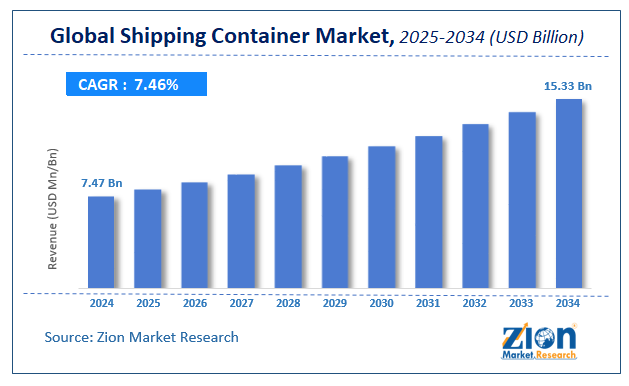
The global Shipping Container Market accrued earnings worth around USD 7.47 billion in 2024 and is predicted to grow to around USD 15.33 billion by 2034 with a compound annual growth rate (CAGR) of roughly 7.46% between 2025 and 2034. The Shipping Container Market is driven by the rapid surge in maritime cargo transportation and intermodal trade activities across global freight corridors.
Shipping Container Market: Overview
A shipping container refers to a standardized, robust, reusable transport structure engineered to safely consolidate, store, and transport diverse cargo loads across intermodal freight networks without direct intermediate cargo handling. Typically fabricated from corrosion-resistant Corten steel or lightweight aluminum alloys under rigorous International Organization for Standardization (ISO) guidelines, these high-capacity containers enable rapid mechanical lifting, stacking, and secured transit across container ships, rail cars, and heavy transport trucks. They serve as the structural backbone of modern globalized logistics, protecting sensitive manufactured goods, raw industrial commodities, and perishable temperature-regulated supplies against environmental degradation, mechanical impact, and theft throughout extended international supply chains.
Key Insights
- As per the analysis shared by our research analyst, the global shipping container market is estimated to grow annually at a CAGR of around 7.46% over the forecast period (2025-2034).
- In terms of revenue, the global shipping container market size was valued at around USD 7.47 billion in 2024 and is projected to reach USD 15.33 billion by 2034.
- The shipping container market is driven by the globalization of international trade, substantial expansion across e-commerce logistics, and rising demand for modular and portable storage and housing solutions.
- Based on Product, the ISO Containers segment is expected to lead the global market with a share of over 85% because strict international transport standards require uniform dimensions, structural corner castings, and stacking compatibility across global deep-sea container vessels and rail corridors.
- On the basis of Type, the Dry Containers segment is growing at a high rate and will continue to dominate the global market.
- Based on the Size, the 20' Containers segment is projected to capture the largest market with a market share of approximately 48% because its compact dimensions and higher weight-carrying capacity per unit length make it ideal for transporting heavy, dense cargo such as machinery, minerals, and metals.
- By Application, the Consumer Goods Transport segment is expected to dominate the global market.
- In terms of Flooring, the Wood Flooring segment is anticipated to command the largest market share.
- Based on region, Asia Pacific dominates with a market share of around 58% because the region serves as the premier manufacturing and export hub of the world, housing dominant container fabrication facilities and high-volume container throughput seaports across China, India, and Japan.
Shipping Container Market: Dynamics
Growth Factors
How does the expansion of maritime commerce and intermodal freight networks accelerate market expansion?
The surge in cargo transport activities through ships & steamers will spur market size. Additionally, shipping containers are used for transporting goods as well as carriage without uploading & reloading needs at intermediate points. This has enhanced the popularity of the product, leading to the humongous growth of the shipping container industry. Apart from this, the rise in maritime shipping activities, along with a rise in trade deals across the globe, will embellish business trends. Nonetheless, huge costs of products can pose a threat to the expansion of the shipping container industry in the near future.
Furthermore, the growing acceptance of automation in container terminals, resulting in container standardization, will drive market trends. In addition to this, some countries such as India are producing cargo containers with the help of regional producers as a part of its Atmanirbhar Bharat initiative. Such moves will create humongous demand for shipping containers across the globe.
Restraints
What challenges do elevated capital acquisition costs and steel price volatility pose to industry growth?
A major restraint constraining the shipping container market is the substantial capital expenditure required to purchase, lease, and maintain container fleets. High-grade Corten steel, protective anti-corrosive chemical coatings, and specialized insulation materials represent a substantial portion of overall manufacturing expenses. Sharp fluctuations in global steel and raw material commodity markets directly inflate production costs, squeezing operator margins and causing logistics providers to delay fleet modernization or container renewal cycles during periods of macroeconomic volatility.
In addition to procurement costs, the operational overhead associated with repositioning empty containers presents a severe financial burden. Structural trade imbalances between net-exporting and net-importing economies create persistent geographic distribution mismatches, forcing ocean carriers to spend billions annually moving empty units back to primary export centers. These lingering logistical inefficiencies and the continuous maintenance costs required to ensure structural seaworthiness restrict broader capital allocation and dampen overall market expansion rates.
Opportunities
How does the rapid proliferation of modular container construction and smart telemetry open new market avenues?
The creative repurposing of decommissioned and newly fabricated shipping containers within architectural and modular construction sectors represents a lucrative growth frontier. Real estate developers and commercial builders are increasingly utilizing standardized container modules to construct sustainable portable storage units, emergency housing facilities, modern commercial pop-up spaces, and residential complexes. Containers offer exceptional intrinsic structural integrity, rapid assembly timelines, and favorable cost efficiencies relative to traditional brick-and-mortar building methods, providing container manufacturers with an expanding non-logistical sales channel.
In addition, the integration of Internet of Things (IoT) sensors, real-time GPS tracking systems, and automated environmental monitoring devices into shipping containers creates strong high-value opportunities. Smart containers allow logistics operators to monitor internal temperature, humidity levels, unauthorized door openings, and real-time physical locations continuously across global transit corridors. As high-value pharmaceuticals and temperature-sensitive food products require absolute supply chain visibility, the accelerating transition toward intelligent connected containers provides manufacturers with high-margin product differentiation avenues.
Challenges
How do severe port congestion, empty container imbalances, and geopolitical route disruptions affect operations?
A persistent challenge confronting the shipping container industry is the vulnerability of global container circulation to terminal bottlenecks and unexpected geopolitical disruptions. Complex logistical bottlenecks, port labor shortages, and vessel queuing at major gateway ports tie up massive volumes of container capacity, causing artificial localized supply crunches. When containers remain stranded at sea or immobilized within crowded storage yards, operational velocity drops sharply, creating unpredictable freight schedule disruptions across industrial supply chains.
Moreover, sudden geopolitical conflicts that force vessel reroutings around strategic maritime choke points significantly increase transit voyage durations. These extended operational loops absorb immense container inventories for longer periods, exacerbating localized equipment shortages in high-demand export regions while generating excess container pileups in import-dominated territories. Overcoming these erratic network disruptions requires advanced predictive fleet allocation technologies and resilient supply chain planning among major shipping consortia.
Shipping Container Market: Segmentation
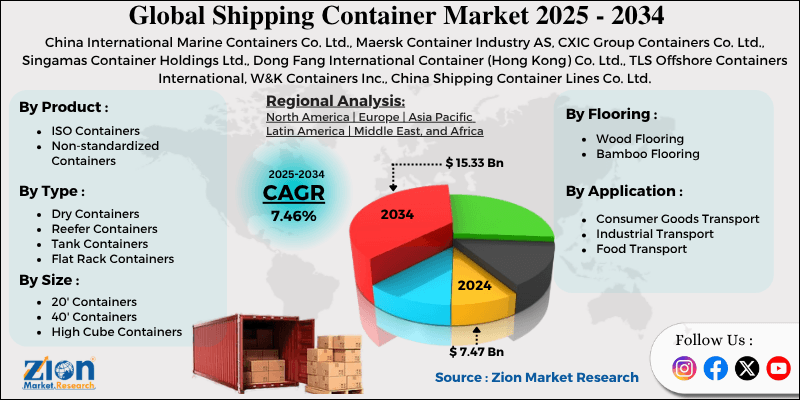
The shipping container market is segmented by product, type, size, application, flooring, and region.
Based on Product, the shipping container market is divided into ISO containers and non-standardized containers. The most dominant segment is ISO containers, capturing the vast majority of global revenue because international shipping lines, intermodal rail networks, and automated terminal handling cranes require standardized exterior dimensions, corner castings, and stacking tolerances to facilitate seamless global intermodal transfers. The second most dominant subsegment is non-standardized containers, which holds a notable niche by catering to specialized industrial applications, oversize customized machinery transport, offshore energy installations, and bespoke modular building projects that require tailored physical dimensions outside international freight norms.
Based on Type, the shipping container market is divided into dry containers, reefer containers, tank containers, flat rack containers, open-top containers, insulated or thermal containers, special purpose containers, and others. The most dominant segment is dry containers, commanding the leading share because they serve as the universal standard for transporting dry bulk freight, packaged retail goods, electronics, and standard non-perishable manufactured items across global trade lanes. The second most dominant subsegment is reefer containers, which is expanding rapidly due to rising worldwide consumption of fresh produce, frozen proteins, and biopharmaceuticals requiring continuous, tightly controlled temperature-regulated cold chain transit.
Based on Size, the shipping container market is divided into 20' containers, 40' containers, high cube containers, and others. The most dominant subsegment is 20' containers, leading market volume because their smaller footprint and superior weight-to-volume ratio make them optimal for shipping heavy, dense bulk commodities such as raw minerals, industrial machinery, and packaged chemicals without exceeding road transit weight restrictions. The second most dominant subsegment is 40' containers, which represent a massive revenue share by offering double the volumetric capacity of standard units, making them the primary container of choice for high-volume, lower-density consumer retail merchandise, apparel, and assembled electronics.
Based on Application, the shipping container market is divided into consumer goods transport, industrial transport, food transport, and others. Consumer goods transport is the most dominant segment, leading in market share due to the exponential growth of global e-commerce retail networks, fast-moving consumer goods (FMCG) distribution, and international wholesale trading that continuously demand secure containerized transit. The second most dominant subsegment is industrial transport, which sustains high steady demand through the bulk movement of heavy automotive components, intermediate industrial chemicals, manufacturing equipment, and raw metallurgical materials between global fabrication hubs.
Based on Flooring, the shipping container market is divided into wood flooring, bamboo flooring, and others. The most dominant segment is wood flooring, maintaining the leading position as treated hardwood plywood provides exceptional mechanical resilience, high frictional resistance that minimizes cargo slipping, and proven shock absorption against heavy forklift operations during cargo loading and unloading cycles. The second most dominant subsegment is bamboo flooring, which is growing at a strong rate as container manufacturers increasingly adopt sustainable, rapid-growth eco-friendly composite alternatives that deliver comparable mechanical strength while addressing global forest conservation objectives.
Shipping Container Market: Report Scope
| Report Attributes | Report Details |
|---|---|
| Report Name | Shipping Container Market |
| Market Size in 2024 | USD 7.47 Billion |
| Market Forecast in 2034 | USD 15.33 Billion |
| Growth Rate | CAGR of 7.46% |
| Number of Pages | 168 |
| Key Companies Covered | China International Marine Containers Co. Ltd., Maersk Container Industry AS, CXIC Group Containers Co. Ltd., Singamas Container Holdings Ltd., Dong Fang International Container (Hong Kong) Co. Ltd., TLS Offshore Containers International, W&K Containers Inc., China Shipping Container Lines Co. Ltd., YMC Container Solutions, Hapag-Lloyd AG, and others. |
| Segments Covered | By Product, By Type, By Size, By Application, By Flooring, and By Region |
| Regions Covered | North America, Europe, Asia Pacific (APAC), Latin America, The Middle East and Africa (MEA) |
| Base Year | 2024 |
| Historical Year | 2020 to 2024 |
| Forecast Year | 2025 to 2034 |
| Customization Scope | Available customized purchase options to meet your exact research needs. Request For Customization |
Shipping Container Market: Regional Insights
Why will Asia Pacific continue to dominate the global market during the projection period?
Asia Pacific is firmly positioned to maintain its commanding dominance in the global shipping container market throughout the forecast period, primarily driven by massive export manufacturing bases and expansive container construction hubs located across China, India, and Japan. The region houses the world's most sophisticated container fabrication shipyards, capable of producing millions of Twenty-Foot Equivalent Units (TEUs) annually with unmatched cost efficiency and technological precision. Furthermore, the extensive concentration of top-tier global container ports across East and Southeast Asia ensures immense domestic and international container throughput, accelerating continuous fleet expansion and rapid container turnover across vital Indo-Pacific maritime lanes.
North America stands as a major regional market, heavily propelled by massive imports of consumer electronics, retail apparel, and industrial machinery through high-volume coastal logistics gateways in the United States. Europe represents another highly significant consumption region, characterized by extensive intermodal rail and short-sea shipping integration, stringent environmental directives driving low-emission reefer container adoption, and strong regional demand for modular container architecture. Meanwhile, Latin America and the Middle East & Africa are displaying sustained developmental growth, supported by heavy infrastructure investments in modern deepwater ports, expanding mineral and agricultural export corridors, and strategic initiatives designed to establish transshipment logistics hubs bridging global trade routes.
Shipping Container Market: Competitive Analysis
The report provides a company market share analysis to give a broader overview of the key market players. In addition, the report also covers key strategic developments of the market, including acquisitions & mergers, new product launches, agreements, partnerships, collaborations & joint ventures, research & development, and regional expansion of major participants involved in the shipping container market on a global and regional basis.
The global shipping container market is dominated by players like:
- China International Marine Containers Co. Ltd.
- Maersk Container Industry AS
- CXIC Group Containers Co. Ltd.
- Singamas Container Holdings Ltd.
- Dong Fang International Container (Hong Kong) Co. Ltd.
- TLS Offshore Containers International
- W&K Containers Inc.
- China Shipping Container Lines Co. Ltd.
- YMC Container Solutions
- Hapag-Lloyd AG
The global shipping container market is segmented as follows;
By Product
- ISO Containers
- Non-standardized Containers
By Type
- Dry Containers
- Reefer Containers
- Tank Containers
- Flat Rack Containers
- Open-Top Containers
- Insulated or Thermal Containers
- Special Purpose Containers
By Size
- 20' Containers
- 40' Containers
- High Cube Containers
- Others
By Application
- Consumer Goods Transport
- Industrial Transport
- Food Transport
By Flooring
- Wood Flooring
- Bamboo Flooring
By Region
- North America
- The U.S.
- Canada
- Mexico
- Europe
- France
- The UK
- Spain
- Germany
- Italy
- Rest of Europe
- Asia Pacific
- China
- Japan
- India
- Australia
- South Korea
- Rest of Asia Pacific
- The Middle East & Africa
- Saudi Arabia
- UAE
- Egypt
- Kuwait
- South Africa
- Rest of the Middle East & Africa
- Latin America
- Brazil
- Argentina
- Rest of Latin America
Table Of Content
Methodology
FrequentlyAsked Questions
The global shipping container market is expected to grow due to global trade growth, demand for intermodal transport, and increasing use in modular construction.
According to a study, the global shipping container market size was worth around USD 7.47 Billion in 2024 and is expected to reach USD 15.33 Billion by 2034.
The global shipping container market is expected to grow at a CAGR of 7.46% during the forecast period.
Asia-Pacific is expected to dominate the shipping container market over the forecast period.
Leading players in the global shipping container market include China International Marine Containers Co. Ltd., Maersk Container Industry AS, CXIC Group Containers Co. Ltd., Singamas Container Holdings Ltd., Dong Fang International Container (Hong Kong) Co. Ltd., TLS Offshore Containers International, W&K Containers Inc., China Shipping Container Lines Co. Ltd., YMC Container Solutions, Hapag-Lloyd AG, among others.
The report explores crucial aspects of the shipping container market, including a detailed discussion of existing growth factors and restraints, while also examining future growth opportunities and challenges that impact the market.

HappyClients

