
Global Sewage Pump Market Size, Share, Trends, Growth and Forecast 2034

Sewage Pump Market By Type (Submersible Sewage Pumps, Grinder Pumps, Non-Submersible Sewage Pumps, and Effluent Pumps), By Material (Cast Iron, Plastic, Stainless Steel, and Composite Materials), By Flow Rate (Low Flow Rate, High Flow Rate, and Medium Flow Rate), By Application (Residential, Industrial, Commercial, and Municipal), By Power Source (Electric, Solar, and Hydraulic), and By Region - Global and Regional Industry Overview, Market Intelligence, Comprehensive Analysis, Historical Data, and Forecasts 2026 - 2034
| Market Size in 2025 | Market Forecast in 2034 | CAGR (in %) | Base Year |
|---|---|---|---|
| USD 4.5 Billion | USD 5.9 Billion | 3.2% | 2025 |
Sewage Pump Market: Industry Perspective
What will be the size of the global sewage pump market during the forecast period?
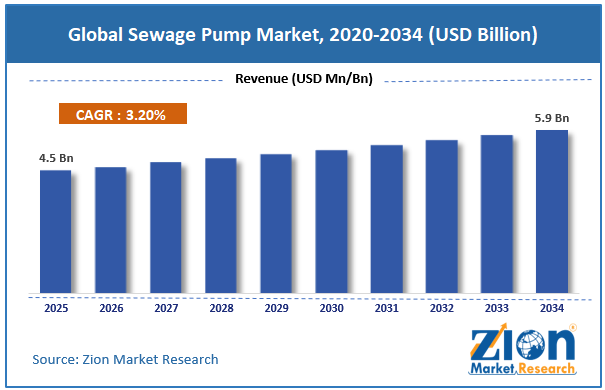
The global sewage pump market size was worth around USD 4.5 billion in 2025 and is predicted to grow to around USD 5.9 billion by 2034, with a compound annual growth rate (CAGR) of roughly 3.2% between 2026 and 2034.
Key Insights
- As per the analysis shared by our research analyst, the global sewage pump market is estimated to grow annually at a CAGR of around 3.2% over the forecast period (2026-2034).
- In terms of revenue, the global sewage pump market size was valued at around USD 4.5 billion in 2025 and is projected to reach USD 5.9 billion by 2034.
- Growth in residential and commercial construction is expected to propel the sewage pump market over the projected period.
- Based on the type, the submersible sewage pumps segment held the largest revenue share in 2025.
- Based on the material, the cast iron segment is expected to contribute significantly to sewage pump market growth in the years to come. It is anticipated to register a healthy revenue increase in the near future.
- Based on the flow rate, the medium flow rate segment is projected to witness higher revenue growth in the sewage pump market.
- Based on the application, the residential segment is anticipated to witness significant revenue growth in the sewage pump market.
- Based on the power source, electric is the highest-value segment in the sewage pump market.
- Based on region, the Asia Pacific region is anticipated to witness the highest revenue growth in the sewage pump market.
Sewage Pump Market: Overview
A sewage pump is a special pump used to transfer sewage or wastewater from one receptacle to another. The equipment is used in housing, municipal, industrial, commercial, and other enterprises to remove dirty water, sewage, and wastewater with solids. Such pumps differ because their impellers have a large diameter, and the flow channel is designed to pass solids of various consistencies: organic matter, slime, hair, and other wastewater components. They are necessary where standard water pumps cannot be used due to inclusions and the need to raise the liquid to a certain height. Sewage pumps are installed in private houses, basements, sewage pumping stations, septic tanks, wastewater treatment plants, and other objects. The devices are also available in submersible and non-submersible models, allowing them to be used in various environments.
Impact of the USA-Israel War on Iran on the Sewage Pump Market
The US-Israeli conflict with Iran has a mainly negative impact on the sewage pump market in the short term, driven by disrupted supply chains, higher freight and raw material costs, and delayed municipal and industrial wastewater infrastructure projects in affected countries. In the long run, the restoration of water and sewage infrastructure and the need to invest in more resilient systems in the Middle East and neighboring countries will boost demand for sewage pumps.
Sewage Pump Market: Dynamics
Growth Drivers
Does the rapid urbanization and the expansion of wastewater infrastructure drive the sewage pump market?
Rapid urbanization and the growing need to expand and upgrade wastewater infrastructure are major factors driving the sewage pump market. According to the World Bank, India's urban population is estimated to rise by an additional 416 million by 2050, creating demand for new sewer networks, pumping stations, and wastewater treatment facilities. India is likely to witness robust demand for sewage pumps due to the rising need for new sewer connections, especially in urban centers. In this regard, India has ambitious plans to upgrade urban water infrastructure with an allocation of around US$150 billion in investment over the next 15 years, while the World Bank approved a US$426 million Karnataka Water Security and Resilience Program that covers the development of nine sewage treatment plants (STPs) and first-time sewer connections for over 100,000 households.
In addition, the Government of India has revealed that the National Mission for Clean Ganga (NMCG) has completed 28 STPs, adding 538.03 million liters per day (MLD) of sewage treatment capacity during FY 2025-26, with nearly Rs 4900 crore invested in the mission. Thus, such initiatives by governments across emerging economies to construct and upgrade urban sewage infrastructure are projected to propel the demand for sewage pumps in these regions.
Restraints
How does the high installation and maintenance costs act as a major restraint to the sewage pump industry's growth?
High installation and maintenance costs are expected to restrain growth in the sewage pump market over the next decade. Sewage pumps and related equipment require substantial capital investments for installation and incur significant maintenance expenditures. Municipalities and industrial entities with limited capital budgets are reluctant to invest substantially in sewage pump installation and maintenance. According to the U.S. Environmental Protection Agency (EPA), the U.S. requires an investment of US$630 billion in wastewater infrastructure to meet the needs of the next 20 years. Such massive expenditure triggers deferment in sewage pump installation or replacement by many utility companies, constraining market growth.
Opportunities
How do rising innovative product launches offer a lucrative opportunity for the sewage pump market?
The innovative product launch is expected to offer a potential opportunity to the sewage pump market over the projected period. For instance, in April 2026, Kirloskar Brothers Limited (KBL) launched two innovative products, namely, a submersible wastewater pump, iNSx, and a small IoT-based remote monitoring solution, KirloSmart™ Nano, at PLUMBEX India 2026. The submersible wastewater pump, iNSx, is a high-performance drainage pump designed for challenging wastewater applications. The iNSx is engineered with a state-of-the-art hydraulic design for efficient handling of sewage, stormwater, sludge, effluent, greywater, and process water in municipal, industrial, commercial, and residential applications. This robust, high-efficiency drainage pump can also be used for dewatering in construction sites and flood-affected areas. A smart submersible pump design that requires less submergence for its operation. It comes with a high-efficiency IE3 motor and a thermistor protected against overheating. The moisture sensor in the pump safeguards the electrical parts from water ingress, resulting in less downtime and lower life cycle costs.
Challenges
Volatility in raw material prices poses a significant challenge to the growth of the sewage pump industry
One of the main factors that could restrain the growth of the sewage pump market is the price volatility of the raw materials. As sewage pumps are mostly made of cast iron, stainless steel, copper, aluminum, and engineering plastics, the price of these materials directly affects the manufacturers’ profits. Fluctuations in prices are influenced by the supply-demand ratio, energy prices, and political situations in relevant countries. Such price changes put an additional burden on manufacturers, resulting in higher pump prices on the market. Moreover, unpredictable price changes make companies more hesitant to buy equipment and delay development or construction projects that require sewage pumps, which in turn reduces the market growth rate.
Sewage Pump Market: Report Scope
| Report Attributes | Report Details |
|---|---|
| Report Name | Sewage Pump Market |
| Market Size in 2025 | USD 4.5 Billion |
| Market Forecast in 2034 | USD 5.9 Billion |
| Growth Rate | CAGR of 3.2% |
| Number of Pages | 229 |
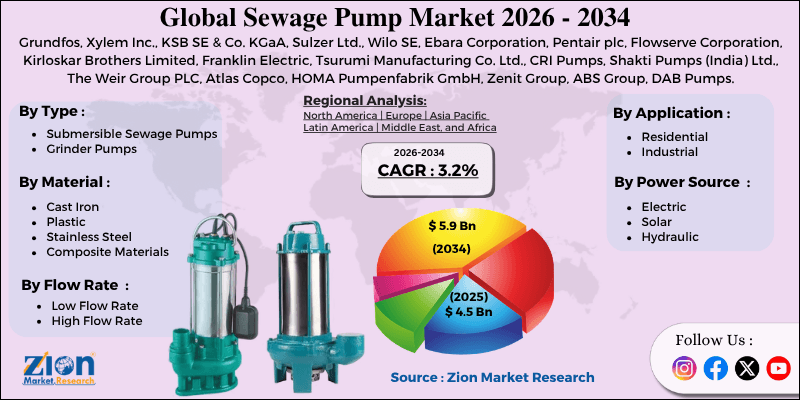
| Key Companies Covered | Grundfos, Xylem Inc., KSB SE & Co. KGaA, Sulzer Ltd., Wilo SE, Ebara Corporation, Pentair plc, Flowserve Corporation, Kirloskar Brothers Limited, Franklin Electric, Tsurumi Manufacturing Co. Ltd., CRI Pumps, Shakti Pumps (India) Ltd., The Weir Group PLC, Atlas Copco, HOMA Pumpenfabrik GmbH, Zenit Group, ABS Group, DAB Pumps, The Gorman-Rupp Company, and others. |
| Segments Covered | By Type, By Material, By Flow Rate, By Application, By Power Source, and By Region |
| Regions Covered | North America, Europe, Asia Pacific (APAC), Latin America, Middle East, and Africa (MEA) |
| Base Year | 2025 |
| Historical Year | 2020 to 2024 |
| Forecast Year | 2026 - 2034 |
| Customization Scope | Avail customized purchase options to meet your exact research needs. Request For Customization |
Sewage Pump Market: Segmentation
Type Insights
Why does the submersible sewage pumps segment hold a prominent position in the sewage pump market?
The submersible sewage pumps segment held the largest revenue share of the sewage pump industry in 2025. The growth is attributed to high efficiency, compact size, and the ability to run while submerged in wastewater. Sewage pumps are used to drain residential, commercial, and municipal wastewater and to power sewage treatment plants because they require less maintenance, produce less noise, and prevent power failures that can lead to basement and surface water floods. Revenue from sewage pumps is growing due to the development of municipal wastewater infrastructure, environmental regulations, and the replacement of older pumps with more energy-efficient, less-clogging models.
Material
How does the cast iron segment capture the largest share in the sewage pump market?
The cast iron segment is expected to contribute significantly to sewage pump market growth in the years to come. It is anticipated to register a healthy revenue increase in the near future. Cast iron sewage pumps are widely used in municipal, industrial, commercial, and residential applications due to their superior abrasion resistance and ability to provide continuous service. These pumps are suitable for heavy-duty service, such as handling wastewater and sewage, due to their resistance to stress, impact, and prolonged use.
Flow Rate Insights
Does the medium flow rate segment capture the largest share in the sewage pump market?
The medium flow rate segment is projected to witness higher revenue growth in the sewage pump market owing to the extensive usage in residential, commercial complexes, municipal buildings, and small-scale industrial facilities. Medium Flow Rate sewage pumps offer a perfect combination of pumping performance, reduced energy consumption, and cost-effectiveness, which makes them suitable for day-to-day sewage management in urban and residential areas. The segment growth is mainly driven by rising urbanization and municipal infrastructure development, alongside the growing construction of commercial and residential buildings.
Application Insights
Why does the residential segment capture the largest market share in the sewage pump market?
The residential segment is anticipated to witness significant revenue growth in the sewage pump market. This growth is attributed to rising urbanization, increasing residential construction, and the adoption of basement drainage and sewage lift systems in residential houses. Sewage pumps are commonly used in residential buildings for pumping wastewater from basement plumbing to the main sewer or septic system.
Moreover, sewage pumps are widely used in homes with basements, bathrooms built below the sewer line, or in hilly areas. The demand surge is expected to be supported by the growing housing construction, redevelopment of existing infrastructure, and improved sanitation facilities in the developing nations.
Power Source Insights
Does the electric segment capture the largest market share in the sewage pump market?
Electric is the highest-value segment in the sewage pump market, and it has strong potential to increase its revenue share due to its high efficiency and performance. The segment is highly adopted in residential, commercial, industrial, and municipal applications because electric sewage pumps offer advantages over internal combustion engines, including reduced maintenance and emissions and increased reliability. Moreover, the rising need for efficient sewage management solutions and the growing emphasis on sustainable technologies are also factors contributing to the segment’s growth.
Regional Insights
What factors drive the Asia Pacific region in the sewage pump market?
The Asia Pacific region is anticipated to witness the highest revenue growth in the sewage pump market, owing to rapid urbanization, growing need for wastewater treatment plants, and rising government expenditure on smart city initiatives in countries such as China, India, Japan, Southeast Asia, among others. Increasing residential and commercial construction activities, along with stringent government regulations regarding wastewater management, are projected to propel demand for sewage pumps during the forecast period.
Moreover, growing product development initiatives by regional manufacturers are further complementing market growth. For instance, in 2025, EBARA Corporation launched the Model DKE High-Efficiency Anti-Clog Submersible Wastewater Pump in China, Southeast Asia, and other 50 Hz markets globally. The product offers an anti-clog impeller and improved operational efficiency, reducing overall maintenance costs and ownership of sewage pumps. Thus, the introduction of high-efficiency pumps by companies is anticipated to drive the regional market growth.
Sewage Pump Market: Competitive Analysis
The global sewage pump market is dominated by players like:
- Grundfos
- Xylem Inc.
- KSB SE & Co. KGaA
- Sulzer Ltd.
- Wilo SE
- Ebara Corporation
- Pentair plc
- Flowserve Corporation
- Kirloskar Brothers Limited
- Franklin Electric
- Tsurumi Manufacturing Co. Ltd.
- CRI Pumps
- Shakti Pumps (India) Ltd.
- The Weir Group PLC
- Atlas Copco
- HOMA Pumpenfabrik GmbH
- Zenit Group
- ABS Group
- DAB Pumps
- The Gorman-Rupp Company
The global sewage pump market is segmented as follows:
By Type
- Submersible Sewage Pumps
- Grinder Pumps
- Non-Submersible Sewage Pumps
- Effluent Pumps
By Material
- Cast Iron
- Plastic
- Stainless Steel
- Composite Materials
By Flow Rate
- Low Flow Rate
- High Flow Rate
- Medium Flow Rate
By Application
- Residential
- Industrial
- Commercial
- Municipal
By Power Source
- Electric
- Solar
- Hydraulic
By Region
- North America
- The U.S.
- Canada
- Mexico
- Europe
- France
- The UK
- Spain
- Germany
- Italy
- Rest of Europe
- Asia Pacific
- China
- Japan
- India
- Australia
- South Korea
- Rest of Asia Pacific
- The Middle East & Africa
- Saudi Arabia
- UAE
- Egypt
- Kuwait
- South Africa
- Rest of the Middle East & Africa
- Latin America
- Brazil
- Argentina
- Rest of Latin America
Table Of Content
Methodology
FrequentlyAsked Questions
A sewage pump is a special pump used to transfer sewage or wastewater from one receptacle to another. The equipment is used in housing, municipal, industrial, commercial, and other enterprises to remove dirty water, sewage, and wastewater with solids.
The sewage pump market is primarily driven by rapid urbanization, expanding wastewater treatment infrastructure, and increasing government investments in sanitation and sewer networks. Rising residential, commercial, and industrial construction is boosting the demand for efficient sewage handling systems, while stricter environmental regulations are encouraging the adoption of advanced wastewater management solutions.
The sewage pump market faces several challenges, including high installation and maintenance costs, which can limit adoption among budget-constrained municipalities and small industries. Fluctuating prices of raw materials such as cast iron, stainless steel, and copper increase manufacturing costs and reduce profit margins. The market is also affected by high energy consumption of conventional pumps, frequent clogging and wear caused by solid-laden wastewater, and delays in wastewater infrastructure projects in developing regions.
Based on the application, the residential segment is expected to dominate the sewage pump market growth during the projected period.
Emerging trends and innovations in the sewage pump market include the increasing adoption of smart sewage pumps equipped with IoT-enabled monitoring, predictive maintenance, and remote diagnostics to improve operational efficiency and reduce downtime. Manufacturers are introducing high-efficiency motors, variable frequency drives (VFDs), and advanced anti-clog impeller designs to lower energy consumption and maintenance costs. The market is also witnessing growing demand for corrosion-resistant materials, compact submersible pumps, and digitally integrated pumping systems for smart cities and wastewater treatment facilities.
According to the report, the global sewage pump market size was worth around USD 4.5 billion in 2025 and is predicted to grow to around USD 5.9 billion by 2034.
The global sewage pump market is expected to grow at a CAGR of 3.2% during the forecast period.
The global sewage pump industry growth is expected to be led by the Asia Pacific over the forecast period.
The global sewage pump market is dominated by players like Grundfos, Xylem Inc., KSB SE & Co. KGaA, Sulzer Ltd., Wilo SE, Ebara Corporation, Pentair plc, Flowserve Corporation, Kirloskar Brothers Limited, Franklin Electric, Tsurumi Manufacturing Co., Ltd., CRI Pumps, Shakti Pumps (India) Ltd., The Weir Group PLC, Atlas Copco, HOMA Pumpenfabrik GmbH, Zenit Group, ABS Group, DAB Pumps, and The Gorman-Rupp Company, among others.
The sewage pump market report covers the geographical market along with a comprehensive competitive landscape analysis. It also includes cash flow analysis, profit ratio analysis, market basket analysis, market attractiveness analysis, sentiment analysis, PESTLE analysis, trend analysis, SWOT analysis, trade area analysis, demand & supply analysis, Porter’s five forces analysis, and value chain analysis.

HappyClients

