
Search Engine Optimization (SEO) Tools Market Size, Share, Growth Analysis Report - Forecast 2034

Search Engine Optimization (SEO) Tools Market By Type (On-Page SEO, Off-Page SEO), By Deployment Mode (Cloud-based SEO Tools, On-premises SEO Tools), By Enterprise Size (Small and Medium Enterprises, Large Enterprise), and By Region - Global and Regional Industry Overview, Market Intelligence, Comprehensive Analysis, Historical Data, and Forecasts 2025 - 2034
| Market Size in 2024 | Market Forecast in 2034 | CAGR (in %) | Base Year |
|---|---|---|---|
| USD 71.82 Billion | USD 195.99 Billion | 13.37% | 2024 |
Search Engine Optimization (SEO) Tools Industry Perspective:
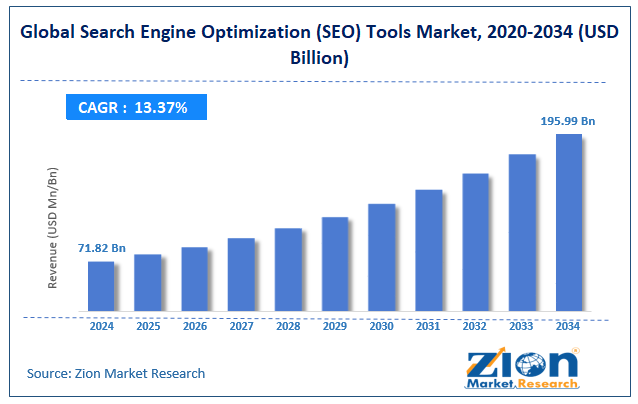
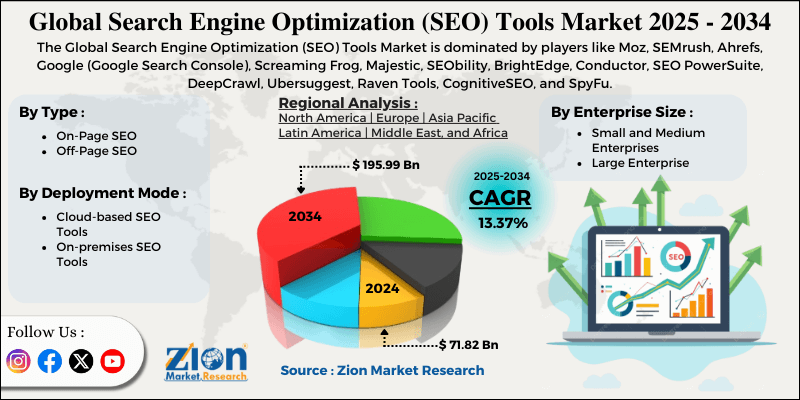
The global Search Engine Optimization (SEO) tools market size was approximately USD 71.82 billion in 2024 and is projected to reach USD 195.99 billion by 2034, with a compound annual growth rate (CAGR) of roughly 13.37% between 2025 and 2034.
Key Insights:
- As per the analysis shared by our research analyst, the global Search Engine Optimization (SEO) tools market is estimated to grow annually at a CAGR of around 13.37% over the forecast period (2025-2034)
- In terms of revenue, the global Search Engine Optimization (SEO) tools market size was valued at around USD 71.82 billion in 2024 and is projected to reach USD 195.99 billion by 2034.
- The Search Engine Optimization (SEO) tools market is projected to grow significantly owing to the expansion of e-commerce and online retail, the shift to mobile-first and voice search, and the adoption of AI/ machine learning in SEO tools.
- Based on type, the On-Page SEO segment is expected to lead the market, while the Off-Page SEO segment is expected to grow considerably.
- Based on deployment mode, the cloud-based SEO tools segment is the dominating segment. In contrast, the on-premises SEO tools segment is projected to witness sizeable revenue over the forecast period.
- Based on enterprise size, the large enterprise segment is expected to lead the market, followed by the small and medium enterprise segment.
- By region, North America is projected to dominate the global market during the forecast period, followed by the Asia Pacific.
Search Engine Optimization (SEO) Tools Market: Overview
Search Engine Optimization (SEO) tools improve a website's visibility in search results by tracking rankings, analyzing keywords, and identifying technical issues that affect performance. These tools offer insights into site traffic, backlink profiles, competitor strategies, and opportunities for content optimization. The global Search Engine Optimization (SEO) tools market is projected to grow substantially, driven by increasing online competition among websites, the growing complexity of search engine algorithms, and surging demand for data-driven digital marketing. As more businesses, e-commerce ventures, and content creators go online, the number of competing websites continues to grow. To stand out in the crowded search results, these entities increasingly rely on SEO tools to enhance overall performance, making them crucial rather than optional. Search engines constantly update their ranking algorithms. This complexity forces SEO specialists and website owners to use dedicated tools to keep up to date, optimize, audit, and monitor sites for compliance with the changing SEO best practices. Moreover, marketers expect concrete metrics, user behavior, backlinks, traffic sources, and keyword rankings to justify their campaigns. SEO tools provide structured data at scale, making them indispensable for freelancers, agencies, and in-house marketing teams pursuing ROI-driven strategies.
Although drivers exist, the global market is challenged by factors such as the volatility of search algorithms, frequent changes, and the difficulty of demonstrating direct ROI for SEO efforts. Since search engines update ranking algorithms unpredictably and frequently, SEO tools may soon become obsolete or need constant updates. This uncertainty may demotivate long-term commitment and reduce trust among users. Likewise, SEO results often take days to months to materialize, making it harder for businesses to correlate tool use with conversions or revenue directly. For smaller companies with constrained budgets, this uncertainty payoff could be a challenge. Even so, the global Search Engine Optimization (SEO) tools industry is well-positioned due to the integration of ML/AI and automation, as well as specialized niche tools. As ML and AI technologies advance, SEO tools can evolve to offer predictive insights, for instance, by automatically optimizing structures, suggesting content topics, generating semantic keyword clusters, and auto-optimizing on-page elements. This may attract more users and boost value. Additionally, as search behavior changes, there is a demand for specialized SEO tools tailored to these niches. Focusing on one niche can lead to loyal customers seeking tailored solutions rather than generic, all-purpose tools.
Search Engine Optimization (SEO) Tools Market Dynamics
Growth Drivers
How is the Search Engine Optimization (SEO) tools market driven by the rising content volumes and data-driven optimization?
The volume of online content continues to grow remarkably, making optimization steadily complex. SEO tools help analyze, improve, and track content performance effectively. Data-driven strategies enable enterprises to make informed decisions and enhance organic search results. Automation in search engine optimization reduces manual effort and increases precision. Companies are leveraging insights from tools to stay ahead of competitors. This rise in content creation is driving significant adoption of SEO platforms and the Search Engine Optimization (SEO) tools market.
How is evolving search behavior and user expectations fueling the Search Engine Optimization (SEO) tools market development?
User behavior is moving toward mobile-first browsing, visual search queries, and voice search. SEO tools now emphasize mobile optimization, multimedia indexing, and voice-friendly keywords. Companies should adapt to evolving user expectations to maintain search visibility. Tools that track changing trends and optimize consequently are in greater demand. Meeting modern search behaviors enhances engagement and traffic. These behavioral shifts fuel continuous innovation in SEO technology.
Restraints
Lack of technical expertise and educational barriers negatively impact the market progress
Effective use of SEO tools needs a solid understanding of SEO principles, content strategy, data interpretation, and website architecture. Several enterprises, mainly the smaller ones, lack in-house SEO expertise or are unfamiliar with SEO best practices. That knowledge gap reduces the perceived value of tools because, even when used properly, advanced tools cannot deliver results, thereby hampering adoption. This obstacle is crucial for companies without specialized digital marketing teams.
Opportunities
How does integration with the broader digital marketing & analytics ecosystem create advantageous conditions for the growth of the Search Engine Optimization (SEO) tools market?
Modern marketing needs more than just search ranking: UX, content marketing, analytics, conversion optimization, and social media – all interconnected. SEO tools that integrate with marketing automation, content management systems, and analytics platforms, as well as UX audit modules, can provide greater value. Businesses choose unified platforms that decrease tool sprawl and streamline workflows. This convergence creates an opportunity for providers offering holistic full-stack digital marketing + SEO platforms. These integrated offerings can appeal to agencies and businesses seeking unified reporting and efficiency, thus impacting the Search Engine Optimization (SEO) tools industry.
Challenges
Frequent algorithm changes & ranking uncertainty restrict the market growth
Search engines regularly update their ranking algorithms, sometimes shifting what works for SEO overnight. This creates instability; strategies that give results today may become ineffective tomorrow. For SEO tool providers, this means consistent investment in recalibration and updates; for users, it offers risk and uncertainty. Such unpredictability underscores the importance of long-term ROI, leading many businesses to be wary of committing heavily to SEO tools. This volatility remains a key structural intricacy for the overall SEO ecosystem.
Search Engine Optimization (SEO) Tools Market: Report Scope
| Report Attributes | Report Details |
|---|---|
| Report Name | Search Engine Optimization (SEO) Tools Market |
| Market Size in 2024 | USD 71.82 Billion |
| Market Forecast in 2034 | USD 195.99 Billion |
| Growth Rate | CAGR of 13.37% |
| Number of Pages | 216 |
| Key Companies Covered | Moz, SEMrush, Ahrefs, Google (Google Search Console), Screaming Frog, Majestic, SEObility, BrightEdge, Conductor, SEO PowerSuite, DeepCrawl, Ubersuggest, Raven Tools, CognitiveSEO, and SpyFu. |
| Segments Covered | By Type, By Deployment Mode, By Enterprise Size, and By Region |
| Regions Covered | North America, Europe, Asia Pacific (APAC), Latin America, The Middle East and Africa (MEA) |
| Base Year | 2024 |
| Historical Year | 2019 to 2023 |
| Forecast Year | 2025 - 2034 |
| Customization Scope | Avail customized purchase options to meet your exact research needs. Request For Customization |
Search Engine Optimization (SEO) Tools Market: Segmentation
The global Search Engine Optimization (SEO) tools market is segmented based on type, deployment mode, enterprise size, and region.
Based on type, the global Search Engine Optimization (SEO) tools industry is divided into On-Page SEO and Off-Page SEO. On-page SEO holds a leading share because it is the foundational step for search engine rankings, and businesses consistently invest in it to ensure their sites meet fundamental standards of relevance, quality, and user experience. On-page SEO tools focus on optimizing individual web pages, such as internal linking, content, page structure, metadata, mobile-friendliness, and other factors within the website's control.
Based on deployment mode, the global Search Engine Optimization (SEO) tools market is segmented into cloud-based and on-premises tools. The cloud-based SEO tools segment holds a substantial share of the deployment mode category. They are preferred for their flexibility, scalability, subscription-based pricing, and remote accessibility, which make them suitable for enterprises of all sizes. Cloud solutions also streamline maintenance, updates, and integration with other digital marketing platforms. Their cost-effectiveness and ease of use fuel broader adoption in large businesses and SMEs alike.
Based on enterprise size, the global market is segmented into small and medium enterprises and large enterprises. The large enterprises segment holds leadership. They dominate because of their extensive websites, significant budgets, and complex digital infrastructure, which allow investment in scalable, comprehensive SEO solutions. Large businesses also need advanced analytics, multi-site management, and technical audits, making them the primary consumers of high-end SEO tools. This demand assures a remarkable industry share, exceeding 50%.
Search Engine Optimization (SEO) Tools Market: Regional Analysis
What enables North America's strong foothold in the global Search Engine Optimization (SEO) Tools Market?
North America is likely to sustain its leadership in the Search Engine Optimization (SEO) tools market due to high market share and adoption, a developed digital economy and infrastructure, and the presence of leading SEO tool vendors. North America registers for nearly 37-46% of the worldwide SEO tools industry, making it the leading regional contributor. Businesses of varying sizes actively use SEO tools to enhance their online visibility. This broader adoption fuels sustained demand to establish regional leadership. The region also benefits from high internet penetration, strong mobile connectivity, and advanced broadband. Online businesses such as e-commerce platforms, content publishers, and SaaS providers depend heavily on SEO to retain and attract traffic. These factors create a favorable environment for the rapid adoption of SEO tools. A majority of the leading global SEO tool providers are situated in North America. Early access to advanced solutions, such as enterprise-grade platforms and AI-driven analytics, augments adoption among businesses. The concentration of vendors assures that companies can quickly integrate cutting-edge SEO tools into their operations.
Asia Pacific continues to hold the second-highest share in the Search Engine Optimization (SEO) tools industry, driven by rapid digitalization, rising internet penetration, a massive SME sector, a growing small-business online presence, and an e-commerce penetration and content-creation boom. Asia Pacific is witnessing rapid growth in internet users, online connectivity, and mobile adoption across countries, driving the launch of new websites, digital businesses, and e-commerce ventures. As more companies come online, demand for SEO technologies increases severely. This growth in digital adoption is driving strong momentum for SEO tool adoption in the region. Moreover, the region has numerous small and medium-sized businesses and startups that are transitioning to or expanding their digital presence. These businesses often need cost-effective, cloud-based SEO tools to reach customers. This helps the region become a fast-growing region. Low-cost barriers and rising awareness of SEO value drive adoption among SMEs. Furthermore, with rapid growth in digital content creation and online retail across the Asia Pacific, there is a growing need to enhance content visibility, product listings, and organic reach. SEO technologies help content creation and e-commerce sites enhance visibility and prominence, driving the demand in the region. The integration of content output and the growth of e-commerce make SEO tools particularly relevant in APAC.
Search Engine Optimization (SEO) Tools Market: Competitive Analysis
The leading players in the global Search Engine Optimization (SEO) tools market are-
- Moz
- SEMrush
- Ahrefs
- Google (Google Search Console)
- Screaming Frog
- Majestic
- SEObility
- BrightEdge
- Conductor
- SEO PowerSuite
- DeepCrawl
- Ubersuggest
- Raven Tools
- CognitiveSEO
- SpyFu.
Search Engine Optimization (SEO) Tools Market: Key Market Trends
Growing importance of voice, multimedia & conversational search
User search behavior is moving toward voice queries, visual search, and video content. SEO tools are evolving to offer voice search optimization, image analysis, and video SEO. Websites now need to diversify content formats and enhance for multiple search contexts. This ensures their continued visibility across evolving digital platforms.
Optimizing for generative & AI-driven search
With the growth of AI-powered search assistants, SEO now focuses on creating structured content that can be directly mentioned in responses. Features like FAQs, concise bullet lists, and schema markup help websites appear in AI-driven results. This trend shifts optimization from just ranking pages to being referenced directly by AI systems. This enhances visibility within emerging search formats.
The global Search Engine Optimization (SEO) tools market is segmented as follows:
By Type
- On-Page SEO
- Off-Page SEO
By Deployment Mode
- Cloud-based SEO Tools
- On-premises SEO Tools
By Enterprise Size
- Small and Medium Enterprises
- Large Enterprise
By Region
- North America
- The U.S.
- Canada
- Europe
- France
- The UK
- Spain
- Germany
- Italy
- Rest of Europe
- Asia Pacific
- China
- Japan
- India
- South Korea
- Southeast Asia
- Rest of Asia Pacific
- Latin America
- Brazil
- Mexico
- Rest of Latin America
- Middle East & Africa
- GCC
- South Africa
- Rest of Middle East & Africa
Table Of Content
Methodology
FrequentlyAsked Questions

HappyClients

