
Global Regulatory Affairs Outsourcing Market Size, Share, Sales Analysis 2032

Regulatory Affairs Outsourcing Market By Services (Regulatory Consulting, Legal Representation, Regulatory Writing & Publishing, Product Registration & Clinical Trial Applications, Regulatory Submission, Regulatory Operations, and Other Services), By Company Size (Small, Medium, and Large), By Category (Pharmaceuticals and Medical Device), By Product Stage (Preclinical, Clinical, and PMA (Post Market Authorization)), By Indication (Oncology, Neurology, Cardiology, Immunology, and Others), By End-use (Medical Device Companies, Pharmaceutical Companies, Biotechnology Companies, and Others), and By Region - Global and Regional Industry Overview, Market Intelligence, Comprehensive Analysis, Historical Data, and Forecasts 2024-2032
| Market Size in 2023 | Market Forecast in 2032 | CAGR (in %) | Base Year |
|---|---|---|---|
| USD 10.18 Billion | USD 21.21 Billion | 8.50% | 2023 |
What is the Market size of the Regulatory Affairs Outsourcing Industry?
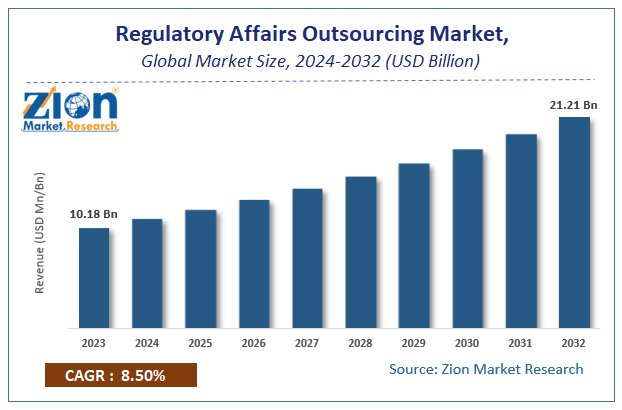
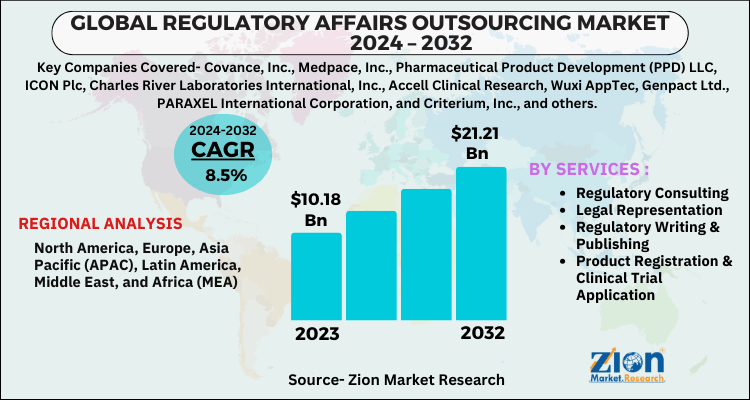
The global regulatory affairs outsourcing market size was worth around USD 10.18 billion in 2023 and is predicted to grow to around USD 21.21 billion by 2032 with a compound annual growth rate (CAGR) of roughly 8.50% between 2024 and 2032. The report examines the primary drivers, challenges, and restraints shaping global demand for the regulatory affairs outsourcing market throughout the forecast period and identifies high-growth opportunities across the industry.
Regulatory Affairs Outsourcing Market: Overview
The report covers forecasts and analyses for the global regulatory affairs outsourcing market. Regulatory affairs outsourcing refers to the practice of engaging external specialized service providers to manage regulatory strategy, documentation, submissions, compliance, and related activities for pharmaceuticals, medical devices, and biotechnology products. These services encompass regulatory consulting, legal representation, writing and publishing of regulatory documents, product registration and clinical trial applications, submission management, regulatory operations, and post-marketing support. Companies utilize outsourcing to access domain expertise, reduce internal fixed costs associated with training, technology, and facilities, accelerate time-to-market, and navigate complex, evolving regulatory landscapes across multiple geographies.
Key Insights
- As per the analysis shared by our research analyst, the global Regulatory Affairs Outsourcing market is estimated to grow annually at a CAGR of around 8.50% over the forecast period (2024-2032).
- In terms of revenue, the global Regulatory Affairs Outsourcing market size was valued at around USD 10.18 billion in 2023 and is projected to reach USD 21.21 billion by 2032.
- The market is driven by significant increases in fixed costs of in-house regulatory resources, rising volumes of clinical trials and product registrations, stringent regulations, geographic expansion by life sciences companies, and demand for specialized expertise and faster approvals.
- Based on the Services, the Product Registration & Clinical Trial Applications segment dominated the market with a share of over 26%
- Based on the Company Size, the Large companies segment held a leading position as they manage complex global portfolios
- Based on the Category, the Pharmaceuticals segment dominated owing to high volumes of drug development, clinical trials, and regulatory submissions
- Based on the Product Stage, the Clinical segment accounted for the largest share of approximately 46.8%
- Based on the End-use, Pharmaceutical Companies represented a major share and are expected to grow rapidly due to expanding pipelines in orphan drugs
- Based on region, Asia Pacific dominated the global Regulatory Affairs Outsourcing market with a revenue share of approximately 41.0% in 2023
Regulatory Affairs Outsourcing Market: Dynamics
Growth Drivers
What factors are accelerating the expansion of the Regulatory Affairs Outsourcing market?
Rising fixed costs associated with maintaining in-house regulatory affairs teams, including specialized training, technology platforms, facilities, and continuous knowledge updates, are compelling life sciences companies to outsource these functions. This shift allows organizations to convert fixed costs into variable expenses while gaining access to specialized expertise that may not be available internally. Concurrently, the global increase in clinical trial activity, product registrations, and regulatory submissions is generating sustained demand for external support across the development lifecycle.
Stringent and evolving regulations in major markets, combined with legal and regulatory reforms in emerging economies, further accelerate outsourcing. Companies expanding geographically seek local regulatory knowledge and representation to achieve faster approvals. The growth of complex modalities such as biologics, personalized medicines, and orphan drugs intensifies the need for sophisticated regulatory strategy and documentation services that specialized providers can deliver efficiently.
Restraints
What factors are limiting the growth of the Regulatory Affairs Outsourcing market?
Data security, confidentiality, and intellectual property protection remain significant concerns when sensitive regulatory and clinical information is shared with external partners, particularly in offshore arrangements. Companies may hesitate to fully outsource critical functions due to perceived risks of information leakage or loss of direct control over compliance-critical processes.
Quality consistency, cultural and communication differences, and the challenge of integrating external teams with internal systems can also restrain adoption. Highly regulated environments demand precise alignment between sponsor expectations and provider execution, and any gaps in this alignment can lead to delays or compliance issues that offset the benefits of outsourcing.
Regulatory Affairs Outsourcing Market: Segmentation
The Regulatory Affairs Outsourcing market is segmented by services, company size, category, product stage, indication, end-use, and region.
Based on Services Segment, the Regulatory Affairs Outsourcing market is divided into Regulatory Consulting, Legal Representation, Regulatory Writing & Publishing, Product Registration & Clinical Trial Applications, Regulatory Submission, Regulatory Operations, and Other Services. Product Registration & Clinical Trial Applications is the most dominant subsegment, accounting for over 26% of revenue, because these activities are essential from early development through commercialization and are driven by rising clinical trial volumes and the need for efficient, compliant filings across multiple jurisdictions. This dominance anchors overall market growth by generating consistent, high-value demand that supports investment in specialized expertise and technology. Regulatory Writing & Publishing ranks as a strong second area, as accurate and high-quality documentation is foundational to successful submissions and ongoing compliance.
Based on Company Size Segment, the Regulatory Affairs Outsourcing market is divided into Small, Medium, and Large. Large companies form the most dominant group because they manage extensive global product portfolios, face complex multi-regional requirements, and increasingly outsource specialized functions to control costs and access deep expertise while concentrating internal resources on core innovation. Their scale drives significant volume and encourages providers to develop sophisticated, technology-enabled service offerings. Medium-sized companies represent an important growth segment as they seek external support to compete effectively without building large internal regulatory infrastructures.
Based on Category Segment, the Regulatory Affairs Outsourcing market is divided into Pharmaceuticals and Medical Device. Pharmaceuticals constitute the most dominant category due to the high volume of drug development programs, clinical trials, and regulatory filings associated with innovative therapies, chronic disease treatments, and biologics. This leadership sustains market expansion by creating continuous demand for registration, writing, consulting, and operational services. Medical Devices form the second major category, supported by technological innovation, evolving classification and approval pathways, and the need for specialized regulatory navigation across global markets.
Based on Product Stage Segment, the Regulatory Affairs Outsourcing market is divided into Preclinical, Clinical, and PMA (Post Market Authorization). The Clinical stage is the most dominant, holding approximately 46.8% share, because clinical development involves intensive regulatory interactions, trial applications, and documentation requirements, with increasing trial activity in developing regions amplifying outsourcing needs. This stage drives substantial market volume and encourages providers to build deep clinical regulatory capabilities. Post-market authorization activities provide steady follow-on demand related to variations, safety reporting, and lifecycle management.
Based on Indication Segment, the Regulatory Affairs Outsourcing market is divided into Oncology, Neurology, Cardiology, Immunology, and Others. Oncology represents a leading indication area due to the high volume of clinical research, complex regulatory pathways for novel therapies, and intensive documentation requirements. Strong activity in this therapeutic area supports specialized service offerings and contributes meaningfully to overall market growth. Immunology and other specialty areas are expanding rapidly with advances in biologics and targeted therapies.
Based on End-use Segment, the Regulatory Affairs Outsourcing market is divided into Medical Device Companies, Pharmaceutical Companies, and Biotechnology Companies. Pharmaceutical Companies form the most dominant end-use group and are expected to grow at a robust pace, driven by expanding pipelines in orphan drugs, personalized therapies, and innovative modalities that require sophisticated regulatory support. Their demand underpins market scale and encourages long-term strategic partnerships with service providers. Biotechnology Companies constitute a fast-growing segment as smaller and mid-sized innovators rely heavily on external regulatory expertise to advance their assets efficiently.
Regulatory Affairs Outsourcing Market: Report Scope
| Report Attributes | Report Details |
|---|---|
| Report Name | Regulatory Affairs Outsourcing Market |
| Market Size in 2023 | USD 10.18 Billion |
| Market Forecast in 2032 | USD 21.21 Billion |
| Growth Rate | CAGR of 8.50% |
| Number of Pages | 230 |
| Key Companies Covered |
IQVIA, Parexel International Corporation, ICON plc, Labcorp Drug Development, Charles River Laboratories, WuXi AppTec, Genpact, Freyr, Syneos Health, Medpace, ProPharma Group, PharmaLex, and Others. |
| Segments Covered |
By Service, By Company Size, By Category, By Product Stage, By Indication, By End-use, and By Region |
| Regions Covered | North America, Europe, Asia Pacific (APAC), Latin America, Middle East, and Africa (MEA) |
| Base Year | 2023 |
| Historical Year | 2018 - 2022 |
| Forecast Year | 2024 - 2032 |
| Customization Scope | Avail customized purchase options to meet your exact research needs. Request For Customization |
Regulatory Affairs Outsourcing Market: Regional Analysis
Why will Asia Pacific continue to dominate the global market during the projection period?
Asia Pacific holds the largest revenue share of the global Regulatory Affairs Outsourcing market. The region benefits from significant cost advantages, a large and growing pool of skilled regulatory and scientific talent, the expansion of multinational and local life sciences companies, and the increasing offshoring of regulatory functions to countries such as India and China. These factors enable efficient delivery of high-volume services including clinical trial applications, product registrations, and documentation support, while supporting rapid geographic expansion by sponsors seeking multi-regional approvals. Continued investment in local life sciences ecosystems and favorable regulatory reforms further reinforce the region’s leadership and contribute to overall global market growth through scalable, cost-effective capacity.
North America maintains a substantial position supported by a mature pharmaceutical and medical device industry, high volumes of innovative product development, and stringent regulatory standards that drive demand for specialized external expertise. The United States remains the primary contributor, with sponsors leveraging outsourcing to manage complex FDA interactions and global submission strategies.
Recent Developments
- In September 2025, Parexel announced a strategic partnership with Weave Bio to accelerate regulatory submission processes using AI-enabled regulatory writing and IND preparation tools, aiming to reduce timelines while maintaining compliance with major regulatory standards.
- In July 2025, Parexel expanded its regulatory consulting capabilities by appointing former FDA experts to strengthen expertise in oncology, AI policy, and global submissions, addressing growing complexity in regulatory compliance.
Regulatory Affairs Outsourcing Market: Competitive Analysis
Some of the major players in the global regulatory affairs outsourcing market include:
- IQVIA
- Parexel International Corporation
- ICON plc
- Labcorp Drug Development
- Charles River Laboratories
- WuXi AppTec
- Genpact
- Freyr
- Syneos Health
- Medpace
- ProPharma Group
- PharmaLex
This report segments the global regulatory affairs outsourcing market as follows:
By Services
- Regulatory Consulting
- Legal Representation
- Regulatory Writing & Publishing
- Product Registration & Clinical Trial Application
- Other Regulatory Services
- Regulatory Submission
- Regulatory Operations
- Other Services
By Company Size
- Small
- Medium
- Large
By Category
- Pharmaceuticals
- Medical Device
By Product Stage
- Preclinical
- Clinical
- PMA (Post Market Authorization)
By Indication
- Oncology
- Neurology
- Cardiology
- Immunology
- Others
By End-use
- Medical Device Companies
- Pharmaceutical Companies
- Biotechnology Companies
By Region
- North America
- The U.S.
- Canada
- Mexico
- Europe
- France
- The UK
- Spain
- Germany
- Italy
- Rest of Europe
- Asia Pacific
- China
- Japan
- India
- Australia
- South Korea
- Rest of Asia Pacific
- The Middle East & Africa
- Saudi Arabia
- UAE
- Egypt
- Kuwait
- South Africa
- Rest of the Middle East & Africa
- Latin America
- Brazil
- Argentina
- Rest of Latin America
Table Of Content
Methodology
FrequentlyAsked Questions
Regulatory affairs outsourcing is the practice of hiring an external company or service provider to handle specific or all aspects of the regulatory processes involved in bringing a product or service to market. This is particularly common in industries with complex and ever-changing regulatory landscapes, such as pharmaceuticals, medical devices, and food and beverage.
According to a study, the global regulatory affairs outsourcing market size was worth around USD 10.18 billion in 2023 and is expected to reach USD 21.21 billion by 2032.
The global regulatory affairs outsourcing market is expected to grow at a CAGR of 8.50% during the forecast period.
Asia Pacific is expected to contribute the largest share and continue leading the global Regulatory Affairs Outsourcing market, supported by cost advantages, skilled talent, life sciences expansion, and significant offshoring of regulatory services.
Leading players in the global regulatory affairs outsourcing market include IQVIA, Parexel International Corporation, ICON plc, Labcorp Drug Development, Charles River Laboratories, WuXi AppTec, Genpact, Freyr, Syneos Health, Medpace, ProPharma Group, PharmaLex, and others.
Major challenges include concerns over data security and intellectual property protection, potential quality and communication gaps in outsourced models, complexity of integrating external providers with internal systems, and the need to manage divergent multi-regional regulatory requirements.
Emerging trends include the adoption of AI and digital platforms for regulatory writing and submissions, the shift toward end-to-end strategic partnerships, the expansion of services supporting advanced therapies and medical devices, and the growth of cost-efficient delivery hubs combined with technology-enabled efficiency gains.
The value chain typically includes regulatory strategy and consulting, document writing and publishing, clinical trial applications and product registrations, submission management and operations, legal representation and local agent services, post-marketing compliance and lifecycle management, and technology platforms that support efficient delivery and quality oversight.
Key growth drivers include rising fixed costs of in-house regulatory resources, increasing volumes of clinical trials and product registrations, stringent and evolving global regulations, geographic expansion by life sciences companies, demand for specialized expertise, and growth in complex modalities such as biologics and personalized therapies.
The report explores crucial aspects of the Regulatory Affairs Outsourcing market, including a detailed discussion of existing growth factors and restraints, while also examining future growth opportunities and challenges that impact the market. It provides comprehensive segmentation analysis, regional insights, competitive landscape, and forecasts based on historical data.

HappyClients

