
Global PU Films Market Size, Share, Trends, Growth, and Forecast 2032

PU Films Market By Type (Polyester and Polyether), By Function (Thermoplastic-Based and Thermoset-Based), By End-Use Industry (Automotive & Aerospace, Textile & Leisure, Medical, and Others), and By Region - Global and Regional Industry Overview, Market Intelligence, Comprehensive Analysis, Historical Data, and Forecasts 2024 - 2032
| Market Size in 2023 | Market Forecast in 2032 | CAGR (in %) | Base Year |
|---|---|---|---|
| USD 981.4 Million | USD 1,509.50 Million | 4.90% | 2023 |
PU Films Industry Perspective
What will be the global PU films market size during the forecast period?
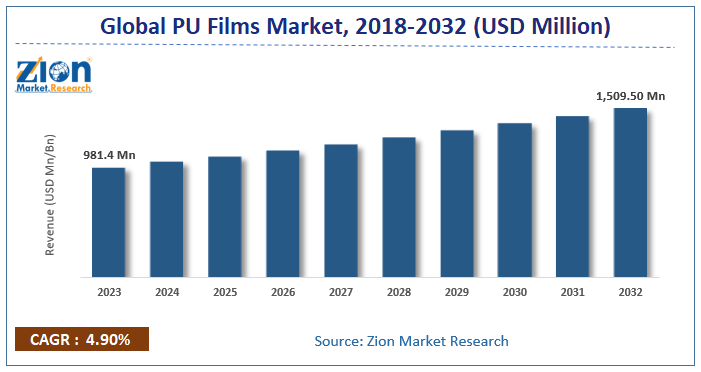
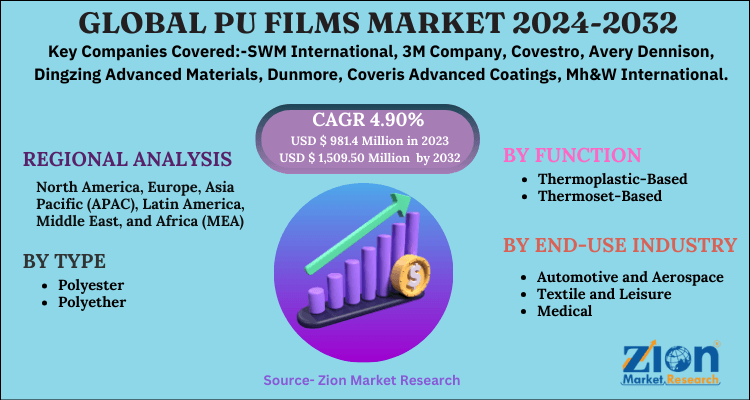
The global PU films market size was valued at around USD 981.4 million in 2023 and is projected to reach about USD 1,509.50 million by 2032, with a compound annual growth rate (CAGR) of roughly 4.90% between 2024 and 2032.
This report provides a comprehensive analysis of the growth drivers, restraints, and challenges shaping demand across the global PU films market throughout the forecast period, while highlighting high-potential emerging opportunities within the industry.
Key Insights
- As per the analysis shared by our research analyst, the global PU films market is estimated to grow at a CAGR of approximately 4.90% during the forecast period from 2024 to 2032.
- In terms of revenue, the global PU films market size was valued at around USD 981.4 million in 2023 and is projected to reach USD 1,509.50 million by 2032.
- The market is driven by increased product demand from automotive, textile, and related industries, excellent physical strength, breathability, elongation, and conformability of PU films, and rising use in medical applications such as wound care, medical tapes, surgical gowns, and drapes.
- Based on the type, polyester PU films serve distinct performance needs, with both types supporting demand across industrial and consumer applications through durability and tailored chemical resistance.
- Based on the function, thermoplastic-based PU films address different processing and end-use requirements, supporting flexibility in manufacturing and performance across automotive, textile, and medical markets.
- Based on the end-use industry, the automotive and aerospace segment held the largest share, supported by high elasticity, grease resistance, and strong low-temperature performance, while the textile and leisure segment is expected to grow rapidly due to the flourishing textile industry.
- Regionally, Asia Pacific is the largest regional market, accounting for the highest share in both revenue and volume, driven by a large population base, rising demand for passenger vehicles, and growth in the luxury car segment.
PU Films Market: Overview
PU films, also referred to as polyurethane films, are thin sheets composed of polyurethane, a highly flexible, resilient, and durable polymer. They are valued for excellent physical strength, surface texture, breathability, elongation, and conformability. Elongation is a particularly favorable property, allowing the films to withstand substantial stretch without breaking and then return to their original dimensions. Because they are manufactured without plasticizers, PU films avoid leaching of hazardous compounds, which makes them well suited for medical and other sensitive applications.
PU Films Market: Dynamics
The PU films market is expected to witness remarkable growth over the forecast period, due to increased product demand from several industries, such as automotive, textile, etc. PU films are widely accepted in these industries due to their excellent physical strength, surface texture, breathability, elongation, conformability, etc. Elongation is one of the most favorable properties of PU films, which makes them withstand around 600% elongation without breaking before returning to their original dimensions after being stretched. Polyurethane films are durable as they are manufactured in the absence of plasticizers, hence preventing the leaching of hazardous compounds. This, in turn, makes it a favorable product to be used by the medical industry.
The flourishing automotive industry in several regions across the globe is expected to be one of the major driving factors for the growth of the global PU films market in the future. The rising disposable income and increasing population have led to the increased demand for passenger cars and vehicles. High elasticity, grease resistance, and low-temperature performance are the major attributes of PU films that make it an ideal product for applications in the automotive industry.
Moreover, the demand from the healthcare industry is expected to further propel the growth of the global PU films market within the forecast time period. In the healthcare industry, PU films are used in wound care components, medical tapes, surgical gowns, and drapes, etc. However, the high cost of PU films as compared to the other substitute products may hamper the market growth in the upcoming years. Alternatively, some manufacturers opt for low-priced and inferior quality PU films to reduce cost.
In order to give the users of this report a comprehensive view of the PU films market, we have included a competitive landscape and an analysis of Porter’s Five Forces model for the market. The study encompasses a market attractiveness analysis, wherein all the segments are benchmarked based on their market size, growth rate, and general attractiveness.
The report provides a company market share analysis to give a broader overview of the key market players. In addition, the report also covers key strategic developments of the market, including acquisitions & mergers, new product launches, agreements, partnerships, collaborations & joint ventures, research & development, product, and regional expansion of major participants involved in the market on a global and regional basis. Moreover, the study covers the product portfolio of various companies.
PU Films Market: Report Scope
| Report Attributes | Report Details |
|---|---|
| Report Name | PU Films Market |
| Market Size in 2023 | USD 981.4 Million |
| Market Forecast in 2032 | USD 1,509.50 Million |
| Growth Rate | CAGR of 4.90% |
| Number of Pages | 285 |
| Key Companies Covered | SWM International, 3M Company, Covestro, Avery Dennison, Dingzing Advanced Materials, Dunmore, Coveris Advanced Coatings, Mh&W International, Par Group, and Permali |
| Segments Covered | By Type, By Function, By End-Use Industry and By Region |
| Regions Covered | North America, Europe, Asia Pacific (APAC), Latin America, Middle East, and Africa (MEA) |
| Base Year | 2023 |
| Historical Year | 2018 - 2022 |
| Forecast Year | 2024 - 2032 |
| Customization Scope | Avail customized purchase options to meet your exact research needs. Request For Customization |
PU Films Market: Segmentation
The pu films market is segmented by type, function, end-use industry, and region. All the segments of the PU films market have been analyzed based on present and future trends and the market is estimated from 2024 to 2032.
Based on Type, the PU films market is divided into polyester and polyether. Both polyester and polyether PU films serve important roles across industrial and consumer applications. Polyester types are often selected for applications requiring good mechanical strength and chemical resistance, while polyether types are valued for flexibility, hydrolysis resistance, and performance in moisture-exposed environments. Together, they support the diverse performance needs of automotive, textile, medical, and other end uses and help drive overall market development through material choice tailored to specific operating conditions.
Based on Function, the PU films market is divided into thermoplastic-based and thermoset-based. Thermoplastic-based PU films offer processability advantages such as heat formability and recyclability in some systems, supporting efficient manufacturing and design flexibility. Thermoset-based films provide high durability and resistance under demanding thermal and mechanical conditions. The availability of both functional approaches allows converters and end users to match film selection to processing methods and performance requirements, reinforcing demand across multiple industries.
Based on End-Use Industry, the PU films market is divided into automotive and aerospace, textile and leisure, medical, and others. The automotive and aerospace segment held the largest share of the global market, owing to the excellent performance of PU films in low-temperature applications and attributes such as high elasticity and grease resistance. These properties support use in vehicle and aircraft components where flexibility and durability are essential. The textile and leisure segment is likely to be among the fastest-growing, driven by the flourishing textile industry and demand for films that combine strength, breathability, and comfort. Medical applications, including wound care, tapes, gowns, and drapes, contribute steady demand based on biocompatibility and performance without plasticizer leaching.
PU Films Market: Regional Insights
Why will Asia Pacific continue to dominate the global market during the projection period?
Asia Pacific is the largest PU films market globally and accounts for the highest market share in both revenue and volume. The region benefits from a huge population base that has increased demand for passenger cars, together with growth in the luxury vehicle segment. Expanding automotive production, rising industrial activity, and growing use of technical textiles and medical products support continued leadership. These conditions enable Asia Pacific to drive volume growth, influence production capacity decisions, and shape global demand patterns for PU films across automotive, textile, and related applications.
North America maintains significant demand supported by automotive, aerospace, medical, and industrial applications and by the presence of established material suppliers. Europe continues to consume PU films for automotive, textile, and medical uses under performance and regulatory requirements. Latin America and the Middle East and Africa represent emerging opportunities where industrialization, vehicle production, and healthcare infrastructure development are expected to support gradual increases in demand over the forecast period.
PU Films Market: Competitive Space
The global PU films market profiles key players such as:
- SWM International
- 3M Company
- Covestro
- Avery Dennison
- Dingzing Advanced Materials
- Dunmore
- Coveris Advanced Coatings
- Mh&W International
- Par Group
- Permali
Segments Covered
The global PU films market is segmented as follows:
By Type
- Polyester
- Polyether
By Function
- Thermoplastic-Based
- Thermoset-Based
By End-Use Industry
- Automotive and Aerospace
- Textile and Leisure
- Medical
- Others
By Region
- North America
- The U.S.
- Canada
- Mexico
- Europe
- France
- The UK
- Spain
- Germany
- Italy
- Rest of Europe
- Asia Pacific
- China
- Japan
- India
- Australia
- South Korea
- Rest of Asia Pacific
- The Middle East & Africa
- Saudi Arabia
- UAE
- Egypt
- Kuwait
- South Africa
- Rest of the Middle East & Africa
- Latin America
- Brazil
- Argentina
- Rest of Latin America
Table Of Content
Methodology
FrequentlyAsked Questions
PU films, also referred to as polyurethane films, are thin sheets composed of polyurethane, an extremely flexible, resilient, and sturdy polymer. Because of their distinctive characteristics, PU films are utilized in a vast array of industries.
The global PU films market is driven by increased demand from automotive, textile, and medical industries, excellent physical properties, including elongation and durability, and the absence of plasticizer leaching that makes the films suitable for healthcare applications.
The global PU films market size was valued at approximately USD 981.4 million in 2023 and is expected to reach around USD 1,509.50 million by 2032.
The global PU films market is expected to grow at a compound annual growth rate (CAGR) of approximately 4.90% during the forecast period from 2024 to 2032.
Asia Pacific is the largest regional market and contributes notably to the global pu films market, supported by a large population base, rising passenger vehicle demand, and growth in related industrial and consumer applications.
Some of the major players leveraging the PU films market growth are SWM International, 3M Company, Covestro, Avery Dennison, Dingzing Advanced Materials, Dunmore, Coveris Advanced Coatings, Mh&W International, Par Group, and Permali.

HappyClients

