
Protein and Peptide Therapeutics Market Size, Share, Value and Forecast 2034

Protein and Peptide Therapeutics Market By Product Type (Innovative Peptides, Genetic Peptides, and Biosimilars), By Molecular/Drug Class Type (Hormonal Peptides, Monoclonal Antibodies, and Insulin & Insulin Analogs), By Route of Administration (Oral, Parenteral, and Others), and By Region - Global and Regional Industry Overview, Market Intelligence, Comprehensive Analysis, Historical Data, and Forecasts 2025 - 2034
| Market Size in 2024 | Market Forecast in 2034 | CAGR (in %) | Base Year |
|---|---|---|---|
| USD 318.43 Billion | USD 578.36 Billion | 6.86% | 2024 |
Protein and Peptide Therapeutics Industry Perspective:
What is the anticipated size of the protein and peptide therapeutics market during the projection period?
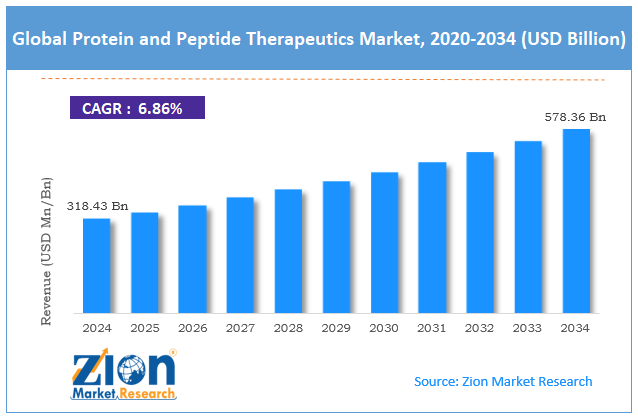
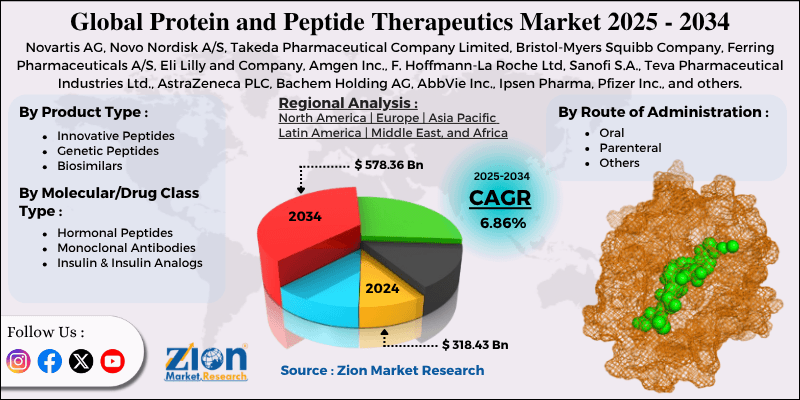
The global protein and peptide therapeutics market size was worth around USD 318.43 billion in 2024 and is predicted to grow to around USD 578.36 billion by 2034 with a compound annual growth rate (CAGR) of roughly 6.86% between 2025 and 2034.
Key Insights:
- As per the analysis shared by our research analyst, the global protein and peptide therapeutics market is estimated to grow annually at a CAGR of around 6.86% over the forecast period (2025-2034)
- In terms of revenue, the global protein and peptide therapeutics market size was valued at around USD 318.43 billion in 2024 and is projected to reach USD 578.36 billion by 2034.
- The market is projected to grow at a significant rate due to the rising prevalence of cancer across the globe
- Based on the product type, the biosimilars segment is growing at a high rate and will continue to dominate the global market, as per industry projections
- Based on the molecular/drug class type, the monoclonal antibodies segment is anticipated to command the largest market share
- Based on the route of administration, the oral segment is expected to lead the market growth trends
- Based on region, North America is projected to dominate the global market during the forecast period
Protein and Peptide Therapeutics Market: Overview
Protein and peptide therapeutics offer several health benefits due to high specificity, potent bioactivity, and favorable safety traits. These medical agents are made of amino acid chains and proteins. In addition, they offer specific targeting of receptors, making them ideal for managing different conditions such as cancer and diabetes. Some prominent examples of protein and peptide therapeutics include monoclonal antibodies, erythropoietin, insulin, and growth hormones. During the forecast period, the rising prevalence of cancer and advancements in novel drug delivery systems are expected to help influence market growth trends. However, inherent limitations of protein and peptide therapeutics, such as reliance on parenteral administration, poor membrane permeability, and rapid enzymatic degradation, may impact business revenue in the long run.
Impact of the USA-Israel war on Iran on the Protein and Peptide Therapeutics Market?
The ongoing war between the USA, Israel, and Iran is expected to drive the production and manufacturing costs of protein and peptide therapeutics. Additionally, it can disrupt the raw material supply chain. In the long run, the war is anticipated to fuel more investments in domestic production of low-cost and generic protein and peptide therapeutics, giving lucrative opportunities to regional players for extended growth.
Protein and Peptide Therapeutics Market: Dynamics
Growth Drivers
How will the rising prevalence of cancer influence the protein and peptide therapeutics market?
The global protein and peptide therapeutics market is expected to grow due to the rising prevalence of cancer across the globe. Excellent specificity offered by protein and peptide therapeutics is one of the key advantages of using the medical agents during cancer treatment. These therapies accurately detect and act on cancer cells, thus sparing healthy cells from damage.
In addition, protein and peptide therapeutics are designed to block cancer growth signals, slowing tumor progression. The growing use of targeted therapy during cancer treatment will work in favor of the industry leaders during the forecast period. According to market research, targeted medical therapies are considered highly effective in certain cancer treatments, showing a success rate of more than 79% as compared to traditional methods.
Growing healthcare investments worldwide are working in favor of the industry players
The world's healthcare infrastructure is under pressure as the world population continues to grow, along with high prevalence of chronic conditions. These factors have resulted in increased healthcare investments backed by government institutions and private companies.
In March 2026, Pinnacle Medicines, a leading biotechnology firm with a special focus on the development of oral peptide therapeutics using proprietary Artificial Intelligence (AI) and physics-based platforms, announced the closing of an oversubscribed USD 89 million Series B financing. The funds will be used to encourage Pinnacle's lead programs focusing on cardiometabolic diseases and immunology, thus contributing to the global protein and peptide therapeutics market.
Restraints
Why will cost barriers affect growth in the protein and peptide therapeutics market?
The global protein and peptide therapeutics industry is expected to be restricted due to high production costs. Protein and peptide therapeutics are expensive biologics as they are produced using highly complex manufacturing processes. In addition, use of advanced technologies such as purification systems further adds to the overall cost of production. Growing economic vitality worldwide will affect industry investments in the coming years.
Opportunities
Advancements in novel drug delivery systems offer growth opportunities to the industry players
The global protein and peptide therapeutics market players are focusing on developing new and more effective drug delivery systems. At present, most protein and peptide therapeutic solutions are administered through parenteral routes. However, market experts are working on ensuring that the drug can be administered topically or orally without impacting its overall efficiency. In February 2026, Novo Nordisk, a global pharmaceutical company, announced a partnership with Vivtex Corporation, a start-up working on increasing the bioavailability of oral peptides. Vivtex will license oral drug-delivery technologies to Novo for diabetes, weight loss, and other conditions.
In March 2026, researchers at Kumamoto University in Japan developed a novel peptide-based oral insulin delivery system, which is expected to replace the conventionally used daily injections by diabetic patients. The innovation will help the drug survive digestion, thus entering the bloodstream and delivering enhanced care.
Challenges
How will the inherent limitations of the drugs limit the protein and peptide therapeutics industry?
The global protein and peptide therapeutics industry is expected to be challenged by the inherent limitations of the drugs. According to industry analysis, protein and peptide therapeutics undergo rapid enzymatic degradation and swift renal clearance. Furthermore, most peptide therapeutics are delivered through parenteral means, which can impact patient adherence, thus limiting market growth trends.
Protein and Peptide Therapeutics Market: Report Scope
| Report Attributes | Report Details |
|---|---|
| Report Name | Protein and Peptide Therapeutics Market |
| Market Size in 2024 | USD 318.43 Billion |
| Market Forecast in 2034 | USD 578.36 Bllion |
| Growth Rate | CAGR of 6.86% |
| Number of Pages | 229 |
| Key Companies Covered | Novartis AG, Novo Nordisk A/S, Takeda Pharmaceutical Company Limited, Bristol-Myers Squibb Company, Ferring Pharmaceuticals A/S, Eli Lilly and Company, Amgen Inc., F. Hoffmann-La Roche Ltd, Sanofi S.A., Teva Pharmaceutical Industries Ltd., AstraZeneca PLC, Bachem Holding AG, AbbVie Inc., Ipsen Pharma, Pfizer Inc., and others. |
| Segments Covered | By Product Type, By Molecular/Drug Class Type, By Route of Administration, and By Region |
| Regions Covered | North America, Europe, Asia Pacific (APAC), Latin America, Middle East, and Africa (MEA) |
| Base Year | 2024 |
| Historical Year | 2019 to 2023 |
| Forecast Year | 2025 - 2034 |
| Customization Scope | Avail customized purchase options to meet your exact research needs. Request For Customization |
Protein and Peptide Therapeutics Market: Segmentation
The global protein and peptide therapeutics market is segmented based on product type, molecular/drug class type, route of administration, and region.
Why will the biosimilars lead the protein and peptide therapeutics market revenue during the forecast period?
Based on product type, the global market segments are innovative peptides, genetic peptides, and biosimilars. In 2024, the highest growth was listed in the biosimilars. segment accounting for 65% of the global revenue. During the forecast period, biosimilars are anticipated to grow at 26% CAGR due to growing demand for affordable healthcare and increasing government spending on the development of biologic drugs.
Which will be the fastest-growing drug class type during the forecast period in the protein and peptide therapeutics market?
Based on molecular/drug class type, the global industry is segmented into hormonal peptides, monoclonal antibodies, and insulin & insulin analogs. In 2024, the monoclonal antibodies segment led the market growth rate, accounting for 64% of the global revenue. It is anticipated to grow at a CAGR of 12.01% during the forecast period due to wider use of the drug class type in treating chronic conditions such as diabetes and cancer.
Why will the oral segment account for the highest market share in the protein and peptide therapeutics industry in the coming years?
Based on the route of administration, the global market is fragmented into oral, parenteral, and others. In 2024, the global market was dominated by the parenteral segment, contributing up to 80% of the global revenue. However, the oral segment is anticipated to grow at a CAGR of 11% during the forecast period as more investments are directed toward novel drug delivery systems.
Protein and Peptide Therapeutics Market: Regional Analysis
Why does North America lead the protein and peptide therapeutics market?
The global protein and peptide therapeutics market is expected to be led by North America during the forecast period. In 2024, it accounted for 45% of the global revenue and is anticipated to offer a CAGR of 10.02% during the forecast period. The presence of one of the world’s most advanced healthcare and research & development (R&D) industries has helped the region thrive. In addition, growing medical tourism, rising demand for targeted therapy, and the presence of major pharmaceutical companies will fuel regional expansion in the future.
How is Asia-Pacific expected to shape the protein and peptide therapeutics market in the coming years?
Asia-Pacific is expected to emerge as the fastest-growing market with a CAGR of 15% during the forecast period. In 2024, it accounted for 21% of the global revenue. The growing prevalence of chronic conditions, rising demand for quality healthcare, and growing focus on the development of affordable medical care and drugs will aid regional expansion. Moreover, the rising use of advanced technology in the production of protein and peptide therapeutics will further help the region thrive.
Protein and Peptide Therapeutics Market: Competitive Analysis
The global protein and peptide therapeutics market is led by players like:
- Novartis AG
- Novo Nordisk A/S
- Takeda Pharmaceutical Company Limited
- Bristol-Myers Squibb Company
- Ferring Pharmaceuticals A/S
- Eli Lilly and Company
- Amgen Inc.
- F. Hoffmann-La Roche Ltd
- Sanofi S.A.
- Teva Pharmaceutical Industries Ltd.
- AstraZeneca PLC
- Bachem Holding AG
- AbbVie Inc.
- Ipsen Pharma
- Pfizer Inc.
What are the latest key trends in the protein and peptide therapeutics market?
Increasing demand for weight loss drugs
Weight loss drugs have gained widespread popularity around the globe in the last few years. These drugs will offer new expansion possibilities to the market leaders in the coming years.
Use of AI during manufacturing
The growing use of AI and machine learning during the drug development process is a promising industry trend. These technologies will promote faster production and process optimization.
The global protein and peptide therapeutics market is segmented as follows:
By Product Type
- Innovative Peptides
- Genetic Peptides
- Biosimilars
By Molecular/Drug Class Type
- Hormonal Peptides
- Monoclonal Antibodies
- Insulin & Insulin Analogs
By Route of Administration
- Oral
- Parenteral
- Others
By Region
- North America
- The U.S.
- Canada
- Mexico
- Europe
- France
- The UK
- Spain
- Germany
- Italy
- Rest of Europe
- Asia Pacific
- China
- Japan
- India
- Australia
- South Korea
- Rest of Asia Pacific
- The Middle East & Africa
- Saudi Arabia
- UAE
- Egypt
- Kuwait
- South Africa
- Rest of the Middle East & Africa
- Latin America
- Brazil
- Argentina
- Rest of Latin America
Table Of Content
Methodology
FrequentlyAsked Questions
Protein and peptide therapeutics offer several health benefits due to high specificity, potent bioactivity, and favorable safety traits.
The global protein and peptide therapeutics market is expected to grow due to the rising prevalence of cancer across the globe.
According to study, the global protein and peptide therapeutics market size was worth around USD 318.43 billion in 2024 and is predicted to grow to around USD 578.36 billion by 2034.
The CAGR value of protein and peptide therapeutics market is expected to be around 6.86% during 2025-2034.
What are the major challenges restraining the growth of the protein and peptide therapeutics market?
The global protein and peptide therapeutics industry is expected to be challenged by the inherent limitations of the drugs.
Increasing demand for weight loss drugs and use of AI during manufacturing are the emerging trends and innovations impacting the protein and peptide therapeutics market.
North America will contribute notably towards the protein and peptide therapeutics market value.
The global protein and peptide therapeutics market is led by players like Novartis AG, Novo Nordisk A/S, Takeda Pharmaceutical Company Limited, Bristol-Myers Squibb Company, Ferring Pharmaceuticals A/S, Eli Lilly and Company, Amgen Inc., F. Hoffmann-La Roche Ltd, Sanofi S.A., Teva Pharmaceutical Industries Ltd., AstraZeneca PLC, Bachem Holding AG, AbbVie Inc., Ipsen Pharma, and Pfizer Inc.
The report explores crucial aspects of the protein and peptide therapeutics market including detailed discussion of existing growth factors and restraints while also browsing future growth opportunities and challenges that impact the market.

List of Contents
Protein and Peptide TherapeuticsIndustry Perspective:Key Insights:OverviewDynamicsReport ScopeSegmentationRegional AnalysisCompetitive AnalysisWhat are the latest key trends in the protein and peptide therapeutics market?The global protein and peptide therapeutics market is segmented as follows:HappyClients

