
Protective Cultures Market Size, Share, Trends, Growth and Forecast 2032

Protective Cultures Market: By Form (Frozen Pellets and Freeze Dried), By Target Organism (Bacteria and Yeast & Molds), By Application (Cheese, Dairy Products, Yogurt & Butter, Seafood, Meat & Poultry Products, Vegetable Foods, Bakery & Confectionaries, and Beverages), and By Region - Global Industry Perspective, Comprehensive Analysis, and Forecast, 2024 - 2032
| Market Size in 2023 | Market Forecast in 2032 | CAGR (in %) | Base Year |
|---|---|---|---|
| USD 112.09 Million | USD 279.84 Million | 10.7% | 2023 |
What is the Market size of the Protective Cultures Industry?
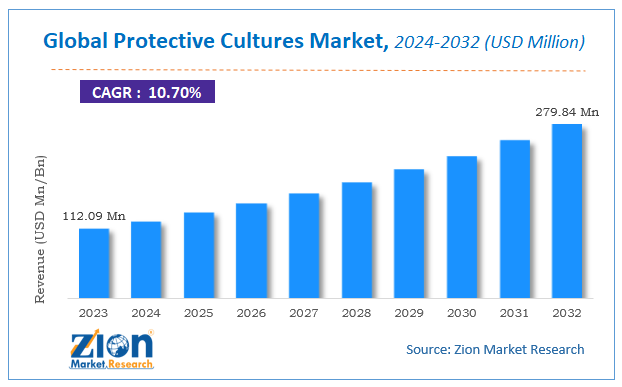
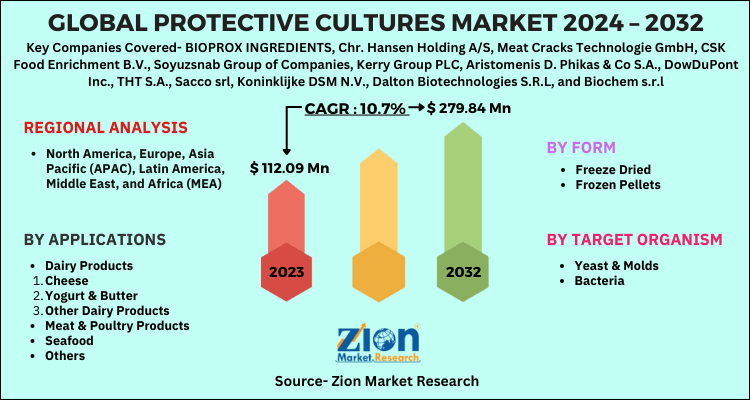
According to Zion Market Research, the global Protective Cultures Market was worth USD 112.09 Million in 2023. The market is forecast to reach USD 279.84 Million by 2032, growing at a compound annual growth rate (CAGR) of 10.7% during the forecast period 2024-2032. The report offers a comprehensive analysis of the market, highlighting the factors that will determine growth, potential challenges, and opportunities that could emerge in the Protective Cultures industry over the next decade.
Introduction
Protective cultures comprise of bacteria selected for their capability to arrest the pathogenic organism growth as well as inhibiting the development or spread of microbiological agents in the food products, particularly, dairy foods and processed meat products. Apart from this, protective cultures also hinder the growth of listeria monocytogenes and E. Coli in sliced, cooked, vacuum, and gas-packed meat products. The product also helps against restricting the spread of campylobacter jejuni as well as listeria monocytogenes in chicken items packaged in the modified environment.
Market Growth Dynamics
According to a study conducted by NCBI in 2005, two lactobacillus-based protective cultures, namely, lactobacillus sakei CECT 4808 & lactobacillus curvatus CECT 904 (T) were found to produce bacteriocin-like inhibitory substances after they were injected in isolation as well as in combination on beef slices. Furthermore, the inoculated beef slices both individually with lactobacillus sakei CECT 4808 strain & lactobacillus curvatus CECT 904 (T) as well as combination of both strains were vacuum packaged & stored in refrigerator at nearly over 4 +/- degree centigrade. These samples were evaluated during its twenty-eight day storage timespan for yeasts, molds, enterobacteriaceae, brochothrix thermosphacta, lactic acid bacteria, and Pseudomonas spp. They were also assessed for abnormal odor and instrumental color.
Moreover, beef slices injected with lactobacillus sakei strain had notably reduced spoilage microbial count as compared to those slices injected with lactobacillus curvatus strain. Furthermore, the inoculation of combination of both strains on beef slices also brought optimum reduction in the spoilage microbial proportion. Apparently, beef slices inoculated individually with lactobacillus sakei strain and combined lactobacillus sakei & lactobacillus curvatus strains exhibited improvement in chemical parameters & abnormal odor scores. It was also found that the Lact. Sakei CECT 4808 strain demonstrated better preserving feature in comparison to combination of both the Lact. Strains. It was concluded that Lact Sakei 4808 strain can help in preserving & storing of vacuum packaged beef for an elongated period. The strain also exemplified restricted anti-oxidative property, thereby preventing lipid oxidative process in meat products, increasing shelf life of meat, and reducing its spoilage. Such favorable outcomes from the clinical experiments are likely to contribute remarkably towards the market growth in the coming years.
Furthermore, protective cultures produce metabolites including lactic acid, propionic acid, and acetic acid acting as antimicrobial agents. This, in turn, has enhanced the popularity of the product as well as its use in various food items.
Protective Cultures Market: Report Scope
| Report Attributes | Report Details |
|---|---|
| Report Name | Protective Cultures Market |
| Market Size in 2023 | USD 112.09 Million |
| Market Forecast in 2032 | USD 279.84 Million |
| Growth Rate | CAGR of 10.7% |
| Number of Pages | 110 |
| Key Companies Covered | BIOPROX INGREDIENTS, Chr. Hansen Holding A/S, Meat Cracks Technologie GmbH, CSK Food Enrichment B.V., Soyuzsnab Group of Companies, Kerry Group PLC, Aristomenis D. Phikas & Co S.A., DowDuPont Inc., THT S.A., Sacco srl, Koninklijke DSM N.V., Dalton Biotechnologies S.R.L, and Biochem s.r.l |
| Segments Covered | By Form, By Target Organism, By Application And By Region |
| Regions Covered | North America, Europe, Asia Pacific (APAC), Latin America, Middle East, and Africa (MEA) |
| Base Year | 2023 |
| Historical Year | 2018 - 2022 |
| Forecast Year | 2024 - 2032 |
| Customization Scope | Avail customized purchase options to meet your exact research needs. Request For Customization |
Europe To Dominate Overall Market Expansion By 2032
The regional market growth over the forecast period is owing to the large-scale dairy item production in the European countries along with escalating concerns vis-à-vis food spoilage. Apart from this, growing health awareness among the end-users about the protective cultures in the Europe will favorably leverage the growth of the market in the continent over the forthcoming years.
Key players included in the report are:
- BIOPROX INGREDIENTS
- Chr. Hansen Holding A/S
- Meat Cracks Technologie GmbH
- CSK Food Enrichment B.V.
- Soyuzsnab Group of Companies
- Kerry Group PLC
- Aristomenis D. Phikas & Co S.A.
- DowDuPont Inc.
- THT S.A.
- Sacco srl
- Koninklijke DSM N.V.
- Dalton Biotechnologies S.R.L
- Biochem s.r.l.
The global protective cultures market is segmented as follows:
By Form
- Freeze Dried
- Frozen Pellets
By Target Organism
- Yeast & Molds
- Bacteria
By Application
- Dairy Products
- Cheese
- Yogurt & Butter
- Other Dairy Products
- Meat & Poultry Products
- Seafood
- Others
By Region
- North America
- The U.S.
- Canada
- Mexico
- Europe
- France
- The UK
- Spain
- Germany
- Italy
- Rest of Europe
- Asia Pacific
- China
- Japan
- India
- Australia
- South Korea
- Rest of Asia Pacific
- The Middle East & Africa
- Saudi Arabia
- UAE
- Egypt
- Kuwait
- South Africa
- Rest of the Middle East & Africa
- Latin America
- Brazil
- Argentina
- Rest of Latin America
Table Of Content
Methodology
FrequentlyAsked Questions
Protective cultures are beneficial bacteria added to food. They help prevent spoilage and extend shelf life naturally
The global Protective Cultures market is expected to be driven by the demand for natural food preservation and clean-label products. Use in dairy, meat, and fermented foods boosts adoption.
According to study, the global Protective Cultures market size was worth around USD 112.09 Million in 2023 and is predicted to grow to around USD 279.84 Million By 2032.
The global Protective Cultures market is expected to grow at a Compound Annual Growth Rate (CAGR) of around CAGR 10.7% during the forecast period from 2024-2032.
The global Protective Cultures industry is projected to be challenged by Challenges include regulatory approvals, strain stability, and limited awareness among processors.
The Opportunities include natural food preservation demand, clean-label products, shelf-life extension, and growth in dairy and meat processing will offer significant growth opportunities in the Protective Cultures market.
Natural biopreservation using beneficial microbes; shelf-life extension without additives; growth in clean-label dairy and meat products are the emerging trends and innovations impacting the Protective Cultures market.
The global Protective Cultures market is expected to be led by Europe during the forecast period.
Some of the prominent players operating in the global Protective Cultures market are; BIOPROX INGREDIENTS, Chr. Hansen Holding A/S, Meat Cracks Technologie GmbH, CSK Food Enrichment B.V., Soyuzsnab Group of Companies, Kerry Group PLC, Aristomenis D. Phikas & Co S.A., DowDuPont Inc., THT S.A., Sacco srl, Koninklijke DSM N.V., Dalton Biotechnologies S.R.L, and Biochem s.r.l and others.
The report explores crucial aspects of the Protective Cultures market, including a detailed discussion of existing growth factors and restraints, while also browsing future growth opportunities and challenges that impact the market.

HappyClients

