
Product Lifecycle Management (PLM) In Fashion Market Size, Share, and Forecast 2034

Product Lifecycle Management (PLM) In Fashion Market By Application (Manufacturers, Retailers, and Others), By Types (CAM, CAD, PDM/CDM, and Others), and By Region - Global and Regional Industry Overview, Market Intelligence, Comprehensive Analysis, Historical Data, and Forecasts 2025 - 2034
| Market Size in 2024 | Market Forecast in 2034 | CAGR (in %) | Base Year |
|---|---|---|---|
| USD 2.50 Billion | USD 5.80 Billion | 9.81% | 2024 |
Product Lifecycle Management (PLM) In Fashion Industry Perspective:
What is the anticipated CAGR for the product lifecycle management (PLM) in fashion market during the projection period?
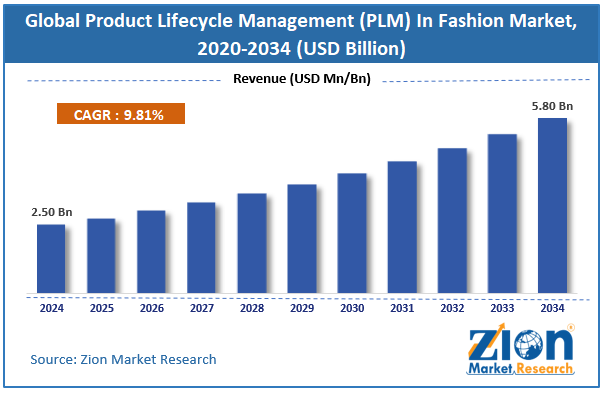
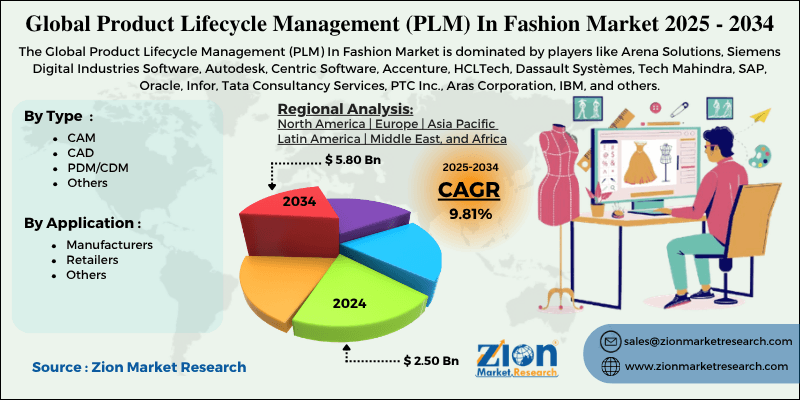
The global product lifecycle management (PLM) in fashion market size was worth around USD 2.50 billion in 2024 and is predicted to grow to around USD 5.80 billion by 2034 with a compound annual growth rate (CAGR) of roughly 9.81% between 2025 and 2034.
Key Insights:
- As per the analysis shared by our research analyst, the global product lifecycle management (PLM) in fashion market is estimated to grow annually at a CAGR of around 9.81% over the forecast period (2025-2034)
- In terms of revenue, the global product lifecycle management (PLM) in fashion market size was valued at around USD 2.50 billion in 2024 and is projected to reach USD 5.80 billion by 2034.
- The market is projected to grow at a significant rate due to the growing expansion of the fast and ultra-fast fashion industries.
- Based on the application, the manufacturers segment is growing at a high rate and will continue to dominate the global market, as per industry projections
- Based on the type, the PDM/CD segment is anticipated to command the largest market share
- Based on region, North America is projected to dominate the global market during the forecast period
Product Lifecycle Management (PLM) In Fashion Market: Overview
Product lifecycle management (PLM) in fashion industry refers to the use of systematic approaches that leverage business solutions, strategies, and tools to manage a product’s entire lifecycle. PLM in fashion is used across stages starting from product conceptualization to diconutunation. The primary applications of PLM in fashion include ideation, product design & development, material sourcing, sampling & prototyping, product planning, distribution, and end-of-life and sustainability considerations. During the forecast period, demand for product lifecycle management (PLM) in fashion is expected to be led by the rapid expansion of fast and ultra-fast fashion industries.
Furthermore, increasing pressure on the fashion industry to achieve sustainability goals will further work in favor of the industry leaders. However, the high cost of technology ownership, risk of technology obsolescence, and concerns over the lack of skilled employees may impede market growth trends.
Product Lifecycle Management (PLM) In Fashion Market: Dynamics
Growth Drivers
How will the expansion of fast and ultra-fast fashion influence growth in the product lifecycle management (PLM) in fashion industry?
The global product lifecycle management (PLM) in fashion market is expected to benefit from the growing expansion of the fast and ultra-fast fashion industries. According to official reports, the global fast fashion industry is expected to cross over USD 400 billion by the end of the forecast period. Fast fashion and ultra-fast fashion industries deal with extremely short production cycles of clothing items.
Additionally, these fashion products are sold at low prices as compared to sustainable brands. Furthermore, consumer preferences are actively evolving as buyers want to keep up with the latest fashion trends, further resulting in the accelerated expansion of the fashion sector. Product lifecycle management in the fashion industry helps fast and ultra-fast fashion companies optimize business operations.
Global expansion of the fashion industry is expected to propel industry growth trends during the forecast period
The global fashion industry is expanding at an unprecedented rate. Fashion brands continue to enter new markets and expand their product portfolio to improve profit margins and strengthen brand value. In January 2026, Edikted, a US fashion brand, announced its European launch by opening a new store at 52-55 Carnaby Street.
Furthermore, market analysis suggests that the US fashion industry is increasingly investing in European markets as regional demand continues to grow. Global expansion of business operations comes with multiple financial and operational complexities. The solutions available in the product lifecycle management (PLM) in fashion help companies navigate these complexities by offering real-time visibility and centralized data management.
Restraints
How will integration complexity limit product lifecycle management (PLM) in fashion industry?
The global product lifecycle management (PLM) in fashion industry is expected to be restricted due to the complexity of integrating PLM systems in existing infrastructure. Companies relying on legacy systems may find it difficult to adopt modern PLM systems, as integration can be resource-consuming. Furthermore, employees may showcase hesitancy in adopting new technologies, leading to a delay in the effective application of product lifecycle management tools.
Opportunities
Fashion e-commerce industry is expected to generate growth opportunities for the market players
The global product lifecycle management (PLM) is expected to generate growth opportunities due to fashion e-commerce. Emergence of several fashion-oriented online portals along with strategic partnerships between fashion brands and e-commerce channels will work in favor of the market players. According to official reports, Amazon, one of the world’s leading e-commerce companies, sells more than 2 million units of fashion items every day.
Furthermore, the online fashion marketplace is also dominated by several regional players. Artificial Intelligence (AI) integration across e-commerce channels will help industry players reach more buyers and deliver optimal customer service, resulting in greater use of PLM in fashion.
How will sustainability goals shape the product lifecycle management (PLM) in fashion market?
Fashion companies are under pressure to improve their business sustainability goals and achieve them using different measures. Product lifecycle management assists in tracing raw materials. It can help companies ensure only certified and recycled materials are used for further production. PLM also promotes greater stakeholder transparency and reduces waste generation. Efficient use of resources using product lifecycle management further contributes to companies ensuring sustainability goals are met without discrepancies.
Challenges
High cost and lack of skilled resources to challenge market growth trends in the future
The global product lifecycle management (PLM) in fashion industry is expected to be challenged by the high cost of technology ownership. The average of an enterprise-scale PLM set-up can reach over USD 650,000 per year. Furthermore, implementation charges can lead to an additional increase in PLM integration. The industry will be further restricted due to a lack of skilled professionals, resulting in additional training and development costs.
Product Lifecycle Management (PLM) In Fashion Market: Report Scope
| Report Attributes | Report Details |
|---|---|
| Report Name | Product Lifecycle Management (PLM) In Fashion Market |
| Market Size in 2024 | USD 2.50 Billion |
| Market Forecast in 2034 | USD 5.80 Billion |
| Growth Rate | CAGR of 9.81% |
| Number of Pages | 225 |
| Key Companies Covered | Arena Solutions, Siemens Digital Industries Software, Autodesk, Centric Software, Accenture, HCLTech, Dassault Systèmes, Tech Mahindra, SAP, Oracle, Infor, Tata Consultancy Services, PTC Inc., Aras Corporation, IBM, and others. |
| Segments Covered | By Application, By Types, and By Region |
| Regions Covered | North America, Europe, Asia Pacific (APAC), Latin America, Middle East, and Africa (MEA) |
| Base Year | 2024 |
| Historical Year | 2019 to 2023 |
| Forecast Year | 2025 - 2034 |
| Customization Scope | Avail customized purchase options to meet your exact research needs. Request For Customization |
Product Lifecycle Management (PLM) In Fashion Market: Segmentation
The global product lifecycle management (PLM) in fashion market is segmented based on application, types, and region.
Why will the manufacturers segment lead the product lifecycle management (PLM) in fashion industry revenue during the forecast period?
Based on application, the global market segments are manufacturers, retailers, and others. In 2024, the highest growth was listed in the manufacturers segment, accounting for 61% of the global revenue. It is expected to deliver a CAGR of 8.1% during the forecast period, driven by growing demand for fashion items. Rising world population, increasing disposable income, and evolving consumer preferences will lead to higher production of fashion items, contributing to segmental growth trends.
Which will be the fastest-growing type during the forecast period in the product lifecycle management (PLM) in fashion market?
Based on types, the global market is divided into CAM, CAD, PDM/CDM, and others. In 2024, the PDM/CD was the leading revenue generator, accounting for 51% of the global revenue. Product Data Management (PDM) and Collaborative Data Management (CDM) are critical elements of managing a product’s lifecycle. The PDM/CDM segment will grow at a CAGR of 8.5% as end-users seek solutions to enhance the product’s value chain in the long run.
Product Lifecycle Management (PLM) In Fashion Market: Regional Analysis
Why will North America continue to lead the product lifecycle management (PLM) in fashion market during the forecast period?
The global product lifecycle management (PLM) in fashion market is expected to be led by North America during the forecast period. In 2024, it accounted for 48% of the global revenue, and it will grow at a CAGR of 10.01% during the forecast period. The US is home to some of the most prominent fashion brands that enjoy global presence and popularity. Furthermore, growing consumerism levels across North America, with the rise of the fast fashion industry, have further helped fuel regional growth trends.
How will the Asia-Pacific shape the product lifecycle management (PLM) in fashion market during the forecast period?
Asia-Pacific is set to emerge as the fastest-growing region in the product lifecycle management (PLM) in fashion market during the forecast period, growing at a CAGR of 13.5%. The fashion e-commerce industry is projected to play a pivotal role in shaping the regional growth trends.
Furthermore, the growing introduction of regional players offering advanced and region-specific PLM tools will aid in accelerated regional growth. Expansion of Asia-Pacific’s manufacturing capabilities and digitalization of the fashion sector will work in favor of Asia-Pacific.
Product Lifecycle Management (PLM) In Fashion Market: Competitive Analysis
The global product lifecycle management (PLM) in fashion market is led by players like:
- Arena Solutions
- Siemens Digital Industries Software
- Autodesk
- Centric Software
- Accenture
- HCLTech
- Dassault Systèmes
- Tech Mahindra
- SAP
- Oracle
- Infor
- Tata Consultancy Services
- PTC Inc.
- Aras Corporation
- IBM
What are the latest key trends in the product lifecycle management (PLM) in fashion market?
Cloud-based PLM
Product lifecycle management systems are being provided through Software-as-a-Service infrastructure. Cloud-based PLM systems are affordable and have faster implementation as compared to on-site counterparts.
AI-driven PLM
Artificial Intelligence-powered PLM promotes real-time demand forecasting and cost prediction. These solutions can help reduce excessive waste, allowing owners to make informed decisions in the long run.
The global product lifecycle management (PLM) in fashion market is segmented as follows:
By Application
- Manufacturers
- Retailers
- Others
By Types
- CAM
- CAD
- PDM/CDM
- Others
By Region
- North America
- The U.S.
- Canada
- Mexico
- Europe
- France
- The UK
- Spain
- Germany
- Italy
- Rest of Europe
- Asia Pacific
- China
- Japan
- India
- Australia
- South Korea
- Rest of Asia Pacific
- The Middle East & Africa
- Saudi Arabia
- UAE
- Egypt
- Kuwait
- South Africa
- Rest of the Middle East & Africa
- Latin America
- Brazil
- Argentina
- Rest of Latin America
Table Of Content
Methodology
FrequentlyAsked Questions
Product lifecycle management (PLM) in fashion industry refers to the use of systematic approaches that leverage business solutions, strategies, and tools to manage a product’s entire lifecycle.
The global product lifecycle management (PLM) in fashion market is expected to benefit from the growing expansion of the fast and ultra-fast fashion industries.
What will be the value of the product lifecycle management (PLM) in fashion market during 2025-2034?
According to study, the global product lifecycle management (PLM) in fashion market size was worth around USD 2.50 billion in 2024 and is predicted to grow to around USD 5.80 billion by 2034.
The CAGR value of product lifecycle management (PLM) in fashion market is expected to be around 9.81% during 2025-2034.
The global product lifecycle management (PLM) in fashion industry is expected to be challenged by the high cost of technology ownership.
Cloud-based PLM and AI PLM are the emerging trends and innovations impacting the product lifecycle management (PLM) in fashion market.
The global product lifecycle management (PLM) in fashion market has performed well so far and will offer similar trends in the coming years.
North America will contribute notably towards the product lifecycle management (PLM) in fashion market value.
The global product lifecycle management (PLM) in fashion market is led by players like Arena Solutions, Siemens Digital Industries Software, Autodesk, Centric Software, Accenture, HCLTech, Dassault Systèmes, Tech Mahindra, SAP, Oracle, Infor, Tata Consultancy Services, PTC Inc., Aras Corporation, and IBM.
The report explores crucial aspects of the product lifecycle management (PLM) in fashion market including detailed discussion of existing growth factors and restraints while also browsing future growth opportunities and challenges that impact the market.

List of Contents
Product Lifecycle Management (PLM) In FashionIndustry Perspective:Key Insights:OverviewDynamicsReport ScopeSegmentationRegional AnalysisCompetitive AnalysisWhat are the latest key trends in the product lifecycle management (PLM) in fashion market?The global product lifecycle management (PLM) in fashion market is segmented as follows:HappyClients

