
Global Prescriptive Analytics Market Size, Share, Trends, Growth, Forecasts, 2030

Prescriptive Analytics Market By deployment mode (on-premises and cloud), By component (services and software), By business function (comprises human resources, operations, finance, marketing, and sales), By vertical (healthcare, government, media & entertainment, retail, IT & telecommunications, BFSI, transportation & logistics, and others And By Region: - Global and Regional Industry Overview, Market Intelligence, Comprehensive Analysis, Historical Data, and Forecasts, 2023-2030
| Market Size in 2022 | Market Forecast in 2030 | Growth Rate (in %) | Base Year |
|---|---|---|---|
| USD 6.03 Billion | USD 31.06 Billion | CAGR at 22.57% | 2022 |
Description
What is Prescriptive Analytics Market Size?
According to the report published by Zion Market Research, the global Prescriptive Analytics Market size was valued at USD 6.03 Billion in 2022 and is predicted to reach USD 31.06 Billion by the end of 2030. The market is expected to grow with a CAGR of 22.57% during the forecast period. The report analyzes the global Prescriptive Analytics Market’s growth drivers, restraints, and impact on demand during the forecast period. It will also help navigate and explore the arising opportunities in the Prescriptive Analytics industry.
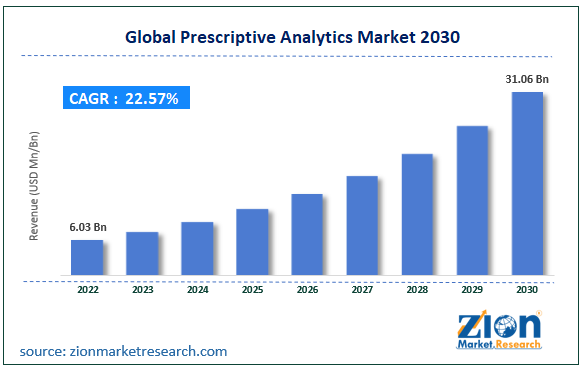
Global Prescriptive Analytics Market: Overview
Prescriptive analytics is a method that analyses the data and provides instantaneous recommendations to enhance business practices that can suit various predicted outcomes. It uses modeling structures for predicting the outcomes and then uses a combination of algorithms, artificial intelligence, business rules, and machine learning to simulate multiple methodologies to these various outcomes. It’s a natural progression from descriptive and predictive analytics procedures.
Global Prescriptive Analytics Market: Growth Factors
The global prescriptive analytics market is primarily driven by the surge in cloud-based predictive analytics demand. Further, with the rise in the amount of structured and unstructured data being generated, there is a growing necessity for analyzing data. In addition to this, there are huge investments in the development of the big data infrastructure. This is propelling the growth of the global market. Prescriptive analytics is the most efficient and smart tool available to support any organization’s business intelligence. It helps the organizations to lessen human error or bias, spend less time thinking & more time doing, inform real-time & long-term business operations, and easily maps the path to success.
It also helps to create more loyal customers, meet business goals, increase efficiency, limit risk, prevents fraud, increase revenue, and gross margin management. Owing to such a broad spectrum of benefits offered by prescriptive analytics, there is an increase in the adoption of prescriptive analytics tools across several industrial sectors. In addition to this, the rise in the frequency of cyber-crimes, growing acceptance of real-time accessibility of data to improve productivity & sales several end-users are hugely demanding for Business Intelligence (BI) which in turn is boosting the growth of the global prescriptive analytics market. Furthermore, the emergence of technologically advanced tools and integration with IoT will have numerous opportunities for the growth of the global prescriptive analytics market over the forecast period. However, the dynamic nature of data and complicated analytical workflow may limit the growth of the global market.
The outbreak of Covid-19 has disrupted mostly everything including supply chain & consumer behavior and led to an economic crisis. However, the pandemic conditions have boosted the adoption of predictive analytics tools, especially in the healthcare sector. The pandemic has generated a large amount of data that has enabled healthcare providers and researchers to monitor patient populations and analyze trends. With the use of these tools, the organizations can understand better where the disease is likely to spike next, where resources are most needed, and which patients are at risk. Thus, predictive analytics is expected to play a significant role in monitoring the impact of the virus.
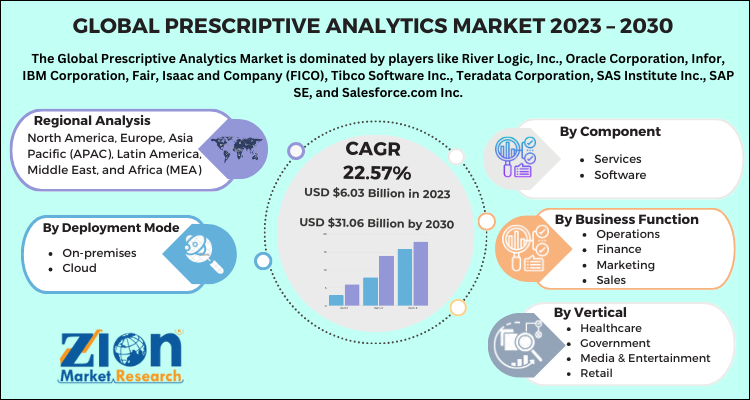
Global Prescriptive Analytics Market: Segmentation
The global prescriptive analytics market is segregated based on deployment mode, component, business function, vertical, and region.
Based on the deployment mode, the global prescriptive analytics market is bifurcated into on-premises and cloud. The component segment is split into services and software. The business function comprises human resources, operations, finance, marketing, and sales.
Based on the vertical, the global market is categorized into healthcare, government, media & entertainment, retail, IT & telecommunications, BFSI, transportation & logistics, and others.
Prescriptive Analytics Market: Report Scope
| Report Attributes | Report Details |
|---|---|
| Report Name | Prescriptive Analytics Market Research Report |
| Market Size in 2022 | USD 6.03 Billion |
| Market Forecast in 2030 | USD 31.06 Billion |
| Growth Rate | CAGR of 22.57% |
| Number of Pages | 178 |
| Key Companies Covered | River Logic, Inc., Oracle Corporation, Infor, IBM Corporation, Fair, Isaac and Company (FICO), Tibco Software Inc., Teradata Corporation, SAS Institute Inc., SAP SE, and Salesforce.com Inc. |
| Segments Covered | By deployment mode, By component, By business function, By vertical and By Region |
| Regions Covered | North America, Europe, Asia Pacific (APAC), Latin America, Middle East, and Africa (MEA) |
| Base Year | 2022 |
| Historical Year | 2017 - 2021 |
| Forecast Year | 2023 - 2030 |
| Customization Scope | Avail customized purchase options to meet your exact research needs. Request For Customization |
Global Prescriptive Analytics Market: Regional Analysis
North America is estimated to dominate the global prescriptive analytics market and is expected to retain its dominance over the forecast period. Factors such as well-established IT infrastructure, the growing necessity of crime prediction, and the presence of major players are augmenting the growth of the market in this region. The European market is expected to grow at a significant rate. On the other hand, Asia Pacific is expected to grow with the highest CAGR and this is due to the growing adoption of cloud-based technologies, increase in demand for predictive analytics from the retail sector, and big data generated in large volumes.
Global Prescriptive Analytics Market: Competitive Players
Some of the key players that are operating in the global prescriptive analytics market are:
- River Logic, Inc.
- Oracle Corporation
- Infor
- IBM Corporation
- Fair
- Isaac and Company (FICO)
- Tibco Software Inc.
- Teradata Corporation
- SAS Institute Inc.
- SAP SE
- Salesforce.com Inc.
The global Prescriptive Analytics Market is segmented as follows:
By Deployment Mode
- On-Premises
- Cloud
By Component
- Services
- Software
By Business Function
- Comprises Human Resources
- Operations
- Finance
- Marketing
- Sales
By Vertical
- Healthcare
- Government
- Media & Entertainment
- Retail
- It & Telecommunications
- Bfsi
- Transportation & Logistics
- And Others
By Region
- North America
- The U.S.
- Canada
- Mexico
- Europe
- France
- The UK
- Spain
- Germany
- Italy
- Rest of Europe
- Asia Pacific
- China
- Japan
- India
- Australia
- South Korea
- Rest of Asia Pacific
- The Middle East & Africa
- Saudi Arabia
- UAE
- Egypt
- Kuwait
- South Africa
- Rest of the Middle East & Africa
- Latin America
- Brazil
- Argentina
- Rest of Latin America
What Reports Provides
- Full in-depth analysis of the parent market
- Important changes in market dynamics
- Segmentation details of the market
- Former, on-going, and projected market analysis in terms of volume and value
- Assessment of niche industry developments
- Market share analysis
- Key strategies of major players
- Emerging segments and regional markets
- Testimonials to companies in order to fortify their foothold in the market.
Table Of Content

FrequentlyAsked Questions
Prescriptive analytics recommends actions using data. It supports better decision-making
The global Prescriptive Analytics market is expected to be driven by the demand for data-driven decision-making and optimization. Adoption across BFSI, healthcare, and supply chain management supports expansion.
According to study, the global Prescriptive Analytics market size was worth around USD 6.03 Billion in 2022 and is predicted to grow to around USD 31.06 Billion by 2030.
The global Prescriptive Analytics market is expected to grow at a Compound Annual Growth Rate (CAGR) of around CAGR 22.57% during the forecast period from 2023-2030.
The global Prescriptive Analytics industry is projected to be challenged by Challenges include data quality issues and complex model interpretation.
The Opportunities include AI-driven decision support, operational optimization, predictive business outcomes, and enterprise analytics adoption will offer significant growth opportunities in the Prescriptive Analytics market.
AI-driven decision automation; real-time scenario modeling; adoption in supply chain and operations optimization are the emerging trends and innovations impacting the Prescriptive Analytics market.
The global Prescriptive Analytics market is expected to be led by North America during the forecast period.
Some of the prominent players operating in the global Prescriptive Analytics market are; River Logic, Inc., Oracle Corporation, Infor, IBM Corporation, Fair, Isaac and Company (FICO), Tibco Software Inc., Teradata Corporation, SAS Institute Inc., SAP SE, and Salesforce.com Inc. and others.
The report explores crucial aspects of the Prescriptive Analytics market, including a detailed discussion of existing growth factors and restraints, while also browsing future growth opportunities and challenges that impact the market.
HappyClients

