
Pozzolan Market Size, Trend, Growth, Industry Analysis 2034

Pozzolan Market By Product Type (Natural Pozzolan, Artificial or Synthetic Pozzolan, Calcined Pozzolan), By Application (Cement and Concrete Production, Infrastructure and Civil Engineering, Building and Construction, Oil Well Cementing, Marine and Coastal Structures), By End-User (Construction Companies, Infrastructure Developers, Oil and Gas Companies, Government and Public Works Agencies, Precast Concrete Manufacturers), By Distribution Channel (Direct Supply, Wholesale Distributors, Construction Material Retailers, Online Procurement Platforms), and By Region - Global and Regional Industry Overview, Market Intelligence, Comprehensive Analysis, Historical Data, and Forecasts 2025 - 2034
| Market Size in 2024 | Market Forecast in 2034 | CAGR (in %) | Base Year |
|---|---|---|---|
| USD 68.01 Billion | USD 98.02 Billion | 4.18% | 2024 |
Pozzolan Industry Perspective:
What will be the size of the pozzolan market during the forecast period?
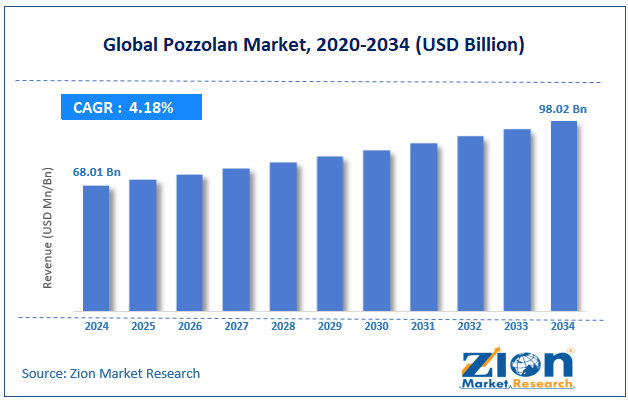
The global pozzolan market size was worth approximately USD 68.01 billion in 2024 and is projected to grow to around USD 98.02 billion by 2034, with a compound annual growth rate (CAGR) of roughly 4.18% between 2025 and 2034.
Pozzolan Market: Overview
Pozzolan is a natural or man-made material that reacts with lime and water to form a strong cement-like binder. On its own, pozzolan does not act like cement. When finely ground and mixed with water and calcium hydroxide, it undergoes a chemical reaction. The reaction creates compounds that help bind materials together and improve strength. Because of this property, pozzolan is widely used in construction. Natural pozzolans come from volcanic and earth-based sources. Common examples include volcanic ash, pumice, diatomite, and certain clays. Many of these materials require little processing before use. Artificial pozzolans are produced as byproducts of industrial activities. Fly ash from coal plants, silica fume from metal production, and ground granulated blast furnace slag from steel manufacturing are widely used examples. Use of pozzolans dates back thousands of years. Ancient Roman builders mixed volcanic ash with lime to construct durable structures. Many Roman buildings, bridges, and harbors still exist, showing the long-lasting performance of pozzolanic materials. In modern construction, pozzolans are used to replace a portion of Portland cement in concrete. Such use reduces material cost and improves durability. Lower cement usage also reduces carbon emissions, making construction more environmentally friendly while maintaining strong structural performance.
The growing focus on sustainable construction, rising infrastructure investment, stricter regulations on cement emissions, and demand for durable concrete are driving steady growth in the pozzolan market.
Key Insights
- As per the analysis shared by our research analyst, the global pozzolan market is estimated to grow annually at a CAGR of around 4.18% over the forecast period (2025–2034).
- In terms of revenue, the global pozzolan market size was valued at approximately USD 68.01 billion in 2024 and is projected to reach USD 98.02 billion by 2034.
- The pozzolan market is expected to grow steadily, driven by rising infrastructure investment, increasing focus on low-carbon construction, wider use of pozzolans as cost- and emission-reducing cement alternatives, expanding construction in emerging regions, and ongoing development of new sources such as calcined clays.
- Based on product type, the artificial or synthetic pozzolan segment is expected to lead the pozzolan market, while the calcined pozzolan segment is anticipated to grow at the fastest rate.
- Based on application, the cement and concrete production segment is expected to lead the pozzolan market, while the infrastructure and civil engineering segment is anticipated to grow significantly.
- Based on end-user, the construction companies segment is the largest current end-user group, while the infrastructure developers segment is anticipated to grow most rapidly during the forecast period.
- Based on distribution channel, the direct supply segment is expected to lead the pozzolan market, while the online procurement platforms segment is anticipated to grow steadily.
- Based on region, Asia Pacific is projected to dominate the global pozzolan market during the estimated period, followed by the Middle East.
Impact of the USA-Israel war on Iran on the Pozzolan Market
The ongoing USA-Israel war on Iran is expected to have a direct short-term and long-term impact on construction material supply chains, including the pozzolan market. The current rise in fuel and logistics costs due to regional tensions will increase construction expenses in the short term. However, as demand for cost-effective, sustainable materials grows, the pozzolan market may expand in the long term.
Pozzolan Market: Technology Roadmap 2025–2034
What is the projected development roadmap of the pozzolan market over the forecast period?
The pozzolan market is evolving through advances in calcined clay processing, improved quality testing and classification methods, growing integration into blended cement standards, expansion of industrial byproduct sourcing networks, and a broader shift toward low-carbon concrete solutions. The market is expected to grow at a CAGR of around 4.18% over the forecast period, driven by strong demand from the cement, infrastructure, housing, and oil and gas sectors.
The following roadmap outlines key development phases expected through 2034.
2025–2027: Standardization-Driven Growth with Calcined Clay Adoption
- Pozzolan producers are expected to upgrade processing equipment and improve quality testing systems to meet stricter global standards for supplementary cementitious materials.
- Calcined clay pozzolans, especially low-carbon LC3 blends using calcined clay and limestone, are likely to see faster adoption in developing markets where fly ash and slag are limited.
- Research institutions and cement manufacturers are expected to strengthen collaborations to develop region-specific pozzolan formulations based on local raw materials and construction needs.
2028–2031: Blended Cement Expansion with Sustainable Infrastructure Push
- Blended cements with higher pozzolan content are expected to become widely used in public infrastructure to meet sustainability goals and carbon-reduction targets.
- Supply chains for natural pozzolans from volcanic regions in Central America, East Africa, and Southeast Asia are likely to become more organized to support rising construction demand.
- Digital material-tracking and environmental-impact reporting systems are projected to become standard requirements for pozzolan sourcing in major government and multinational infrastructure projects.
2032–2034: High-Performance Innovation with Circular Material Integration
- Advanced pozzolan blends designed for properties like sulfate resistance, alkali-silica reaction control, and higher strength are expected to become widely available.
- Industrial waste from geothermal and biomass energy plants is likely to be explored and used as new pozzolan sources, supporting circular economy goals.
- Artificial intelligence-driven concrete mix design tools are expected to gain widespread adoption, enabling optimized selection and dosing of pozzolans to improve performance and sustainability outcomes.
Pozzolan Market: Dynamics
Growth Drivers
Why is rising infrastructure development and low-carbon construction increasing growth in the pozzolan market?
The pozzolan market is growing steadily as global investment in infrastructure and sustainable construction continues to rise. Countries are spending heavily on roads, bridges, railways, airports, housing, and urban development, thereby increasing demand for cement and concrete. Pozzolans are widely used as a partial replacement for Portland cement, helping reduce costs while improving material performance. Governments across Asia, Africa, the Middle East, and Latin America are funding large infrastructure projects to boost economic growth, generate jobs, and improve living standards, which directly support demand in the pozzolan market.
At the same time, stricter environmental regulations and the push for low-carbon construction are driving the use of pozzolans, as they help reduce carbon emissions associated with cement production. Pozzolans also improve concrete quality by reducing the heat of hydration during setting, reducing the risk of cracking, and increasing long-term strength. They enhance resistance to chemicals, seawater, and harsh soil conditions, making them ideal for long-lasting structures. These advantages are increasing their use in marine construction, water treatment plants, and large infrastructure projects, further strengthening market growth.
Carbon reduction goals and cleaner construction practices are driving long-term growth in the pozzolan market.
The pozzolan industry is growing steadily as global efforts to reduce carbon emissions from cement production continue to increase. The cement industry accounts for a large share of global carbon dioxide emissions, mainly because limestone must be heated to very high temperatures, which releases carbon dioxide during the process. As governments introduce stricter climate targets and carbon pricing policies, cement manufacturers are under pressure to reduce emissions and adopt cleaner materials. Pozzolans offer a simple, cost-effective solution by replacing a portion of Portland cement in concrete, reducing overall carbon output without requiring major changes in production or construction practices.
The pozzolan market is also benefiting from rising demand for sustainable construction materials, as builders and developers seek ways to meet green building standards and obtain environmental certifications. Cement companies are investing in research to develop stronger blended cements with higher pozzolan content while maintaining durability and performance. These combined factors, including regulatory pressure, cost benefits, and sustainability goals, are creating strong and long-term growth opportunities for the pozzolan market.
Restraints
How do inconsistent quality and limited availability of high-grade pozzolanic materials create challenges for the pozzolan market?
The pozzolan market faces several challenges due to inconsistent material quality and limited availability of high-grade pozzolanic resources. Natural pozzolans can vary widely in composition and performance depending on source, location, and processing method, making it difficult for manufacturers to ensure consistent concrete quality. Variations between batches can lead to uneven strength, durability issues, and a higher risk in construction projects where reliability is critical. This forces cement and concrete producers to invest in additional testing and quality control, increasing time and cost. The pozzolan market also relies heavily on industrial byproducts, such as fly ash and ground granulated blast furnace slag, produced by coal power generation and steel production.
As the global shift toward cleaner energy reduces coal usage and changes industrial output, the supply of these materials is becoming uncertain. In some regions, declining fly ash availability is already creating shortages, making it harder for producers to maintain a stable supply.
Opportunities
How is rising affordable housing demand in developing regions creating new opportunities in the pozzolan market?
The pozzolan market is poised for strong growth as developing regions face increasing demand for affordable housing and basic infrastructure. Countries in Sub-Saharan Africa, South and Southeast Asia, and Latin America are dealing with rapid population growth, urban expansion, and limited construction budgets, which increases the demand for cost-effective building materials. Pozzolans help reduce cement use in concrete by 20-40%, lowering construction costs while maintaining strength and durability. In many areas, materials such as volcanic ash, rice husk ash, and calcined clay are readily available locally, making them even more affordable and reducing the need for imports.
Governments, development agencies, and construction companies are increasingly using pozzolan-based materials to build roads, housing, water systems, and sanitation facilities within tight budgets. Many of these regions also have rich natural deposits of pozzolanic materials, creating long-term opportunities for mining, processing, and supply businesses. As construction standards improve and demand for durable, low-cost materials increases, the pozzolan market is expected to expand significantly in these high-growth regions.
Challenges
Awareness gaps and environmental concerns are limiting growth in the pozzolan market.
The pozzolan industry faces key challenges due to low awareness and environmental concerns around industrial materials. In many regions, builders, contractors, and engineers are not fully familiar with the benefits, correct usage, and standards of pozzolanic materials, which creates hesitation in adopting them. This lack of knowledge can lead to doubts about performance and resistance to changing traditional concrete practices. The pozzolan market also faces regulatory challenges related to industrial byproducts such as fly ash, which may contain small amounts of harmful substances from coal burning. Strict regulations on quality and safe usage can limit supply and increase compliance costs for manufacturers.
In addition, different rules across countries make it harder for suppliers to operate smoothly in global markets. These factors slow adoption, increase operational complexity, and create barriers to wider use, especially in regions where technical knowledge and regulatory systems are still developing.
Pozzolan Market: Report Scope
| Report Attributes | Report Details |
|---|---|
| Report Name | Pozzolan Market |
| Market Size in 2024 | USD 68.01 Billion |
| Market Forecast in 2034 | USD 98.02 Billion |
| Growth Rate | CAGR of 4.18% |
| Number of Pages | 227 |
| Key Companies Covered | Heidelberg Materials, CEMEX, LafargeHolcim, Buzzi Unicem, Vicat Group, National Cement Company, Pozzolan Inc., SCB International Holdings, Salt River Materials Group, U.S. Concrete, and others. |
| Segments Covered | By Product Type, By Application, By End-User, By Distribution Channel, and By Region |
| Regions Covered | North America, Europe, Asia Pacific (APAC), Latin America, Middle East, and Africa (MEA) |
| Base Year | 2024 |
| Historical Year | 2019 - 2023 |
| Forecast Year | 2025 - 2034 |
| Customization Scope | Avail customized purchase options to meet your exact research needs. Request For Customization |
Pozzolan Market: Segmentation
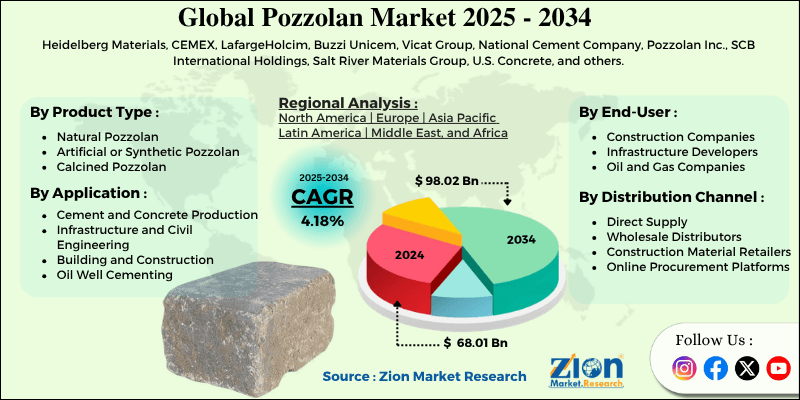
The global pozzolan market is segmented by product type, application, end-user, distribution channel, and region.
What makes the artificial or synthetic pozzolan segment the expected leader in the pozzolan market?
Based on product type, the global pozzolan market is categorized into natural pozzolan, artificial or synthetic pozzolan, and calcined pozzolan. The artificial or synthetic pozzolan segment accounts for about 57% of the global market and remains dominant due to the easy availability of industrial byproducts, such as fly ash and slag, and their proven performance in construction. The natural pozzolan segment holds around 28% share. It remains important in regions with natural volcanic resources and is widely used in traditional and regional construction applications.
How does the cement and concrete production segment maintain its leading position in the pozzolan market?
Based on application, the pozzolan industry is segmented into cement and concrete production, infrastructure and civil engineering, building and construction, oil well cementing, and marine structures. The cement and concrete production segment accounts for about 52% of the global market and leads due to its large-scale use in reducing cement costs and emissions. The infrastructure and civil engineering segment holds around 23% share. It is growing rapidly, supported by rising investments in roads, bridges, and water infrastructure.
What helps the construction companies segment lead the pozzolan end-user market?
Based on end user, the pozzolan market is classified into construction companies, infrastructure developers, oil and gas companies, government agencies, and precast concrete manufacturers. The construction companies segment accounts for around 41% of the global market and leads it, driven by high demand for blended cement across various building projects. The infrastructure developers segment holds about 27% of the market share. It is growing due to rising investment in durable, long-lasting infrastructure projects.
How does the direct supply channel dominate the pozzolan market?
Based on distribution channel, the market is segregated into direct supply, wholesale distributors, construction material retailers, and online procurement platforms. The direct supply segment accounts for about 46% of the global market and remains dominant due to long-term supply agreements between producers and large buyers. The online procurement platforms segment holds around 9% of the market share. It is growing steadily as digital sourcing increases and smaller buyers look for cost-effective purchasing options.
Pozzolan Market: Regional Analysis
How does Asia Pacific's massive construction industry and cement production base drive its dominance in the pozzolan market?
The pozzolan market is led by Asia Pacific, which is expected to grow at a CAGR of around 6.5% during the forecast period and at a steady pace due to strong construction activity and a large cement production base. The region has a high demand for cement and concrete because of rapid urbanization, population growth, and major infrastructure projects. China plays a key role as the world’s largest cement producer and consumer, using large volumes of pozzolanic materials such as fly ash from its coal power plants.
Even as China gradually shifts toward cleaner energy, fly ash remains widely available, and the use of slag and natural pozzolans is also increasing. India is another major contributor and one of the fastest-growing cement markets, supported by government projects like highways, smart cities, affordable housing, and railway expansion. The country also has a strong domestic availability of fly ash and natural pozzolans, which supports a steady supply. Southeast Asian countries such as Indonesia, Vietnam, the Philippines, and Thailand are also driving regional growth through rising construction activity and infrastructure investment, making the Asia Pacific the dominant region in the pozzolan market. High cement consumption and ongoing large-scale construction activity create strong, consistent demand for pozzolanic materials. Strong government support for infrastructure and housing development further accelerates the adoption of blended cement and sustainable construction materials.
How is the Middle East emerging as the second-leading region in the pozzolan market?
The pozzolan market is seeing the Middle East emerge as the second-largest region, expected to grow at a CAGR of around 6.1% during the forecast period, supported by rising infrastructure investment. Countries across the region are investing heavily in transport networks, housing projects, water systems, and energy infrastructure, which is increasing demand for high-performance concrete. The region’s harsh climate, with extreme heat and exposure to salts, creates challenging conditions for traditional concrete, leading to faster deterioration.
Pozzolanic materials help improve concrete durability by increasing resistance to chemical attack, reducing cracking, and enhancing long-term strength. It makes them highly suitable for construction in the Middle East, where structures must withstand harsh environmental conditions for extended periods. Governments and developers are also focusing on cost-effective, sustainable construction practices, which further support the use of pozzolans as partial replacements for cement. With continued urban development, large-scale infrastructure projects, and growing awareness of durable building materials, the Middle East is strengthening its position as a key growth region and an important contributor to the expansion of the pozzolan market.
Recent Market Developments
- In November 2025, Gebr. Pfeiffer supported the expansion of calcined clay-based blended cement technologies, enabling higher use of pozzolanic materials as clinker substitutes in modern cement production.
- In September 2025, Yamuna International Airport Private Limited implemented large-scale use of LC3 pozzolan-based cement in the Noida International Airport project, marking one of the first major infrastructure applications of low-carbon blended cement in India.
Pozzolan Market: Competitive Analysis
The leading players in the global pozzolan market are:
- Heidelberg Materials
- CEMEX
- LafargeHolcim
- Buzzi Unicem
- Vicat Group
- National Cement Company
- Pozzolan Inc.
- SCB International Holdings
- Salt River Materials Group
- U.S. Concrete
The global pozzolan market is segmented as follows:
By Product Type
- Natural Pozzolan
- Artificial or Synthetic Pozzolan
- Calcined Pozzolan
By Application
- Cement and Concrete Production
- Infrastructure and Civil Engineering
- Building and Construction
- Oil Well Cementing
- Marine and Coastal Structures
By End-User
- Construction Companies
- Infrastructure Developers
- Oil and Gas Companies
- Government and Public Works Agencies
- Precast Concrete Manufacturers
By Distribution Channel
- Direct Supply
- Wholesale Distributors
- Construction Material Retailers
- Online Procurement Platforms
By Region
- North America
- The U.S.
- Canada
- Mexico
- Europe
- France
- The UK
- Spain
- Germany
- Italy
- Rest of Europe
- Asia Pacific
- China
- Japan
- India
- Australia
- South Korea
- Rest of Asia Pacific
- The Middle East & Africa
- Saudi Arabia
- UAE
- Egypt
- Kuwait
- South Africa
- Rest of the Middle East & Africa
- Latin America
- Brazil
- Argentina
- Rest of Latin America
Table Of Content
Methodology
FrequentlyAsked Questions
Pozzolan is a natural or man-made material that reacts with lime and water to form a strong cement-like binder. On its own, pozzolan does not act like cement. When finely ground and mixed with water and calcium hydroxide, it undergoes a chemical reaction. The reaction creates compounds that help bind materials together and improve strength.
The global pozzolan market is expected to grow, driven by rising infrastructure investment, increasing use of low-carbon concrete, expanding construction in developing regions, growing adoption of calcined clays, and stricter cement emission regulations.
According to a study, the global pozzolan market size was worth around USD 68.01 billion in 2024 and is predicted to grow to around USD 98.02 billion by 2034.
The CAGR value of the pozzolan market is expected to be around 4.18% during 2025–2034.
Asia Pacific is expected to lead the global pozzolan market during the forecast period, driven by China and India's massive cement industries, large-scale infrastructure programs, and abundant industrial byproduct pozzolan supply.
The major players in the global pozzolan market include Heidelberg Materials, CEMEX, LafargeHolcim, Buzzi Unicem, Vicat Group, National Cement Company, Pozzolan Inc., SCB International Holdings, and Salt River Materials Group.
The report examines key aspects of the pozzolan market, including a detailed analysis of growth drivers and restraints, emerging opportunities, significant challenges, the competitive landscape, regional market breakdowns, and a future outlook across all major product types, applications, end users, and geographies.
Stakeholders in the pozzolan market should invest in advanced processing technologies, secure long-term raw material sources, develop high-performance blended products, and align with sustainability goals, while forming partnerships and expanding supply chains to meet rising global construction demand.
The pozzolan market is influenced by strict environmental regulations, carbon reduction policies, and green building standards that promote low-emission materials, while compliance requirements and quality controls for industrial byproducts can increase operational complexity and costs.
The pozzolan market will see strong growth in infrastructure, residential construction, marine structures, and sustainable concrete applications, driven by demand for durable, low-cost, and environmentally friendly building materials.

HappyClients

