
Part Feeders Market Size, Share, Value and Forecast Report 2034

Part Feeders Market By Type (Vibratory Bowl Feeder, Centrifugal Parts Feeder, Flexible Parts Feeder and Others), By Application (Consumer Electronics and Semiconductor, Automotive, Consumer Goods, General Manufacturing, Medical and Others) and By Region - Global and Regional Industry Overview, Market Intelligence, Comprehensive Analysis, Historical Data, and Forecasts 2025 - 2034
| Market Size in 2024 | Market Forecast in 2034 | CAGR (in %) | Base Year |
|---|---|---|---|
| USD 456 Million | USD 757 Million | 5.2% | 2024 |
Part Feeders Industry Perspective:
What will be the size of the global part feeders market during the forecast period?
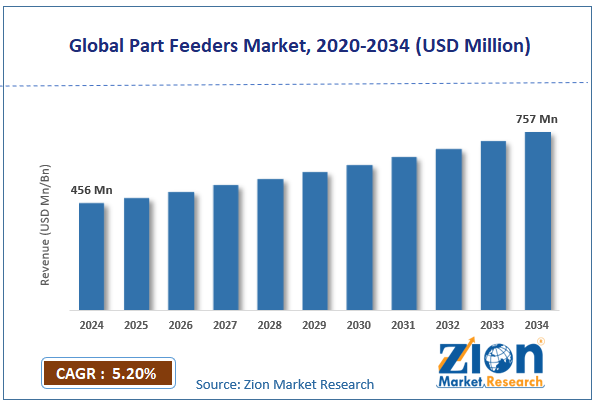
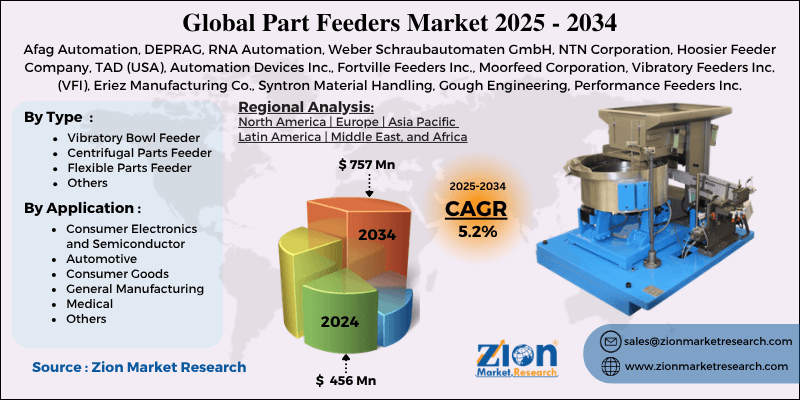
The global part feeders market size was worth around USD 456 million in 2024 and is predicted to grow to around USD 757 million by 2034 with a compound annual growth rate (CAGR) of roughly 5.2% between 2025 and 2034.
Key Insights
- As per the analysis shared by our research analyst, the global part feeders market is estimated to grow annually at a CAGR of around 5.2% over the forecast period (2025-2034).
- In terms of revenue, the global part feeders market size was valued at around USD 456 million in 2024 and is projected to reach USD 757 million by 2034.
- Growing automotive industry is expected to propel the part feeders market over the projected period.
- Based on the type, the vibratory bowl feeder segment captures the largest market share in 2024.
- Based on the application, the consumer electronics and semiconductor capture the largest revenue share in 2024.
- Based on region, the Asia Pacific accounted for the highest market share in the part feeders market in 2024.
Part Feeders Market: Overview
A part feeder is an automated industrial device used to keep parts in a uniform manner for sorting, orienting, and supplying them to a machine. Part feeders are very significant because they ensure specific parts, such as screws, caps, various electrical parts, and mechanical parts, are supplied in the proper order and with proper orientation for use in the next operation. Part feeders, which are vital parts of most manufacturing systems, include vibratory bowl feeders, centrifugal feeders, and flexible feeders.
Industries use feeders in the automotive, electronics, pharmaceutical, and food processing fields, where high speed and high accuracy are vital. The part feeders not only increase the efficiency and speed of the process but also reduce errors.
Impact of the USA-Israel War on Iran on the Part Feeders Market
The ongoing U.S.-Israeli war against Iran is having significant indirect effects on the global market of part feeders, largely through their effect on oil prices and industrial supply chains. Indeed, the ongoing conflict has led to the closure of the Strait of Hormuz, an important oil channel, which has caused a massive rise in fuel and energy prices, triggering a global energy crisis. Such price hikes have affected manufacturing companies, which are major end users of part feeders, by increasing their material procurement costs for part feeder applications. Moreover, the disruption of oil channels by ongoing wars has disrupted international supply chains and raised freight costs, causing increased manufacturing delays for part feeder systems due to a lack of critical components.
At the same time, geopolitical insecurity and economic inflation have led to declining confidence among businesses, which will therefore be less willing to make substantial investments in automation equipment, such as part feeders. This, however, may prove useful for the future growth of the global part feeders market, as industries will need to secure their supply chains and manufacturing facilities from future risks and invest in automation technologies.
Part Feeders Market: Dynamics
Growth Drivers
How does the rising industrial automation drive the part feeders market?
Automation in the industrial sector will be a significant driver of demand for part feeders. As the trend towards increased automation in manufacturing plants continues to grow across just about every industry, including, but not limited to, automotive, electronics, pharmaceuticals, and packaging, the demand for part feeders to enable the smooth operation of automated manufacturing plants is also increasing.
The use of part feeders within manufacturing plants is invaluable, as they consistently ensure a consistent supply of parts along assembly lines by automatically feeding, sorting, and orienting them. The main application of part feeders is therefore in automated systems to reduce the scope for human error in manufacturing plants.
Restraints
Why do high initial investment cost act as a major restraint to the part feeders market?
High capital investment is an important factor that limits the development of the part feeders market. The deployment of a part feeding system involves substantial investments at the very beginning of installation due to the costs of purchasing equipment, adapting it to the existing production chain, installing relevant control systems, and others. The use of high-end technology and software solutions, including vision-guided and flexible feeders, requires additional investment due to the complexity of their technologies. Heavy capital investment is likely to constitute a significant barrier for SMEs, preventing them from enjoying the benefits of automation.
Opportunities
How does the rising product launch offer a lucrative opportunity for the part feeders market?
The innovation introduction will create an attractive growth prospect for the forecast period. For instance, in May 2025, HASLER Group introduced GRAVIT 2, the next-generation solution for the world-famous GRAVIT belt dosing system. GRAVIT 2 is a high-precision universal feeder belt for granulates, with a focus on user-friendly operation and maintenance. Performance, convenience, modularity, and safety are the key features that make GRAVIT 2 a distinctive solution for continuous industrial processes (24/7).
The high-precision solution stands out for its wide turndown ratio (up to 1:100). In addition, its accuracy remains consistent at ±0.25% across all dosing flow rate ranges. Moreover, it is modular and adaptable, with five belt widths ranging from 650 mm to 1,400 mm.
Challenges
Shortage of skilled workforce pose a significant challenge to the part feeders market
The lack of a technically skilled workforce represents one of the key issues hindering the development of the part feeder market. State-of-the-art part feeding systems, which include highly advanced systems based on vibration, robotics, and vision-guided control, require a technically trained workforce to install, program, use, and maintain them.
Unfortunately, in many places, especially in developing countries, there is a shortage of skilled manpower with the required skills in automation, robotics, and controls. Such a problem makes it impossible for manufacturers to employ part feeders or implement them effectively in production processes.
Moreover, companies may experience increased downtime, additional expenses, and inefficiencies due to a lack of technical skills. The unavailability of skilled manpower can also prevent smaller businesses from using part feeder systems at all.
Part Feeders Market: Report Scope
| Report Attributes | Report Details |
|---|---|
| Report Name | Part Feeders Market |
| Market Size in 2024 | USD 456 Million |
| Market Forecast in 2034 | USD 757 Mllion |
| Growth Rate | CAGR of 5.2% |
| Number of Pages | 228 |
| Key Companies Covered | Afag Automation, DEPRAG, RNA Automation, Weber Schraubautomaten GmbH, NTN Corporation, Hoosier Feeder Company, TAD (USA), Automation Devices Inc., Fortville Feeders Inc., Moorfeed Corporation, Vibratory Feeders Inc. (VFI), Eriez Manufacturing Co., Syntron Material Handling, Gough Engineering, Performance Feeders Inc., JVI Vibratory Equipment, Rodix Inc., and others. |
| Segments Covered | By Type, By Application, and By Region |
| Regions Covered | North America, Europe, Asia Pacific (APAC), Latin America, Middle East, and Africa (MEA) |
| Base Year | 2024 |
| Historical Year | 2019 to 2023 |
| Forecast Year | 2025 - 2034 |
| Customization Scope | Avail customized purchase options to meet your exact research needs. Request For Customization |
Part Feeders Market: Segmentation
Type Insights
Why does the vibratory bowl feeder dominate the part feeders market?
The vibratory bowl feeder segment captures the largest market share in 2024. The increase is attributed to the extensive use of this equipment in high-volume manufacturing applications. This type of feeder is widely used for its ability to orient, sort, and present small parts at high speed, making it very important in industries such as automotive, electronics, pharmaceuticals, and packaging. The simplicity of design, durability, and affordability, compared with complex flexible feeders, make them suitable for high-volume industrial settings. Furthermore, vibratory bowl feeders can handle a wide range of parts, regardless of size or shape, without compromising efficiency. This factor makes their use common, thereby driving revenue growth in this segment.
Application Insights
Does the consumer electronics and semiconductor capture the largest market share in the part feeders market?
The consumer electronics and semiconductor capture the largest revenue share in 2024. Growth drivers include the rapid growth of electronic product manufacturing and the need for highly accurate small parts for these products. As more and more smartphones and other electronic products are manufactured in higher volumes, there is a need for efficient, accurate part-feeding equipment to handle the extremely delicate components. These include microchips and other microcomponents used in the manufacture of electronic devices. The ability to accurately orient and feed these highly sophisticated parts is made possible by part feeders.
Regional Insights
Why does the Asia Pacific lead the Part Feeders market?
The Asia Pacific accounted for the highest market share in the part feeders market in 2024. It is facilitated by the fast pace of industrialization and the rise in manufacturing operations and investments in automation technologies in regions such as China, Japan, South Korea, and India. This region serves as an important manufacturing center for industries such as automobiles, electronics, semiconductors, and packaging, among others, that require effective component-handling systems, such as part feeders. Labor cost escalation and increased emphasis on productivity have prompted companies to move towards automation systems, thereby creating more opportunities.
Furthermore, governmental policies promoting industrial automation, smart factories, and indigenous manufacturing, through campaigns such as Make in India and similar initiatives in other countries, have hastened the implementation of advanced feeding systems. The existence of numerous small- and medium-sized enterprises shifting towards automation technologies, along with continued investments from abroad, is also driving revenue growth in the Asia Pacific feeder’s industry.
Part Feeders Market: Competitive Analysis
The global part feeders market is dominated by players like:
- Afag Automation
- DEPRAG
- RNA Automation
- Weber Schraubautomaten GmbH
- NTN Corporation
- Hoosier Feeder Company
- TAD (USA)
- Automation Devices Inc.
- Fortville Feeders Inc.
- Moorfeed Corporation
- Vibratory Feeders Inc. (VFI)
- Eriez Manufacturing Co.
- Syntron Material Handling
- Gough Engineering
- Performance Feeders Inc.
- JVI Vibratory Equipment
- Rodix Inc.
The global part feeders market is segmented as follows:
By Type
- Vibratory Bowl Feeder
- Centrifugal Parts Feeder
- Flexible Parts Feeder
- Others
By Application
- Consumer Electronics and Semiconductor
- Automotive
- Consumer Goods
- General Manufacturing
- Medical
- Others
By Region
- North America
- The U.S.
- Canada
- Mexico
- Europe
- France
- The UK
- Spain
- Germany
- Italy
- Rest of Europe
- Asia Pacific
- China
- Japan
- India
- Australia
- South Korea
- Rest of Asia Pacific
- The Middle East & Africa
- Saudi Arabia
- UAE
- Egypt
- Kuwait
- South Africa
- Rest of the Middle East & Africa
- Latin America
- Brazil
- Argentina
- Rest of Latin America
Table Of Content
Methodology
FrequentlyAsked Questions
A part feeder is an automated industrial device used to keep parts in a uniform manner for sorting, orienting, and supplying them to a machine. Part feeders are very significant because they ensure specific parts, such as screws, caps, various electrical parts, and mechanical parts, are supplied in the proper order and with proper orientation for use in the next operation.
The key growth drivers for the part feeders market are rising industrial automation, increasing demand for high-speed and precision manufacturing, and the expansion of automotive, electronics, and semiconductor industries.
The major challenges restraining the growth of the part feeders market include high initial investment and maintenance costs, integration complexity with existing systems, and a shortage of skilled workforce to operate and maintain advanced automation equipment.
Based on the type, the vibratory bowl feeder segment is expected to dominate the part feeders market growth during the projected period.
One of the most significant trends is the rapid adoption of flexible feeding systems integrated with robotics and AI-based vision technologies, which allow manufacturers to handle multiple part types without frequent reconfiguration, improving adaptability in dynamic production environments.
According to the report, the global part feeders market size was worth around USD 456 million in 2024 and is predicted to grow to around USD 757 million by 2034.
The global part feeders market is expected to grow at a CAGR of 5.2% during the forecast period.
The global part feeders industry growth is expected to be led by the Asia Pacific over the forecast period.
The global part feeders market is dominated by players like Afag Automation, DEPRAG, RNA Automation, Weber Schraubautomaten GmbH, NTN Corporation, Hoosier Feeder Company, TAD (USA), Automation Devices Inc., Fortville Feeders Inc., Moorfeed Corporation, Vibratory Feeders Inc. (VFI), Eriez Manufacturing Co., Syntron Material Handling, Gough Engineering, Performance Feeders Inc., JVI Vibratory Equipment and Rodix Inc. among others.
The market report covers the geographical market along with a comprehensive competitive landscape analysis. It also includes cash flow analysis, profit ratio analysis, market basket analysis, market attractiveness analysis, sentiment analysis, PESTLE analysis, trend analysis, SWOT analysis, trade area analysis, demand & supply analysis, Porter’s five forces analysis, and value chain analysis.

HappyClients

