
Global Paper Pigments Market Size, Share, Industry Analysis, Trends, Growth, 2032

Paper Pigments Market By Type (Calcium Carbonate and Kaolin), By Application (Coated Paper and Uncoated Paper), and By Region - Global and Regional Industry Overview, Market Intelligence, Comprehensive Analysis, Historical Data, and Forecasts 2024 - 2032
| Market Size in 2023 | Market Forecast in 2032 | CAGR (in %) | Base Year |
|---|---|---|---|
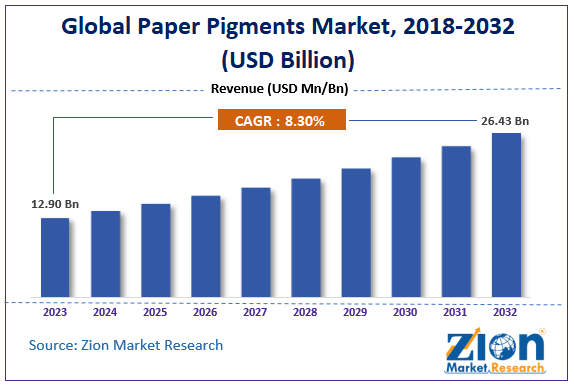
| USD 12.90 Billion | USD 26.43 Billion | 8.30% | 2023 |
Paper Pigments Market: Industry Perspective
What will be the global paper pigments market size during the forecast period?
The global paper pigments market size was worth around USD 12.90 billion in 2023 and is predicted to reach around USD 26.43 billion by 2032, with a compound annual growth rate (CAGR) of roughly 8.30% between 2024 and 2032.
This report provides a comprehensive analysis of the growth drivers, restraints, and challenges shaping demand across the global paper pigments market throughout the forecast period, while highlighting high-potential emerging opportunities within the industry.
Key Insights
- As per the analysis shared by our research analyst, the paper pigments market is estimated to grow annually at a CAGR of roughly 4.90% over the forecast period from 2024 to 2032.
- In terms of revenue, the global paper pigments market size was valued at around USD 11.85 billion in 2023 and is projected to reach USD 18.24 billion by 2032.
- The paper pigments market is driven by escalating demand for sustainable paper packaging, premium coated printing materials, and rising requirements for enhanced opacity, brightness, and ink absorbency across consumer packaging formats.
- Based on the type, the calcium carbonate category accounted for the leading share of 58.5% in the global paper pigments market because ground and precipitated forms offer exceptional brightness, cost efficiency, and optimal runnability in alkaline papermaking systems.
- Based on the application, the coated paper category accounted for the leading share of 62.4% in the global paper pigments market because modern packaging boxes, catalogs, and commercial print materials demand superior gloss, barrier protection, and high-resolution graphic reproduction.
- Asia Pacific dominated the global paper pigments market with a revenue share of 44.2% because of expanding packaging and paper production hubs in China and India, massive domestic consumption, and continuous capacity expansions by pulp and paper manufacturers.
Paper Pigments Market: Overview
The Paper Pigments Market covers the manufacturing, distribution, and use of pigments developed specifically for the paper and pulp industry. These pigments significantly improve the visual and optical qualities of paper, such as color, brightness, and printability, and play a critical role in the process. Paper pigments fall into several categories, the most important of which are titanium dioxide, calcium carbonate, kaolin, and talc.
Paper Pigments Market: Growth Drivers
What factors are primarily accelerating demand in the paper pigments market?
Several important reasons are driving the expansion of the paper pigments market. Paper and paperboard goods are becoming more in demand all over the world, which is being driven by the expansion of the printing and packaging sectors. This is a crucial driver. The need for pigments that improve the visual qualities of paper is growing in tandem with the fact that consumers are increasingly interested in purchasing packaging materials that are both visually appealing and of excellent quality. In addition, the market is being influenced by the emphasis on environmentally responsible and sustainable paper production techniques, which is increasing demand for environmentally friendly pigments.
Technological developments in pigment composition are also contributing to market expansion by improving color retention and printability. In addition, legislative actions that encourage the use of non-hazardous and non-toxic pigments further shape the industry landscape. Overall, these factors position the Paper Pigments Market for expansion, reflecting changing dynamics in the paper and pulp industry.
Paper Pigments Market: Restraints
What factors are limiting the expansion of the paper pigments market?
Environmental regulations and the shift toward more sustainable materials can increase compliance costs and require reformulation of certain pigment products.
Competition among pigment types and fluctuations in raw material availability or pricing can influence margins and adoption rates in some applications and regions.
Paper Pigments Market: Opportunities
Where do significant growth opportunities lie for the paper pigments market?
A growing focus on sustainability creates opportunities for environmentally friendly, cost-effective pigment solutions that meet performance and regulatory expectations.
Continued innovation in formulations that deliver improved color stability, brightness, and printability supports higher-value applications in coated paper and premium packaging, opening avenues for product differentiation and volume growth.
Paper Pigments Market: Challenges
What key challenges confront participants in the paper pigments market?
Balancing performance requirements such as brightness, opacity, and printability with cost and environmental considerations remains an ongoing challenge. Producers must invest in research and process optimization to meet evolving paper industry standards.
Supply chain reliability for key mineral and chemical inputs and the need to adapt to changing regulatory frameworks across regions further influence competitive positioning.
 Request Free Sample
Paper Pigments Market: Report Scope
| Report Attributes | Report Details |
|---|---|
| Report Name | Paper Pigments Market Research Report |
| Market Size in 2023 | USD 12.90 Billion |
| Market Forecast in 2032 | USD 26.43 Billion |
| Growth Rate | CAGR of 8.30% |
| Number of Pages | 245 |
| Forecast Units | Value (USD Billion) and Volume (Units) |
| Key Companies Covered | AsImerys S.A., J.M. Huber Corporation, BASF SE, Kemira Oyj, The Chemours Company, Thiele Kaolin Company, Omya AG, Ashapura Group, Kamin/Cadam, and Minerals Technologies Inc., among others. |
| Segments Covered | By Type, By Application, and By Region |
| Regions Covered | North America, Europe, Asia Pacific (APAC), Latin America, Middle East and Africa (MEA) |
| Base Year | 2023 |
| Historical Year | 2018 - 2022 |
| Forecast Year | 2024 - 2032 |
| Customization Scope | Avail customized purchase options to meet your exact research needs. Request For Customization |
Paper Pigments Market: Segmentation
The paper pigments market is segmented by type, application, and region. All the segments of the paper pigments market have been analyzed based on present and future trends and the market is estimated from 2024 to 2032.
By type, the paper pigments market is divided into calcium carbonate and kaolin. Calcium carbonate is expected to lead the market because of its extensive use in enhancing brightness, opacity, and printability in paper production. This leadership supports overall market growth by enabling cost-effective improvement of paper optical properties across a wide range of grades, encouraging continued adoption in both coated and uncoated applications and driving volume demand from paper manufacturers seeking consistent quality and performance.
By application segment, the paper pigments market is divided into coated paper and uncoated paper. Coated paper is expected to lead owing to strong demand for high-quality surface finish and superior print performance in packaging and commercial printing. This dominance drives market expansion by linking pigment consumption to value-added paper grades that require higher pigment loadings for brightness, smoothness, and printability, while uncoated paper applications continue to contribute steady demand for fillers and related pigment uses.
Paper Pigments Market: Regional Analysis
Why will Asia-Pacific continue to contribute notably to the global market during the projection period?
Asia-Pacific has historically been a primary focus region and a major contributor to the paper pigments market due to fast industrialization and rising paper demand. Expanding packaging and printing industries across countries such as China, India, and others support higher consumption of pigments that improve paper appearance and performance. Growth in manufacturing capacity and increasing use of paper and paperboard in consumer and industrial applications further strengthen regional demand. This momentum drives overall market growth by generating large production volumes, encouraging capacity expansion among pigment suppliers, and reinforcing the role of calcium carbonate and kaolin in meeting the optical and printability requirements of modern paper grades that influence global supply and technology trends.
North America maintains steady demand linked to established paper and packaging industries and ongoing quality requirements. Europe benefits from mature markets and strong emphasis on sustainable and regulated pigment use. Latin America and the Middle East and Africa are progressing as industrial and packaging activity expands, creating additional opportunities for paper pigment applications.
Recent Developments
-
In November 2023, Omya completed the strategic commissioning of a new state-of-the-art precipitated calcium carbonate (PCC) satellite plant integrated directly with an industrial paperboard mill, optimizing wet-end filler efficiency and significantly reducing logistics-related carbon emissions.
Paper Pigments Market: Competitive Analysis
The global paper pigments market is dominated by players:
- AsImerys S.A.
- J.M. Huber Corporation
- BASF SE
- Kemira Oyj
- The Chemours Company
- Thiele Kaolin Company
- Omya AG
- Ashapura Group
- Kamin/Cadam
- Minerals Technologies Inc.
Paper Pigments Market: Key Trends
What are the key trends in the paper pigments market?
Rising demand for sustainable and high-performance pigments
Growing emphasis on environmentally responsible production is increasing interest in pigments that combine performance with lower environmental impact, supporting adoption across packaging and printing applications.
Focus on improved optical and print properties
Technological advances in pigment formulations aimed at better color retention, brightness, and printability continue to drive product development and differentiation in both coated and uncoated paper segments.
Segments Covered
This report segments the global paper pigments market as follows
By Type
- Calcium Carbonate
- Kaolin
By Application
- Coated Paper
- Uncoated Paper
By Region
- North America
- The U.S.
- Canada
- Mexico
- Europe
- France
- The UK
- Spain
- Germany
- Italy
- Rest of Europe
- Asia Pacific
- China
- Japan
- India
- Australia
- South Korea
- Rest of Asia Pacific
- The Middle East & Africa
- Saudi Arabia
- UAE
- Egypt
- Kuwait
- South Africa
- Rest of the Middle East & Africa
- Latin America
- Brazil
- Argentina
- Rest of Latin America
Table Of Content
Methodology
FrequentlyAsked Questions
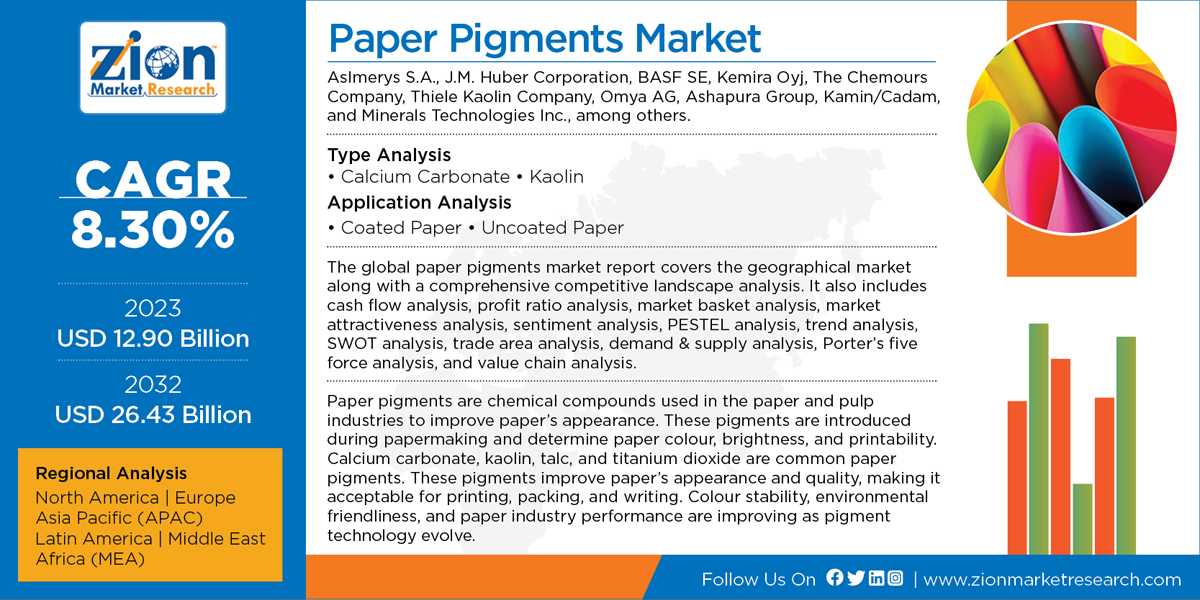
Paper pigments are chemical compounds used in the paper and pulp industries to improve paper's appearance. These pigments are introduced during papermaking and determine paper colour, brightness, and printability. Calcium carbonate, kaolin, talc, and titanium dioxide are common paper pigments. These pigments improve paper's appearance and quality, making it acceptable for printing, packing, and writing. Colour stability, environmental friendliness, and paper industry performance are improving as pigment technology evolve.
The Paper Pigments Market is driven by rising global demand for paper and paperboard, particularly in packaging and printing. Sustainable pigments are also in demand due to the market's growing focus on sustainability. Pigment formulation innovations that improve colour retention and printability are key drivers. Safe pigment regulations further impact the sector. These factors determine the Paper Pigments Market's growth.
According to a study, the global paper pigments market size was worth around USD 12.90 billion in 2023 and is predicted to grow to around USD 26.43 billion by 2032
The CAGR value of the paper pigments market is expected to be around 8.30% during 2024-2032.
Asia-Pacific is expected to contribute notably, supported by fast industrialization and rising paper demand across the region.
The report covers a detailed competitive outlook including the market share and company profiles of the key participants operating in the global paper pigments market, such asImerys S.A., J.M. Huber Corporation, BASF SE, Kemira Oyj, The Chemours Company, Thiele Kaolin Company, Omya AG, Ashapura Group, Kamin/Cadam, and Minerals Technologies Inc., among others.
The global paper pigments market report covers the geographical market along with a comprehensive competitive landscape analysis. It also includes cash flow analysis, profit ratio analysis, market basket analysis, market attractiveness analysis, sentiment analysis, PESTEL analysis, trend analysis, SWOT analysis, trade area analysis, demand & supply analysis, Porter’s five force analysis, and value chain analysis.

HappyClients

