
Global Packaging Robot Market Size, Share, Growth Trends and Forecast 2032

Packaging Robot Market by Type (Primary Packaging, Secondary Packaging, and Tertiary Packaging), by Application (Filling, Picking and Packing, Case Packing, Tray Packing, and Palletizing, and Others), by End Use Industry (Food & Beverages, Pharmaceutical, Healthcare, Transportation & Logistics, Retail, and Others): Global Industry Perspective, Comprehensive Analysis and Forecast, 2024 - 2032
| Market Size in 2023 | Market Forecast in 2032 | CAGR (in %) | Base Year |
|---|---|---|---|
| USD 6.12 Billion | USD 16.02 Billion | 11.28% | 2023 |
What is Packaging Robot Market Size?
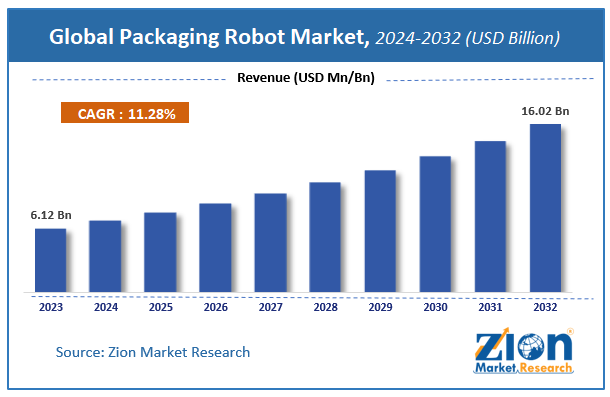
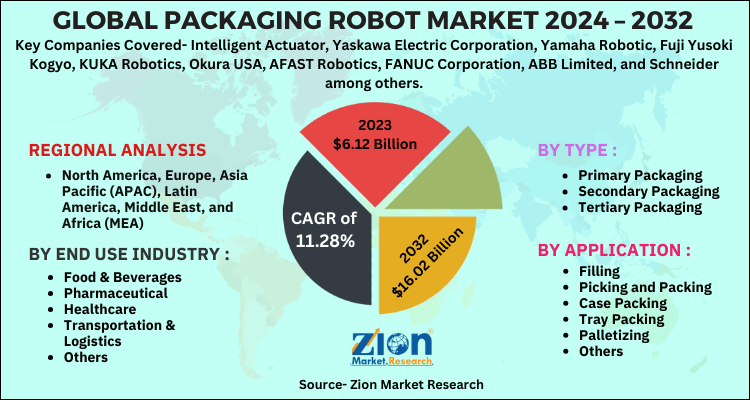
According to a report from Zion Market Research, the global Packaging Robot Market was valued at USD 6.12 Billion in 2023 and is projected to hit USD 16.02 Billion by 2032, with a compound annual growth rate (CAGR) of 11.28% during the forecast period 2024 to 2032. This report explores market strengths, weakness, opportunities, and threats. It also provides valuable insights into the market's growth drivers, challenges, and the future prospects that may emerge in the Packaging Robot Market industry over the next decade.
Market Overview
Packaging robots are automated systems equipped with intelligent vision technology that identify the shape, position, and orientation of products on conveying lines and transfer them to designated handling areas. These robots perform a wide range of tasks including unlocking, loading, delivering, palletizing, sealing, coding, and marking. As a specialized application within the broader robotics industry, they combine mechanical precision with software intelligence to handle diverse product formats efficiently and safely.
Technological progress in sensors, programming simplicity, unified controls, end-of-arm tooling, and artificial intelligence has expanded the capabilities of packaging robots. Manufacturers increasingly integrate AI platforms and collaborative robots to boost productivity and enhance workplace safety. At the same time, the packaging function itself has evolved beyond physical protection and logistics convenience; it now serves as a key marketing tool. Companies therefore prioritize attractive, customized, sustainable, and smart packaging solutions, creating sustained demand for flexible robotic systems that can adapt to changing product designs and production volumes.
Key Insights
- As per the analysis shared by our research analyst, the global Packaging Robot market is estimated to grow annually at a CAGR of around 11.28% over the forecast period (2025-2034).
- In terms of revenue, the global Packaging Robot market size was valued at around USD 6.12 billion in 2024 and is projected to reach USD 16.02 billion by 2034.
- The market is driven by technological advancements in robotics and the rising emphasis on creative, customized packaging solutions that help brands attract customers.
- Based on the Type segment, Secondary Packaging held a dominant position driven by easier deployment at the end of the line, ability to handle hard-to-handle materials, multi-axis manipulation, and growing brand investment in visible secondary formats such as shrink wrapping and case packaging, particularly in food and beverage applications.
- Based on the Application segment, Picking and Packing and related end-of-line operations maintained strong shares because of high-speed precision, error reduction, and improved floor-space utilization that robotics delivers across industries.
- Based on the End Use Industry segment, Food & Beverages and Pharmaceutical segments led adoption; the pharmaceutical segment in particular benefits from demand for personalized configurations, high-speed precision, traceability, and reduced contamination risk.
- Europe held a notable share exceeding 22% in earlier reference years and continues to influence the market due to high automation penetration in Germany, the United Kingdom, and France together with expanding logistics automation, while Asia Pacific is expected to record rapid growth supported by large-scale robot production in China and Japan.
Market Dynamics
Growth Drivers
Why is demand for packaging robots accelerating across industries?
Technological developments have delivered better sensors, simpler programming interfaces, automated unified controls, an expanding range of end-of-arm tooling, and rapid advances in artificial intelligence. These improvements enable packaging robots to manage complex operations at distribution centers with higher proficiency and reliability.
In parallel, the role of packaging has shifted from pure functional protection to a strategic marketing instrument. Companies now invest in attractive and customized packaging formats to differentiate products and attract consumers, thereby increasing the need for flexible robotic systems capable of handling varied designs and frequent changeovers.
Restraints
What factors limit faster adoption of packaging robots?
High initial capital investment for advanced robotic systems and associated integration costs can deter smaller manufacturers and facilities with constrained budgets.
Technical complexity related to programming, maintenance of vision systems, and ensuring compatibility with existing production lines also creates barriers, particularly in environments that require frequent wash-downs or handle highly variable product mixes.
Opportunities
Where do the strongest growth opportunities lie?
Integration of artificial intelligence platforms offers significant potential to maximize productivity, optimize safety, and enable adaptive handling of diverse product shapes.
Rising demand for sustainable, environment-friendly, and smart packaging solutions creates openings for robots that support recyclable materials, reduced waste, and data-enabled packaging processes across food, pharmaceutical, and logistics sectors, complementing wider investment in automated material handling equipment.
Challenges
What operational and structural challenges must the industry overcome?
Ensuring seamless integration of robots into existing packaging lines while maintaining high throughput and minimizing downtime remains a persistent challenge.
Shortage of skilled personnel capable of programming, maintaining, and troubleshooting advanced robotic systems can slow deployment, especially in regions with limited technical training infrastructure.
Packaging Robot Market: Report Scope
| Report Attributes | Report Details |
|---|---|
| Report Name | Packaging Robot Market |
| Market Size in 2023 | USD 6.12 Billion |
| Market Forecast in 2032 | USD 16.02 Billion |
| Growth Rate | CAGR of 11.28% |
| Number of Pages | 150 |
| Key Companies Covered | Intelligent Actuator, Yaskawa Electric Corporation, Yamaha Robotic, Fuji Yusoki Kogyo, KUKA Robotics, Okura USA, AFAST Robotics, FANUC Corporation, ABB Limited, and Schneider among others |
| Segments Covered | By Type, By Application, By End Use Industry and By Region |
| Regions Covered | North America, Europe, Asia Pacific (APAC), Latin America, Middle East, and Africa (MEA) |
| Base Year | 2023 |
| Historical Year | 2018 - 2022 |
| Forecast Year | 2024 - 2032 |
| Customization Scope | Avail customized purchase options to meet your exact research needs. Request For Customization |
Market Segmentation
The Packaging Robot market is segmented by type, application, end use industry, and region.
Based on Type Segment, The Packaging Robot market is divided into Primary Packaging, Secondary Packaging, Tertiary Packaging, and others. Secondary Packaging stands as the most dominant sub-segment because robots can be deployed more readily at the end of the line, avoiding wash-down constraints common in primary food handling. These systems effectively address challenges such as difficult materials, multi-axis manipulation, fluctuating speeds, and compact plant layouts in applications including shrink wrapping and case packaging. Brand owners seeking stronger retail visibility invest heavily in secondary formats, especially within food and beverage packaging, which further reinforces the segment’s leadership and contributes to overall market expansion through higher throughput and presentation quality.Tertiary Packaging follows as an important secondary contributor by enabling efficient palletizing and unit-load formation that supports logistics efficiency and reduces labor intensity, an area increasingly overlapping with the broader warehousing and logistics robots industry.
Based on Application Segment, The Packaging Robot market is divided into Filling, Picking and Packing, Case Packing, Tray Packing, Palletizing, and others. Picking and Packing, together with related high-precision operations, holds a leading position due to the advantages of high speed, accuracy, real-time monitoring and traceability, error-free performance, reduced injury risk, and better utilization of floor space. In pharmaceutical manufacturing these benefits are particularly valued for personalized packaging configurations. Food and beverage producers deploy delta and six-axis robots equipped with advanced sensors for material processing, sealing, packing, and palletizing within compact footprints, while vision-guided systems perform routine tasks such as bottle handling, bin picking, and tray filling. Case Packing and Palletizing rank as the next most significant applications, driving market growth by automating end-of-line processes that improve consistency and reduce manual handling costs.
Based on End Use Industry Segment, The Packaging Robot market is divided into Food & Beverages, Pharmaceutical, Healthcare, Transportation & Logistics, and others. Food & Beverages remains a core dominant segment because of the need for hygienic, high-speed handling of diverse product formats and the widespread adoption of vision-guided and collaborative robots for packing and palletizing. Pharmaceutical applications constitute a rapidly growing and highly influential segment, supported by demand for personalized packaging, precision, traceability, and contamination control; the segment is projected to expand at a strong rate as manufacturers leverage robotics for error reduction and space optimization. Transportation & Logistics and Healthcare follow as important contributors, benefiting from automation that addresses labor shortages and improves throughput in distribution and medical product handling.
Regional Analysis
Why will Europe continue to dominate the global market during the projection period?
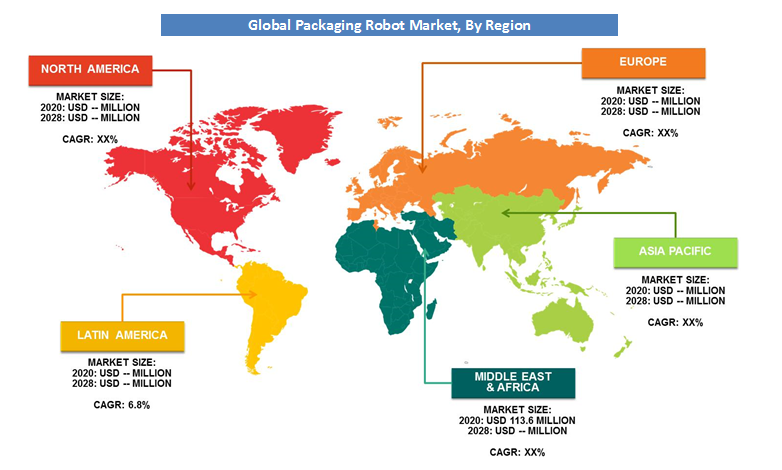
Europe maintains a strong position supported by extensive automation adoption in key manufacturing economies. Germany, the United Kingdom, and France account for a substantial share of robotic system consumption, driven by mature industrial bases and continuous investment in advanced packaging lines. Expanding use of automated solutions within the logistics sector further reinforces regional demand and encourages innovation in flexible, high-precision packaging robots. These factors collectively sustain Europe’s influence on overall market growth, technology standards, and capacity expansion.
North America benefits from advanced manufacturing infrastructure and high labor costs that accelerate robot deployment in food, pharmaceutical, and e-commerce packaging operations. Leading companies continue to integrate collaborative and vision-guided systems, alongside broader warehouse automation solutions, to improve efficiency and address workforce constraints .
Asia Pacific is projected to record the fastest growth, fueled by rapid production of robotic systems by Chinese and Japanese manufacturers. Substantial financial and regulatory support from policymakers encourages adoption of automation in both personal and professional settings, while expanding manufacturing and logistics activities across China, Japan, India, and Southeast Asia drive volume expansion and technology localization.
Latin America and the Middle East & Africa represent emerging opportunities. Growth in these regions is supported by rising industrialization, expanding food and beverage production, and gradual modernization of logistics infrastructure, although adoption rates remain lower than in more mature markets.
Recent Developments
- In August 2025, FANUC released the CRX-25iA collaborative robot designed for handling irregular-shaped products in distribution and packaging environments, expanding payload capacity for e-commerce and mixed-SKU operations.
- In September 2025, ABB committed significant investment to expand collaborative-robot production capacity in Sweden and China, adding AI-enabled features tailored for high-mix packaging applications.
- In June 2025, Yaskawa opened a major AI robotics research and development center in Singapore focused on packaging requirements across Southeast Asia.
- In May 2025, KUKA partnered with Microsoft Azure to integrate cloud-based predictive maintenance capabilities aimed at reducing packaging-line downtime.
Key Market Players & Competitive Landscape
Some of key players in packaging robot market are:
- Intelligent Actuator
- Yaskawa Electric Corporation
- Yamaha Robotic
- Fuji Yusoki Kogyo
- KUKA Robotics
- Okura USA
- AFAST Robotics
- FANUC Corporation
- ABB Limited
- Schneider among others.
Packaging robotic manufacturing companies are now using new emerging technologies. End-of-arm tool firms like Schmalz and Piab have supported 3D printing of end-of-arm equipment that can quickly convert to various formats that robots can run in packaging.
What are the key trends in the Packaging Robot Market?
- Integration of artificial intelligence and advanced vision systems: Manufacturers are embedding AI platforms and sophisticated vision technology into packaging robots to enable real-time product recognition, adaptive gripping, and optimized path planning. This trend improves handling of irregular or mixed products and supports higher overall equipment effectiveness.
- Growing preference for collaborative and flexible end-of-arm tooling: Collaborative robots that work safely alongside human operators, combined with rapidly changeable or 3D-printed end-of-arm tools, allow packaging lines to switch between product formats with minimal downtime. This flexibility addresses the rising demand for customized and short-run packaging.
The global packaging robot market is segmented as follows:
By Type
- Primary Packaging
- Secondary Packaging
- Tertiary Packaging
By Application
- Filling
- Picking and Packing
- Case Packing
- Tray Packing
- Palletizing
- Others
By End Use Industry
- Food & Beverages
- Pharmaceutical
- Healthcare
- Transportation & Logistics
- Others
By Region
- North America
- The U.S.
- Canada
- Mexico
- Europe
- France
- The UK
- Spain
- Germany
- Italy
- Rest of Europe
- Asia Pacific
- China
- Japan
- India
- Australia
- South Korea
- Rest of Asia Pacific
- The Middle East & Africa
- Saudi Arabia
- UAE
- Egypt
- Kuwait
- South Africa
- Rest of the Middle East & Africa
- Latin America
- Brazil
- Argentina
- Rest of Latin America
Table Of Content
Methodology
FrequentlyAsked Questions
Emerging trends include deeper integration of artificial intelligence for adaptive handling, adoption of collaborative robots, use of 3D-printed and rapidly changeable end-of-arm tooling, and growing demand for sustainable and smart packaging solutions
The value chain typically encompasses research and development of robotic hardware and software, component and end-of-arm tooling manufacturing, system integration and programming, distribution and installation, after-sales service and maintenance, and end-user deployment across packaging lines.
Europe holds a substantial share supported by high automation levels in Germany, the United Kingdom, and France, while Asia Pacific is expected to contribute strongly through rapid growth driven by robot production in China and Japan.
Intelligent Actuator, Yaskawa Electric Corporation, Yamaha Robotic, Fuji Yusoki Kogyo, KUKA Robotics, Okura USA, AFAST Robotics, FANUC Corporation, ABB Limited, Schneider, and others.

HappyClients

