Multichannel Analytics Market Size, Share, Sales, Trends Analysis Report 2032

Multichannel Analytics Market By Service (Support & Maintenance Service and Professional Service), By Deployment Type (On-Demand Deployment and On- Premise Deployment), By Organization Size (Small & Medium Enterprises and Large Enterprises), By Solution (Query & Reporting, Visualization, Multidimensional Analysis, Data Mining & Predictive Analytics, and Others), By Application (Cross-Selling & Up-Selling, Campaign Management, Customer Retention & Acquisition, Loyalty & Customer Experience Management, Sales Performance Management, and Others), By Vertical (Retail & Consumer Goods, Government, Media & Entertainment, Telecommunication & IT, Banking Financial Services & Insurance (BFSI), Travel & Tourism, Healthcare, and Others), and By Region: Global and Regional Industry Overview, Market Intelligence, Comprehensive Analysis, Historical Data, and Forecasts 2024 - 2032
| Market Size in 2023 | Market Forecast in 2032 | CAGR (in %) | Base Year |
|---|---|---|---|
| USD 12.35 Billion | USD 27.40 Billion | 9.26% | 2023 |
What is the projected value for the Multichannel Analytics Market during 2024 to 2032?
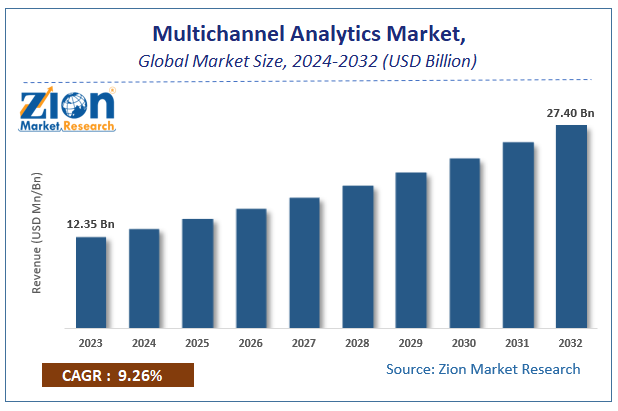
According to Zion Market Research, the global Multichannel Analytics Market was worth USD 12.35 billion in 2023. The market is forecast to reach USD 27.40 billion by 2032, growing at a compound annual growth rate (CAGR) of 9.26% during the forecast period 2024-2032. The Multichannel Analytics Market is driven by the growing need to understand customer behavior across multiple channels, rising adoption of cloud-based services, and increasing use of data for personalized marketing, campaign optimization, and customer experience enhancement.
Multichannel Analytics Market: Overview
Multichannel analytics involves the collection, integration, and analysis of customer interaction data gathered from various touchpoints such as websites, mobile apps, social media, call centers, email, and physical stores to provide a unified view of customer journeys and behavior. It enables organizations to gain actionable insights, optimize marketing strategies, improve customer engagement, and enhance decision-making across sales, service, and loyalty programs.
The market dynamics are shaped by robust growth driven by a surge in multichannel customer interactions and digital transformation, tempered by the need for specialized expertise and high implementation costs. Opportunities arise from AI-powered personalization and omnichannel strategies, while challenges stem from data privacy regulations and integration complexities across fragmented systems.
Key Insights
- As per the analysis shared by our research analyst, the global Multichannel Analytics market is expected to grow at a CAGR of 9.26% during the forecast period 2024-2032.
- In terms of revenue, the market was valued at approximately USD 12.35 billion in 2023 and is projected to reach USD 27.40 billion by 2032.
- The market is driven by increasing adoption of analytical solutions to understand customer behavior across channels, rising digital commerce, growing utilization of social media data, and the need for unified customer insights to support personalized marketing and improve the customer experience.
- Based on the service, the professional service segment dominates with a significant share & it is dominated due to the complexity of implementing multichannel analytics solutions, requiring expert consulting, integration, and customization services that help organizations derive maximum value from their data investments.
- Based on the deployment type, the on-demand deployment segment dominates with the largest share & it is dominated because of its flexibility, scalability, lower upfront costs, and faster time-to-value, making it highly attractive for businesses of all sizes seeking cloud-based analytics capabilities.
- Based on the organization size, the large enterprises segment dominates with the leading share & it is dominated owing to their substantial data volumes, complex customer journeys, higher budgets for advanced analytics, and strategic focus on omnichannel customer experience management.
- Based on the solution, the data mining & predictive analytics segment dominates with a strong share & it is dominated as organizations increasingly rely on predictive modeling to forecast customer behavior, optimize campaigns, and drive proactive decision-making across channels.
- Based on the application, the customer retention & acquisition segment dominates with the highest share & it is dominated because effective multichannel analytics directly supports targeted marketing, personalized engagement, and loyalty programs that reduce churn and improve lifetime customer value.
- Based on the vertical, the retail & consumer goods segment dominates with the leading share & it is dominated due to the highly competitive nature of the sector, extensive use of multiple sales and marketing channels, and the critical need to deliver seamless customer experiences across online and offline touchpoints.
- Based on the region segment, the North America region dominates with the highest share & it is dominated owing to advanced digital infrastructure, high adoption of cloud and AI technologies, strong presence of leading analytics vendors, and significant investments by enterprises in customer experience and data-driven strategies.
Market Dynamics
Growth Drivers
What are the primary growth drivers for the Multichannel Analytics Market?
The exponential growth in customer interactions across multiple digital and physical channels, driven by e-commerce expansion and social media usage, compels organizations to adopt advanced analytics tools to gain a holistic view of customer journeys and deliver personalized experiences that boost engagement and conversion rates.
Rising investments in cloud-based deployment models and AI-powered analytics enable real-time data processing, predictive insights, and seamless integration across channels, allowing businesses to optimize marketing spend, improve campaign effectiveness, and enhance overall operational efficiency in a competitive marketplace.
Restraints
What factors are restraining the growth of the Multichannel Analytics Market?
The requirement for high-level technical expertise to implement, manage, and interpret multichannel analytics solutions increases operational costs and creates a barrier for smaller organizations with limited skilled resources or budgets.
Data privacy regulations such as GDPR and CCPA, along with concerns over data security and integration challenges from fragmented legacy systems, add complexity and compliance burdens that can slow adoption rates across industries.
Opportunities
What opportunities are available in the Multichannel Analytics Market?
The emergence of AI-driven insights, real-time attribution modeling, and omnichannel customer engagement platforms presents substantial opportunities for vendors to offer unified solutions that help businesses create seamless experiences and achieve higher ROI on marketing initiatives.
Expansion into emerging markets with growing digital commerce and the development of niche packaged solutions tailored for specific verticals such as healthcare, travel, and government open new revenue streams for both established players and innovative startups.
Challenges
What are the major challenges in the Multichannel Analytics Market?
Fragmented data sources across channels and the complexity of accurate attribution modeling make it difficult to measure true campaign performance and customer value, requiring sophisticated tools and ongoing refinement of analytics frameworks.
Rapidly evolving customer expectations for privacy and consent, combined with the need for continuous technology upgrades to handle increasing data volumes, demand significant investment and agility from both providers and end-users.
Multichannel Analytics Market: Segmentation
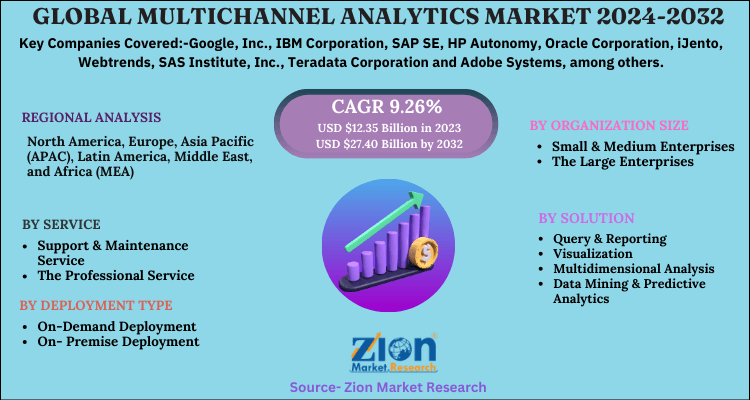
The Multichannel Analytics market is segmented by service, deployment type, organization size, solution, application, vertical, and region.
Based on Service Segment, the Multichannel Analytics market is divided into Support & Maintenance Service and Professional Service. The professional service segment is the most dominant with a significant share because successful implementation of multichannel analytics requires expert consulting, system integration, custom development, and training, helping drive the market by ensuring organizations can effectively leverage complex tools for maximum business impact; the support & maintenance service segment ranks as the second most dominant with steady demand as ongoing technical support, updates, and optimization are essential for long-term system performance and compliance.
Based on the Deployment Type Segment, the Multichannel Analytics market is divided into On-Demand Deployment and On-Premise Deployment. The on-demand deployment segment is the most dominant with the largest share due to its scalability, lower initial capital expenditure, faster deployment, and easy access to regular updates, enabling businesses to quickly adopt advanced analytics without heavy infrastructure investments; the on-premise deployment segment ranks as the second most dominant in sectors with strict data security or regulatory requirements that prefer full control over their analytics environment.
Based on the Organization Size Segment, the Multichannel Analytics market is divided into Small & Medium Enterprises and Large Enterprises. The large enterprises segment is the most dominant with the leading share because of their massive data volumes, complex multichannel operations, higher budgets for sophisticated analytics platforms, and strategic priority on customer experience and competitive differentiation; the small & medium enterprises segment ranks as the second most dominant with accelerating growth as affordable cloud-based solutions make advanced analytics accessible to smaller businesses seeking efficiency gains.
Based on Solution Segment, the Multichannel Analytics market is divided into Query & Reporting, Visualization, Multidimensional Analysis, Data Mining & Predictive Analytics, and others. The data mining & predictive analytics segment is the most dominant with a strong share as organizations increasingly use these capabilities to uncover hidden patterns, forecast customer behavior, and optimize marketing and sales strategies across channels, directly driving market growth through higher ROI and proactive decision-making; the visualization segment ranks as the second most dominant by enabling intuitive interpretation of complex multichannel data for faster insights and stakeholder communication.
Based on Application Segment, the Multichannel Analytics market is divided into Cross-Selling & Up-Selling, Campaign Management, Customer Retention & Acquisition, Loyalty & Customer Experience Management, Sales Performance Management, and others. The customer retention & acquisition segment is the most dominant with the highest share because multichannel analytics provides deep insights into customer preferences and journey touchpoints, enabling targeted retention strategies and efficient acquisition campaigns that improve loyalty and lifetime value; the campaign management segment ranks as the second most dominant by allowing precise measurement and optimization of marketing efforts across channels for better performance.
Based on Vertical Segment, the Multichannel Analytics market is divided into Retail & Consumer Goods, Government, Media & Entertainment, Telecommunication & IT, Banking Financial Services & Insurance (BFSI), Travel & Tourism, Healthcare, and others. The retail & consumer goods segment is the most dominant with the leading share due to the sector's heavy reliance on multiple online and offline channels, intense competition, and the critical need for seamless customer experiences and personalized recommendations to drive sales and loyalty; the banking financial services & insurance (BFSI) segment ranks as the second most dominant with strong adoption for compliance, fraud detection, and personalized financial services across digital and traditional channels.
Multichannel Analytics Market: Report Scope
| Report Attributes | Report Details |
|---|---|
| Report Name | Multichannel Analytics Market |
| Market Size in 2023 | USD 12.35 Billion |
| Market Forecast in 2032 | USD 27.40 Billion |
| Growth Rate | CAGR of 9.26% |
| Number of Pages | 235 |
| Key Companies Covered | Google, Inc., IBM Corporation, SAP SE, HP Autonomy, Oracle Corporation, iJento, Webtrends, SAS Institute, Inc., Teradata Corporation, and Adobe Systems, among others |
| Segments Covered | By Service, By Deployment Type, By Organization Size, By Solution, By Application, By Vertical, and By Region |
| Regions Covered | North America, Europe, Asia Pacific (APAC), Latin America, the Middle East and Africa (MEA) |
| Base Year | 2023 |
| Historical Year | 2018 - 2022 |
| Forecast Year | 2024 - 2032 |
| Customization Scope | Avail customized purchase options to meet your exact research needs. Request For Customization |
Multichannel Analytics Market: Regional Analysis
Why will North America continue to dominate the global market during the projection period?
North America continues to dominate the global Multichannel Analytics market through its advanced digital infrastructure, high adoption rate of cloud and AI technologies, and substantial investments by enterprises in customer experience initiatives. The United States leads with a large number of technology-savvy organizations across retail, BFSI, and media sectors that prioritize data-driven decision-making and omnichannel strategies. Strong presence of leading analytics vendors and a mature ecosystem of service providers support rapid innovation and implementation. High digital commerce penetration and consumer expectations for personalized interactions further accelerate demand for unified analytics solutions. Collaborative efforts between technology firms and industry verticals foster the development of advanced tools for real-time insights and predictive modeling. The region's focus on regulatory compliance and data privacy also drives adoption of sophisticated, secure analytics platforms.
Europe maintains a significant position with robust emphasis on customer data protection and digital transformation across key economies. Countries benefit from mature e-commerce markets and strong regulatory frameworks that encourage ethical use of customer analytics.
Asia Pacific exhibits the fastest growth potential fueled by rapid digitalization, expanding e-commerce, and increasing smartphone penetration in emerging economies.
Recent Developments
- In 2025, leading vendors enhanced their multichannel analytics platforms with deeper AI and machine learning capabilities for real-time attribution and personalized customer journey mapping.
- In 2025, several companies introduced unified analytics solutions that integrate data from emerging channels such as social commerce and voice assistants.
- In 2024, strategic partnerships between analytics providers and cloud hyperscalers accelerated the adoption of scalable, on-demand multichannel analytics services.
Multichannel Analytics Market: Competitive Players
Some main participants in the Multichannel Analytics market are:
- Google, Inc.
- IBM Corporation
- SAP SE
- HP Autonomy
- Oracle Corporation
- iJento
- Webtrends
- SAS Institute, Inc.
- Teradata Corporation
- Adobe Systems
What are the key trends in the Multichannel Analytics Market?
Rise of AI-Driven Unified Customer Insights
The rise of AI-driven unified customer insights is enabling organizations to move beyond siloed data views toward comprehensive journey analytics that support hyper-personalization and proactive engagement strategies.
Growth of Privacy-Compliant and Real-Time Analytics
Growth of privacy-compliant and real-time analytics is gaining momentum as businesses seek solutions that balance regulatory requirements with the need for instant insights and agile marketing responses across all channels.
The global Multichannel Analytics market is segmented as follows:
By Service
- Support & Maintenance Service
- Professional Service
By Deployment Type
- On-Demand Deployment
- On- Premise Deployment
By Organization Size
- Small & Medium Enterprises
- Large Enterprises
By Solution
- Query & Reporting
- Visualization
- Multidimensional Analysis
- Data Mining & Predictive Analytics
- Others
By Application
- Cross-Selling & Up-Selling
- Campaign Management
- Customer Retention & Acquisition
- Loyalty & Customer Experience Management
- Sales Performance Management
- Others
By Vertical
- Retail & Consumer Goods
- Government
- Media & Entertainment
- Telecommunication & IT
- Banking Financial Services & Insurance (BFSI)
- Travel & Tourism
- Healthcare
- Others
By Region
- North America
- The U.S.
- Canada
- Mexico
- Europe
- France
- The UK
- Spain
- Germany
- Italy
- Rest of Europe
- Asia Pacific
- China
- Japan
- India
- Australia
- South Korea
- Rest of Asia Pacific
- The Middle East & Africa
- Saudi Arabia
- UAE
- Egypt
- Kuwait
- South Africa
- Rest of the Middle East & Africa
- Latin America
- Brazil
- Argentina
- Rest of Latin America
Table Of Content
Methodology
FrequentlyAsked Questions
Multichannel analytics is the process of collecting, integrating, and analyzing customer interaction data from multiple channels such as web, mobile, social media, email, and physical stores to gain a unified understanding of customer behavior and optimize marketing, sales, and service strategies.
The global Multichannel Analytics market is expected to be driven by the demand for unified customer insights, omnichannel marketing, and data-driven decision-making. Growth in digital commerce and AI analytics boosts adoption.
According to study, the global Multichannel Analytics market size was worth around USD 12.35 Billion in 2023 and is predicted to grow to around USD 27.40 Billion By 2032.
The global Multichannel Analytics market is expected to grow at a Compound Annual Growth Rate (CAGR) of around CAGR 9.26% during the forecast period from 2024-2032.
The global Multichannel Analytics industry is projected to be challenged by Challenges include fragmented data sources, attribution complexity, and data privacy regulations.
The Opportunities include AI-driven insights, personalized marketing, omnichannel customer engagement, and growth in digital commerce analytics will offer significant growth opportunities in the Multichannel Analytics market.
Unified customer journey analytics across touchpoints; real-time attribution using AI; privacy-compliant data integration platforms are the emerging trends and innovations impacting the Multichannel Analytics market.
The global Multichannel Analytics market is expected to be led by North America during the forecast period.
Some of the prominent players operating in the global Multichannel Analytics market are; Google, Inc., IBM Corporation, SAP SE, HP Autonomy, Oracle Corporation, iJento, Webtrends, SAS Institute, Inc., Teradata Corporation and Adobe Systems, among others and others.
The report explores crucial aspects of the Multichannel Analytics market, including a detailed discussion of existing growth factors and restraints, while also browsing future growth opportunities and challenges that impact the market.

HappyClients