
Global Medical Computer Carts Market Size, Share, Growth Report 2032

Medical Computer Carts Market By Product (Powered Medical Computer Carts and Non-Powered Medical Computer Carts), By End User (Hospitals, Clinics, and Ambulatory Surgical Centers), and By Region - Global and Regional Industry Overview, Market Intelligence, Comprehensive Analysis, Historical Data, and Forecasts 2024 - 2032
| Market Size in 2023 | Market Forecast in 2032 | CAGR (in %) | Base Year |
|---|---|---|---|
| USD 5.46 Billion | USD 18.17 Billion | 14.29% | 2023 |
Medical Computer Carts Industry Perspective
What will be the global medical computer carts market size during the forecast period?
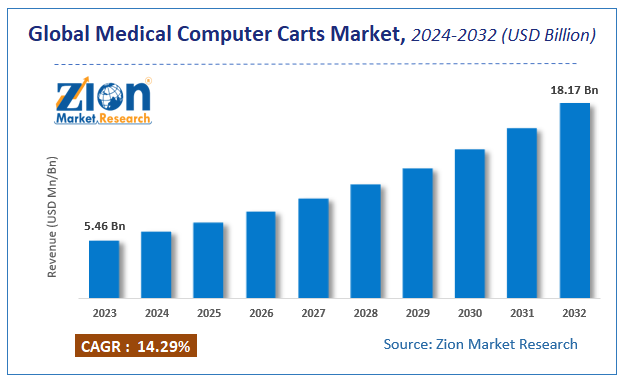
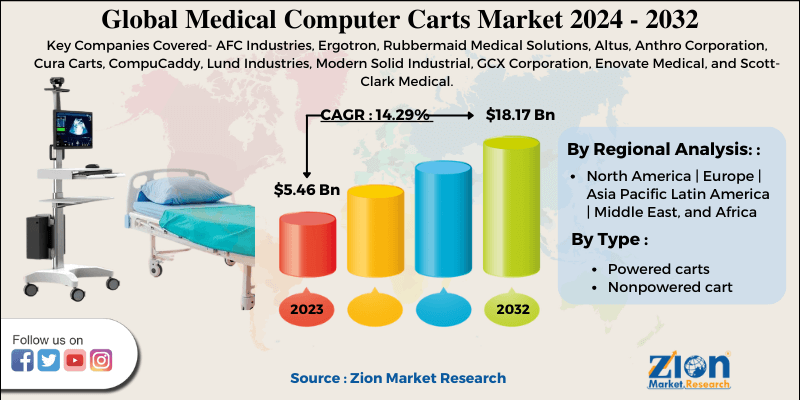
According to a report from Zion Market Research, the global medical computer carts market size was valued at USD 5.46 billion in 2023 and is projected to hit USD 18.17 billion by 2032, with a compound annual growth rate (CAGR) of 14.29% during the forecast period 2024-2032.
This report provides a comprehensive analysis of the growth drivers, restraints, and challenges shaping demand across the global medical computer carts market throughout the forecast period, while highlighting high-potential emerging opportunities within the industry.
Key Insights
- As per the analysis shared by our research analyst, the global medical computer carts market is estimated to grow annually at a CAGR of around 14.29% over the forecast period (2024-2032).
- In terms of revenue, the global medical computer carts market size was valued at around USD 5.46 billion in 2023 and is projected to reach USD 18.17 billion by 2032.
- The market is driven by growing adoption of EMR/EHR systems, integration of IT solutions in healthcare environments, healthcare organizations’ efforts to reinforce staff productivity and patient care, and the ability of mobile carts to improve access to patient information and workflow efficiency.
- Based on the product, the non-powered medical cart segment accounted for more than 55% share of the global market and is expected to continue its dominance due to easy availability and low cost.
- Based on the end user, the hospitals segment represents the primary demand center owing to the large installed base of facilities requiring mobile computing for charting, EMR access, and medication workflows.
- By Region, North America holds the major share of the medical computer carts market due to a large number of hospitals in the region and strong adoption of electronic medical record systems and mobile clinical workstations.
Medical Computer Carts Market: Overview
Medical computer carts are needed in healthcare facilities to support various procedures smoothly. These carts and workstations help in maintaining essential patient information and also provide prompt access to such information, improving the standard and effectiveness of patient care. Factors like the growing adoption of EMR/EHR, integration of IT solutions in healthcare environments, and healthcare organizations’ efforts to reinforce staff productivity and patient care are major drivers for market growth.
A medical computer cart is an advanced technology used in hospitals that increases the convenience of nurses and other healthcare professionals. These carts are used in a wide range of applications such as charting and EMR, medication dispensing, and nursing education. Mobile computer carts are available with or without on-board power systems. Powered cart and non powered cart are the types of medical computer carts. It possesses different features like adjustable height and settings for standing or sitting use.
Medical Computer Carts Market: Growth Factors
The global medical computer carts market has observed strong growth within the past few years, driven by improved adoption of electronic medical record (EMR) systems in hospitals, diagnostic labs, etc. This high-tech system is employed to gather, store, and display patients’ health information. Medical computer carts offer ergonomic features and workflow solutions to accommodate and reduce the difficult routine tasks related to patient care. The mobile cart allows one computing system to be utilized in many places in a hospital, lab, and clinic, thereby saving space & time, especially in old structures where setup doesn't easily accommodate costly new technology solutions.
The medical computer carts market is primarily driven by increased adoption of electronic medical records (EMR). Electronic medical records (EMR) are used to collect, store, and display patient health information. Therefore, this development in health information technology simultaneously increases the demand for medical computer carts.
Medical Computer Carts Market: Restraints
The high cost of technologically advanced medical computer carts and lack of skilled professionals are some major restraints that may hinder the growth of the medical computer carts market. Even so, the increase in remote monitoring of patients due to advancements in technology may open up alluring growth opportunities for the medical computer carts market within the forecast period.
Medical Computer Carts Market: Report Scope
| Report Attributes | Report Details |
|---|---|
| Report Name | Medical Computer Carts Market |
| Market Size in 2023 | USD 5.46 Billion |
| Market Forecast in 2032 | USD 18.17 Billion |
| Growth Rate | CAGR of 14.29% |
| Number of Pages | 265 |
| Key Companies Covered | AFC Industries, Ergotron, Rubbermaid Medical Solutions, Altus, Anthro Corporation, Cura Carts, CompuCaddy, Lund Industries, Modern Solid Industrial, GCX Corporation, Enovate Medical, and Scott-Clark Medical. |
| Segments Covered | By Product, By End User, and By Region |
| Regions Covered | North America, Europe, Asia Pacific (APAC), Latin America, Middle East, and Africa (MEA) |
| Base Year | 2023 |
| Historical Year | 2018 - 2022 |
| Forecast Year | 2024 - 2032 |
| Customization Scope | Avail customized purchase options to meet your exact research needs. Request For Customization |
Medical Computer Carts Market: Segment Analysis
The medical computer carts market is segmented by product, end user, and region. All the segments of the medical computer carts market have been analyzed based on present and future trends and the market is estimated from 2024 to 2032.
Based on Product, the medical computer carts market is divided into powered medical computer carts and non-powered medical computer carts. The non-powered medical cart was the largest segment in terms of revenue and is expected to continue its dominance in coming years due to its easy availability and low cost. Non-powered medical carts accounted for more than 55% share of the global market, supporting broad adoption across hospitals and clinics and driving overall market volume. The powered cart segment is expected to gain a significant share of the global market in the next few years, led by upgraded battery management technology that improves mobility and continuous use at the point of care.
Based on End User, the medical computer carts market is divided into hospitals, clinics, and ambulatory surgical centers. Hospitals form the primary demand center because of the large number of facilities requiring mobile computing for charting, EMR access, medication dispensing, and clinical workflows. This concentration of demand anchors market volume and encourages ongoing investment in ergonomic and powered solutions. Clinics and ambulatory surgical centers represent important secondary channels as outpatient and ambulatory care expands and point-of-care documentation becomes more widespread.
Medical Computer Carts Market: Regional Analysis
Why will North America continue to dominate the global market during the projection period?
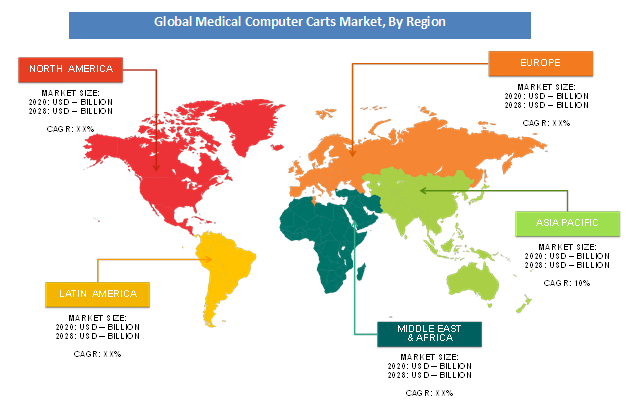
North America holds the major share of the medical computer carts market. The region was the leading market and accounted for a significant share of the total market due to a large number of hospitals and strong adoption of electronic medical record systems and mobile clinical workstations. Easy integration of IT solutions in healthcare environments, emphasis on staff productivity, and established infrastructure for point-of-care computing further reinforce demand. These factors enable North America to drive overall market growth, set workflow standards, and accelerate innovation in powered and non-powered medical computer cart solutions.
Asia Pacific is anticipated to experience promising growth in the medical computer carts market in the coming years. The rise in the geriatric population, growing medical tourism, rising prevalence of various disorders, increasing government initiatives for investments in health care, and growing demand for quality health care in countries such as China, India, Singapore, and South Korea support expansion.
Latin America and the Middle East & Africa hold significant growth potential driven by developing healthcare infrastructure, rising investments, and increasing adoption of digital clinical tools in emerging markets such as Brazil, Mexico, and key Gulf countries.
Medical Computer Carts Market: Competitive Landscape
Key players operating in the medical computer carts market include:
- AFC Industries
- Ergotron
- Rubbermaid Medical Solutions
- Altus
- Anthro Corporation
- Cura Carts
- CompuCaddy
- Lund Industries
- Modern Solid Industrial
- GCX Corporation
- Enovate Medical
- Scott-Clark Medical
Segments Covered
The global medical computer carts market is segmented as follows:
By Product
- Powered Medical Computer Carts
- Non-Powered Medical Computer Carts
By End User
- Hospitals
- Clinics
- Ambulatory Surgical Centers
By Region
- North America
- The U.S.
- Canada
- Mexico
- Europe
- France
- The UK
- Spain
- Germany
- Italy
- Rest of Europe
- Asia Pacific
- China
- Japan
- India
- Australia
- South Korea
- Rest of Asia Pacific
- The Middle East & Africa
- Saudi Arabia
- UAE
- Egypt
- Kuwait
- South Africa
- Rest of the Middle East & Africa
- Latin America
- Brazil
- Argentina
- Rest of Latin America
Table Of Content
Methodology
FrequentlyAsked Questions
Medical computer carts are mobile workstations used in healthcare facilities to hold computing equipment and support procedures such as charting, EMR access, medication dispensing, and nursing workflows. They improve access to patient information and enhance the efficiency and quality of care.
Key growth drivers include increasing adoption of electronic medical records, integration of IT solutions in healthcare environments, efforts to improve staff productivity and patient care, ergonomic workflow benefits, and the ability of mobile carts to provide computing access across multiple locations within a facility.
The global medical computer carts market size was valued at approximately USD 5.46 billion in 2023 and is projected to reach around USD 18.17 billion by 2032.
The global medical computer carts market is expected to grow at a compound annual growth rate (CAGR) of approximately 14.29% during the forecast period from 2024 to 2032.
Key players operating in the medical computer carts market include AFC Industries, Ergotron, Rubbermaid Medical Solutions, Altus, Anthro Corporation, Cura Carts, CompuCaddy, Lund Industries, Modern Solid Industrial, GCX Corporation, Enovate Medical, and Scott-Clark Medical.
North America is expected to contribute notably and hold the major share of the medical computer carts market, supported by a large hospital base and strong adoption of electronic medical records and mobile clinical workstations.
The report provides a detailed examination of growth drivers, restraints, opportunities, and challenges, along with comprehensive segmentation analysis, regional insights, competitive landscape, and forward-looking forecasts for the medical computer carts market.

HappyClients

