
Marine Turbocharger Market Size, Share, Industry Analysis, Trends, Growth, Forecasts, 2032

Marine Turbocharger Market By components (central shaft, compressor, turbine, and others), By operation (radial and axial), By technology (electro-assist turbo, single turbo, variable geometry turbo, and twin turbo), By application (recreational boats, commercial ships, and military ships) And By Region: - Global And Regional Industry Overview, Market Intelligence, Comprehensive Analysis, Historical Data, And Forecasts, 2024-2032
| Market Size in 2023 | Market Forecast in 2032 | CAGR (in %) | Base Year |
|---|---|---|---|
| USD 896.4 Million | USD 1694.3 Million | 7.33% | 2023 |
Description
How big is the Marine Turbocharger Market?
According to the report published by Zion Market Research, the global Marine Turbocharger Market size was valued at USD 896.4 Million in 2023 and is predicted to reach USD 1694.3 Million by the end of 2032. The market is expected to grow with a CAGR of 7.33% during the forecast period. The report analyzes the global Marine Turbocharger Market's growth drivers, restraints, and impact on demand during the forecast period. It will also help navigate and explore the arising opportunities in the Marine Turbocharger industry.
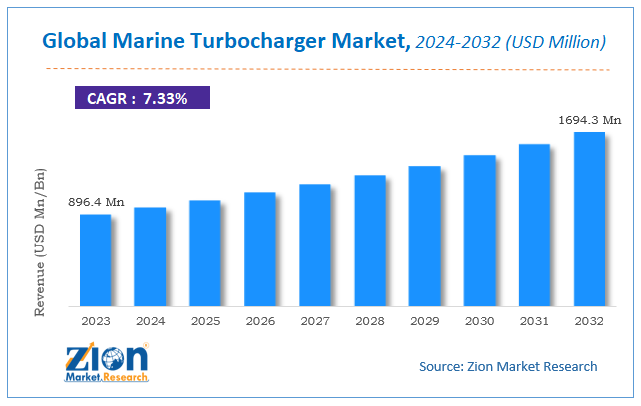
Global Marine Turbocharger Market: Overview
In ships, the turbocharger is among the most important parts of the main propulsion system. To enhance the overall efficiency of the engine, the turbocharger reuses the exhaust gases. A turbocharger comprises two parts including turbine sides and a blower. Turbochargers are usually used to provide a high density of air to the engines and thus are a mechanism of providing forced-induction to marine diesel engines.
Global Marine Turbocharger Market: Growth Factors
The demand for the marine turbocharger is rising at a substantial rate. Factors such as an increase in marine tourism, an increase in production of ships due to a rise in trade activities across the seas, and growing demand for marine turbochargers from naval forces are boosting the growth of the global marine turbocharger market. Owing to the rise in disposable income, there is a significant rise in marine recreational activities. This includes whale watching, diving, and fishing. In addition to this, there is a surge in the demand for water sports. This has led to a rise in the demand for motorboats, yachts, and other recreational boats.
Also, the use of marine turbochargers offers several benefits such as high turbine efficiency, reduction in special fuel oil consumption of 5-7%, no exhaust grouping, is suitable for high output engine, good performance in high load. All such benefits of marine turbochargers have led to an increase in its adoption rate in recreational boats and several other commercial ships including cargo ships, container ships, bulk carriers, and many more thereby contributing to the growth of the global market.
Furthermore, an increase in R&D activities to enhance the efficacy of the turbochargers is likely to create ample opportunities in the growth of the global marine turbocharger market during the forecast period. However, high initial investment and maintenance costs associated with the marine turbochargers are some of the factors that may hinder the growth of the global marine turbocharger market.
The global marine turbocharger market is severely hit by the Covid-19 pandemic. The complete lockdown and strict restrictions on movement have ceased all the marine recreational activities & marine tourism and thus the demand for recreational boats also declined. A decline in trade activities across the seas is also been registered as restrictions on trade and transport were imposed by the government. In addition to this, the outbreak negatively impacted the manufacture of marine turbochargers owing to disruption in the supply chain and constraints on personnel movement.
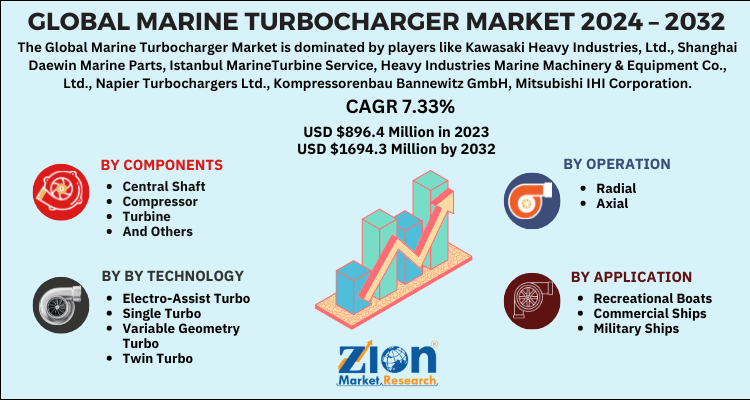
Global Marine Turbocharger Market: Segmentation
The global marine turbocharger market is bifurcated into components, operation, technology, application, and region.
Based on the component, the global marine turbocharger market is divided into central shaft, compressor, turbine, and others.
Based on the operation, the global market is classified into radial and axial.
The technology segment is categorized into the electro-assist turbo, single turbo, variable geometry turbo, and twin turbo.
Based on the application, the market is classified into recreational boats, commercial ships, and military ships.
Marine Turbocharger Market: Report Scope
| Report Attributes | Report Details |
|---|---|
| Report Name | Marine Turbocharger Market |
| Market Size in 2023 | USD 896.4 Million |
| Market Forecast in 2032 | USD 1694.3 Million |
| Growth Rate | CAGR of 7.33% |
| Number of Pages | 197 |
| Key Companies Covered | Kawasaki Heavy Industries, Ltd., Shanghai Daewin Marine Parts, Istanbul MarineTurbine Service, Heavy Industries Marine Machinery & Equipment Co., Ltd., Napier Turbochargers Ltd., Kompressorenbau Bannewitz GmbH, Mitsubishi IHI Corporation, Hedemora Turbo & Diesel AB, MAN Diesel & Turbo, and Liaoning RongLi Turbocharger Co., Ltd |
| Segments Covered | By components, By operation, By technology, By application and By Region |
| Regions Covered | North America, Europe, Asia Pacific (APAC), Latin America, Middle East, and Africa (MEA) |
| Base Year | 2023 |
| Historical Year | 2018 - 2022 |
| Forecast Year | 2024 - 2032 |
| Customization Scope | Avail customized purchase options to meet your exact research needs. Request For Customization |
Global Marine Turbocharger Market: Regional Analysis
In terms of revenue, North America is predicted to dominate the global marine turbocharger market during the forecast period. Factors such as rise in marine recreational activities, presence of advanced technology, increase in marine tourism, presence of major key players, and growing demand for the marine turbocharger to improve the efficiency of the engines of the ship are majorly contributing to the growth of the market in this region. Asia Pacific on the other hand is expected to grow at a faster rate. This is attributable to trade activities, a rise in demand for marine turbochargers from commercial ships, and an increase in the population's interest in water sports. Europe is also estimated to account for a significant share in the market growth due to the rise in R&D activities for the launch of innovative products and key strategies of the key players to increase the sales of the marine turbocharger.
Global Marine Turbocharger Market: Competitive Players
Some of the key manufacturers operating in the global marine turbocharger market include:
- Kawasaki Heavy Industries, Ltd.
- Shanghai Daewin Marine Parts
- Istanbul MarineTurbine Service
- Heavy Industries Marine Machinery & Equipment Co., Ltd.
- Napier Turbochargers Ltd.
- Kompressorenbau Bannewitz GmbH
- Mitsubishi IHI Corporation
- Hedemora Turbo & Diesel AB
- MAN Diesel & Turbo
- Liaoning RongLi Turbocharger Co., Ltd.
The Global Marine Turbocharger Market is segmented as follows:
By components
- central shaft
- compressor
- turbine
- and others
By operation
- radial
- axial
By technology
- electro-assist turbo
- single turbo
- variable geometry turbo
- twin turbo
By application
- recreational boats
- commercial ships
- military ships
By Region
- North America
- The U.S.
- Canada
- Mexico
- Europe
- France
- The UK
- Spain
- Germany
- Italy
- Rest of Europe
- Asia Pacific
- China
- Japan
- India
- Australia
- South Korea
- Rest of Asia Pacific
- The Middle East & Africa
- Saudi Arabia
- UAE
- Egypt
- Kuwait
- South Africa
- Rest of the Middle East & Africa
- Latin America
- Brazil
- Argentina
- Rest of Latin America
What Reports Provides
- Full in-depth analysis of the parent market
- Important changes in market dynamics
- Segmentation details of the market
- Former, on-going, and projected market analysis in terms of volume and value
- Assessment of niche industry developments
- Market share analysis
- Key strategies of major players
- Emerging segments and regional markets
- Testimonials to companies in order to fortify their foothold in the market.
Table Of Content

FrequentlyAsked Questions
A marine turbocharger is a device used to boost engine power in marine vessels. It increases efficiency by forcing more air into the engine.
The global Marine Turbocharger market is expected to be driven by the Market growth is driven by increasing marine trade, demand for fuel-efficient engines, and stricter emission regulations. Technological advancements in turbocharging systems enhance engine performance and efficiency.
According to study, the global Marine Turbocharger market size was worth around USD 896.4 Million in 2023 and is predicted to grow to around USD 1694.3 Million By 2032.
The global Marine Turbocharger market is expected to grow at a Compound Annual Growth Rate (CAGR) of around CAGR 7.33% during the forecast period from 2024-2032.
The global Marine Turbocharger industry is projected to be challenged by High maintenance and replacement costs; cyclicality of shipbuilding industry; compliance with evolving emission norms increases complexity.
The Stringent emission regulations drive demand for efficient turbochargers; growth in global seaborne trade; retrofitting of existing fleets for fuel efficiency will offer significant growth opportunities in the Marine Turbocharger market.
Higher-efficiency turbo designs to meet IMO emissions targets; hybridization with waste-heat recovery and electric assist concepts; condition monitoring sensors for predictive maintenance at sea are the emerging trends and innovations impacting the Marine Turbocharger market.
The global Marine Turbocharger market is expected to be led by APAC during the forecast period.
Some of the prominent players operating in the global Marine Turbocharger market are; Kawasaki Heavy Industries, Ltd., Shanghai Daewin Marine Parts, Istanbul MarineTurbine Service, Heavy Industries Marine Machinery & Equipment Co., Ltd., Napier Turbochargers Ltd., Kompressorenbau Bannewitz GmbH, Mitsubishi IHI Corporation, Hedemora Turbo & Diesel AB, MAN Diesel & Turbo, and Liaoning RongLi Turbocharger Co., Ltd and others.
The report explores crucial aspects of the Marine Turbocharger market, including a detailed discussion of existing growth factors and restraints, while also browsing future growth opportunities and challenges that impact the market.
HappyClients

