
Magneto Resistive Ram (Mram) Market Size, Growth, Global Trends, Forecast 2034

Magneto Resistive Ram (Mram) Market By Type (Spin-Transfer Torque MRAM (STT-MRAM) and Toggle MRAM), By Offering (Embedded and Stand-Alone), By Application (Robotics, Consumer Electronics, Automotive, Enterprise Storage, Aerospace & Defense, and Others), and By Region - Global and Regional Industry Overview, Market Intelligence, Comprehensive Analysis, Historical Data, and Forecasts 2025 - 2034
| Market Size in 2024 | Market Forecast in 2034 | CAGR (in %) | Base Year |
|---|---|---|---|
| USD 3.1 Billion | USD 27.00 Billion | 26.71% | 2024 |
Magneto Resistive Ram (Mram) Industry Perspective:
What is the anticipated size of the magneto resistive ram (Mram) market during the projection period?
The global magneto resistive ram (Mram) market size was worth around USD 3.1 billion in 2024 and is predicted to grow to around USD 27.00 billion by 2034 with a compound annual growth rate (CAGR) of roughly 26.71% between 2025 and 2034.
-market-size.png)
Magneto Resistive Ram (Mram) Market: Overview
Magneto resistive RAM (Mram) is a novel data storage method. It stores data bits leveraging magnetic states instead of electrical charges that are otherwise used by devices such as dynamic random access memory (DRAM). Magneto resistive ram combines the high speed of static random access memory (SRAM) and the high density of DRAM, thus offering significant improvements in electronic products. MRAM allows faster data access, stores greater volumes of data, and consumes less energy compared to its counterparts. During the forecast period, demand for magneto resistive ram is expected to grow due to rising investments in Artificial Intelligence (AI) and Machine Learning (ML), shift toward edge computing, and industrial automation. Rising focus on improving the energy efficiency of electronic products will work in favor of the market players.
However, concerns over supply chain disruptions, competition from other data storage solutions, and high cost will affect business revenue in the long run.
Key Insights:
- As per the analysis shared by our research analyst, the global magneto resistive ram (Mram) market is estimated to grow annually at a CAGR of around 26.71% over the forecast period (2025-2034)
- In terms of revenue, the global magneto resistive ram (Mram) market size was valued at around USD 3.1 billion in 2024 and is projected to reach USD 27.00 billion by 2034.
- The market is projected to grow at a significant rate due to the growing Artificial Intelligence and Machine Learning investments.
- Based on the type, the spin-transfer torque MRAM (STT-MRAM) segment is growing at a high rate and will continue to dominate the global market, as per industry projections
- Based on the offering, the embedded segment is anticipated to command the largest market share.
- Based on the application, the consumer electronics segment is expected to lead the market growth trends.
- Based on region, the Asia-Pacific is projected to dominate the global market during the forecast period.
Impact of the USA-Israel and Iran war on the Magneto Resistive Ram (Mram) Market:
The ongoing war between the USA, Israel, and Iran has significantly impacted raw material supply, especially impacting the distribution of bromine and helium. They are essential starting materials for chip production. Furthermore, the war also affected logistics & transportation costs, leading to reduced investments in the semiconductor industry. During the forecast period, the war is projected to encourage more domestic reliance on chip production and supply.
Magneto Resistive Ram (Mram) Market: Dynamics
Growth Drivers
How will increased investments in AI and ML influence growth in the magneto resistive ram (Mram) market?
The global magneto resistive ram (Mram) market is expected to benefit from growing Artificial Intelligence and Machine Learning investments. In 2024, researchers at the University of Minnesota Twin Cities introduced a new AI hardware accelerator using MRAM memory. The accelerator can increase AI computation by a factor of 1,000. According to industry analysis, magneto resistive ram has emerged as a key enabler of future AI-based smart infrastructure since it allows non-volatile storage and high-speed data processing.
In 2024, AI-led venture capital funding reached over USD 100 billion. In the coming years, more companies are expected to amplify investments toward next-generation AI and ML tools as end applications reach new heights. This trend is subsequently expected to drive demand for powerful data storage systems such as MRAM.
Shift toward edge computing to influence improved market revenue in the long run
Accelerated shift toward edge computing in the technology world is expected to work in favor of the global magento resistive ram (Mram) market in the coming years. Edge computing deals with processing information close to where it is generated instead of cloud centers. Highly effective memory storage systems that can generate a response instantly with a limited power supply and high endurance are required to make edge computing a successful venture.
In March 2026, Everspin Technologies, Inc., a leading developer of MRAM, launched the UNISYST MRAM family. It is a new generation of unified memory developed to revolutionize the way embedded systems store and access code and data.
Restraints
Which limiting factors will restrict the expansion of the magneto resistive ram (Mram) market?
The global magneto resistive ram (Mram) industry is projected to be restricted due to factors such as supply chain disruptions and the high cost of initial investment. Since the war between the US, Israel, and Iran began, globally helium supply is down by more than 30.5%. This has affected semiconductor production and distribution, subsequently impacting access to MRAM. Furthermore, magneto resistive ram is expensive to develop due to the use of specialized materials such as magnetic tunnel junctions (MTJs) and a complex manufacturing process.
Opportunities
Rapid industrial automation to generate growth opportunities in the long run
The global magneto resistive ram (Mram) market is projected to generate growth opportunities due to rapid industrial automation. Smart factories equipped with cutting-edge robotics & automaton tools have garnered global attention in the last few years. Modern industrial automation is powered by technologies that allow real-time data processing, facilitating remote monitoring, predictive maintenance, and autonomous decision-making using Internet-of-Things (IoT) technologies, influencing demand for powerful MRAM systems.
How will energy efficiency trends shape the magneto resistive ram (Mram) market in the coming years?
The global technology sector is under government pressure to optimize energy consumption by electronic items. Magento resistive ram is highly energy efficient as compared to other memory storage solutions. MRAM does not require frequent refresh cycles, and it can be applied in unified memory systems, which further leads to optimal energy utilization, accelerating market growth trends.
Challenges
Concerns over scaling and competition from alternative solutions to challenge market growth
The global magneto resistive ram (Mram) industry is expected to be challenged by scaling concerns as end applications worldwide continue to grow. In addition, MRAM is not the preferred choice for high storage density applications. The growing competition from alternative technologies such as Phase-Change Memory (PCM) and Resistive RAM (ReRAM) will further affect market growth trends.
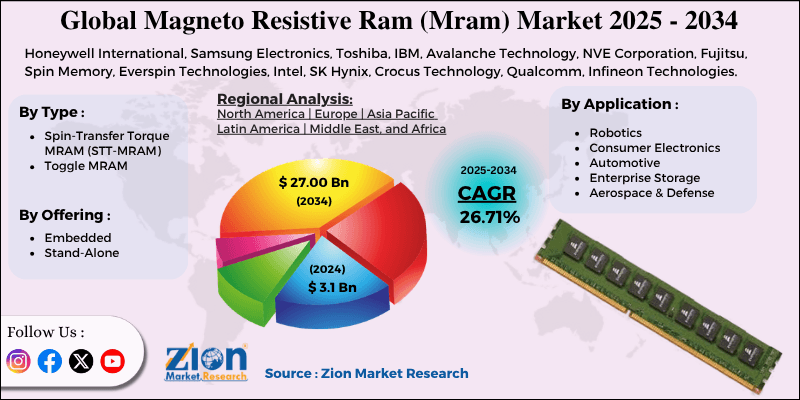
Magneto Resistive Ram (Mram) Market: Report Scope
| Report Attributes | Report Details |
|---|---|
| Report Name | Magneto Resistive Ram (Mram) Market |
| Market Size in 2024 | USD 3.1 Billion |
| Market Forecast in 2034 | USD 27.00 Billion |
| Growth Rate | CAGR of 26.71% |
| Number of Pages | 225 |
| Key Companies Covered | Honeywell International, Samsung Electronics, Toshiba, IBM, Avalanche Technology, NVE Corporation, Fujitsu, Spin Memory, Everspin Technologies, Intel, SK Hynix, Crocus Technology, Qualcomm, Infineon Technologies, TSMC, and others. |
| Segments Covered | By Type, By Offering, By Application, and By Region |
| Regions Covered | North America, Europe, Asia Pacific (APAC), Latin America, Middle East, and Africa (MEA) |
| Base Year | 2024 |
| Historical Year | 2019 - 2023 |
| Forecast Year | 2025 - 2034 |
| Customization Scope | Avail customized purchase options to meet your exact research needs. Request For Customization |
Magneto Resistive Ram (Mram) Market: Segmentation
The global magneto resistive ram (Mram) market is segmented based on type, offering, application, and region.
Why will the spin-transfer torque MRAM (STT-MRAM) segment lead the magneto resistive ram (Mram) industry revenue during the forecast period?
Based on type, the global market divisions are spin-transfer torque MRAM (STT-MRAM) and toggle MRAM. In 2024, the highest growth was listed in the spin-transfer torque MRAM (STT-MRAM). It accounted for 71% of the global revenue and will grow at a CAGR of 18.01% since STR-MRAM has greater end-user applications, better scalability, and higher energy efficiency.
Which will be the fastest-growing offering during the forecast period in the magneto resistive ram (Mram) market?
Based on offering, the global magneto resistive ram (Mram) industry is divided into embedded and stand-alone. The highest market share was held by the embedded segment in 2024, accounting for 35% of the global revenue. During the forecast period, it is expected to deliver a CAGR of 31% due to higher integration of embedded systems in edge computing and IoT technology.
Why will the consumer electronics segment lead the magneto resistive ram (Mram) industry during the forecast period?
Based on application, the global market divisions are robotics, consumer electronics, automotive, enterprise storage, aerospace & defense, and others. Around 31% of the global revenue was listed in the consumer electronics segment in 2024. It will continue leading the market with a CAGR of 29%, driven by higher sales of consumer electronics and wearables.
Magneto Resistive Ram (Mram) Market: Regional Analysis
What is the projected CAGR for Asia-Pacific in the magneto resistive ram (Mram) market for the forecast period?
Asia-Pacific is projected to emerge as the fastest-growing and the most dominant region in the global magneto resistive ram (Mram) market during the forecast period. Asia-Pacific accounted for 45% of the total revenue in 2024 and is expected to record a CAGR of 33.01% in the coming years. Growth in the Asia-Pacific is led by China, India, South Korea, and Taiwan. These are the leading producers of advanced chips and electronic products. In addition, growing demand for factory automation and increased AI investments will aid higher growth across the Asia-Pacific.
Why is North America the second-largest region in the magneto resistive ram (Mram) market during the forecast period?
North America is the second leading market in the magneto resistive ram (Mram) market. In 2024, it accounted for 38.9% of the global revenue and will grow at a CAGR of 31.56% during the forecast period. Increasing investments in research & development, higher defense spending, and accelerated use of next-generation technologies in the healthcare sector will work in favor of the regional players. In addition, the US has amplified investment in domestic chip production, further accelerating market growth trends.
Magneto Resistive Ram (Mram) Market: Competitive Analysis
The global magneto resistive ram (Mram) market is led by players like:
- Honeywell International
- Samsung Electronics
- Toshiba
- IBM
- Avalanche Technology
- NVE Corporation
- Fujitsu
- Spin Memory
- Everspin Technologies
- Intel
- SK Hynix
- Crocus Technology
- Qualcomm
- Infineon Technologies
- TSMC
What are the latest key trends in the magneto resistive ram (Mram) market?
Applications in unified memory systems
Magneto resistive ram is widely used in modern unified memory systems. Use of MRAM eliminates the need to use additional memory storage solutions such as NOT AND (NAN) and facilitates real-time information processing.
Expansion of data centers
The ongoing investments in modern data centers have amplified demand for MRAM. The memory storage solution is used in buffer storage and cache memory, powering large-scale data centers.
The global magneto resistive ram (Mram) market is segmented as follows:
By Type
- Spin-Transfer Torque MRAM (STT-MRAM)
- Toggle MRAM
By Offering
- Embedded
- Stand-Alone
By Application
- Robotics
- Consumer Electronics
- Automotive
- Enterprise Storage
- Aerospace & Defense
- Others
By Region
- North America
- The U.S.
- Canada
- Mexico
- Europe
- France
- The UK
- Spain
- Germany
- Italy
- Rest of Europe
- Asia Pacific
- China
- Japan
- India
- Australia
- South Korea
- Rest of Asia Pacific
- The Middle East & Africa
- Saudi Arabia
- UAE
- Egypt
- Kuwait
- South Africa
- Rest of the Middle East & Africa
- Latin America
- Brazil
- Argentina
- Rest of Latin America
Table Of Content
Methodology
FrequentlyAsked Questions
Magneto resistive RAM (Mram) is a novel data storage method. It stores data bits leveraging magnetic states instead of electrical charges that are otherwise used by devices such as dynamic random access memory (DRAM).
The global magneto resistive ram (Mram) market is expected to benefit from growing Artificial Intelligence and Machine Learning investments.
According to study, the global magneto resistive ram (Mram) market size was worth around USD 3.1 billion in 2024 and is predicted to grow to around USD 27.00 billion by 2034.
The CAGR value of magneto resistive ram (Mram) market is expected to be around 26.71% during 2025-2034.
The global magneto resistive ram (Mram) industry is expected to be challenged by scaling concerns as end applications worldwide continue to grow.
Applications in unified memory systems and expansion of data centers are the emerging trends and innovations impacting the magneto resistive ram (Mram) market.
The global magneto resistive ram (Mram) market has performed well so far and will offer similar trends in the coming years.
Asia-Pacific will contribute notably towards the magneto resistive ram (Mram) market value.
The global magneto resistive ram (Mram) market is led by players like Honeywell International, Samsung Electronics, Toshiba, IBM, Avalanche Technology, NVE Corporation, Fujitsu, Spin Memory, Everspin Technologies, Intel, SK Hynix, Crocus Technology, Qualcomm, Infineon Technologies and TSMC.
The report explores crucial aspects of the magneto resistive ram (Mram) market including detailed discussion of existing growth factors and restraints while also browsing future growth opportunities and challenges that impact the market.

List of Contents
Magneto Resistive Ram (Mram)Industry Perspective:OverviewKey Insights:DynamicsReport ScopeSegmentationRegional AnalysisCompetitive AnalysisWhat are the latest key trends in the magneto resistive ram (Mram) market?The global magneto resistive ram (Mram) market is segmented as follows:HappyClients

