
Magnesium Recycling Market Size, Share, Value and Forecast 2034

Magnesium Recycling Market By Type (Magnesium Oxide Residues and Scrap Magnesium Alloys), By Recycling Method (Hydrometallurgical Recycling and Pyrometallurgical Recycling), By Magnesium Alloy Type (Zinc-based Alloys, Aluminum-based Alloys, Rare Earth Element-based Alloys, and Others), By End-User Industry (Construction, Aerospace, Automotive, Electronics, and Others), and By Region - Global and Regional Industry Overview, Market Intelligence, Comprehensive Analysis, Historical Data, and Forecasts 2025 - 2034
| Market Size in 2024 | Market Forecast in 2034 | CAGR (in %) | Base Year |
|---|---|---|---|
| USD 799.86 Million | USD 1,522.43 Million | 6.53% | 2024 |
Magnesium Recycling Industry Perspective:
What will be the size of the global magnesium recycling market during the forecast period?
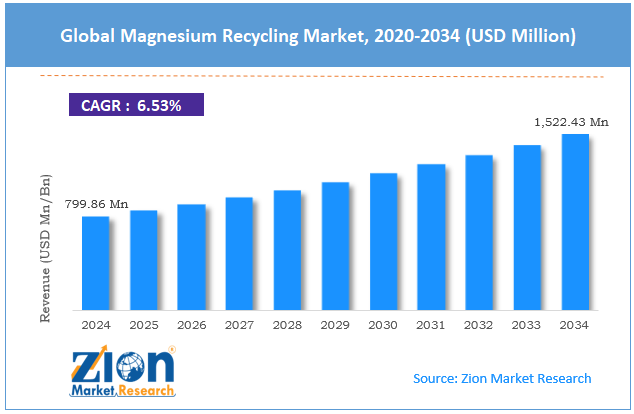
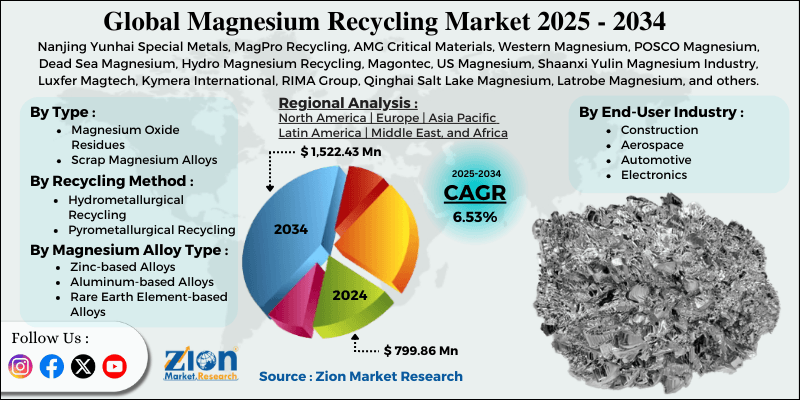
The global magnesium recycling market size was worth around USD 799.86 million in 2024 and is predicted to grow to around USD 1,522.43 million by 2034, with a compound annual growth rate (CAGR) of roughly 6.53% between 2025 and 2034.
Key Insights:
- As per the analysis shared by our research analyst, the global magnesium recycling market is estimated to grow annually at a CAGR of around 6.53% over the forecast period (2025-2034)
- In terms of revenue, the global magnesium recycling market size was valued at around USD 799.86 million in 2024 and is projected to reach USD 1,522.43 million by 2034.
- The magnesium recycling market is projected to grow at a significant rate due to the rising demand for lightweight materials.
- Based on the type, the scrap magnesium alloys segment is growing at a high rate and will continue to dominate the global market, as per industry projections
- Based on the magnesium alloy type, the aluminum-based alloys segment is anticipated to command the largest market share
- Based on region, the Asia-Pacific is projected to dominate the global market during the forecast period
Magnesium Recycling Market: Overview
Magnesium recycling refers to the process of transforming discarded metals into reusable elements. The process involves capturing magnesium scrap from several industries, such as consumer products, die-casting operations, and automotive foundries, before the scrap enters the waste cycle. According to industry research, the process of recycling magnesium has several environmental benefits as compared to producing the metal from scratch. Magnesium scrap is classified into four types, from Type I to Type IV, with Type I being the purest form, while Type IV is more challenging to process due to the presence of fines and chips. Global demand for magnesium recycling is expected to increase as lightweight materials gain popularity in the automotive and aerospace sectors.
In addition, rising focus on developing a circular economy and strict government regulations may further help the industry thrive. A major drawback of the magnesium recycling industry is the high cost of investment and uncertainty in terms of resource availability.
Magnesium Recycling Market: Dynamics
Growth Drivers
Why will increased demand for lightweight materials influence the magnesium recycling market growth?
The global magnesium recycling market is expected to grow due to the rising demand for lightweight materials. Magnesium is a considerably lightweight metal. Its weight is almost 35% less than that of aluminum. Growing industries such as the automotive and aerospace sectors have increased demand for and applications of lightweight materials in the production of various vehicle and aircraft components. Reducing the weight of a vehicle is directly linked to the overall fuel efficiency of the automotive. According to industry research, reducing vehicle weight by 10% can improve fuel efficiency by 6% to 8%. Automotive companies and aircraft manufacturers are increasingly preferring parts made of magnesium instead of traditionally used aluminum and steel.
For instance, in March 2025, Iranian researchers announced the development of a highly advanced nanocomposite coating that can help protect against corrosion in magnesium alloys, thus effectively reducing aircraft weight. The growing use of magnesium as a lightweight alternative to aluminum and steel will help encourage investment in recycling scrap magnesium to produce the desired parts.
Rising focus on developing a robust circular economy to work in favor of the industry players
The growing investments worldwide in developing a robust, high-performance circular economy will work in favor of magnesium recycling solution providers. It is a novel method of production and consumption that aims to reuse the initial resources for as long as possible by extracting them before they enter the waste cycle and repurposing them for further use. Magnesium recycling is a prominent means of ensuring the material is used as efficiently as possible until the end of the metal’s life. Producing magnesium from scratch is a highly costly and resource-intensive process.
However, recycling existing magnesium consumes less energy and also ensures that the raw material remains in continuous circulation for an extended period. The global magnesium recycling market will continue to attract renewed investment as the circular economy gains greater momentum in the coming years.
Restraints
Why will cost constraints limit the expansion of the magnesium recycling industry in the coming years?
The global magnesium recycling industry is expected to be restricted due to the high cost of investment associated with the market. Although the process is less expensive than producing fresh batches of magnesium, developing an efficient recycling infrastructure requires considerable initial investment. For instance, the recycling architecture demands the use of highly complex, specialized recycling furnaces and skilled labor. These factors contribute to high upfront expenditure for the market players.
Opportunities
Will ongoing technological advancements offer growth opportunities to the magnesium recycling industry players?
The global magnesium recycling market is projected to generate growth opportunities due to the improving rate of technological advancements reported in the industry. These innovations are directed toward exploring new resources for magnesium scrap, developing new separation technologies, and enhancing the alloy purification process, among other advancements.
For instance, in July 2025, reports emerged suggesting that Magrathea, a US-based startup operating in the magnesium extraction industry, announced a major breakthrough in extracting the metal from seawater. The company aims to achieve improved carbon neutrality through a novel approach to metal extraction. The company has launched a new generation of magnesium chloride electrolyzers that leverage a unique seawater electrolysis technology to produce magnesium metal. On the other hand, Latrobe Magnesium (LMG) has developed a hydrometallurgical method for extracting magnesium metal from fly ash. The company has managed to achieve high-value utilization of industrial solid waste using the cutting-edge method of extraction.
Challenges
Which challenges will limited raw material availability create for the magnesium recycling market?
The global industry for magnesium recycling is expected to be challenged by the limited availability of highly pure magnesium extracts for further recycling. Additionally, the lack of standard quality control measures governing recycling procedures of metals may further impact business revenue in the long run. Other factors, such as tough competition from primary magnesium and lower acceptance of recycled metals, may impede industry revenue in the coming years.
Magnesium Recycling Market: Report Scope
| Report Attributes | Report Details |
|---|---|
| Report Name | Magnesium Recycling Market |
| Market Size in 2024 | USD 799.86 Million |
| Market Forecast in 2034 | USD 1,522.43 Mllion |
| Growth Rate | CAGR of 6.53% |
| Number of Pages | 225 |
| Key Companies Covered | Nanjing Yunhai Special Metals, MagPro Recycling, AMG Critical Materials, Western Magnesium, POSCO Magnesium, Dead Sea Magnesium, Hydro Magnesium Recycling, Magontec, US Magnesium, Shaanxi Yulin Magnesium Industry, Luxfer Magtech, Kymera International, RIMA Group, Qinghai Salt Lake Magnesium, Latrobe Magnesium, and others. |
| Segments Covered | By Type, By Recycling Method, By Magnesium Alloy Type, By End-User Industry, and By Region |
| Regions Covered | North America, Europe, Asia Pacific (APAC), Latin America, Middle East, and Africa (MEA) |
| Base Year | 2024 |
| Historical Year | 2019 to 2023 |
| Forecast Year | 2025 - 2034 |
| Customization Scope | Avail customized purchase options to meet your exact research needs. Request For Customization |
Magnesium Recycling Market: Segmentation
The global magnesium recycling market is segmented based on type, recycling method, magnesium alloy type, end-user industry, and region.
Why does the scrap magnesium alloys segment lead the magnesium recycling market?
Based on type, the global market segments are magnesium oxide residues and scrap magnesium alloys. In 2024, the highest growth was listed in the scrap magnesium alloys segment due to the wider availability of the raw material through several means. Furthermore, scrap magnesium alloys are easier to recycle than oxide residues. The growing demand for magnesium parts made from alloy recycling will aid the demand in the future.
Based on the recycling method, the global magnesium recycling industry is divided into hydrometallurgical recycling and pyrometallurgical recycling.
Will the aluminum-based alloys segment dominate the magnesium recycling industry?
Based on magnesium alloy type, the global market is divided into zinc-based alloys, aluminum-based alloys, rare-earth element-based alloys, and others. The highest revenue in 2024 was listed in the aluminum-based alloys segment, led by higher use across end-user industries such as the automotive sector. Additionally, aluminum-based alloys are more cost-effective due to the establishment of a well-defined processing infrastructure.
Based on end-user industry, the global market divisions are construction, aerospace, automotive, electronics, and others.
Magnesium Recycling Market: Regional Analysis
Why will Asia-Pacific continue to dominate the magnesium recycling market during the forecast period?
The global magnesium recycling market is expected to be led by Asia-Pacific during the forecast period. It accounted for nearly 40.01% of the global revenue in 2024 and is expected to deliver a CAGR of over 7.15% in the coming years. A major regional market growth propeller is the rising demand for magnesium alloys across major end-user industries such as the automotive sector. Furthermore, the regional market will benefit from increased government support and easier access to metal scraps from dynamic sources such as electronic waste and end-of-life vehicles.
What position does Europe hold in the magnesium recycling industry?
Europe is expected to emerge as the second-highest revenue generator in the magnesium recycling market, with a CAGR of 6.9% during the projection period. Countries such as Germany, Switzerland, and France are expected to emerge as critical drivers of regional market growth. European countries have seen increased regulatory efforts to establish a robust, highly efficient circular economy, especially in resource-intensive industries. The regional market will benefit from the rising demand for lightweight vehicles, increased government support, and a surge in the number of magnesium recycling service providers.
Magnesium Recycling Market: Competitive Analysis
The global magnesium recycling market is led by players like:
- Nanjing Yunhai Special Metals
- MagPro Recycling
- AMG Critical Materials
- Western Magnesium
- POSCO Magnesium
- Dead Sea Magnesium
- Hydro Magnesium Recycling
- Magontec
- US Magnesium
- Shaanxi Yulin Magnesium Industry
- Luxfer Magtech
- Kymera International
- RIMA Group
- Qinghai Salt Lake Magnesium
- Latrobe Magnesium
What are the key trends in the global magnesium recycling market?
Decarbonization
The accelerated adoption of decarbonization trends across major global economies is expected to promote investment in magnesium recycling, as it uses fewer resources and limits harmful emissions.
Strategic collaborations
The rising strategic collaboration reported between relevant stakeholders, such as scrap providers and end-user industries, is a promising trend for the market revenue. The partnerships will allow smoother global expansion of magnesium recycling in the coming years.
The global magnesium recycling market is segmented as follows:
By Type
- Magnesium Oxide Residues
- Scrap Magnesium Alloys
By Recycling Method
- Hydrometallurgical Recycling
- Pyrometallurgical Recycling
By Magnesium Alloy Type
- Zinc-based Alloys
- Aluminum-based Alloys
- Rare Earth Element-based Alloys
- Others
By End-User Industry
- Construction
- Aerospace
- Automotive
- Electronics
- Others
By Region
- North America
- The U.S.
- Canada
- Mexico
- Europe
- France
- The UK
- Spain
- Germany
- Italy
- Rest of Europe
- Asia Pacific
- China
- Japan
- India
- Australia
- South Korea
- Rest of Asia Pacific
- The Middle East & Africa
- Saudi Arabia
- UAE
- Egypt
- Kuwait
- South Africa
- Rest of the Middle East & Africa
- Latin America
- Brazil
- Argentina
- Rest of Latin America
Table Of Content
Methodology
FrequentlyAsked Questions

HappyClients

