
Global Lung Assessment Device Market Size, Share, Growth, Trends, and Forecast 2030

Lung Assessment Device Market: by Type (Spirometers, Nebulizers); End-user (Hospitals, Home Care, Diagnostic Laboratories), and By Regions: Global Industry Analysis, Size, Share, Growth, Trends, and Forecast, 2023-2030
| Market Size in 2022 | Market Forecast in 2030 | CAGR (in %) | Base Year |
|---|---|---|---|
| USD 11.80 Billion | USD 20.56 Billion | 7.19% | 2022 |
Description
What is Lung Assessment Device Market Size?
The global Lung Assessment Device market size was evaluated at $11.80 billion in 2022 and is slated to hit $20.56 billion by the end of 2030 with a CAGR of nearly 7.19% between 2023 and 2030.
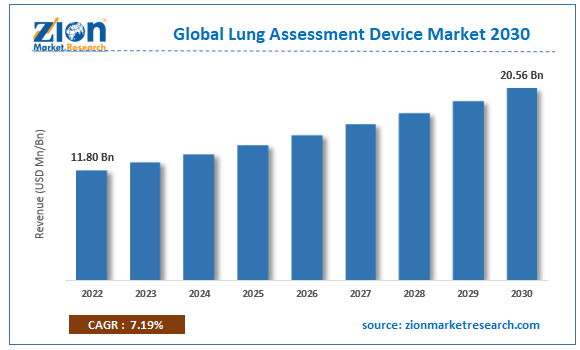
Global Lung Assessment Device Market: Overview
Respiration is an irreplaceable life process. A normal human body is able to breathe properly for decades but the growing pollution in the metropolitan cities and unhealthy lifestyle is clogging the airways and other lung structures which in turn causing various respiratory issues in the human body. Lung assessment devices facilitate medication to manage the arising symptoms and mitigate the acceleration of multiple lung disorders like asthma and chronic obstructive pulmonary disease. These devices have single or multiple combinations of drugs like corticosteroids and bronchodilators. Lung assessment is a kind of noninvasive test that is used to examine the working status of the lungs. Lung assessments are used to measure peak expiratory flow rate, forced expiratory flow, functional residual capacity, forced vital capacity, vital capacity, total lung capacity, forced expiratory volume, minute volume, residue volume, and tidal volume.
Global Lung Assessment Device Market: Growth Factors
One of the major factors driving the growth of the global lung assessment device market is the growing prevalence of respiratory diseases all across the world. Moreover, the growing geriatric population coupled with the rise in pollution levels in metropolitan cities is also boosting the growth of the global lung assessment device market. The adoption of unhealthy lifestyles like smoking has propelled the demand for lung assessment devices in the market globally. The manufacturers in the global market are launching wearable strain sensors for advanced management of chronic lung diseases to measure the respiration rate and volume with high accuracy.
Favorable healthcare policies along with the increasing initiatives of the government to reduce the burden of diseases are some of the key factors bolstering the growth of the global lung assessment device market. Prominent market players are increasing investments to boost the research and development activities to launch advanced devices that are capable of detecting respiration under different ambulatory conditions. Moreover, the growing awareness among people regarding lung assessment tests is also propelling the demand for lung assessment devices in the market globally.
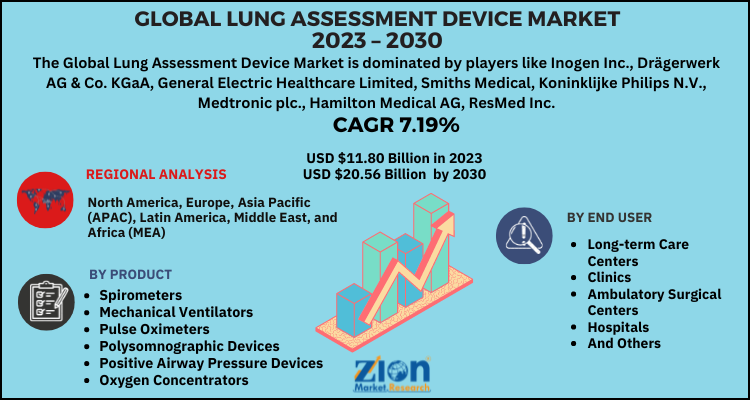
Global Lung Assessment Device Market: Segmentation
The global lung assessment device market can be segmented into product, end-user, and region.
By product, the market can be segmented into spirometers, mechanical ventilators, pulse oximeters, polysomnographic devices, positive airway pressure devices, oxygen concentrators, nebulizers, and respiratory consumables. The spirometer segment holds the largest share in the global lung assessment device market due to the growing incidences of chronic lung disorder. Moreover, the pulse oximeter segment is also expected to witness huge growth during the forecast period due to the spike in demand for the lung assessment test.
By end-user, the market can be segmented into long-term care centers, clinics, ambulatory surgical centers, hospitals, and others. The hospital segment accounts for the largest share in the global lung assessment device market owing to the large number of market players receiving approval for home-use lung assessment devices.
Lung Assessment Device Market: Report Scope
| Report Attributes | Report Details |
|---|---|
| Report Name | Lung Assessment Device Market |
| Market Size in 2022 | USD 11.80 Billion |
| Market Forecast in 2030 | USD 20.56 Billion |
| Growth Rate | CAGR of 7.19% |
| Number of Pages | 225 |
| Key Companies Covered | Inogen Inc., Drägerwerk AG & Co. KGaA, General Electric Healthcare Limited, Smiths Medical, Koninklijke Philips N.V., Medtronic plc., Hamilton Medical AG, ResMed Inc., Fisher & Paykel Healthcare Limited, Teleflex Incorporated, Massimo Corporation, and Other |
| Segments Covered | By Type, By End User, and By Region |
| Regions Covered | North America, Europe, Asia Pacific (APAC), Latin America, Middle East, and Africa (MEA) |
| Base Year | 2022 |
| Historical Year | 2019 - 2022 |
| Forecast Year | 2022 - 2030 |
| Customization Scope | Avail customized purchase options to meet your exact research needs. Request For Customization |
Global Lung Assessment Device Market: Regional analysis
North America accounts for the largest share in the global lung assessment device market owing to the rising prevalence of respiratory disease in the region. Favorable healthcare policies and growing awareness of people regarding their health are contributing vigorously towards the growth of the regional market.
Europe accounts for the second-largest share in the global lung assessment device market due to the high incidences of chronic lung disorder coupled with the growing awareness of people regarding the lung assessment test.
Asia Pacific is also anticipated to witness huge growth during the forecast period due to the presence of prominent market players in the region along with the growing government initiatives supporting the growth of healthcare infrastructure.
Global Lung Assessment Device Market: Competitive Players
Some of the significant players in the global lung assessment device market are
- Inogen Inc.
- Drägerwerk AG & Co. KGaA
- General Electric Healthcare Limited
- Smiths Medical
- Koninklijke Philips N.V.
- Medtronic plc.
- Hamilton Medical AG
- ResMed Inc.
- Fisher & Paykel Healthcare Limited
- Teleflex Incorporated
- and Massimo Corporation
The Global Lung Assessment Device Market is segmented as follows:
By Type
- Spirometers
- Nebulizers
By End-user
- Hospitals
- Home Care
- Diagnostic Laboratories
By Region
- North America
- The U.S.
- Canada
- Mexico
- Europe
- France
- The UK
- Spain
- Germany
- Italy
- Rest of Europe
- Asia Pacific
- China
- Japan
- India
- Australia
- South Korea
- Rest of Asia Pacific
- The Middle East & Africa
- Saudi Arabia
- UAE
- Egypt
- Kuwait
- South Africa
- Rest of the Middle East & Africa
- Latin America
- Brazil
- Argentina
- Rest of Latin America
What Reports Provides
- Full in-depth analysis of the parent market
- Important changes in market dynamics
- Segmentation details of the market
- Former, on-going, and projected market analysis in terms of volume and value
- Assessment of niche industry developments
- Market share analysis
- Key strategies of major players
- Emerging segments and regional markets
- Testimonials to companies in order to fortify their foothold in the market.
Table Of Content

FrequentlyAsked Questions
A lung assessment device evaluates lung function and breathing. It helps diagnose respiratory conditions
The global Lung Assessment Device market is expected to be driven by the rising respiratory disorders and need for early diagnosis. Adoption in hospitals and pulmonary care supports expansion.
According to study, the global Lung Assessment Device market size was worth around USD 11.80 Billion in 2022 and is predicted to grow to around USD 20.56 Billion by 2030.
The global Lung Assessment Device market is expected to grow at a Compound Annual Growth Rate (CAGR) of around CAGR 7.19% during the forecast period from 2023-2030.
The global Lung Assessment Device industry is projected to be challenged by Challenges include clinical validation needs and reimbursement uncertainty.
The Opportunities include respiratory disease diagnosis, home monitoring, COPD prevalence, and non-invasive assessment demand will offer significant growth opportunities in the Lung Assessment Device market.
Portable and non-invasive diagnostic devices; AI-based respiratory analysis; use in critical care and remote monitoring are the emerging trends and innovations impacting the Lung Assessment Device market.
The global Lung Assessment Device market is expected to be led by North America during the forecast period.
Some of the prominent players operating in the global Lung Assessment Device market are; Inogen Inc., Drägerwerk AG & Co. KGaA, General Electric Healthcare Limited, Smiths Medical, Koninklijke Philips N.V., Medtronic plc., Hamilton Medical AG, ResMed Inc., Fisher & Paykel Healthcare Limited, Teleflex Incorporated, Massimo Corporation, and Other and others.
The report explores crucial aspects of the Lung Assessment Device market, including a detailed discussion of existing growth factors and restraints, while also browsing future growth opportunities and challenges that impact the market.
HappyClients

