
Legal Practice Management Software Market Size, Share, Analysis, Trends, Growth, 2032

Legal Practice Management Software Market By Deployment (Cloud-based Deployment and On-premise Deployment), By Application (Legal Firms, Attorneys, and Law Courts), and By Region: Global Industry Perspective Comprehensive Analysis and Forecast, 2024 - 2032
| Market Size in 2023 | Market Forecast in 2032 | CAGR (in %) | Base Year |
|---|---|---|---|
| USD 1.81 Billion | USD 5.24 Billion | 12.55% | 2023 |
What is the Legal Practice Management Software Market Size?
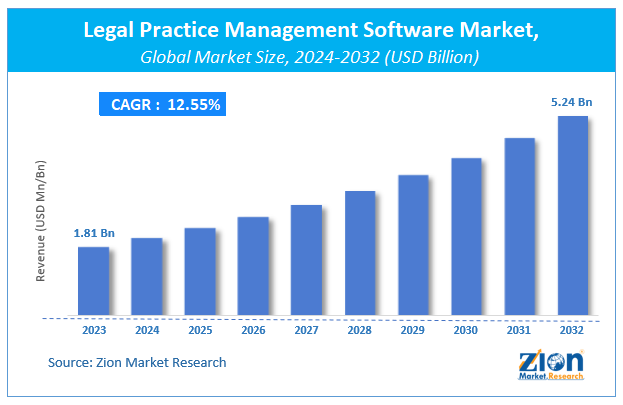
Zion Market Research has published a report on the global Legal Practice Management Software Market, estimating its value at USD 1.81 billion in 2023, with projections indicating that it will reach USD 5.24 billion by 2032. The market is expected to expand at a compound annual growth rate (CAGR) of 12.55% over the forecast period 2024-2032. The legal practice management software Market is driven by the massive acceptance of cloud-based systems and the critical need to automate tedious administrative processes within law firms. The report examines the primary drivers, challenges, and restraints shaping global demand for the legal practice management software market throughout the forecast period and identifies high-growth opportunities across the industry.
Legal Practice Management Software Market: Overview
Legal practice management software is helpful in studying management practices from a legal perspective. The software helps in effectively arranging and handling client records & legal cases along with scheduling appointments, billing, bookkeeping, computer filing, and fixing deadlines. Furthermore, the legal practice management software helps in complying with court needs like electronic filing structures and document retention rules. Since law schools typically do not teach the business skills of operating a law office to new lawyers, many offices have turned to technology to ease the learning curve and eliminate clerical errors.
The American Bar Association (ABA) has discovered that most legal malpractice lawsuits account for calendar- and deadline-related errors. In order to protect against such arguments, an initial investment in software tools may also deliver long-term savings.
Key Insights
- As per the analysis shared by our research analyst, the Legal Practice Management Software Market is expected to grow annually at a CAGR of around 12.55% (2024-2032).
- In terms of revenue, the Legal Practice Management Software Market size was valued at nearly USD 1.81 billion in 2023 and is projected to reach USD 5.24 billion by 2032.
- The global market is driven by the soaring demand for operational efficiency, rapid cloud-based infrastructure adoption, and the increasing necessity for stringent data security and regulatory compliance within the legal industry.
- Based on the deployment, the cloud-based deployment segment dominated the global market with a massive share
- Based on the application, the legal firms segment dominated the global market with a significant share
- Based on region, North America dominated the global market with a commanding share, primarily due to the early adoption of advanced legal technologies
Legal Practice Management Software Market: Growth Factors
The growth of the legal practice management software industry is likely to be influenced by the massive acceptance of cloud-based legal practice management software along with the easy accessibility to advanced IT infrastructure. Apart from this, high penetration of legal firms in the emerging economies, as well as the developed nations, will further accelerate the expansion of the business over the years to come. Furthermore, the rise in the use of end-user-friendly software to improve client satisfaction will boost the market trends over the estimated timeline.
Moreover, beneficial product features like reporting, sharing, contact databases, and appointment scheduling will further multiply the expansion of the legal practice management software market in the foreseeable future. However, the high maintenance, as well as implementation charges of the software, can decimate the industry growth in the near future. Nevertheless, the use of the product by lawyers and secretaries to effectively provide legal services to their clients will open new horizons of growth for the market. Additionally, the market for legal practice management software is likely to witness noteworthy growth in the coming decade as key information & data is easily available from the software and the confidentiality & safety of the stored data can be ensured with its backup.
Legal Practice Management Software Market: Segmentation
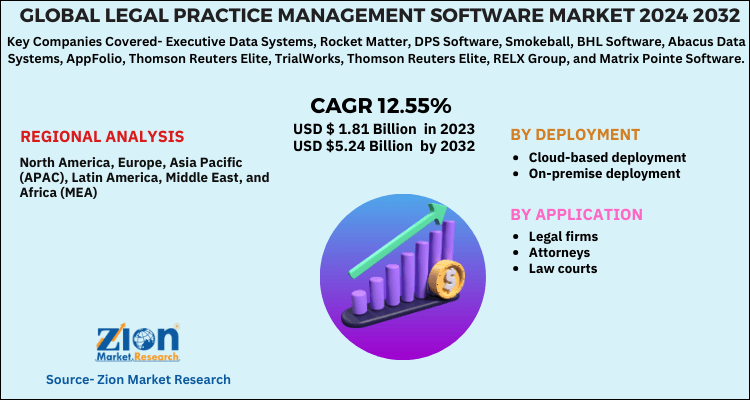
The legal practice management software market can be classified into deployment and application.
On the basis of deployment, the industry can be segmented into cloud-based deployment and on-premises deployment. The cloud-based deployment subsegment unequivocally leads the global market, securing the maximum operational share. This overwhelming dominance is primarily fueled by the compelling advantages of remote accessibility, seamless disaster recovery, and the elimination of expensive in-house IT maintenance costs. Law firms globally are aggressively migrating to cloud platforms to ensure their attorneys can securely access real-time case data, billing, and scheduling tools from any internet-connected device, vastly improving operational agility.
On the basis of application, the market for legal practice management software can be divided into legal firms, attorneys, and law courts. The legal firms segment clearly dominates the global market landscape with a substantial share. This immense growth is directly credited to the complex, multifaceted administrative requirements of multi-partner organizations that necessitate robust, centralized digital platforms to coordinate expansive teams, manage cross-jurisdictional matters, and execute consolidated corporate billing efficiently. The sheer volume of concurrent cases handled by legal firms necessitates advanced workflow automation to maintain profitability and client satisfaction.
Legal Practice Management Software Market: Report Scope
| Report Attributes | Report Details |
|---|---|
| Report Name | Legal Practice Management Software Market |
| Market Size in 2023 | USD 1.81 Billion |
| Market Forecast in 2032 | USD 5.24 Billion |
| Growth Rate | CAGR of 12.55% |
| Number of Pages | 210 |
| Key Companies Covered | Executive Data Systems, Rocket Matter, DPS Software, Smokeball, BHL Software, Abacus Data Systems, AppFolio, Thomson Reuters Elite, TrialWorks, Thomson Reuters Elite, RELX Group, and Matrix Pointe Software |
| Segments Covered | By Deployment, By Application, and By Region |
| Regions Covered | North America, Europe, Asia Pacific (APAC), Latin America, Middle East, and Africa (MEA) |
| Base Year | 2023 |
| Historical Year | 2018 - 2022 |
| Forecast Year | 2024 - 2032 |
| Customization Scope | Avail customized purchase options to meet your exact research needs. Request For Customization |
Legal Practice Management Software Market: Regional Analysis
Why will North America continue to dominate the global market during the projection period?
North American region is likely to dominate the overall market growth during the assessment period. The regional growth can be attributed to the presence of many legal firms deploying the software for acquiring precision as well as speed while arranging legal appointments for their clients. The region is home to a massive concentration of the world's most prominent law firms and elite corporate legal departments, which possess the substantial capital required to continually invest in cutting-edge, enterprise-grade software systems to maintain a competitive edge.
Moreover, with massive awareness about the benefits of the product use among the law professionals in countries like India and China, the legal practice management software market in the Asia Pacific is predicted to gain traction in the years ahead.
Europe and Latin American markets have huge growth potential and are likely to make massive contributions towards the overall business growth in the foreseeable future.
Global Legal Practice Management Software Market: Competitive Players
Few of the main participants in legal practice management software business are
- Executive Data Systems
- Rocket Matter
- DPS Software
- Smokeball
- BHL Software
- Abacus Data Systems
- AppFolio
- Thomson Reuters Elite
- TrialWorks
- Thomson Reuters Elite
- RELX Group
- Matrix Pointe Software
The report segments the Global Legal Practice Management Software market as follows:
By Deployment
- Cloud-based deployment
- On-premise deployment
By Application
- Legal firms
- Attorneys
- Law courts
By Region
- North America
- The U.S.
- Canada
- Mexico
- Europe
- France
- The UK
- Spain
- Germany
- Italy
- Rest of Europe
- Asia Pacific
- China
- Japan
- India
- Australia
- South Korea
- Rest of Asia Pacific
- The Middle East & Africa
- Saudi Arabia
- UAE
- Egypt
- Kuwait
- South Africa
- Rest of the Middle East & Africa
- Latin America
- Brazil
- Argentina
- Rest of Latin America
Table Of Content
Methodology
FrequentlyAsked Questions
Legal practice management software is helpful in studying management practices from a legal perspective. The software helps in effectively arranging and handling client records & legal cases along with scheduling appointments, billing, bookkeeping, computer filing, and fixing deadlines.
The growth of the legal practice management software industry is likely to be influenced by the massive acceptance of cloud-based legal practice management software along with the easy accessibility to the advanced IT infrastructure.
According to a study, the global legal practice management software Industry size was $1.81 Billion in 2023 and is projected to reach $5.24 Billion by the end of 2032.
The global legal practice management software market is expected to grow at a CAGR of 12.55% during the forecast period.
North American region is likely to dominate the overall market growth during the assessment period.
Few of the main participants in legal practice management software business are Executive Data Systems, Rocket Matter, DPS Software, Smokeball, BHL Software, Abacus Data Systems, AppFolio, Thomson Reuters Elite, TrialWorks, Thomson Reuters Elite, RELX Group, and Matrix Pointe Software.
The global legal practice management software market report covers the geographical market along with a comprehensive competitive landscape analysis. It also includes cash flow analysis, profit ratio analysis, market basket analysis, market attractiveness analysis, sentiment analysis, PESTEL analysis, trend analysis, SWOT analysis, trade area analysis, demand & supply analysis, Porter’s five force analysis, and value chain analysis.

HappyClients

