
Global Insecticides Market Trend, Share, Growth, Size and Forecast 2032

Insecticides Market By Product (Pyrethroids, Neonicotinoids, Methyl Carbamates, Organophosphates, and Others), By Crop Type (Cereals and Grains, Oilseeds & Pulses, Fruits & Vegetables, and Others), and By Region - Global and Regional Industry Overview, Market Intelligence, Comprehensive Analysis, Historical Data, and Forecasts 2024 - 2032
| Market Size in 2023 | Market Forecast in 2032 | CAGR (in %) | Base Year |
|---|---|---|---|
| USD 18.77 Billion | USD 40.49 Billion | 8.92% | 2023 |
Insecticides Market: Industry Perspective
What will be the global insecticides market size during the forecast period?
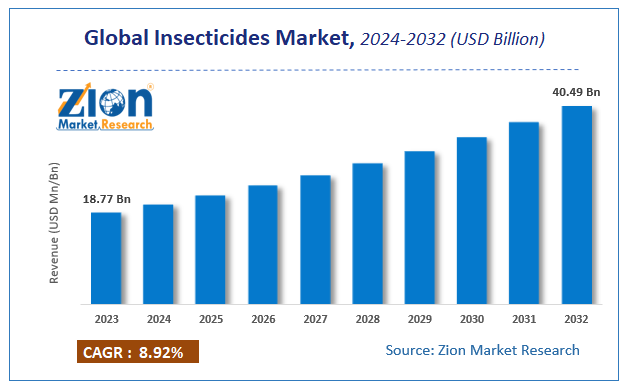
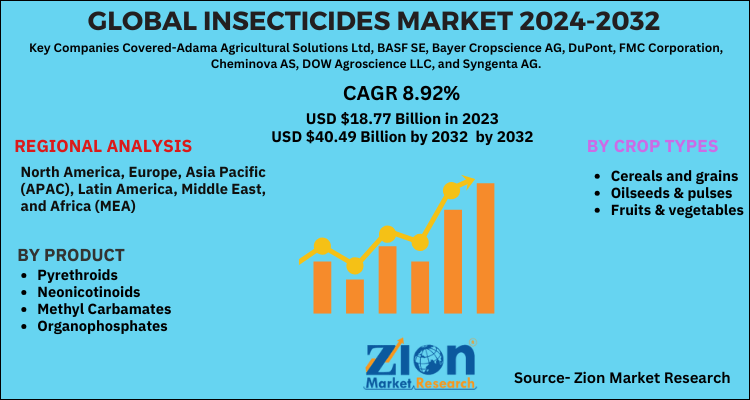
The global insecticides market size was worth around USD 18.77 billion in 2023 and is predicted to reach around USD 40.49 billion by 2032, with a compound annual growth rate (CAGR) of roughly 8.92% between 2024 and 2032.
This report provides a comprehensive analysis of the growth drivers, restraints, and challenges shaping demand across the global insecticides market throughout the forecast period, while highlighting high-potential emerging opportunities within the industry.
Key Insights
- As per the analysis shared by our research analyst, the insecticides market is estimated to grow annually at a CAGR of roughly 8.92% over the forecast period from 2024 to 2032.
- In terms of revenue, the global insecticides market size was valued at around USD 18.77 billion in 2023 and is projected to reach USD 40.49 billion by 2032.
- The insecticides market is driven by rising global food demand, declining arable farmland per capita, and the urgent need to prevent devastating crop yield losses from invasive insect infestations.
- By product, the organophosphates category accounted for the leading share of 34.6% in the global insecticides market because broad-spectrum efficacy, rapid knockdown kinetics, and cost-effective multi-crop pest control drive widespread adoption across major agricultural economies.
- By crop type, the cereals and grains category accounted for the largest share of 42.8% in the global insecticides market because staple crops like rice, wheat, and corn are cultivated across vast acreage and face intense vulnerability to stem borers, armyworms, and grain-destroying beetles.
- Asia Pacific dominated the global insecticides market with a revenue share of 43.5% because tropical climatic conditions foster year-round pest multiplication alongside extensive production of staple cereals like paddy and commercial cash crops across India and China.
Insecticides Market: Overview
Insecticides kill crop-damaging insects. The market includes many types of insecticides, including organic insecticides, repellents, non-repellent insecticides, and inorganic insecticides, among others. They have a range of applications, including agriculture, medical, industrial, and household uses.
Insecticides are specialty chemical products used to destroy or inhibit the growth of insects such as mites, ticks, spiders, rats, and mice. Selective insecticides target specific pests while leaving the desired crop relatively unharmed. Pesticides are also used in agriculture, floriculture, horticulture, various industrial applications, and public health. Insecticides are used in agriculture, gardens, and homes.
However, most of the pesticides are hazardous to humans. Farmers must take great care when using pesticides. Farmers must wear a mask, gloves, and a coat to prevent skin contact. In developed countries, farmers often use airplanes to spray insecticides to prevent any contact between the human body and the insecticides. This method also covers large farm areas quickly. Farmers usually rent airplanes during farming season. Different type of insects requires different types of insecticides.
Insecticides Market: Growth Drivers
What factors are primarily accelerating demand in the insecticides market?
The growing commercial pest management service sector and rising concerns about insect-borne diseases are among the main drivers of the global insecticides market. Rising food demand due to population growth is one of the primary drivers of global insecticides market growth. Rising urbanization and lowering per capita farmland due to industrialization are additionally boosting the global insecticides market.
Insecticides demand has been growing gradually owing to the increasing need for better crop production and growing pest threats. Climate change is a major factor driving the growth of crop pests, crop diseases, and weeds. Climate changes such as rising temperatures or water shortages lead to increased insect and disease outbreaks. Thus, there is a constant need to introduce new types of insecticides to the market. Furthermore, growing demand for home and garden insecticides is expected to drive growth in the insecticides market during the forecast period. Different practices have emerged, such as pest management, organic farming, genetically modified crops, and crop rotation. These practices may hamper the insecticides market in near future due to their advanced and less toxic impact on the environment.
Insecticides Market: Restraints
What factors are limiting the expansion of the insecticides market?
Alternative practices such as integrated pest management, organic farming, genetically modified crops, and crop rotation may hamper the market because of their advanced and less toxic impact on the environment.
Many insecticides are hazardous to humans, requiring intensive safety measures during application. Regulatory restrictions and the discontinuation of certain organophosphate products in some markets can also constrain volume in specific segments.
Insecticides Market: Opportunities
Where do significant growth opportunities lie for the insecticides market?
The ongoing need for higher crop yields and protection against climate-driven pest pressure creates opportunities for both established and newer insecticide chemistries. Expansion of commercial pest control services and public health applications further supports demand.
Development and introduction of products suited to major crop systems, including cereals and grains, and solutions that balance efficacy with improved safety profiles open additional avenues for market growth.
Insecticides Market: Challenges
What key challenges confront participants in the insecticides market?
Ensuring safe application and minimizing human and environmental exposure remain critical challenges. Farmers must use protective equipment, and some developed markets use aerial spraying to reduce contact and improve coverage.
Regulatory scrutiny, resistance management, and competition from alternative pest control methods require continuous product stewardship and innovation to maintain market relevance.
Insecticides Market: Report Scope
| Report Attributes | Report Details |
|---|---|
| Report Name | Insecticides Market |
| Market Size in 2023 | USD 18.77 Billion |
| Market Forecast in 2032 | USD 40.49 Billion |
| Growth Rate | CAGR of 8.92% |
| Number of Pages | 227 |
| Key Companies Covered | Adama Agricultural Solutions Ltd, BASF SE, Bayer CropScience AG, DuPont, FMC Corporation, Cheminova AS, DOW Agroscience LLC, and Syngenta AG. |
| Segments Covered | By Product, By Crop Type, and By Region |
| Regions Covered | North America, Europe, Asia Pacific (APAC), Latin America, Middle East, and Africa (MEA) |
| Base Year | 2023 |
| Historical Year | 2018 - 2022 |
| Forecast Year | 2024 - 2032 |
| Customization Scope | Avail customized purchase options to meet your exact research needs. Request For Customization |
Insecticides Market: Segmentation
The insecticides market is segmented by product, crop types, and region. All the segments of the insecticides market have been analyzed based on present and future trends, and the market is estimated from 2024 to 2032.
Based on Product Segment, the insecticides market is divided into pyrethroids, neonicotinoids, methyl carbamates, organophosphates, and others. Organophosphates are projected to dominate the market during the forecast period because of their cost-effectiveness and ability to be applied across a wide range of crops and targeted uses. This leadership supports overall market growth by anchoring demand in agriculture, homes, gardens, and related applications, while pyrethroids remain widely used because they are highly effective even at low application rates. Several organophosphates have been discontinued in the past decade, yet the class remains important where permitted and cost-efficient performance is required.
Based on Crop Type Segment, the insecticides market is divided into cereals and grains, oilseeds and pulses, fruits and vegetables, and others. Cereals and grains are projected to dominate during the forecast period due to high production volumes and substantial pest pressure in major growing regions. This dominance drives market expansion by linking insecticide consumption to staple crop protection needs, particularly in tropical and high-production areas, while oilseeds, pulses, fruits, and vegetables contribute additional demand across diverse agricultural systems.
Insecticides Market: Regional Analysis
Why will Asia Pacific continue to dominate the global market during the projection period?
Asia Pacific rules the global insecticides market and has historically accounted for a substantial share of total revenue. Insecticides are widely employed to control insects in the region because tropical conditions provide a favorable environment for insect growth. High production of cereals such as paddy and cotton, particularly in India, further supports demand. Constraints on insecticide use in North America and Europe, along with a focus on genetically modified crops, also reinforce relative reliance on chemical control in parts of Asia. This regional leadership drives overall market growth by generating large application volumes, sustaining product demand across major crop systems, and influencing global supply, formulation, and stewardship practices.
Europe and North America hold significant shares, with relatively constrained utilization in some systems due to emphasis on genetically modified crops and alternative practices. The Middle East and Africa and Latin America are expected to see solid growth as agricultural and pest-control needs expand.
Recent Developments
- On October 1, 2014, ADAMA Agricultural Solutions Ltd. and CNAC (China National Agrochemical Corporation) announced a definitive agreement for ADAMA to acquire control of businesses in China with substantial sales, a transaction that significantly affected the global insecticides market.
-
In January 2024, Syngenta AG secured regulatory clearance for a novel, next-generation insecticide active ingredient engineered to combat resistant sucking pests across cotton and specialty vegetable crops with minimal impact on beneficial insects.
Insecticides Market: Competitive Landscape
The global insecticides market is dominated by players
- Adama Agricultural Solutions Ltd
- BASF SE
- Bayer CropScience AG
- DuPont, FMC Corporation
- Cheminova AS
- DOW Agroscience LLC
- Syngenta AG
Segments Covered
The global Insecticides market is segmented as follows
By Product
- Pyrethroids
- Neonicotinoids
- Methyl Carbamates
- Organophosphates
- Others
By Crop Type
- Cereals and grains
- Oilseeds & pulses
- Fruits & vegetables
- Others
By Region
- North America
- The U.S.
- Canada
- Mexico
- Europe
- France
- The UK
- Spain
- Germany
- Italy
- Rest of Europe
- Asia Pacific
- China
- Japan
- India
- Australia
- South Korea
- Rest of Asia Pacific
- The Middle East & Africa
- Saudi Arabia
- UAE
- Egypt
- Kuwait
- South Africa
- Rest of the Middle East & Africa
- Latin America
- Brazil
- Argentina
- Rest of Latin America
Table Of Content
Methodology
FrequentlyAsked Questions
Insecticides are biological or synthetic chemical agents specifically formulated to eliminate, control, or deter insect pests, safeguarding agricultural crop yields, stored grain commodities, and human habitats from pest-induced damage and vector-borne infections.
Key growth drivers include rising global food demand from a growing population, shrinking per-capita arable land, the expanding geographic spread of invasive pests due to climate shifts, and the economic need to prevent devastating harvest losses.
The global insecticides market was valued at approximately USD 18.77 billion in 2023 and is predicted to reach around USD 40.49 billion by 2032.
The global insecticides market is projected to expand at a compound annual growth rate (CAGR) of roughly 8.92% over the forecast period from 2024 to 2032.
Asia Pacific is the largest contributor to overall market value because of its extensive cultivated acreage for staple grains, tropical weather patterns that foster year-round pest multiplication, and intensive agricultural output across India and China.
The major players leveraging market growth include Adama Agricultural Solutions Ltd., BASF SE, Bayer CropScience AG, DuPont, FMC Corporation, Cheminova AS, Dow AgroSciences LLC, Syngenta AG, Nufarm Limited, UPL Limited, Sumitomo Chemical Co., Ltd., Corteva Agriscience, American Vanguard Corporation, Ishihara Sangyo Kaisha, Ltd., and Marrone Bio Innovations.
The report provides a thorough quantitative and qualitative evaluation of historic revenue trends, market drivers and restraints, supply chain economics, segment breakdowns, competitive intelligence, and strategic regional growth projections through 2032.

HappyClients

