
Global Ice Pops Market Size, Share, Growth Analysis Report - Forecast 2034

Ice Pops Market By Type (Fruit Ice Pops, Dairy Ice Pops, Sugar-free Ice Pops), By Flavor (Chocolate, Vanilla, Mango, Strawberry, Others), By Application (Residential, Commercial, Institutional), By Distribution Channel (Supermarkets/Hypermarkets, Convenience Stores, Online Retailers), and By Region: Global and Regional Industry Overview, Market Intelligence, Comprehensive Analysis, Historical Data, and Forecasts 2025 - 2034
| Market Size in 2024 | Market Forecast in 2034 | CAGR (in %) | Base Year |
|---|---|---|---|
| USD 4.98 Billion | USD 8.57 Billion | 5.2% | 2024 |
How big is the Ice Pops Market?
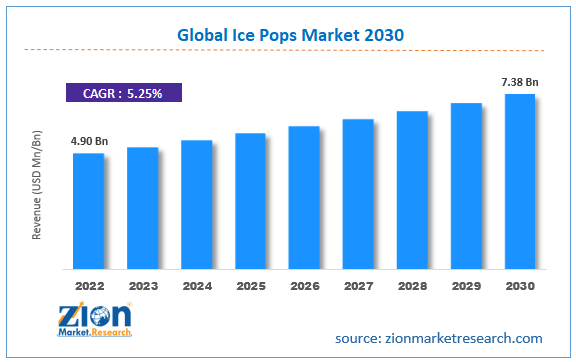
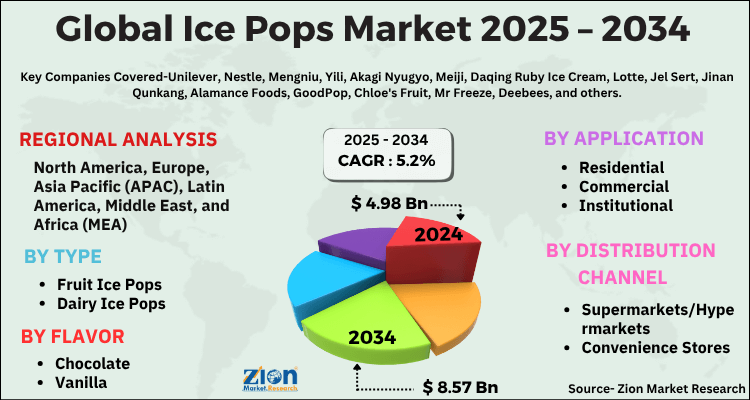
The global ice pops market size was worth around USD 4.98 Billion in 2024 and is predicted to grow to around USD 8.57 Billion by 2034 with a compound annual growth rate (CAGR) of roughly 5.2% between 2025 and 2034. The report analyzes the global ice pops market's drivers, restraints/challenges, and the effect they have on the demands during the projection period. In addition, the report explores emerging opportunities in the ice pops industry.
Ice Pops Market: Overview
A frozen treat on a stick made of liquid is known as an ice pop. An ice pop is "quiescently" frozen, or frozen when at rest, and turns into a solid block of ice, unlike ice cream or sorbet, which are churned while freezing to avoid ice crystal formation. It is held by the stick, which serves as a handle. The frozen food item would be a freezie if there was no stick. Ice pops, commonly referred to as frozen snacks, are a fun way to cool down in the summer. Popsicles, ice lollipops, flavored ice pops, and dairy-free ice pops are cool frozen treats that come in a variety of flavors and come in a sweet and frosty shape, making them ideal for beating the heat. To offer consumers a broad variety of taste options, artificial flavors are occasionally employed in ice pops. Increased customer desire for cool frozen delights like ice pops supports the ice pop market expansion of ice pops throughout the anticipated timeframe.
Key Insights
- As per the analysis shared by our research analyst, the global ice pops market is estimated to grow annually at a CAGR of around 5.2% over the forecast period (2025-2034).
- Regarding revenue, the global ice pops market size was valued at around USD 4.98 Billion in 2024 and is projected to reach USD 8.57 Billion by 2034.
- The ice pops market is projected to grow at a significant rate due to rising demand for convenient, refreshing, and healthier snack options, evolving consumer preferences for natural and innovative flavors, and increasing disposable incomes, especially in emerging economies.
- Based on Type, the Fruit Ice Pops segment is expected to lead the global market.
- On the basis of Flavor, the Chocolate segment is growing at a high rate and will continue to dominate the global market.
- Based on the Application, the Residential segment is projected to swipe the largest market share.
- By Distribution Channel, the Supermarkets/Hypermarkets segment is expected to dominate the global market.
- Based on region, North America is predicted to dominate the global market during the forecast period.
Ice Pops Market: Dynamics
Key Growth Drivers:
The ice pops market is primarily driven by the increasing consumer preference for convenient, refreshing, and affordable frozen snacks, especially during hot weather seasons. Rising disposable incomes and changing lifestyles have boosted the demand for ready-to-eat and on-the-go products, contributing to market growth. The introduction of innovative flavors, natural ingredients, and healthier formulations such as low-sugar, dairy-free, and fruit-based ice pops has attracted health-conscious consumers. Moreover, the growing popularity of premium and artisanal ice pops, supported by attractive packaging and creative marketing strategies, is further enhancing market expansion across both developed and emerging economies.
Restraints:
The ice pops market faces restraints such as fluctuating raw material prices, particularly of fruits, dairy, and sweeteners, which can affect production costs and profit margins. Additionally, the high sugar content in traditional ice pops raises health concerns among consumers, leading to reduced demand from those prioritizing healthy diets. Seasonal dependency is another limiting factor, as sales tend to decline during colder months. Moreover, intense competition among local and international brands makes it challenging for smaller players to sustain in the market, while storage and transportation requirements under controlled temperatures add to operational expenses.
Opportunities:
Emerging markets in Asia-Pacific, Latin America, and the Middle East offer lucrative growth opportunities for the ice pops industry due to rising urbanization, westernization of food habits, and increasing consumer spending on frozen desserts. The growing trend of clean-label and organic products provides an avenue for brands to develop ice pops made from natural ingredients without artificial additives or preservatives. Expanding retail distribution channels, including e-commerce platforms and convenience stores, further supports market penetration. Additionally, innovation in packaging, portion control, and eco-friendly materials presents opportunities to attract environmentally conscious consumers and enhance brand differentiation.
Challenges:
The ice pops market faces challenges related to maintaining product quality and consistency during transportation and storage, especially in regions with underdeveloped cold chain infrastructure. Regulatory restrictions concerning food labeling, artificial colors, and preservatives can complicate product formulation and compliance. Increasing competition from alternative frozen desserts, such as ice creams, sorbets, and frozen yogurts, also poses a challenge to market share. Furthermore, sustainability concerns related to plastic packaging and environmental impact compel manufacturers to invest in eco-friendly solutions, which may increase production costs and affect pricing strategies.
Ice Pops Market: Report Scope
| Report Attributes | Report Details |
|---|---|
| Report Name | Ice Pops Market |
| Market Size in 2024 | USD 4.98 Billion |
| Market Forecast in 2034 | USD 8.57 Billion |
| Growth Rate | CAGR of 5.2% |
| Number of Pages | 211 |
| Key Companies Covered | Unilever, Nestle, Mengniu, Yili, Akagi Nyugyo, Meiji, Daqing Ruby Ice Cream, Lotte, Jel Sert, Jinan Qunkang, Alamance Foods, GoodPop, Chloe's Fruit, Mr Freeze, Deebees, and others. |
| Segments Covered | By Type, By Flavor, By Application, By Distribution Channel, and By Region |
| Regions Covered | North America, Europe, Asia Pacific (APAC), Latin America, The Middle East and Africa (MEA) |
| Base Year | 2024 |
| Historical Year | 2020 to 2023 |
| Forecast Year | 2025 - 2034 |
| Customization Scope | Avail customized purchase options to meet your exact research needs. Request For Customization |
Ice Pops Market: Segmentation
The global Ice Pops industry is segmented based on type, flavor, application, distribution channel, and region.
Based on the type, the global market is bifurcated into fruit ice pops, dairy ice pops, and sugar-free ice pops. The fruit ice pops segment is expected to dominate the market during the forecast period owing to the health benefits. Fruit ice pops are a great source of vitamins, minerals, antioxidants, and dietary fiber, depending on the fruits used. For instance, berries are known for their high antioxidant content. In addition, compared to traditional ice pops, which can be high in empty calories from sugars and artificial additives, fruit ice pops are generally lower in calories and offer more nutritional value. Thus, driving the segment expansion.
Based on the flavor, the ice pop industry is bifurcated into chocolate, vanilla, mango, strawberry, and others.
Based on the application, the market is bifurcated into residential, commercial, and institutional.
Based on the distribution channel, the global ice pop industry is bifurcated into supermarkets/hypermarkets, convenience stores, and online retailers. The supermarkets/hypermarkets segment is expected to hold the largest market share over the forecast period. Supermarkets and hypermarkets offer a diverse selection of ice pops, including various flavors, sizes, and brands. This wide range allows consumers to choose products that suit their preferences and dietary requirements. Moreover, these retail outlets often run promotions, discounts, and bundle deals on ice pops, especially during peak seasons like summer. This encourages consumers to purchase larger quantities and try new flavors. Thereby, driving the segment growth over the forecast period.
The Regional, this segment includes the current and forecast demand for North America, Europe, Asia Pacific, Latin America,and the Middle East and Africa.
Ice Pops Market: Regional Analysis
North America is expected to dominate the market during the forecast period
North America is expected to dominate the global ice pop market during the forecast period. Ice pop demand varies seasonally in North America, with summer months seeing the highest levels of consumption. Depending on the locale, this seasonality might differ, with hotter regions having more constant demand. Moreover, a growing number of variables, including customer desire, convenience, and taste, are driving up demand for ice pops and other frozen delicious foods. Most notably during the summer months, consumers are searching for convenient and healthful cuisine. Ice pop sales have been impacted by an emphasis on health and fitness.
Consumers are searching for products with clean, natural, and healthy labeling, such as ice pops produced from actual fruit or those that have been substantially fortified with vitamins and minerals. To cater to consumer tastes, ice pop manufacturers in North America release a broad array of flavors and inventive combinations. This covers goods that meet special dietary criteria or play a role in the natural and organic alternatives market. For instance, the French introduced Ketchup ice pops in North America in June 2024. These ice pops were made in association with the Happy Pops brand using only Canadian tomatoes. Thus, driving the market growth over the forecast period.
Ice Pops Market: Competitive Analysis
The report provides a company market share analysis to give a broader overview of the key market players. In addition, the report also covers key strategic developments of the market, including acquisitions & mergers, new product launches, agreements, partnerships, collaborations & joint ventures, research & development, and regional expansion of major participants involved in the ice pops market on a global and regional basis.
The global Ice Pops market is dominated by players like:
- Unilever
- Nestle
- Mengniu
- Yili
- Akagi Nyugyo
- Meiji
- Daqing Ruby Ice Cream
- Lotte
- Jel Sert
- Jinan Qunkang
- Alamance Foods
- GoodPop
- Chloe's Fruit
- Mr Freeze
- Deebees
The global Ice Pops market is segmented as follows:
By Type
- Fruit Ice Pops
- Dairy Ice Pops
- Sugar-free Ice Pops
By Flavor
- Chocolate
- Vanilla
- Mango
- Strawberry
- Others
By Application
- Residential
- Commercial
- Institutional
By Distribution Channel
- Supermarkets/Hypermarkets
- Convenience Stores
- Online Retailers
By Region
- North America
- The U.S.
- Canada
- Mexico
- Europe
- France
- The UK
- Spain
- Germany
- Italy
- Rest of Europe
- Asia Pacific
- China
- Japan
- India
- Australia
- South Korea
- Rest of Asia Pacific
- The Middle East & Africa
- Saudi Arabia
- UAE
- Egypt
- Kuwait
- South Africa
- Rest of the Middle East & Africa
- Latin America
- Brazil
- Argentina
- Rest of Latin America
Table Of Content
Methodology
FrequentlyAsked Questions
A frozen treat on a stick made of liquid is known as an ice pop. An ice pop is "quiescently" frozen, or frozen when at rest, and turns into a solid block of ice, unlike ice cream or sorbet, which are churned while freezing to avoid ice crystal formation. It is held by the stick, which serves as a handle. The frozen food item would be a freezie if there was no stick.
The global ice pops market is expected to grow due to growing popularity of natural and organic flavors, rising consumer demand for refreshing and convenient frozen snacks, expanding retail distribution channels, and innovative product offerings catering to health-conscious consumers.
According to a study, the global ice pops market size was worth around USD 4.98 Billion in 2024 and is expected to reach USD 8.57 Billion by 2034.
The global ice pops market is expected to grow at a CAGR of 5.2% during the forecast period.
North America is expected to dominate the ice pops market over the forecast period.
Leading players in the global ice pops market include Unilever, Nestle, Mengniu, Yili, Akagi Nyugyo, Meiji, Daqing Ruby Ice Cream, Lotte, Jel Sert, Jinan Qunkang, Alamance Foods, GoodPop, Chloe's Fruit, Mr Freeze, Deebees, among others.
The report explores crucial aspects of the ice pops market, including a detailed discussion of existing growth factors and restraints, while also examining future growth opportunities and challenges that impact the market.

HappyClients

