
Global Hybrid Drivetrain Market Size, Share Report, Growth, Trends, and Forecasts 2032

Hybrid Drivetrain Market By Component (PHEV and HEV), By Level (PHEV, Full HEV, and Mild HEV), By Type (Parallel, Series-Parallel, and Series), and By Region: Global and Regional Industry Overview, Market Intelligence, Comprehensive Analysis, Historical Data, and Forecasts 2024 - 2032
| Market Size in 2023 | Market Forecast in 2032 | CAGR (in %) | Base Year |
|---|---|---|---|
| USD 107.71 Billion | USD 326.16 Billion | 13.1% | 2023 |
Hybrid Drivetrain Market: Industry Perspective
What will be the global Hybrid Drivetrain market size during the forecast period?
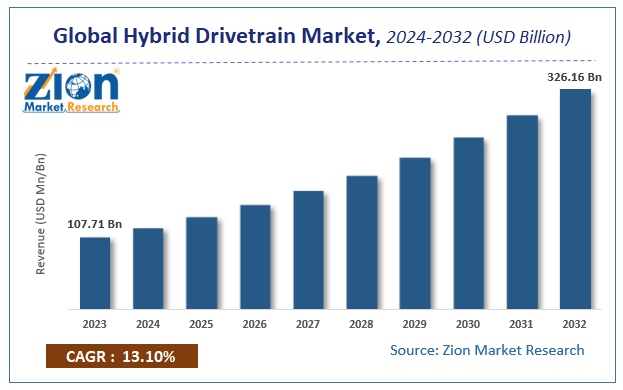
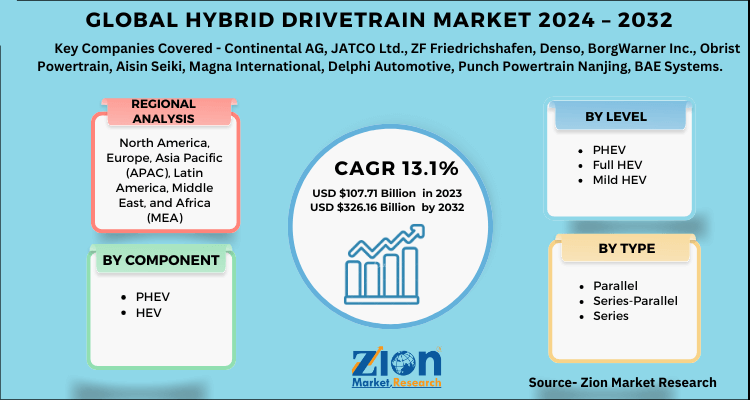
According to a report from Zion Market Research, the global Hybrid Drivetrain Market was valued at USD 107.71 billion in 2023 and is projected to hit USD 326.16 billion by 2032, with a compound annual growth rate (CAGR) of 13.10% during the forecast period 2024-2032. The Hybrid Drivetrain Market is driven by stringent governmental carbon emission mandates and rising consumer preference for fuel-efficient hybrid propulsion systems.
This report provides a comprehensive analysis of the growth drivers, restraints, and challenges shaping demand across the global market throughout the forecast period, while highlighting high-potential emerging opportunities within the industry.
Hybrid Drivetrain Market: Overview
A hybrid drivetrain is an advanced vehicular propulsion architecture that integrates an internal combustion engine with one or more electric motor-generators and an energy storage system to optimize performance and efficiency. This integrated powertrain relies on sophisticated electronic control modules, dedicated hybrid transmissions, and power electronics to intelligently apportion mechanical and electrical tractive effort. By capturing kinetic energy through regenerative braking and modulating load points on the combustion engine, hybrid drivetrains drastically minimize energy dissipation. They provide an immediate, practical bridge between conventional hydrocarbon-fueled vehicles and zero-emission battery electric platforms, eliminating range anxiety while complying with strict greenhouse gas mitigation targets.
Key Insights
- As per the analysis shared by our research analyst, the global hybrid drivetrain market is estimated to grow annually at a CAGR of roughly 13.10% over the forecast period (2024-2032).
- In terms of revenue, the global hybrid drivetrain market size was valued at around USD 107.71 billion in 2023 and is projected to reach USD 326.16 billion by 2032.
- The global hybrid drivetrain market is driven by tightening corporate average fuel economy standards, escalating hydrocarbon fuel prices, and consumer demand for transitional low-emission transport options.
- Based on the Component segment, the HEV segment dominated the global market in 2023
- Based on the Level segment, the Full HEV segment held the largest market share of nearly 52.8% in 2023
- Based on the Type segment, the Parallel hybrid drivetrain architecture dominated the global market with a share of approximately 48.6% in 2023
- Asia Pacific dominated the hybrid drivetrain market with a commanding revenue share of around 44.5% in 2024 due to high passenger vehicle sales volumes and early technological adoption by Japanese and Korean automotive giants
Hybrid Drivetrain Market: Dynamics
Growth Drivers
How are stricter global automotive emission norms accelerating hybrid drivetrain adoption?
Governmental bodies across key global markets are continually ratifying aggressive automotive decarbonization roadmaps, compelling original equipment manufacturers to curb tailpipe emissions across fleet portfolios. Regimes such as the European Union Euro 7 mandates, the United States Corporate Average Fuel Economy revisions, and China 6b regulations impose steep monetary penalties on vehicle manufacturers exceeding specific carbon emission thresholds. Hybrid drivetrains provide an immediately viable pathway to comply with these benchmarks without requiring buyers to navigate the currently inadequate fast-charging public infrastructure. Consequently, automakers are actively deploying parallel and series-parallel hybrid powertrains across high-volume passenger vehicles and light commercial fleets.
Furthermore, escalating volatility in retail fossil fuel prices has catalyzed consumer interest in fuel-efficient vehicular alternatives. Modern hybrid drivetrains optimize engine thermal efficiency by switching off the internal combustion unit during idling, coasting, and low-speed urban commuting while relying on regenerative braking to recover lost kinetic energy. This operational economy directly translates into lower total cost of ownership for motorists over extended operational lifespans. As consumers demand higher fuel economy without sacrificing long-distance road trip dependability, hybrid drivetrain architectures remain the most practical, cost-effective, and commercially attractive mobility solution available on the global market.
Restraints
Why do elevated component architectures and packaging complexities hold back market expansion?
The primary restraint curbing broader hybrid drivetrain integration lies in the heightened engineering complexity and cost structure associated with dual-propulsion machinery. Unlike conventional single-source drivetrains, hybrid platforms require internal combustion engines, high-torque traction motors, bi-directional inverters, dedicated hybrid transmissions, and battery packs to coexist within limited engine bay envelopes. Integrating these disparate mechanical and high-voltage electrical sub-assemblies inflates upfront production expenses, which ultimately elevates the retail acquisition price for end consumers.
In addition to direct production costs, the added mass and structural re-engineering required to house hybrid transmissions and secondary battery packs present severe packaging hurdles. Automakers must redesign vehicle crash structures, suspension dynamics, and thermal dissipation channels to accommodate high-voltage electronics safely. These architectural adjustments prolong model development cycles and necessitate capital-intensive retooling across legacy assembly facilities. For cost-sensitive vehicle segments and price-conscious developing markets, the resultant price disparity continues to present a considerable barrier against rapid, widespread adoption.
Hybrid Drivetrain Market: Report Scope
| Report Attributes | Report Details |
|---|---|
| Report Name | Hybrid Drivetrain Market |
| Market Size in 2023 | USD 107.71 Billion |
| Market Forecast in 2032 | USD 326.16 Billion |
| Growth Rate | CAGR of 13.1% |
| Number of Pages | 210 |
| Key Companies Covered | Continental AG, JATCO Ltd., ZF Friedrichshafen, Denso, BorgWarner Inc., Obrist Powertrain, Aisin Seiki, Magna International, Delphi Automotive, Punch Powertrain Nanjing, BAE Systems, and Hofer Powertrain |
| Segments Covered | By Component, By Level, By Type, and By Region |
| Regions Covered | North America, Europe, Asia Pacific (APAC), Latin America, Middle East, and Africa (MEA) |
| Base Year | 2023 |
| Historical Year | 2018 - 2022 |
| Forecast Year | 2024 - 2032 |
| Customization Scope | Avail customized purchase options to meet your exact research needs. Request For Customization |
Hybrid Drivetrain Market: Segmentation
The hybrid drivetrain market is segmented by component, level, type, and region.
Based on Component Segment, the hybrid drivetrain market is divided into PHEV and HEV. The HEV component subsegment maintains undisputed dominance in the marketplace, closely followed by the PHEV subsegment as the second most prominent category. HEV drivetrains dominate because they deliver noticeable fuel savings without mandating access to dedicated grid charging infrastructure, making them exceptionally convenient for the global mass-market consumer base.
Based on Level Segment, the hybrid drivetrain market is divided into PHEV, Full HEV, Mild HEV, and others. The Full HEV level represents the most dominant category in this sector, while Mild HEV stands firmly as the second most dominant subsegment. Full HEV powertrains dominate industry revenue because their architectural capability to switch dynamically into pure electric mode at low speeds delivers superior fuel efficiency in congested city driving conditions.
Based on Type Segment, the hybrid drivetrain market is divided into Parallel, Series-Parallel, Series, and others. The Parallel hybrid drivetrain architecture emerges as the most dominant structural approach, followed by the Series-Parallel configuration as the second most dominant category. Parallel configurations dominate because they allow both the combustion engine and the electric motor to transfer tractive torque directly to the driven wheels through a common transmission coupler, maintaining mechanical simplicity and high highway cruising efficiency
Hybrid Drivetrain Market: Regional Analysis
Why will Asia Pacific continue to dominate the global market during the projection period?
Asia Pacific maintains an unrivaled leadership position within the global hybrid drivetrain arena, spearheaded predominantly by the industrial dominance of Japan, China, and South Korea. Japanese automotive conglomerates established early commercial foundations for hybrid power systems, creating mature domestic supply ecosystems, deep technical patent portfolios, and refined high-volume manufacturing competencies. The regional market is heavily reinforced by robust consumer appetite for dependable, high-efficiency personal mobility, alongside supportive national regulatory frameworks that incentivize vehicle electrification.
Moreover, the extensive presence of major Tier-1 drivetrain, semiconductor, and battery cell manufacturers across East Asia provides a resilient supply chain framework that lowers localized assembly costs, spurs persistent engineering innovations, and anchors the global expansion of advanced hybrid propulsion platforms.
Hybrid Drivetrain Market: Competitive Analysis
The global hybrid drivetrain market is dominated by players:
- Continental AG
- JATCO Ltd.
- ZF Friedrichshafen
- Denso
- BorgWarner Inc.
- Obrist Powertrain
- Aisin Seiki
- Magna International
- Delphi Automotive
- Punch Powertrain Nanjing
- BAE Systems
- Hofer Powertrain
The global hybrid drivetrain market is segmented as follows:
By Component
- PHEV
- HEV
By Level
- PHEV
- Full HEV
- Mild HEV
By Type
- Parallel
- Series-Parallel
- Series
By Region
- North America
- The U.S.
- Canada
- Mexico
- Europe
- France
- The UK
- Spain
- Germany
- Italy
- Rest of Europe
- Asia Pacific
- China
- Japan
- India
- Australia
- South Korea
- Rest of Asia Pacific
- The Middle East & Africa
- Saudi Arabia
- UAE
- Egypt
- Kuwait
- South Africa
- Rest of the Middle East & Africa
- Latin America
- Brazil
- Argentina
- Rest of Latin America
Table Of Content
Methodology
FrequentlyAsked Questions
A hybrid drivetrain is an advanced automotive powertrain system that pairs an internal combustion engine with one or more electric traction motors, an inverter unit, and an energy storage system.
The primary growth drivers fueling the hybrid drivetrain market include intensifying international government emission mandates, rising corporate average fuel economy targets, volatile global fossil fuel prices, and strong consumer demand for fuel-efficient vehicles that bypass the immediate constraints of dedicated charging infrastructure.
The global hybrid drivetrain market size was valued at approximately USD 107.71 billion in 2023 and is projected to expand significantly to reach an estimated valuation of USD 326.16 billion by the end of 2032.
The global hybrid drivetrain market is projected to register a compound annual growth rate (CAGR) of roughly 13.1% across the forecast period.
Market players such as Continental AG, JATCO Ltd., ZF Friedrichshafen, Denso, BorgWarner Inc., Obrist Powertrain, Aisin Seiki, Magna International, Delphi Automotive, Punch Powertrain Nanjing, BAE Systems, and Hofer Powertrain
Key restraining factors hindering market growth encompass elevated initial manufacturing costs, complex vehicle packaging integration, added curb weight from dual powertrains, and complex thermal management requirements across intertwined internal combustion and high-voltage electrical components.
Notable emerging trends influencing the market include the widespread commercial transition toward Dedicated Hybrid Transmissions, the incorporation of 800V high-voltage platforms in plug-in hybrids, and the adoption of high-efficiency silicon-carbide power inverters that maximize power density and minimize thermal waste.
The Asia Pacific region will contribute most prominently to the global market valuation, driven by high automotive manufacturing volumes, supportive regional regulatory frameworks, and deep consumer adoption across major markets including Japan, China, and South Korea.
The value chain spans raw material sourcing (rare earth elements, copper, lithium), component manufacturing (inverters, electric motors, planetary gears, electronic control units), subsystem integration into hybrid transaxles by Tier-1 suppliers, final vehicle assembly by automotive OEMs, and downstream distribution through dealership sales and aftermarket servicing networks.
The global hybrid drivetrain market report provides an exhaustive assessment of industry dynamics, quantitative market sizing from 2018 to 2032, competitive market share intelligence, qualitative regional evaluations, value chain analysis, and strategic profiling of top component innovators navigating future automotive electrification demands.

HappyClients

