
Global Fluid Couplings Market Size, Share, Trends, Growth 2032

Fluid Couplings Market By Type (Constant-fill Fluid Couplings, and Variable Speed Fluid Couplings), By End-Use (Mining, Chemicals & Petrochemicals, Cement, Steel & Metal Processing, Paper, Paperboards, Packaging & Labeling, and Power Generation), and By Region - Global and Regional Industry Overview, Market Intelligence, Comprehensive Analysis, Historical Data, and Forecasts 2024 - 2032
| Market Size in 2023 | Market Forecast in 2032 | CAGR (in %) | Base Year |
|---|---|---|---|
| USD 71.52 Billion | USD 126.06 Billion | 6.5% | 2023 |
Fluid Couplings Market: Industry Perspective
What will be the global fluid couplings market size during the forecast period?
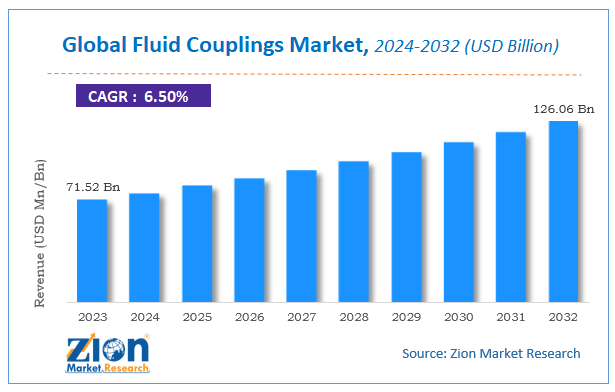
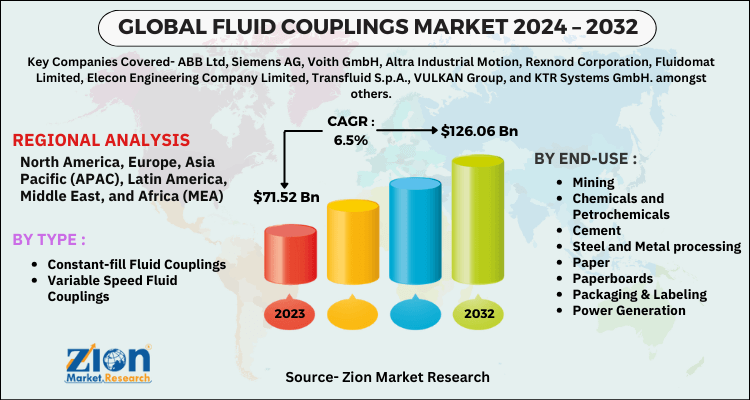
The global fluid couplings market size was worth around USD 71.52 billion in 2023 and is predicted to reach around USD 126.06 billion by 2032, with a compound annual growth rate (CAGR) of roughly 6.5% between 2024 and 2032.
Key Insights
- As per the analysis shared by our research analyst, the global fluid couplings market is estimated to grow annually at a CAGR of around 6.5% over the forecast period (2024-2032).
- In terms of revenue, the global fluid couplings market size was valued at around USD 71.52 billion in 2023 and is projected to reach USD 126.06 billion by 2032.
- The market is driven by superior advantages including smooth power transmission, overload protection, and high efficiency owing to low slip at rated duty, along with major applications in the oil and gas industry and equipment such as reciprocating pumps, crushers, feeders, belt conveyors, process pumps, compressors, diesel locomotives, boiler feed pumps, and extruders.
- Based on the type segment, constant-fill fluid couplings are expected to lead due to their widespread use for start-up applications to limit torque and torsional vibration in the drive chain.
- Based on the end-use segment, cement is expected to remain a key demand area, supported by infrastructure development and rising cement production, particularly in Asia Pacific.
- Asia Pacific is expected to contribute notably, driven by increasing demand for cement in countries such as India and China linked to infrastructure development, along with superior efficiency and maintenance flexibility of fluid couplings.
Fluid Couplings Market: Overview
Fluid couplings, also called hydraulic couplings or torque converters, use fluid dynamics to transfer rotational power between two shafts. They are commonly used in mechanical systems to connect a driven load, such as a pump or fan, to a power supply, such as a motor. Fluid couplings enable smooth acceleration, reduce mechanical stress, and protect equipment.
Fluid Couplings Market: Growth Factors
What factors are primarily accelerating demand in the fluid couplings market?
The global fluid couplings market is likely to grow significantly in the coming years and is expected to grow at a steady rate during the forecast period. The fluid couplings market has enormous scope due to its advantages, advanced applications, and growing demand. Smooth power transmission, overload protection, and high efficiency due to low slip at rated duty are key advantages of fluid couplings that will significantly propel the market globally.
Fluid couplings have major applications in the oil and gas industry, a key driver of the fluid couplings market. These couplings are primarily used in reciprocating pumps, crushers, feeders, belt conveyors, process pumps, compressors, diesel locomotives, boiler feed pumps, and extruders, creating strong demand in this market.
Fluid Couplings Market: Restraints
What factors are limiting the expansion of the fluid couplings market?
Availability of substitutes such as variable frequency drives may replace fluid couplings in electric motors in some applications.
The cost incurred for manufacturing fluid couplings is high compared with variable frequency drives, which can influence purchasing decisions in cost-sensitive installations.
Fluid Couplings Market: Opportunities
Where do significant growth opportunities lie for the fluid couplings market?
Rising demand for cement production linked to infrastructure development, particularly in Asia Pacific markets such as India and China, creates opportunities for fluid couplings used in related heavy equipment.
Superior efficiency and maintenance flexibility of fluid couplings support continued adoption in mining, power generation, steel and metal processing, and other heavy industrial applications where smooth start-up and overload protection are valued.
Fluid Couplings Market: Challenges
What key challenges confront participants in the fluid couplings market?
Competition from alternative drive technologies, including variable frequency drives, requires fluid coupling suppliers to emphasize performance advantages such as overload protection and suitability for heavy-duty start-up conditions.
Cost competitiveness and the need to demonstrate total cost of ownership benefits in industrial environments remain ongoing considerations for market participants.
Fluid Couplings Market: Report Scope
| Report Attributes | Report Details |
|---|---|
| Report Name | Fluid Couplings Market |
| Market Size in 2023 | USD 71.52 Billion |
| Market Forecast in 2032 | USD 126.06 Billion |
| Growth Rate | CAGR of 6.5% |
| Number of Pages | 220 |
| Key Companies Covered | ABB Ltd, Siemens AG, Voith GmbH, Altra Industrial Motion, Rexnord Corporation, Fluidomat Limited, Elecon Engineering Company Limited, Transfluid S.p.A., VULKAN Group, and KTR Systems GmbH. amongst others |
| Segments Covered | By Type, By End-Use, and By Region |
| Regions Covered | North America, Europe, Asia Pacific (APAC), Latin America, Middle East, and Africa (MEA) |
| Base Year | 2023 |
| Historical Year | 2018 - 2022 |
| Forecast Year | 2024 - 2032 |
| Customization Scope | Avail customized purchase options to meet your exact research needs. Request For Customization |
Fluid Couplings Market: Segmentation
The fluid couplings market is segmented by type, end-use, and region. All the segments of the fluid couplings market have been analyzed based on present and future trends and the market is estimated from 2024 to 2032.
Based on Type Segment, the fluid couplings market is divided into constant-fill fluid couplings and variable speed fluid couplings. Constant-fill fluid couplings are expected to lead because they are widely utilized for start-up applications to limit torque and torsional vibration in the drive chain. This leadership supports overall market growth by addressing critical needs for smooth acceleration and equipment protection in heavy industrial drives, while variable speed fluid couplings contribute by monitoring and controlling the speed of driven machines and providing smooth acceleration under heavy belt loads.
Based on End-Use Segment, the fluid couplings market is divided into mining, chemicals and petrochemicals, cement, steel and metal processing, paper, paperboards, packaging and labeling, and power generation. Cement is expected to remain a key demand area because production is rising with infrastructure development, especially in major Asia Pacific markets. This focus drives market expansion by connecting fluid coupling demand to heavy process equipment in cement plants, while mining, power generation, steel and metal processing, and chemicals and petrochemicals continue to generate substantial volume through applications in crushers, conveyors, pumps, and compressors.
Fluid Couplings Market: Regional Analysis
Why will Asia Pacific continue to contribute notably to the global market during the projection period?
Asia Pacific is expected to contribute notably to the fluid couplings market. Rising demand for cement production driven by infrastructure development, particularly in India and China, is a crucial factor supporting regional growth. Increased use of heavy equipment in cement, mining, and related industries raises the need for reliable power transmission solutions. Superior efficiency and maintenance flexibility of fluid couplings further support adoption. This regional momentum drives overall market growth by increasing equipment volumes, encouraging deployment of both constant-fill and variable-speed couplings, and reinforcing demand patterns that influence global supply and technology development in heavy industrial applications.
North America and Europe maintain demand linked to established heavy industry, power generation, and process sectors. Latin America and the Middle East and Africa are progressing as mining, cement, and industrial activity expands, creating additional opportunities for fluid coupling applications.
Recent Developments
-
In March 2024, Voith GmbH & Co. KGaA announced the global rollout of an upgraded digital condition-monitoring package for its hydrodynamic fluid coupling product portfolio, allowing industrial operators to monitor fluid temperature and rotational slip in real time via cloud-connected mobile interfaces.
Fluid Couplings Market: Competitive Analysis
The global fluid couplings market is dominated by players:
- ABB Ltd
- Siemens AG
- Voith GmbH
- Altra Industrial Motion
- Rexnord Corporation
- Fluidomat Limited
- Elecon Engineering Company Limited
- Transfluid S.p.A.
- VULKAN Group
- KTR Systems GmbH
Fluid Couplings Market: Key Trends
What are the key trends in the fluid couplings market?
Demand for smooth start-up and overload protection
Constant-fill and variable speed fluid couplings continue to be valued for limiting torque and torsional vibration during start-up and for protecting driven equipment under heavy loads across mining, cement, and process industries.
Infrastructure-linked industrial growth
Expansion of cement production and infrastructure development, particularly in Asia Pacific, supports higher demand for fluid couplings used in crushers, conveyors, pumps, and related heavy equipment.
Segments Covered
This report segments the global fluid couplings market as follows:
By Type
- Constant-fill Fluid Couplings
- Variable Speed Fluid Couplings
By End-Use
- Mining
- Chemicals and Petrochemicals
- Cement
- Steel and Metal Processing
- Paper
- Paperboards
- Packaging & Labeling
- Power Generation
By Region
- North America
- The U.S.
- Canada
- Mexico
- Europe
- France
- The UK
- Spain
- Germany
- Italy
- Rest of Europe
- Asia Pacific
- China
- Japan
- India
- Australia
- South Korea
- Rest of Asia Pacific
- The Middle East & Africa
- Saudi Arabia
- UAE
- Egypt
- Kuwait
- South Africa
- Rest of the Middle East & Africa
- Latin America
- Brazil
- Argentina
- Rest of Latin America
Table Of Content
Methodology
FrequentlyAsked Questions
Fluid couplings, also called hydraulic couplings or torque converters, use fluid dynamics to transfer rotational power between two shafts. They are often used in mechanical systems to connect a driven load, such as a pump or fan, to a power supply, such as a motor. Fluid couplings can enable smooth acceleration, reduce mechanical stress, and protect equipment.
The demand for fluid couplings is driven by increased industrial activity, including expansion in the manufacturing and heavy machinery sectors, to enable efficient, seamless power transmission. Market growth is also driven by expanding construction and mining activities, which require heavy equipment that uses fluid couplings.
The global fluid couplings market size was evaluated at $71.52 billion in 2023 and is slated to hit $126.06 billion by the end of 2032.
The global fluid couplings market a CAGR of nearly 6.5% between 2024 and 2032.
Asia Pacific is expected to contribute notably, supported by rising cement demand in India and China linked to infrastructure development and by the efficiency and maintenance flexibility of fluid couplings.
Major players include ABB Ltd, Siemens AG, Voith GmbH, Altra Industrial Motion, Rexnord Corporation, Fluidomat Limited, Elecon Engineering Company Limited, Transfluid S.p.A., VULKAN Group, and KTR Systems GmbH.
The report provides comprehensive analysis of market size, growth drivers, restraints, opportunities, segmentation by type and end-use, regional dynamics, competitive landscape, and future outlook for the period 2024-2032.

HappyClients

