
Excitation Systems Market Size, Share, Trends, Growth 2032

Excitation Systems Market By Type (Brushless and Static), By Controller Type (Digital and Analog), By Application (Synchronous Motors and Synchronous Generators), By End-User (OEMs Heavy Industries, and Power Generation), And By Region - Global And Regional Industry Overview, Market Intelligence, Comprehensive Analysis, Historical Data, And Forecasts 2024 - 2032
| Market Size in 2023 | Market Forecast in 2032 | CAGR (in %) | Base Year |
|---|---|---|---|
| USD 3.09 Billion | USD 4.59 Billion | 4.5% | 2023 |
Description
Excitation Systems Industry Perspective:
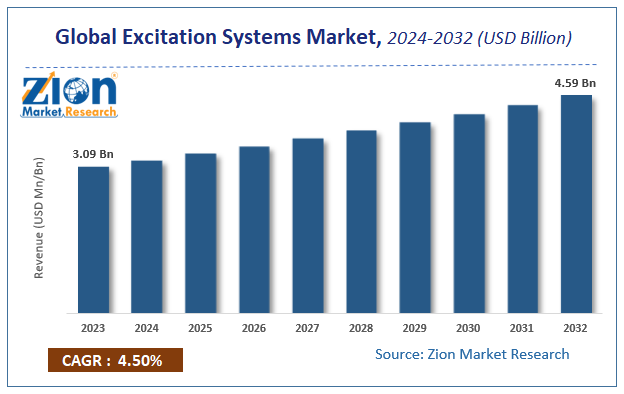
According to the report published by Zion Market Research, the global Excitation Systems Market size was valued at USD 3.09 Billion in 2023 and is predicted to reach USD 4.59 Billion by the end of 2032. The market is expected to grow with a CAGR of 4.5% during the forecast period.
The report analyzes the global Excitation Systems Market's growth drivers, restraints, and impact on demand during the forecast period. It will also help navigate and explore the arising opportunities in the Excitation Systems industry.
Global Excitation Systems Market: Overview
Excitation systems are the systems that provide DC to the field winding of a generator. In other words, they are fundamental to the operation of modern synchronous machines. The modern excitation systems also consist of diagnostics functions to make troubleshooting, communication protocols for SCADA integration simpler, and limiter/protection functions to make sure that the generator is functioning within its capability curve.
Global Excitation Systems Market: Growth Factors
The global excitation systems market is growing at a substantial rate. Factors that are fostering the growth of the global market include an increase in the use of synchronous machines, expanding use of excitation systems in power generation, and rapid industrialization in developing countries. The excitation systems reduce set-up time with high-tech software, offline simulator aids to detect and troubleshoot the logic without any need for expensive physical hardware, and advanced microprocessor-based design offers reliable operation, flexibility, and visionary expand-ability for any system. In addition to this, these systems consist of several features such as outstanding voltage regulation accuracy, precise excitation control for synchronous motor applications or synchronous generators, automatic field current regulation or voltage regulation, configurable protection, load sharing over Ethernet, exciter diode monitoring, and many more.
Thus, most of the industries are investing in excitation systems to procure all these benefits with better ROI which in turn is spurring the growth of the global excitation systems market. Moreover, the growing demand for generators equipped with the PMG excitation systems, rise in investment in R&D, and expanding use of brushless systems are propelling the growth of the global market. Furthermore, technological advancements for the innovation of products may create ample opportunities for the growth of the global excitation systems market over the forecast period. However, high maintenance costs due to complex designs of excitation systems may restrain the growth of the global excitation systems market.
COVID-19 pandemic badly impacted the growth of the excitation systems market globally. The excitation systems market is mainly affected due to the halt on the device manufacturing process by major market players across the world. This is due to stringent lockdowns imposed by several governments to curb the spread of the infection. Strict lockdowns have not only affected the manufacturing process but also affected the sale of the products due to disruption of the supply chain and distributor network. In addition, restrictions on transportation and personnel movements also contributed to the slow growth of the market in the pandemic period. The global excitation systems market is expected to grow with low CAGR as the second and third wave of infection is predicted in many regions across the world.
Global Excitation Systems Market: Segmentation
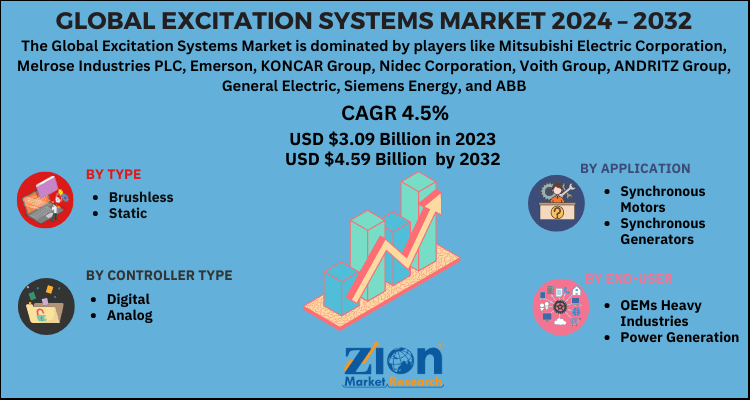
The global excitation systems market is bifurcated based on type, controller type, application, end-user, and region.
Based on type, the global excitation systems market is split into brushless and static.
The controller type segment is categorized into digital and analog.
The application segment is bifurcated as synchronous motors and synchronous generators.
The end-user segment is categorized based on OEMs heavy industries, and power generation.
Excitation Systems Market: Report Scope
| Report Attributes | Report Details |
|---|---|
| Report Name | Excitation Systems Market |
| Market Size in 2023 | USD 3.09 Billion |
| Market Forecast in 2032 | USD 4.59 Billion |
| Growth Rate | CAGR of 4.5% |
| Number of Pages | 202 |
| Key Companies Covered | Mitsubishi Electric Corporation, Melrose Industries PLC, Emerson, KONCAR Group, Nidec Corporation, Voith Group, ANDRITZ Group, General Electric, Siemens Energy, and ABB |
| Segments Covered | By type, By controller type, By application, By end-user and By Region |
| Regions Covered | North America, Europe, Asia Pacific (APAC), Latin America, Middle East, and Africa (MEA) |
| Base Year | 2023 |
| Historical Year | 2018 - 2022 |
| Forecast Year | 2024 - 2032 |
| Customization Scope | Avail customized purchase options to meet your exact research needs. Request For Customization |
Global Excitation Systems Market: Regional Analysis
Asia Pacific is expected to hold the maximum share of the global excitation systems market over the forecast period. China, India, and Japan are expected to be the largest revenue contributor in the Asia Pacific region. Major factors that are contributing to the large share of the market include increasing government initiatives and funding on renewable energy sources and growing demand for excitation systems in rapidly growing manufacturing industries. Whereas, excitation systems market growth in North America is expected to remain steady. North America is expected to contribute a significant share in the global excitation systems market over the forecast period.
Excitation Systems Market: Competitive Analysis
The global excitation systems market is led by players like:
- Mitsubishi Electric Corporation
- Melrose Industries PLC
- Emerson
- KONCAR Group
- Nidec Corporation
- Voith Group
- ANDRITZ Group
- General Electric
- Siemens Energy
- ABB
The global excitation systems market is segmented as follows:
By Type
- Brushless
- Static
By Controller Type
- Digital
- Analog
By Application
- Synchronous Motors
- Synchronous Generators
By End-User
- OEMs Heavy Industries
- Power Generation
By Region
- North America
- The U.S.
- Canada
- Mexico
- Europe
- France
- The UK
- Spain
- Germany
- Italy
- Rest of Europe
- Asia Pacific
- China
- Japan
- India
- Australia
- South Korea
- Rest of Asia Pacific
- The Middle East & Africa
- Saudi Arabia
- UAE
- Egypt
- Kuwait
- South Africa
- Rest of the Middle East & Africa
- Latin America
- Brazil
- Argentina
- Rest of Latin America
What Reports Provides
- Full in-depth analysis of the parent market
- Important changes in market dynamics
- Segmentation details of the market
- Former, on-going, and projected market analysis in terms of volume and value
- Assessment of niche industry developments
- Market share analysis
- Key strategies of major players
- Emerging segments and regional markets
- Testimonials to companies in order to fortify their foothold in the market.
Table Of Content

FrequentlyAsked Questions
Excitation systems are used in generators to control the magnetic field and output voltage. They help maintain system stability and improve power generation efficiency.
The global Excitation Systems market is expected to be driven by the Growth is supported by upgrades in power generation plants, demand for grid stability, and expansion of transmission infrastructure. Modern digital excitation systems improve generator control, efficiency, and compliance.
According to study, the global Excitation Systems market size was worth around USD 3.09 Billion in 2023 and is predicted to grow to around USD 4.59 Billion By 2032.
The global Excitation Systems market is expected to grow at a Compound Annual Growth Rate (CAGR) of around CAGR 4.5% during the forecast period from 2024-2032.
The global Excitation Systems industry is projected to be challenged by Challenges include long replacement cycles, high reliability requirements, and dependency on large utility and industrial project spending.
The Opportunities include power plant modernization, grid stability initiatives, upgrades for hydro and thermal generators, and demand from emerging market generation projects will offer significant growth opportunities in the Excitation Systems market.
Digital excitation with advanced controls for grid stability; condition monitoring and predictive maintenance; integration for renewables, hybrid plants, and grid code compliance are the emerging trends and innovations impacting the Excitation Systems market.
The global Excitation Systems market is expected to be led by APAC during the forecast period.
Some of the prominent players operating in the global Excitation Systems market are; Mitsubishi Electric Corporation, Melrose Industries PLC, Emerson, KONCAR Group, Nidec Corporation, Voith Group, ANDRITZ Group, General Electric, Siemens Energy, and ABB and others.
The report explores crucial aspects of the Excitation Systems market, including a detailed discussion of existing growth factors and restraints, while also browsing future growth opportunities and challenges that impact the market.
HappyClients

