
Global Endodontic Devices Market Size Share, Growth and Forecast 2032

Endodontic Devices Market By Product (Consumables and Instruments), By End-User (Dental Hospitals, Dental Clinics, Dental Academic & Research Institutes, and Others), and By Region - Global and Regional Industry Overview, Market Intelligence, Comprehensive Analysis, Historical Data, and Forecasts 2024 - 2032
| Market Size in 2023 | Market Forecast in 2032 | CAGR (in %) | Base Year |
|---|---|---|---|
| USD 1454.44 Million | USD 2195.18 Million | 4.68% | 2023 |
Endodontic Devices Industry Perspective
What will be the global endodontic devices market size during the forecast period?
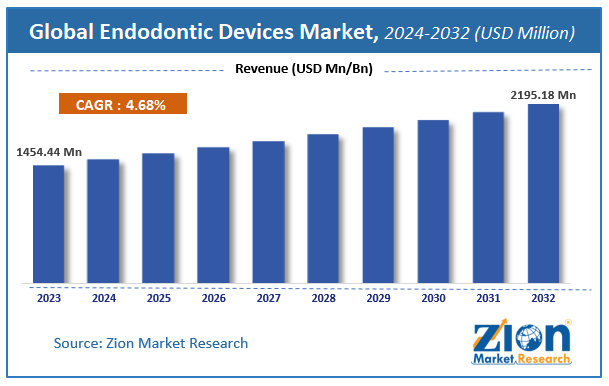
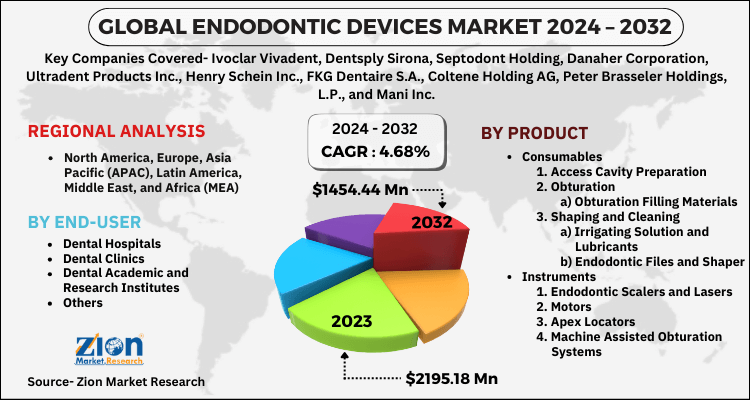
The global endodontic devices market size was valued at around USD 1454.44 million in 2023 and is projected to reach about USD 2195.18 million by 2032, with a compound annual growth rate (CAGR) of roughly 4.68% between 2024 and 2032.
This report provides a comprehensive analysis of the growth drivers, restraints, and challenges shaping demand across the global endodontic devices market throughout the forecast period, while highlighting high-potential emerging opportunities within the industry.
Key Insights
- As per the analysis shared by our research analyst, the global endodontic devices market is estimated to grow at a CAGR of approximately 4.68% during the forecast period from 2024 to 2032.
- In terms of revenue, the global endodontic devices market size was valued at around USD 1454.44 million in 2023 and is projected to reach USD 2195.18 million by 2032.
- The market is driven by a growing geriatric population, high prevalence of dental caries among children, increased awareness nd dental health maintenance, expanding research and development in developing countries, and increasing adoption of technologically advanced products.
- Based on the product, consumables dominate the market due to their repetitive use in root canal and related endodontic procedures, supporting consistent demand across clinical settings.
- Based on the end-user, dental clinics hold a leading position as patients and practitioners often prefer clinic-based care over hospital settings for endodontic treatments, fueling demand for devices in this channel.
- Regionally, Europe is expected to lead the endodontic devices market, supported by the growing prevalence of dental diseases among the geriatric population, strong awareness of advanced treatment technologies, and the introduction of technologically advanced products across the region.
Endodontic Devices Market: Overview
Endodontics embeds two Greek words: “endo,” referring to “inside,” and “odont,” referring to the tooth. Endodontics is a dental specialty where the inner part of the tooth is studied and treated. Dentists specializing in endodontics are known as endodontists. Endodontic devices consist of consumables and instruments, which are utilized for the treatment of endodontic diseases. Endodontic treatment is famously known as root canal treatment.
According to the WHO (World Health Organization), in 2010, about 524 million of the global population fell under the elderly category. This data is projected to reach around 2 billion by 2050. Aging affects the tooth enamel of the geriatric population, which, in turn, leads to the risk of different dental disorders among the geriatric population. The escalating geriatric population worldwide is mainly fueling the growth of the global endodontic devices market.
The growing prevalence of dental caries among children, growing research and development related to endodontic devices in developing countries, rising awareness regarding the maintenance of one’s dental health, and the development of technologically advanced products by companies are likely to fuel the growth of the global endodontic devices market in the upcoming years.
Endodontic Devices Market: Dynamics
Growth Drivers
What factors are accelerating the expansion of the endodontic devices market?
The escalating geriatric population is a primary growth driver. Aging affects tooth enamel and increases susceptibility to dental disorders, raising the need for endodontic evaluation and treatment. As the share of older adults continues to rise globally, demand for root canal procedures and related devices is expected to remain strong.
Additional drivers include the growing prevalence of dental caries among children, expanding research and development activities related to endodontic devices in developing countries, rising awareness of dental health maintenance, and the continuous introduction of technologically advanced products by leading companies. These factors collectively increase procedure volumes and encourage investment in modern consumables and instruments.
Restraints
What factors are limiting the growth of the endodontic devices market?
High costs associated with advanced endodontic instruments and materials can limit adoption in price-sensitive practices and regions. The need for specialized training to use newer rotary systems, apex locators, and obturation technologies may slow uptake among some clinicians. Availability of alternative treatments and variability in reimbursement or patient willingness to pay for complex procedures can also restrain market expansion in certain settings.
These constraints require manufacturers to balance innovation with affordability and to support education that helps clinicians integrate new devices effectively into daily practice.
Opportunities
What emerging opportunities exist in the endodontic devices market?
Growing dental care infrastructure and rising procedure volumes in emerging markets present significant opportunities. Increasing focus on minimally invasive techniques, improved file systems, bioceramic materials, and integrated motor and apex locator solutions supports product differentiation. Expansion of dental clinics and academic training programs further broadens the customer base for both consumables and instruments.
Manufacturers that combine clinical performance, ease of use, and reliable supply chains are well positioned to capture demand from clinics, hospitals, and educational institutions seeking modern endodontic solutions.
Challenges
What challenges does the endodontic devices market face?
Maintaining consistent product quality and clinical reliability across diverse practice environments remains important. Competition among established global suppliers and regional manufacturers intensifies pressure on pricing and innovation cycles. Ensuring adequate clinician training and demonstrating clear procedural benefits are ongoing requirements for successful product adoption and sustained market growth.
Endodontic Devices Market: Report Scope
| Report Attributes | Report Details |
|---|---|
| Report Name | Endodontic Devices Market |
| Market Size in 2023 | USD 1454.44 Million |
| Market Forecast in 2032 | USD 2195.18 Million |
| Growth Rate | CAGR of 4.68% |
| Number of Pages | 285 |
| Key Companies Covered | Ivoclar Vivadent, Dentsply Sirona, Septodont Holding, Danaher Corporation, Ultradent Products Inc., Henry Schein Inc., FKG Dentaire S.A., Coltene Holding AG, Peter Brasseler Holdings, L.P., and Mani Inc |
| Segments Covered | By Product, By End-User, and By Region |
| Regions Covered | North America, Europe, Asia Pacific (APAC), Latin America, Middle East, and Africa (MEA) |
| Base Year | 2023 |
| Historical Year | 2018 - 2022 |
| Forecast Year | 2024 - 2032 |
| Customization Scope | Avail customized purchase options to meet your exact research needs. Request For Customization |
Endodontic Devices Market: Segmentation
The endodontic devices market is segmented by product, end-user, and region. All the segments of the endodontic devices market have been analyzed based on present and future trends and the market is estimated from 2024 to 2032.
Based on Product, the endodontic devices market is divided into consumables and instruments. Consumables dominate the market because of their repetitive use in access cavity preparation, shaping and cleaning, irrigation, and obturation during root canal treatment. Files, irrigants, lubricants, and filling materials are required for nearly every procedure, generating consistent recurring demand. Instruments, including motors, apex locators, machine-assisted obturation systems, and endodontic lasers and scalers, support efficiency and precision. Adoption of advanced instrument systems continues to grow as clinicians seek improved control, safety, and workflow integration, reinforcing overall market development.
Based on End-User, the endodontic devices market is divided into dental hospitals, dental clinics, dental academic and research institutes, and others. Dental clinics hold a leading position due to high patient preference for clinic-based care for root canal and related treatments. Clinics typically perform a large volume of endodontic procedures and therefore represent a major channel for both consumables and instruments. Dental hospitals serve more complex cases and contribute steady demand. Academic and research institutes support training and evaluation of new technologies, helping to expand awareness and long-term adoption of advanced endodontic devices across the profession.
Endodontic Devices Market: Regional Insights
Why will Europe continue to dominate the global market during the projection period?
Europe is expected to lead the endodontic devices market. The region benefits from a growing prevalence of dental diseases among the geriatric population, high awareness of advanced treatment technologies, and the regular introduction of technologically sophisticated products. Well-developed dental care systems and strong clinical adoption of modern instruments and materials reinforce Europe’s position. These factors enable the region to drive standards of care, influence product development priorities, and support sustained demand that shapes global market trends and competitive activity.
North America maintains significant demand supported by advanced dental infrastructure, high procedure volumes, and early adoption of innovative endodontic systems. Asia Pacific is anticipated to record the highest growth rate, driven by rising dental caries among children and older adults, an expanding population of baby boomers, and the introduction of new products and technologies by leading companies. Latin America and the Middle East and Africa represent emerging opportunities where improving access to dental care and growing awareness of oral health are expected to support gradual market expansion.
Endodontic Devices Market: Competitive Space
Some key players of the global endodontic devices market include
- Ivoclar Vivadent
- Dentsply Sirona
- Septodont Holding
- Danaher Corporation
- Ultradent Products Inc
- Henry Schein Inc
- FKG Dentaire S.A
- Coltene Holding AG
- Peter Brasseler Holdings, L.P.
- Mani Inc
Segments Covered
This report segments the global endodontic devices market as follows:
By Product
- Consumables
- Access Cavity Preparation
- Obturation
- Obturation Filling Materials
- Others
- Shaping and Cleaning
- Irrigating Solution and Lubricants
- Endodontic Files and Shaper
- Others
- Instruments
- Endodontic Scalers and Lasers
- Motors
- Apex Locators
- Machine Assisted Obturation Systems
- Others
By End-User
- Dental Hospitals
- Dental Clinics
- Dental Academic and Research Institutes
- Others
By Region
- North America
- The U.S.
- Canada
- Mexico
- Europe
- France
- The UK
- Spain
- Germany
- Italy
- Rest of Europe
- Asia Pacific
- China
- Japan
- India
- Australia
- South Korea
- Rest of Asia Pacific
- The Middle East & Africa
- Saudi Arabia
- UAE
- Egypt
- Kuwait
- South Africa
- Rest of the Middle East & Africa
- Latin America
- Brazil
- Argentina
- Rest of Latin America
Table Of Content
Methodology
FrequentlyAsked Questions
Endodontic devices are specialized tools and materials used in endodontics, the dental specialty focused on the diagnosis, prevention, and treatment of diseases and injuries affecting the dental pulp and surrounding tissues. Root canal therapy is the most common procedure involving these devices.
The global endodontic devices market is driven by the escalating geriatric population, growing prevalence of dental caries among children, rising awareness of dental health, expanding research and development in developing countries, and the introduction of technologically advanced products by manufacturers.
The global endodontic devices market size was valued at approximately USD 1454.44 million in 2023 and is expected to reach around USD 2195.18 million by 2032.
The global endodontic devices market is expected to grow at a compound annual growth rate (CAGR) of approximately 4.68% during the forecast period from 2024 to 2032.
Europe is expected to lead and contribute notably to the global endodontic devices market, supported by dental disease prevalence among older adults, awareness of advanced technologies, and strong adoption of modern products.
Some of the major players leveraging the endodontic devices market growth are Ivoclar Vivadent, Dentsply Sirona, Septodont Holding, Danaher Corporation, Ultradent Products Inc., Henry Schein Inc., FKG Dentaire S.A., Coltene Holding AG, Peter Brasseler Holdings, L.P., and Mani Inc.

HappyClients

