
Disposable Lancets Market Trend, Share, Growth, Demand, Size and Forecast 2032

Disposable Lancets Market By Type (Homecare Disposable Lancets, Safety Disposable Lancets, and Others), By Application (Adults and Newborn), By End-User (Medical Device Companies, Pharmaceutical Industries, Hospitals, and Others), And By Region: Global Industry Perspective, Comprehensive Analysis And Forecast, 2024-2032
| Market Size in 2023 | Market Forecast in 2032 | CAGR (in %) | Base Year |
|---|---|---|---|
| USD 2.79 Billion | USD 6.01 Billion | 8.9% | 2023 |
What is the Market size of the Disposable Lancets Industry?
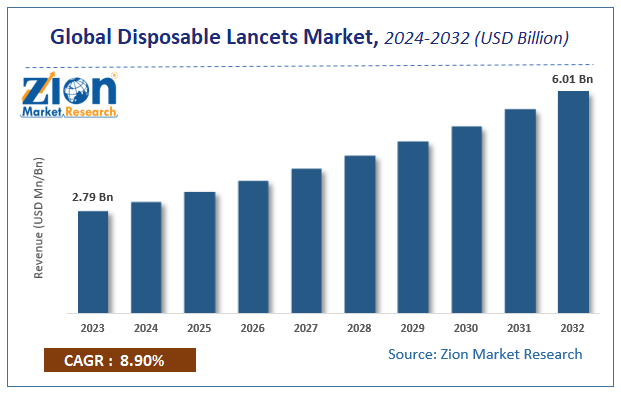
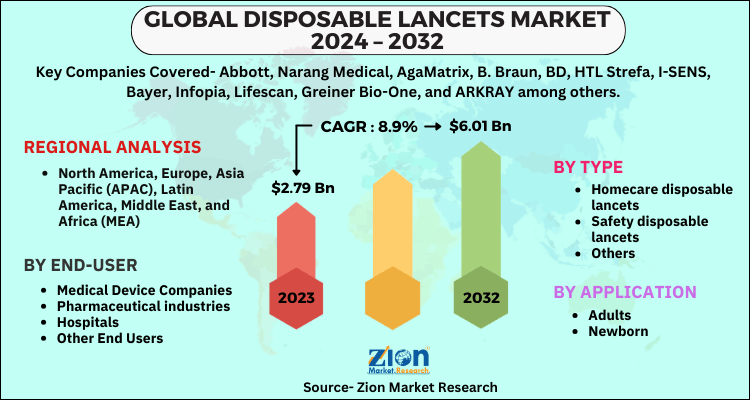
The global disposable lancets Market size was valued at USD 2.79 billion in 2023 and is predicted to reach USD 6.01 billion by the end of 2032. The market is expected to grow with a CAGR of 8.9% during the forecast period. The Disposable Lancets Market is driven by the growing global prevalence of diabetes and the rising demand for safe, hygienic blood sampling methods.
The report examines the primary drivers, challenges, and restraints shaping global demand for the disposable lancets market throughout the forecast period and identifies high-growth opportunities across the industry.
Disposable Lancets Market: Overview
Disposable lancets are small, sharp medical instruments designed to create a quick, precise, and minimally invasive puncture in the skin to obtain capillary blood samples. They are fundamentally engineered for single-use to ensure maximum hygiene, prevent cross-contamination, and protect patients and healthcare workers from bloodborne pathogens. Widely utilized in both clinical settings and home care environments, these devices are essential for routine diagnostic tests, such as blood glucose monitoring, cholesterol checks, and neonatal screening.
Modern disposable lancets often feature advanced safety mechanisms, such as automatic needle retraction, which instantly conceals the sharp point post-use to eliminate the risk of accidental needlestick injuries, thereby elevating the standard of patient and occupational safety.
Key Insights
- As per the analysis shared by our research analyst, the global disposable lancets market is estimated to grow annually at a CAGR of around 8.9% over the forecast period (2024-2032).
- In terms of revenue, the global disposable lancets market size was valued at around USD 2.79 billion in 2023 and is projected to reach USD 6.01 billion by 2032.
- The global market is driven by the increasing incidence of diabetes worldwide, heightened awareness regarding infection control, and the rising trend of home-based point-of-care testing.
- Based on the type, the safety disposable lancets segment dominated the global market with a significant share
- Based on the application, the adults segment dominated the global market with a major share
- Based on the end-user, the hospitals segment dominated the global market with a prominent share
- Based on region, North America dominated the global market with a massive share, attributed to its highly established healthcare infrastructure and high prevalence of lifestyle diseases
Disposable Lancets Market: Dynamics
Growth Drivers
How is the surging prevalence of diabetes driving the global market expansion?
Worldwide demand for disposable lancets is growing at a rapid pace. Global demand for disposable lancets is expected to be driven by a large population affected by severe medical conditions or diseases like dyslipidemia, diabetes, and hyperlipidemia. The procedure for using a disposable lancet is painless and convenient. It is useful in detecting fat levels, blood sugar levels, and hemoglobin. Furthermore, it is used to analyze essential blood components. Healthcare centers use disposable lancets to prevent the risk of diseases arising from blood transfusion. There is also an increase in R&D for the development of single-use lancets, which are also cost-effective and multipurpose.
Restraints
Why do environmental concerns regarding medical waste pose a significant market restraint?
A major restraint challenging the disposable lancets market is the escalating environmental concern associated with the massive generation of sharp medical waste and non-biodegradable plastics. Because lancets are strictly single-use to prevent cross-contamination, billions of these devices are discarded globally every year. The safe disposal of used lancets requires specialized sharps containers and strict waste management protocols to prevent environmental hazards and accidental injuries to sanitation workers. However, in many developing regions with inadequate medical waste infrastructure, improper disposal remains a severe issue, leading to significant environmental pollution and public health risks.
Disposable Lancets Market: Segmentation
The Disposable Lancets market is segmented by type, application, end-user, and region.
Based on type, the market is segmented into homecare disposable lancets, safety disposable lancets, and others. The safety disposable lancets segment unequivocally leads the global market, securing the maximum operational share. This overwhelming dominance is primarily fueled by stringent governmental and institutional regulations mandating the use of safety-engineered devices to prevent occupational needlestick injuries and the transmission of bloodborne pathogens among healthcare workers. These advanced lancets feature auto-retracting needles that permanently lock inside the casing post-puncture, making them indispensable in high-volume clinical settings.
Based on the Application, the Disposable Lancets market is divided into adults and newborns. The adults segment clearly dominates the global market landscape with a substantial share. This immense growth is directly credited to the extraordinarily high global prevalence of adult-onset chronic diseases, most notably Type 2 diabetes, which necessitates routine and frequent capillary blood sampling for disease management. Furthermore, the extensive use of lancets for adult preventative health screenings, such as cholesterol and infectious disease testing, solidifies this segment's commanding position.
Based on the End-User, the Disposable Lancets market is divided into medical device companies, pharmaceutical industries, hospitals, and other end users. Hospitals are the major end-user segment that dominated the market in terms of revenue in 2023 owing to a large number of diseases such as cholesterol, diabetes, and infections arising out of blood transfusion, that are treated using disposable lancets.
Disposable Lancets Market: Report Scope
| Report Attributes | Report Details |
|---|---|
| Report Name | Disposable Lancets Market |
| Market Size in 2023 | USD 2.79 Billion |
| Market Forecast in 2032 | USD 6.01 Billion |
| Growth Rate | CAGR of 8.9% |
| Number of Pages | 210 |
| Key Companies Covered | Abbott, Narang Medical, AgaMatrix, B. Braun, BD, HTL Strefa, I-SENS, Bayer, Infopia, Lifescan, Greiner Bio-One, and ARKRAY, among others |
| Segments Covered | By Type, By Application, By End-user, and By Region |
| Regions Covered | North America, Europe, Asia Pacific (APAC), Latin America, Middle East, and Africa (MEA) |
| Base Year | 2023 |
| Historical Year | 2018 - 2022 |
| Forecast Year | 2024 - 2032 |
| Customization Scope | Avail customized purchase options to meet your exact research needs. Request For Customization |
Disposable Lancets Market: Regional Analysis
Why will North America continue to dominate the global market during the projection period?
At the regional level, North America dominated the global disposable lancets market. The North American region is projected to lead the market over the forecast period, with progress mostly focused on the U.S. market. There are a large number of populations suffering from diseases such as hyperlipidemia, anemia, diabetes, and dyslipidemia. The sedentary lifestyle of people is increasing the growth of this market due to a rise in many diseases such as obesity and diabetes arising from an increase in intake of processed food products. Lack of exercise is further pushing the market to grow. Europe was the second-largest disposable lancets market in 2023 globally. The incomes of people earning are generally high, and the government's initiative for research and development and various health programs drive the growth of the market in this region. This has led to increased awareness among patients of preventive surgical treatment. There is an increasing demand for safer and painless retract devices. Testing of newborns and infants for diseases is compulsory due to the Healthcare Act and is a major factor driving the demand for disposable lancets in Europe.
Asia Pacific and the Middle East and Africa have a high prevalence of infections and diseases, especially among women and children. There are many companies manufacturing lancing devices. They are used to increase safety and hygiene. A growing number of health care centers, legislators, and health authorities, growing awareness among people, the introduction of reimbursement policies, a growing geriatric population, and increased government support for research centers to manufacture improved varieties of medical products are some of the factors driving the growth of the market. However, the lack of financial resources and an unstable economic environment are slowing down the growth of the disposable lancet market.
Disposable Lancets Market: Competitive Analysis
Some of the key players in the disposable lancets market include;
- Abbott
- Narang Medical
- AgaMatrix
- B. Braun
- BD
- HTL Strefa
- I-SENS
- Bayer
- Infopia
- Lifescan
- Greiner Bio-One
The global Disposable Lancets market is segmented as follows:
By Type
- Homecare Disposable Lancets
- Safety Disposable Lancets
- Others
By Application
- Adults
- Newborn
By End-User
- Medical Device Companies
- Pharmaceutical Industries
- Hospitals
- Other End Users
By Region
- North America
- The U.S.
- Canada
- Mexico
- Europe
- France
- The UK
- Spain
- Germany
- Italy
- Rest of Europe
- Asia Pacific
- China
- Japan
- India
- Australia
- South Korea
- Rest of Asia Pacific
- The Middle East & Africa
- Saudi Arabia
- UAE
- Egypt
- Kuwait
- South Africa
- Rest of the Middle East & Africa
- Latin America
- Brazil
- Argentina
- Rest of Latin America
Table Of Content
Methodology
FrequentlyAsked Questions
Disposable lancets are small medical devices used to prick the skin for blood sampling. They are single-use to ensure hygiene and safety.
The global disposable lancets market is expected to be driven by the rising diabetes prevalence, increased blood glucose monitoring, and demand for single-use medical devices.
According to study, the global disposable lancets market size was worth around USD 2.79 Billion in 2023 and is predicted to grow to around USD 6.01 Billion By 2032.
The global disposable lancets market is expected to grow at a Compound Annual Growth Rate (CAGR) of around CAGR 8.9% during the forecast period from 2024-2032.
The global disposable lancets industry is projected to be challenged by Major challenges include pricing pressure, regulatory compliance, and waste management concerns. Product differentiation is limited, intensifying competition.
The Opportunities include rising diabetes monitoring, safety-engineered designs, and home-use testing. Cost-effective mass production and infection-control standards sustain demand will offer significant growth opportunities in the disposable lancets market.
Ultra-thin and pain-reduction designs; safety-engineered retractable lancets; rising demand from home diagnostics are the emerging trends and innovations impacting the disposable lancets market.
North America is decisively anticipated to contribute majorly towards the global market value. This profound dominance is massively driven by a highly mature healthcare infrastructure, strict occupational safety mandates requiring safety-engineered devices, and a vast population requiring routine chronic disease management.
Some of the prominent players operating in the global disposable lancets market are; Abbott, Narang Medical, AgaMatrix, B. Braun, BD, HTL Strefa, I-SENS, Bayer, Infopia, Lifescan, Greiner Bio-One, and ARKRAY among others and others.
The report explores crucial aspects of the disposable lancets market, including a detailed discussion of existing growth factors and restraints, while also browsing future growth opportunities and challenges that impact the market.

HappyClients