
Digital Inverter Market Size, Trends, And Industry Share 2032

Digital Inverter Market By Application (Digital Inverter In An Air Conditioner, A Digital Inverter In A Washing Machine, A Digital Inverter In A Refrigerator, A Digital Inverter In Water Pumps, And Others), By Region - Global And Regional Industry Overview, market Intelligence, Comprehensive Analysis, Historical Data, And Forecasts 2024-2032
| Market Size in 2023 | Market Forecast in 2032 | CAGR (in %) | Base Year |
|---|---|---|---|
| USD 7.46 Billion | USD 14.07 Billion | 7.3% | 2023 |
Description
What is the projected value for the Digital Inverter Market during 2024 to 2032?
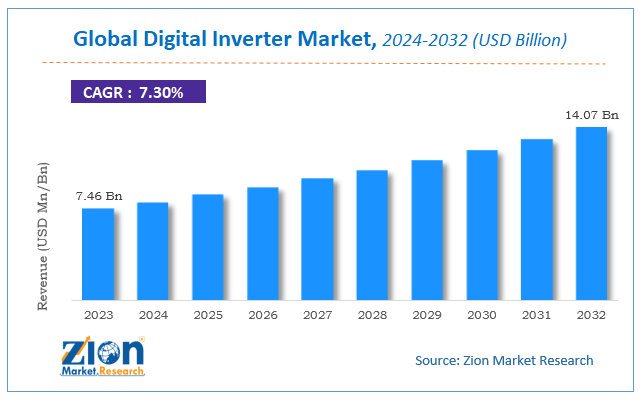
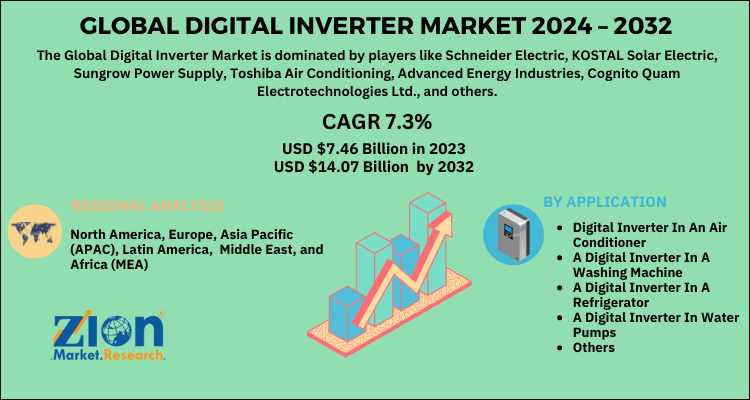
The global digital inverter market size was worth around USD 7.46 billion in 2023 and is predicted to grow to around USD 14.07 billion by 2032 with a compound annual growth rate (CAGR) of roughly 7.3% between 2024 and 2032.
The study provides historical data from 2018 to 2022 along with a forecast from 2024 to 2032 based on revenue (USD Billion). The report covers a forecast and an analysis of the Digital Inverter market on a global and regional level.
Digital Inverter Market: Overview
The digital inverter is the fundamental building block of several binary devices, thus it takes the binary input and returns the binary output. The digital inverter is implanted with components such as the compressor which is used in order to produce the DC output. When used in compressor it reduces the consumption of the energy and helps in managing the temperature.
Digital Inverter Market: Facts
Samsung has launched the refrigerator that consumes the solar energy with the help of the digital inverter. The new product by the Samsung S-Inverter Air Conditioner series also generates exceptional cooling comfort and consumes less power. It has an advanced new 8-pole motor in its digital inverter range which enables faster cooling and uses less energy.
Digital Inverter Market: Growth Factors
The key factors that are contributing to the growth of the digital inverter market are the rapid technological development in the energy utilization and the increasing need for the durability of the products. The digital inverters are being adopted at a significant rate owing to the limitations of the conventional products such as disruptive noises, abrupt start, and others. Other factors that positively affect the growth of the market are an increased rate of performance and the low maintenance cost. The inadequate exposure of the digital inverter in the global market acts as the major factor that limits the growth of digital inverter market. Owing to which there is limited usage of the digital inverter which is hindering the development of the digital inverter market.
Digital Inverter Market: Segmentation
The global market for the digital inverter is fragmented into its application and regions.
Based on the application, the market is segregated into the digital inverter in an air conditioner, a digital inverter in a washing machine, a digital inverter in a refrigerator, a digital inverter in water pumps, and others.
The regional diversification of the digital inverter is given by North America, Eastern Europe, Asia Pacific, Latin America, the Middle East and Africa, and Western Europe.
Digital Inverter Market: Report Scope
| Report Attributes | Report Details |
|---|---|
| Report Name | Digital Inverter Market |
| Market Size in 2023 | USD 7.46 Billion |
| Market Forecast in 2032 | USD 14.07 Billion |
| Growth Rate | CAGR of 7.3% |
| Number of Pages | 194 |
| Key Companies Covered | Schneider Electric, KOSTAL Solar Electric, Sungrow Power Supply, Toshiba Air Conditioning, Advanced Energy Industries, Cognito Quam Electrotechnologies Ltd., and others |
| Segments Covered | By Type, By Application, By End-Use Industry, By Technology and By Region |
| Regions Covered | North America, Europe, Asia Pacific (APAC), Latin America, Middle East, and Africa (MEA) |
| Base Year | 2023 |
| Historical Year | 2018 - 2022 |
| Forecast Year | 2024 - 2032 |
| Customization Scope | Avail customized purchase options to meet your exact research needs. Request For Customization |
Digital Inverter Market: Regional Analysis
The global digital inverter market is dominated by the North American region due to the increased rate of adoption of the developed technologies and the increasing use of the digital inverters in a wide range of applications. Asia Pacific region is developing rapidly in the digital inverters market owing to the increasing potential opportunities in the emerging economies such as China, India, and Japan. In the regions such as Europe and Latin America, there are several growth opportunities for the digital inverters market owing to the growth of the advanced technologies in these regions.
Digital Inverter Market: Competitive Players
The key market players that are involved in the digital inverter market include:
- Schneider Electric
- KOSTAL Solar Electric
- Sungrow Power Supply
- Toshiba Air Conditioning
- Advanced Energy Industries
- Cognito Quam Electrotechnologies Ltd.
- Others
The Global Digital Inverter Market is segmented as follows:
By Application
- Digital Inverter In An Air Conditioner
- A Digital Inverter In A Washing Machine
- A Digital Inverter In A Refrigerator
- A Digital Inverter In Water Pumps
- Others
By Region
- North America
- The U.S.
- Canada
- Mexico
- Europe
- France
- The UK
- Spain
- Germany
- Italy
- Rest of Europe
- Asia Pacific
- China
- Japan
- India
- Australia
- South Korea
- Rest of Asia Pacific
- The Middle East & Africa
- Saudi Arabia
- UAE
- Egypt
- Kuwait
- South Africa
- Rest of the Middle East & Africa
- Latin America
- Brazil
- Argentina
- Rest of Latin America
What Reports Provides
- Full in-depth analysis of the parent market
- Important changes in market dynamics
- Segmentation details of the market
- Former, on-going, and projected market analysis in terms of volume and value
- Assessment of niche industry developments
- Market share analysis
- Key strategies of major players
- Emerging segments and regional markets
- Testimonials to companies in order to fortify their foothold in the market.
Table Of Content

FrequentlyAsked Questions
A digital inverter is a power device that converts DC power to AC power using digital control. It improves energy efficiency and provides stable power output.
The global Digital Inverter market is expected to be driven by the Driven by rising adoption of energy-efficient power systems, growing use in appliances and industrial drives, and demand for stable power conversion. Growth in solar/backup power and EV charging infrastructure supports expansion.
According to study, the global Digital Inverter market size was worth around USD 7.46 Billion in 2023 and is predicted to grow to around USD 14.07 Billion By 2032.
The global Digital Inverter market is expected to grow at a Compound Annual Growth Rate (CAGR) of around CAGR 7.3% during the forecast period from 2024-2032.
The global Digital Inverter industry is projected to be challenged by Challenges include price competition, component shortages (power semiconductors), reliability concerns in harsh conditions, and need for skilled installation and service.
The Opportunities include rising renewable energy integration, growth in energy-efficient HVAC and appliances, expansion of solar inverters, and demand for stable power in emerging regions will offer significant growth opportunities in the Digital Inverter market.
SiC/GaN-enabled higher efficiency; smart inverters with grid-forming features; IoT monitoring and predictive maintenance in solar/industrial drives are the emerging trends and innovations impacting the Digital Inverter market.
The global Digital Inverter market is expected to be led by APAC during the forecast period.
Some of the prominent players operating in the global Digital Inverter market are; Schneider Electric, KOSTAL Solar Electric, Sungrow Power Supply, Toshiba Air Conditioning, Advanced Energy Industries, Cognito Quam Electrotechnologies Ltd., and others and others.
The report explores crucial aspects of the Digital Inverter market, including a detailed discussion of existing growth factors and restraints, while also browsing future growth opportunities and challenges that impact the market.
HappyClients

