
Data Annotation Service Market Size, Share, Trends, Growth 2034

Data Annotation Service Market By Type (Text Annotation, Image Annotation, Video Annotation, Audio Annotation, 3D Point Cloud Annotation, and Others), By Application (Autonomous Vehicles, Healthcare and Medical Imaging, Retail and E-commerce, Security and Surveillance, Natural Language Processing, Robotics), By Annotation Technique (Manual Annotation, Semi-Automated Annotation, Fully Automated Annotation), By End-User (Technology Companies, Automotive Industry, Healthcare Providers, Government Agencies, Research Institutions, Financial Services), By Deployment Mode (On-Premises, Cloud-Based, Hybrid), and By Region - Global and Regional Industry Overview, Market Intelligence, Comprehensive Analysis, Historical Data, and Forecasts 2025 - 2034
| Market Size in 2024 | Market Forecast in 2034 | CAGR (in %) | Base Year |
|---|---|---|---|
| USD 1.30 Billion | USD 14.40 Billion | 27.14% | 2024 |
Data Annotation Service Industry Perspective:
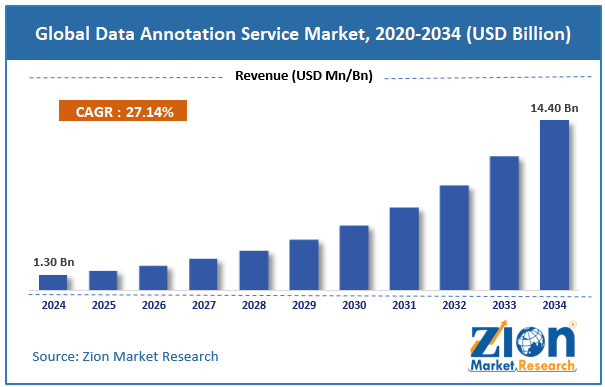
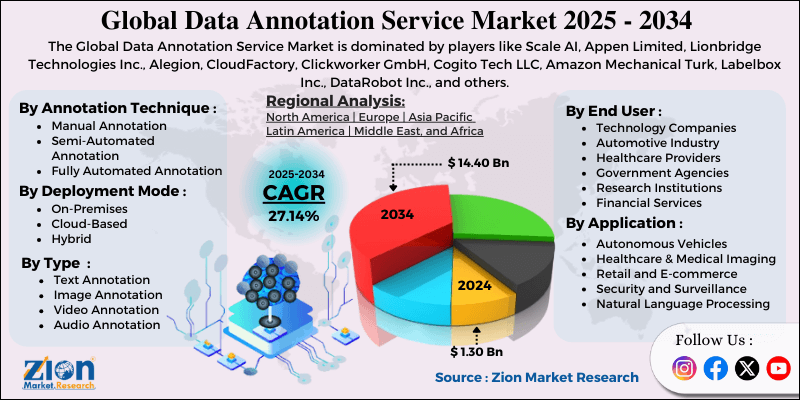
The global data annotation service market size was worth approximately USD 1.30 billion in 2024 and is projected to grow to around USD 14.40 billion by 2034, with a compound annual growth rate (CAGR) of roughly 27.14% between 2025 and 2034.
Key Insights
- As per the analysis shared by our research analyst, the global data annotation service market is estimated to grow annually at a CAGR of around 27.14% over the forecast period (2025-2034).
- In terms of revenue, the global data annotation service market size was valued at approximately USD 1.30 billion in 2024 and is projected to reach USD 14.40 billion by 2034.
- The data annotation service market is projected to grow significantly due to the rapid expansion of artificial intelligence applications, increasing investment in autonomous vehicle development, growing adoption of computer vision technologies, and rising demand for natural language processing capabilities.
- Based on type, the image annotation segment is expected to lead the data annotation service market, while the video annotation segment is anticipated to experience significant growth.
- Based on application, the autonomous vehicles segment is expected to lead the data annotation service market, while the healthcare and medical imaging segment is anticipated to witness notable growth.
- Based on the annotation technique, the manual annotation segment is the dominating segment, while the semi-automated annotation segment is projected to witness sizeable revenue over the forecast period.
- Based on end-user, the technology companies segment is expected to lead the market compared to the automotive industry segment.
- Based on region, North America is projected to dominate the global data annotation service market during the estimated period, followed by the Asia Pacific.
Data Annotation Service Market: Overview
Data annotation services refer to the process of adding labels, tags, and organized information to raw data so artificial intelligence and machine learning systems can understand and learn from it effectively. These services use trained human annotators or specialized tools to prepare images, text, audio, video, and other data for model training. Image annotation may involve drawing boxes around objects, outlining shapes, marking facial points, or classifying full images. Text annotation includes identifying names of people and places, understanding the tone in written content, recognizing user intentions, and linking related ideas. Video annotation involves tracking objects across frames, identifying actions, and marking important moments within a scene. Audio annotation includes speech transcription, speaker identification, sound labeling, and emotion detection in voice recordings. Three-dimensional point cloud annotation labels objects in space for uses such as autonomous vehicles and robotics. Quality checks ensure accuracy through reviews and validation steps. As artificial intelligence adoption increases, global demand for high-quality annotated data continues to grow rapidly.
The accelerating adoption of artificial intelligence across industries and the increasing complexity of machine learning applications are expected to drive growth in the data annotation service market throughout the forecast period.
Data Annotation Service Market Dynamics
Growth Drivers
Autonomous vehicle revolution
The data annotation service industry is growing quickly because autonomous vehicles require large datasets with precise labels to achieve safe and dependable driving performance. Self-driving systems must recognize vehicles, pedestrians, cyclists, road signs, traffic lights, lane markings, and road boundaries across many environments. Each recorded scene from cameras, radar, and LIDAR sensors needs detailed labels covering object type, position, orientation, and movement direction. Weather conditions, such as rain, fog, and snow, as well as changing light, create varied situations requiring accurate annotation for reliable model training.
Rare events, including construction zones, emergency vehicles, unusual pedestrian actions, and unexpected obstacles, require extra care during labeling. Three-dimensional point cloud data from LIDAR sensors needs skilled annotators who can identify boundaries in complex spatial layouts. Sensor fusion projects require synchronized labels across multiple data sources collected at the same moment. Regional driving differences require localized datasets created by annotators familiar with specific rules and environments.
How are expanding applications across healthcare and medical imaging driving the data annotation service market growth?
The global data annotation service market is expanding quickly as healthcare organizations use artificial intelligence to improve diagnosis, treatment planning, and overall patient care. Medical image annotation supports AI systems by labeling tumors, fractures, lesions, and anatomical structures in X-rays, CT scans, MRIs, and ultrasound images. Precise segmentation of organs and blood vessels requires medical knowledge to ensure meaningful clinical interpretation across many imaging scenarios. Pathology slide annotation labels cells, tissues, and disease patterns used for cancer detection and classification in laboratory environments.
Dermatology applications involve labeling skin conditions, moles, and lesions in clinical photographs for AI-supported screening tools. Retinal image annotation identifies conditions like diabetic retinopathy and macular degeneration in fundus photographs and OCT scans. Electronic health record annotation extracts diagnoses, medications, and procedures from unstructured clinical notes. Multi-modal annotation combines data from several imaging sources to yield stronger clinical insights. Longitudinal annotation compares patient data across time to track disease progression or treatment response.
Restraints
How are data privacy, quality issues, and regulatory pressures restraining the growth of the data annotation service market?
The data annotation service market faces several restraints that limit growth across many industries. Rising concerns about data privacy make companies hesitant to share sensitive medical, financial, or legal information with external annotation providers. Strict regulations such as GDPR and HIPAA increase compliance costs and slow project timelines due to required security measures. Inconsistent labeling quality caused by human error, subjective interpretation, and limited domain expertise reduces the reliability of training datasets.
Large-scale projects create time pressure, leading to rushed work and accuracy issues. Complex annotation tasks, including medical imaging and autonomous driving data, require specialized skills that many providers struggle to supply. High-quality annotation also demands strong quality control processes, adding cost and slowing delivery. Limited access to multilingual talent further restricts the ability to annotate global datasets effectively.
Opportunities
How is the growth of conversational AI and natural language processing creating new opportunities for the data annotation service industry?
The data annotation service industry is growing quickly as natural language processing becomes widely used in customer support, virtual assistants, content moderation, and communication tools across many sectors. Chatbot and assistant development require labeled conversation datasets that identify user intent, key entities, and suitable system responses for smooth dialogue training. Sentiment analysis annotation captures the emotional tone and opinions expressed in social media posts, customer reviews, and general feedback written by users. Named entity recognition labels names, locations, organizations, and dates to support strong information extraction in large document collections.
Relationship extraction maps connections between entities, such as employment ties, family links, or business partnerships, appearing in text. Language translation work provides aligned sentence pairs and context guidance, improving machine translation performance across languages. Content moderation annotation identifies harmful language, hate speech, policy violations, and misleading information across online platforms. Question-answering systems use labeled datasets pairing questions with accurate answers and clear supporting passages. Speech recognition projects rely on detailed audio transcription and speaker labeling for improved voice interface accuracy across applications.
Challenges
Annotation quality and consistency
The data annotation service industry faces significant challenges, as quality issues, inconsistent labeling, and human error reduce the reliability of the training datasets used by artificial intelligence systems. Subjective decisions during complex tasks often create disagreements among annotators, especially when cases require careful interpretation or subtle differences. Long hours of repetitive labeling lead to fatigue, lower attention levels, and higher error rates across large projects. Inadequate training leaves workers unsure about guidelines or domain requirements, producing labels with limited accuracy and weak consistency across teams.
Ambiguous instructions increase confusion and create uneven results across similar examples within the same dataset. Difficult tasks that require expert knowledge exceed the capabilities of general annotators, leading to unreliable outcomes in specialized fields. Limited quality checks allow errors to pass into final datasets, weakening the performance of trained models. Pressure to complete large volumes quickly encourages rushed work without proper review. Cultural and language differences also reduce accuracy when annotators misunderstand context, idioms, or visual details from unfamiliar environments.
Data Annotation Service Market: Report Scope
| Report Attributes | Report Details |
|---|---|
| Report Name | Data Annotation Service Market |
| Market Size in 2024 | USD 1.30 Billion |
| Market Forecast in 2034 | USD 14.40 Billion |
| Growth Rate | CAGR of 27.14% |
| Number of Pages | 214 |
| Key Companies Covered | Scale AI, Appen Limited, Lionbridge Technologies Inc., Alegion, CloudFactory, Clickworker GmbH, Cogito Tech LLC, Amazon Mechanical Turk, Labelbox Inc., DataRobot Inc., and others. |
| Segments Covered | By Type, By Application, By Annotation Technique, By End User, By Deployment Mode, and By Region |
| Regions Covered | North America, Europe, Asia Pacific (APAC), Latin America, Middle East, and Africa (MEA) |
| Base Year | 2024 |
| Historical Year | 2019 to 2023 |
| Forecast Year | 2025 - 2034 |
| Customization Scope | Avail customized purchase options to meet your exact research needs. Request For Customization |
Data Annotation Service Market: Segmentation
The global data annotation service market is segmented based on type, application, annotation technique, end-user, deployment mode, and region.
Based on type, the global data annotation service industry is classified into text annotation, image annotation, video annotation, audio annotation, 3D point cloud annotation, and others. Image annotation leads the market due to the widespread adoption of computer vision applications and the visual nature of many AI use cases.
Based on application, the industry is divided into autonomous vehicles, healthcare and medical imaging, retail and e-commerce, security and surveillance, natural language processing, and robotics. Autonomous vehicles lead the market due to the massive data volumes required for safe self-driving systems, and the critical importance of annotation quality for safety-critical applications.
Based on the annotation technique, the global data annotation service market is segmented into manual annotation, semi-automated annotation, and fully automated annotation. Manual annotation is expected to lead the market during the forecast period due to the superior quality achieved through human judgment and the complexity of many annotation tasks that exceed current automation capabilities.
Based on end-user, the global market is categorized into technology companies, the automotive industry, healthcare providers, government agencies, research institutions, and financial services. Technology companies hold the largest market share due to their leading role in developing AI systems and substantial investment in machine learning research and development.
Based on deployment mode, the global market is segregated into on-premises, cloud-based, and hybrid. Cloud-based holds the largest market share due to the scalability advantages for handling variable workloads, reduced infrastructure costs compared to on-premises systems, and easier collaboration between distributed annotation teams and client organizations.
Data Annotation Service Market: Regional Analysis
North America leads the global market.
North America leads the data annotation service market because major technology companies, strong research investment, and advanced adoption of artificial intelligence create continuous demand across many industries. The United States hosts Google, Amazon, Microsoft, Meta, and Apple, all of which invest heavily in artificial intelligence projects requiring enormous volumes of labeled data. Technology hubs such as Silicon Valley employ thousands of engineers and data scientists who rely on annotated datasets for model development and testing across many applications. Autonomous vehicle companies, including Tesla, Waymo, and Cruise, generate large amounts of camera, radar, and LIDAR data requiring detailed annotation for safe self-driving capabilities.
Venture capital firms fund numerous artificial intelligence startups working on computer vision, natural language processing, and predictive analytics, each of which needs high-quality labels to train systems effectively. Research universities conduct advanced machine learning research that requires annotated datasets for experiments and performance evaluation. Government defense and intelligence agencies invest in artificial intelligence for security, creating demand for annotation services with strict clearance requirements. Healthcare organizations use annotated medical images to support diagnostic systems, thereby improving patient care. Retail and e-commerce companies apply computer vision for shelf monitoring, product matching, and checkout automation. Financial institutions use annotated transaction data for fraud detection, risk scoring, and regulatory compliance.
Strong intellectual property protections encourage companies to work with domestic annotation providers offering trusted security practices. High labor costs do not reduce demand because specialized annotation work requires experience, accuracy, and technical understanding. Cloud infrastructure leadership supports large-scale annotation environments. Canada also contributes significantly through active technology sectors in Toronto, Montreal, and Vancouver, supported by government programs and leading research institutions.
What factors are contributing to the Asia Pacific’s significant growth in the data annotation service market?
Asia Pacific is experiencing rapid growth in the data annotation service market as the region becomes a major center for artificial intelligence development, large-scale outsourcing, and widespread machine learning adoption across many industries. India serves as the largest global provider of annotation services, supported by thousands of skilled workers who deliver cost-effective labeling for international clients. China’s strong investment in artificial intelligence, from government programs to private companies, creates domestic demand that matches its growing role in outsourced annotation work. English proficiency in India, the Philippines, and several other countries supports efficient text labeling for natural language processing applications serving global markets.
Lower labor costs across the region make the Asia Pacific highly attractive for labor-intensive annotation tasks requiring long hours and large teams. Time zone advantages enable continuous workflows where Asian teams contribute while clients in Western countries rest. Large, educated populations across Asia create scalable workforces able to expand quickly as annotation volumes increase. Technology sector growth in Singapore, Japan, and South Korea generates rising domestic demand for labeled datasets supporting artificial intelligence innovation. Autonomous vehicle development in China and Japan increases the need for video, radar, and LIDAR data annotation.
Healthcare digitization across hospitals in Asia opens opportunities for medical imaging annotation supporting diagnostic tools. Rapid e-commerce expansion in India, China, and Southeast Asia increases demand for product labeling used in search, recommendations, and catalog management. Mobile-first adoption patterns in emerging markets produce unique annotation needs for smartphone-based applications. Manufacturing automation, agricultural technology development, and smart city projects also generate strong regional requirements for high-quality annotated data.
Recent Market Developments
- In July 2025, Labelbox released a major upgrade of its annotation platform to support multi-modal data (images, video, text, audio, 3D), aiming to help developers build complex AI systems more quickly and with better data handling.
- In September 2025, Encord was listed among the top 12 data annotation and labeling companies for 2025, noted for strong support for enterprise-grade computer vision and multi-modal annotation services for clients globally.
Data Annotation Service Market: Competitive Analysis
The leading players in the global data annotation service market are:
- Scale AI
- Appen Limited
- Lionbridge Technologies Inc.
- Alegion
- CloudFactory
- Clickworker GmbH
- Cogito Tech LLC
- Amazon Mechanical Turk
- Labelbox Inc.
- DataRobot Inc.
The global data annotation service market is segmented as follows:
By Type
- Text Annotation
- Image Annotation
- Video Annotation
- Audio Annotation
- 3D Point Cloud Annotation
- Others
By Application
- Autonomous Vehicles
- Healthcare and Medical Imaging
- Retail and E-commerce
- Security and Surveillance
- Natural Language Processing
- Robotics
By Annotation Technique
- Manual Annotation
- Semi-Automated Annotation
- Fully Automated Annotation
By End User
- Technology Companies
- Automotive Industry
- Healthcare Providers
- Government Agencies
- Research Institutions
- Financial Services
By Deployment Mode
- On-Premises
- Cloud-Based
- Hybrid
By Region
- North America
- The U.S.
- Canada
- Europe
- France
- The UK
- Spain
- Germany
- Italy
- Rest of Europe
- Asia Pacific
- China
- Japan
- India
- South Korea
- Southeast Asia
- Rest of Asia Pacific
- Latin America
- Brazil
- Mexico
- Rest of Latin America
- Middle East & Africa
- GCC
- South Africa
- Rest of Middle East & Africa
Table Of Content
Methodology
FrequentlyAsked Questions

HappyClients

