
Global Cryogenic Insulation Market Size, Share, Trends, Growth and Forecast 2032

Cryogenic Insulation Market By Type (PU & PIR, Cellular Glass, Polystyrene, Fiberglass, Perlite, and Others), By Cryogenic Equipment (Tank, Pumps, Vaporizers, Valve, and Others), By Form (Bulk-fill, Foam, and Multi-layer), By Application (Energy & Power, Chemicals, Metallurgical, Electronics, and Shipping), and By Region - Global and Regional Industry Overview, Market Intelligence, Comprehensive Analysis, Historical Data, and Forecasts 2024 - 2032
| Market Size in 2023 | Market Forecast in 2032 | CAGR (in %) | Base Year |
|---|---|---|---|
| USD 3.67 Billion | USD 6.80 Billion | 7.1% | 2023 |
Cryogenic Insulation Industry Perspective
What will be the global cryogenic insulation market size during the forecast period?
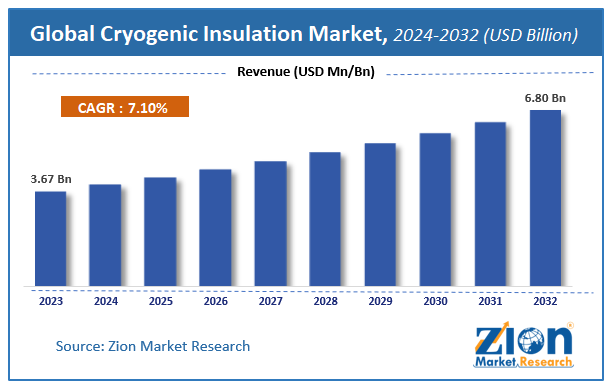
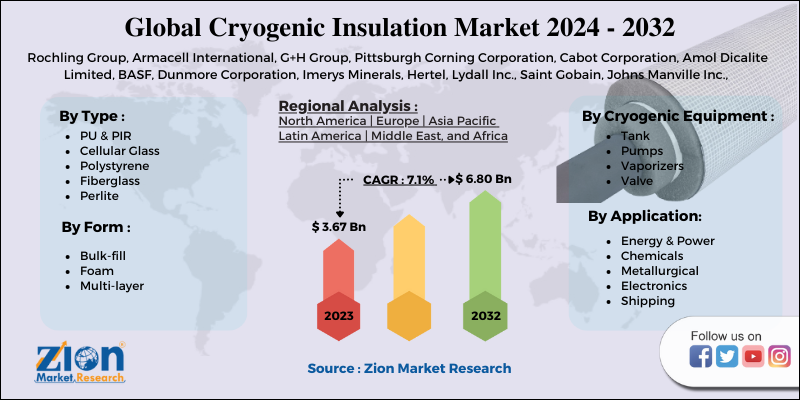
The global cryogenic insulation market size was valued at around USD 3.67 billion in 2023 and is projected to reach about USD 6.80 billion by 2032, with a compound annual growth rate (CAGR) of roughly 7.10% between 2024 and 2032.
This report provides a comprehensive analysis of the growth drivers, restraints, and challenges shaping demand across the global cryogenic insulation market throughout the forecast period, while highlighting high-potential emerging opportunities within the industry.
Key Insights
- As per the analysis shared by our research analyst, the global cryogenic insulation market is estimated to grow at a CAGR of approximately 7.10% during the forecast period from 2024 to 2032.
- In terms of revenue, the global cryogenic insulation market size was valued at around USD 3.67 billion in 2023 and is projected to reach USD 6.80 billion by 2032.
- The market is driven by lucrative demand for liquefied natural gas as fuel, the need for reliable storage and transport of LNG, rising LNG terminals, storage tanks, and ships, and growing environmental awareness.
- Based on the type, PU & PIR materials hold a leading position due to their favorable balance of thermal performance, mechanical stability, and suitability for LNG infrastructure and cryogenic piping systems.
- Based on the form, foam insulation is widely adopted because of its versatility across LNG facilities, industrial gas storage, and cold utility applications, supporting efficient installation and reliable performance.
- Based on the application, the energy and power sector dominates demand as transportation and storage of LNG remain core uses of cryogenic insulation and continue to expand with global gas trade and power generation needs.
- Regionally, Asia Pacific is positioned for strong growth and significant market contribution, driven by rising demand for storing and transporting cryogenic fluids across chemicals, shipbuilding, electronics, and energy and power industries, with China accounting for a major share within the region.
Cryogenic Insulation Market: Overview
Cryogenic insulation materials and systems are designed to minimize heat transfer at extremely low temperatures, typically below -150 degrees Celsius. These solutions are essential for the reliable storage and effective transport of cryogenic liquids such as liquefied natural gas, liquid nitrogen, and liquid helium. High-performing cryogenic insulation helps safeguard LNG manufacturing plants, raise production capacity, and maintain product integrity during handling and logistics. Favorable features include high mechanical stability, low maintenance requirements, and proven quality under demanding operating conditions.
Cryogenic Insulation Market: Dynamics
The cryogenic insulation market growth is anticipated to gain traction over the coming years owing to a lucrative demand for liquefied natural gas as fuel. Transportation and storage of LNG are some of the major applications of cryogenic insulation in the energy and power sector, and they are likely to contribute notably towards the growth of the market in the years ahead. Escalating need for LNG in myriad sectors such as automotive, domestic & commercial fuel, and power generation is expected to boost natural gas exploration and production, thereby driving the growth of the cryogenic insulation market in the near future. In the forthcoming years, due to an increase in LNG terminals, storage tanks, and ships carrying LNG, a substantial amount of insulating materials will be required, which is projected to drive the cryogenic insulation market.
However, the volatile raw material price is likely to act as a major restraint for the growth of the cryogenic insulation market in the forthcoming years. Nevertheless, growing environmental awareness will contribute notably towards the cryogenic insulation market earnings in the coming years.
Cryogenic Insulation Market: Report Scope
| Report Attributes | Report Details |
|---|---|
| Report Name | Cryogenic Insulation Market |
| Market Size in 2023 | USD 3.67 Billion |
| Market Forecast in 2032 | USD 6.80 Billion |
| Growth Rate | CAGR of 7.1% |
| Number of Pages | 285 |
| Key Companies Covered | Rochling Group, Armacell International, G+H Group, Pittsburgh Corning Corporation, Cabot Corporation, Amol Dicalite Limited, BASF, Dunmore Corporation, Imerys Minerals, Hertel, Lydall Inc., Saint-Gobain, Johns Manville Inc., among others |
| Segments Covered | By Type, By Cryogenic Equipment, By Form, By Application And By Region |
| Regions Covered | North America, Europe, Asia Pacific (APAC), Latin America, Middle East, and Africa (MEA) |
| Base Year | 2023 |
| Historical Year | 2018 - 2022 |
| Forecast Year | 2024 - 2032 |
| Customization Scope | Avail customized purchase options to meet your exact research needs. Request For Customization |
Cryogenic Insulation Market: Segmentation
The cryogenic insulation market is segmented by type, cryogenic equipment, form, application, and region. All the segments of the cryogenic insulation market have been analyzed based on present and future trends and the market is estimated from 2024 to 2032.
Based on Type, the cryogenic insulation market is divided into PU & PIR, cellular glass, polystyrene, fiberglass, perlite, and others. PU & PIR materials hold a leading position because they offer a practical balance of thermal efficiency, mechanical strength, and suitability for LNG carrier cargo holds, onshore liquefaction piping, and related cryogenic systems. Their performance characteristics support reliable operation across a wide temperature range and make them a preferred choice for many large-scale projects. Cellular glass and other specialized materials serve demanding applications where moisture resistance, compressive strength, or specific chemical compatibility is critical, reinforcing overall market diversity and capability.
Based on Cryogenic Equipment, the market is divided into tanks, pumps, vaporizers, valves, and others. Tanks represent a primary equipment category because storage of LNG and other cryogenic fluids requires extensive high-performance insulation to minimize heat ingress and product loss. Pumps, vaporizers, and valves also require carefully engineered insulation to maintain process efficiency and safety. Demand across these equipment types is closely tied to the expansion of LNG terminals, industrial gas facilities, and related infrastructure, driving consistent requirements for specialized insulation solutions.
Based on Form, the cryogenic insulation market is divided into bulk-fill, foam, and multi-layer. Foam insulation is widely used due to its versatility, ease of application, and proven performance across LNG infrastructure, industrial gas storage, and cold utility piping. It remains familiar to designers and installation teams and suits a broad range of operating conditions. Multi-layer and bulk-fill forms address specialized needs where space constraints, extreme performance requirements, or specific installation methods favor alternative approaches, supporting a complete portfolio of cryogenic insulation solutions.
Based on Application, the market is divided into energy and power, chemicals, metallurgical, electronics, and shipping. The energy and power sector dominates demand because transportation and storage of LNG are core applications that continue to expand with global gas trade and power generation needs. Chemicals, metallurgical, electronics, and shipping industries also rely on cryogenic insulation for process efficiency, product integrity, and safe handling of low-temperature fluids, contributing to diversified and resilient market demand.
Cryogenic Insulation Market: Regional Analysis
Why will Asia Pacific continue to dominate the global market during the projection period?
Asia Pacific is expected to play a leading role in the growth of the cryogenic insulation market. Asia Pacific cryogenic market is estimated to witness considerable growth owing to rising demand for storing and transporting cryogenic fluids in a wide range of end-use industries such as chemicals, shipbuilding, electronics, and energy & power. Rising demand for LNG and increasing investment in the energy sector is expected to drive the cryogenic insulation market in the region during the forecast period.
China is estimated to account for the largest share of the cryogenic insulation market in the APAC region during the forecast period, in terms of value, owing to the high demand for storing and transporting cryogenic fluids from a wide range of end-use industries such as chemicals, shipbuilding, electronics, and energy & power industries.
Europe and North America are expected to see continued growth driven by rising LNG demand, investment in the energy sector, and the need to maintain and upgrade existing cryogenic infrastructure. Established industrial bases and regulatory focus on efficiency and safety support steady demand for advanced insulation materials. Latin America and the Middle East and Africa represent emerging opportunities where energy projects and industrial development are expected to increase the need for reliable cryogenic storage and transport solutions over the forecast period.
Cryogenic Insulation Market: Competitive Players
Some of the major players in the global cryogenic insulation market include;
- Rochling Group
- Armacell International
- G+H Group
- Pittsburgh Corning Corporation
- Cabot Corporation
- Amol Dicalite Limited
- BASF
- Dunmore Corporation
- Imerys Minerals
- Hertel
- Lydall Inc
- Saint Gobain
- Johns Manville Inc
Segments Covered
The global cryogenic insulation market is segmented as follows:
By Type
- PU & PIR
- Cellular Glass
- Polystyrene
- Fiberglass
- Perlite
- Others
By Cryogenic Equipment
- Tank
- Pumps
- Vaporizers
- Valve
- Others
By Form
- Bulk-fill
- Foam
- Multi-layer
By Application
- Energy & Power
- Chemicals
- Metallurgical
- Electronics
- Shipping
By Region
- North America
- The U.S.
- Canada
- Mexico
- Europe
- France
- The UK
- Spain
- Germany
- Italy
- Rest of Europe
- Asia Pacific
- China
- Japan
- India
- Australia
- South Korea
- Rest of Asia Pacific
- The Middle East & Africa
- Saudi Arabia
- UAE
- Egypt
- Kuwait
- South Africa
- Rest of the Middle East & Africa
- Latin America
- Brazil
- Argentina
- Rest of Latin America
Table Of Content
Methodology
FrequentlyAsked Questions
Cryogenic insulation refers to materials and techniques designed to minimize heat transfer at extremely low temperatures, typically below -150 degrees Celsius. It is essential for the reliable storage and transport of cryogenic liquids such as liquefied natural gas, liquid nitrogen, and liquid helium, helping maintain temperature and prevent excessive evaporation or boil-off.
The global cryogenic insulation market is driven by strong demand for liquefied natural gas as fuel, the need for reliable LNG storage and transport, expansion of LNG terminals, storage tanks, and ships, and growing environmental awareness that favors efficient low-temperature insulation systems.
According to a report from Zion Market Research, the global Cryogenic Insulation Market was valued at USD 3.67 Billion in 2023 and is projected to hit USD 6.80 Billion by 2032.
According to a report from Zion Market Research, the global Cryogenic Insulation Market a compound annual growth rate (CAGR) of 7.1% during the forecast period 2024-2032.
Asia Pacific is expected to contribute notably, supported by rising demand for cryogenic fluid storage and transport across the chemicals, shipbuilding, electronics, and energy and power industries, with China representing a major share within the region.
Some main participants of the Cryogenic Insulation market are Rochling Group, Armacell International, G+H Group, Pittsburgh Corning Corporation, Cabot Corporation, Amol Dicalite Limited, BASF, Dunmore Corporation, Imerys Minerals, Hertel, Lydall Inc., Saint Gobain, Johns Manville Inc., among others.

HappyClients

