
Global Controlled Release Fertilizers Market Size, Share, Trends, Growth 2032

Controlled Release Fertilizers Market By Product (Polymer Sulfur Coated Urea/Sulfur Coated Urea, Polymer-Coated Urea, Polymer-Coated NPK Fertilizer, and Other Micronutrients), By Application (Fertigation, Foliar Application, Soil, and Others), By End-Use (Agriculture and Non-agriculture), and By Region - Global and Regional Industry Overview, Market Intelligence, Comprehensive Analysis, Historical Data, and Forecasts 2024 - 2032
| Market Size in 2023 | Market Forecast in 2032 | CAGR (in %) | Base Year |
|---|---|---|---|
| USD 2.38 Billion | USD 4.21 Billion | 5.9% | 2023 |
Controlled Release Fertilizers Industry Perspective
What will be the global controlled release fertilizers market size during the forecast period?
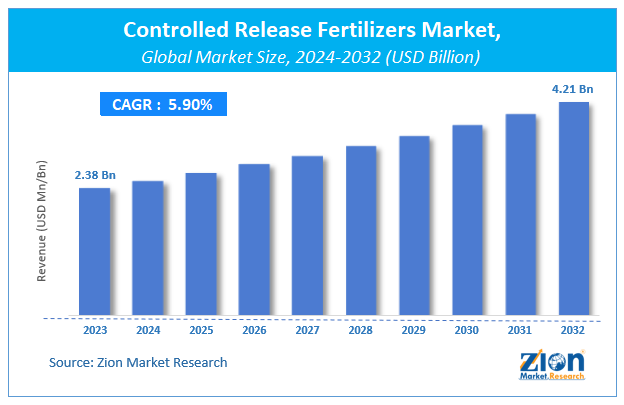
The global controlled release fertilizers market size was valued at around USD 2.38 billion in 2023 and is projected to reach about USD 4.21 billion by 2032, with a compound annual growth rate (CAGR) of roughly 5.9% between 2024 and 2032.
This report provides a comprehensive analysis of the growth drivers, restraints, and challenges shaping demand across the global controlled release fertilizers market throughout the forecast period, while highlighting high-potential emerging opportunities within the industry.
Key Insights
- As per the analysis shared by our research analyst, the global controlled release fertilizers market is estimated to grow annually at a CAGR of around 5.9% over the forecast period (2024-2032).
- In terms of revenue, the global controlled release fertilizers market size was valued at around USD 2.38 billion in 2023 and is projected to reach USD 4.21 billion by 2032.
- The controlled release fertilizers market is driven by escalating demand for high-value food items, rising disposable incomes, farmers focusing on modernized equipment, increasing awareness of the harmful effects of conventional fertilizers on the environment, the need to increase agricultural yield, and reduced labor efforts.
- Based on the product, polymer sulfur coated urea/sulfur coated urea is the world’s leading category and is projected to acquire exceptional momentum due to labor-saving features, resource-saving capacity, and being environmentally friendly.
- Based on the end-use, agriculture is the primary end-use category driving volume, while non-agriculture applications form a secondary demand base.
- Asia Pacific is the dominating region for controlled release fertilizers across the world, supported by agro-based economies, increasing demand from developing economies such as India, China, and Thailand, and higher consumption in China due to its large population base.
Controlled Release Fertilizers Market: Overview
Controlled release fertilizers (CRFs) are designed to gradually and under control release nutrients into the soil at a regulated pace over a prolonged period, matching the nutrient demands of a plant. Unlike conventional fertilizers that release nutrients rapidly, CRFs control the nutrient release by using a coating or specialised chemical composition, therefore minimising waste and lowering the danger of leaching and runoff.
Controlled Release Fertilizers Market: Growth Factors
What factors are accelerating demand for controlled release fertilizers?
Escalating demand for high-value food items and a rise in disposable incomes have created a massive demand for food. Farmers focusing on the use of modernized equipment to cater to the ever-increasing and diversifying needs of consumers will push the demand for controlled-release fertilizers in the future. Conversely, the unpredictable nature of the climate may restrain the global controlled-release fertilizers market growth to some extent.
However, many people are accepting other occupations than farming; hence, this may act as a major challenge for the global controlled-release fertilizers market. Increasing awareness among farmers regarding the harmful effects of fertilizers on the environment has resulted in increased adoption of advanced controlled-release fertilizers, fostering the global market growth. Moreover, increased agricultural yield and reduced labor efforts by farmers are anticipated to boost global market growth in the near future.
Controlled Release Fertilizers Market: Restraints
What barriers are limiting market expansion?
The unpredictable nature of the climate may restrain the global controlled-release fertilizers market growth to some extent. High prices of these specialized fertilizers can also discourage adoption in price-sensitive markets.
Limited awareness of the benefits of controlled-release products in certain regions further constrains broader uptake and requires continued education and demonstration of value.
Controlled Release Fertilizers Market: Opportunities
Where do future growth prospects lie?
Strict rules on nitrogen emissions and fertilizer run-off are driving the acceptance of controlled-release fertilizers since they reduce environmental contamination and nutrient leaching. Growing focus on sustainable agriculture and the need to improve nutrient use efficiency open additional avenues.
Expansion of high-value crop production and the continued shift toward labor-saving and resource-efficient farming practices support longer-term opportunity for coated and controlled-release products.
Controlled Release Fertilizers Market: Challenges
What obstacles must the industry overcome?
Many people are accepting other occupations than farming; hence, this may act as a major challenge for the global controlled-release fertilizers market. High product prices and limited awareness in some developing regions continue to pose barriers.
Balancing cost, performance, and accessibility while demonstrating clear agronomic and environmental benefits remains important for sustained market expansion.
Controlled Release Fertilizers Market: Report Scope
| Report Attributes | Report Details |
|---|---|
| Report Name | Controlled Release Fertilizers Market |
| Market Size in 2023 | USD 2.38 Billion |
| Market Forecast in 2032 | USD 4.21 Billion |
| Growth Rate | CAGR of 5.9% |
| Number of Pages | 255 |
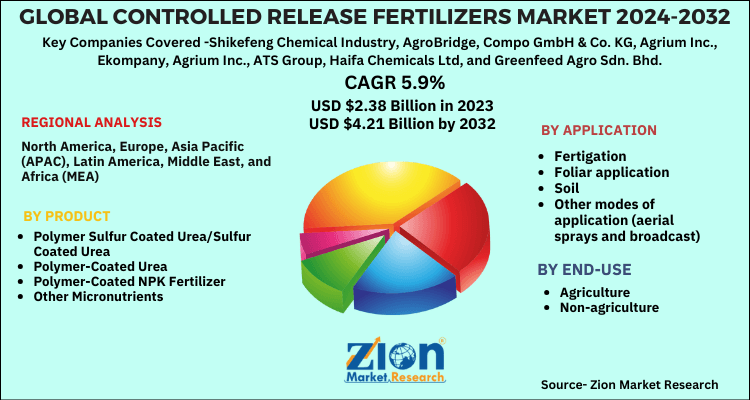
| Key Companies Covered | Shikefeng Chemical Industry, AgroBridge, Compo GmbH & Co. KG, Agrium Inc., Ekompany, Agrium Inc., ATS Group, Haifa Chemicals Ltd, and Greenfeed Agro Sdn. Bhd |
| Segments Covered | By Product, By Application, By End-Use, and By Region |
| Regions Covered | North America, Europe, Asia Pacific (APAC), Latin America, Middle East, and Africa (MEA) |
| Base Year | 2023 |
| Historical Year | 2018 - 2022 |
| Forecast Year | 2024 - 2032 |
| Customization Scope | Avail customized purchase options to meet your exact research needs. Request For Customization |
Controlled Release Fertilizers Market: Segmentation
The controlled release fertilizers market is segmented by product, application, end-use, and region. All the segments of the controlled release fertilizers market have been analyzed based on present and future trends and the market is estimated from 2024 to 2032.
Based on Product, the controlled release fertilizers market is divided into polymer sulfur coated urea/sulfur coated urea, polymer-coated urea, polymer-coated NPK fertilizer, and other micronutrients. Polymer sulfur coated urea/sulfur coated urea is the world’s leading category and is projected to acquire exceptional momentum in the near future. Due to labor-saving features, resource-saving capacity, and being environmentally friendly, the market for polymer sulfur coated urea/sulfur coated urea is growing and helps drive overall market expansion. Polymer-coated urea and polymer-coated NPK fertilizers form important secondary categories that support broader nutrient management needs across different crops and regions.
Based on Application, the controlled release fertilizers market is divided into fertigation, foliar application, soil, and others (including aerial sprays and broadcast). Soil application remains a core method for delivering controlled-release nutrients in line with plant demand over time, supporting efficient nutrient use and reduced losses. Fertigation and foliar application provide complementary routes that enable more precise delivery in irrigated and specialty systems, helping expand the addressable use cases and overall market growth.
Based on End-Use, the controlled release fertilizers market is divided into agriculture and non-agriculture. Agriculture is the primary end-use category, driven by the need to increase yields, address food security challenges, and improve nutrient efficiency under pressure from climate variability and land constraints. This dominance anchors market volume and supports continued product development. Non-agriculture applications form a secondary demand base linked to turf, ornamental, and specialty uses.
Controlled Release Fertilizers Market: Regional Analysis
Why will Asia Pacific continue to dominate the global market during the projection period?
Asia-Pacific is the dominating region for controlled-release fertilizers across the world. Major countries in this region possess agro-based economies. The Asia-Pacific region is anticipated to grow further owing to increasing demand from developing economies such as India, China, and Thailand. China has a higher consumption of controlled-release fertilizers due to the increasing population base. Polymer sulfur-coated urea/sulfur-coated urea is extensively used in the Asia Pacific. However, people are less aware of the benefits of these fertilizers, and high prices may discourage people in this region.
North America and Europe maintain significant presence through advanced agricultural practices, environmental regulations that favor reduced nutrient losses, and established use of specialty and coated fertilizers. Focus on efficiency and sustainability supports steady regional demand.
Latin America and the Middle East & Africa offer emerging opportunities linked to expanding agricultural activity, efforts to improve yields, and gradual adoption of more efficient nutrient management practices that can increase the role of controlled-release products over time.
Controlled Release Fertilizers Market: Competitive Players
Some of the important players in the worldwide controlled-release fertilizers market are
- Shikefeng Chemical Industry
- AgroBridge
- Compo GmbH & Co. KG
- Agrium Inc.
- Ekompany
- Agrium Inc
- ATS Group
- Haifa Chemicals Ltd
- Greenfeed Agro Sdn. Bhd
Segments Covered
The global controlled release fertilizers market is segmented as follows:
By Product
- Polymer Sulfur Coated Urea/Sulfur Coated Urea
- Polymer-Coated Urea
- Polymer-Coated NPK Fertilizer
- Other Micronutrients
By Application
- Fertigation
- Foliar application
- Soil
- Other modes of application (aerial sprays and broadcast)
By End-Use
- Agriculture
- Non-agriculture
By Region
- North America
- The U.S.
- Canada
- Mexico
- Europe
- France
- The UK
- Spain
- Germany
- Italy
- Rest of Europe
- Asia Pacific
- China
- Japan
- India
- Australia
- South Korea
- Rest of Asia Pacific
- The Middle East & Africa
- Saudi Arabia
- UAE
- Egypt
- Kuwait
- South Africa
- Rest of the Middle East & Africa
- Latin America
- Brazil
- Argentina
- Rest of Latin America
Table Of Content
Methodology
FrequentlyAsked Questions
Controlled release fertilizers are designed to gradually and under control release nutrients into the soil at a regulated pace over a prolonged period, matching the nutrient demands of a plant. Unlike conventional fertilizers that release nutrients rapidly, they control nutrient release by using a coating or specialised chemical composition, minimising waste and lowering the risk of leaching and runoff.
Key growth drivers include escalating demand for high-value food items, rising disposable incomes, farmers’ focus on modernized equipment, increasing awareness of the environmental effects of conventional fertilizers, the need to raise agricultural yields, and reduced labor efforts associated with controlled-release products.
According to Zion Market Research, the Global Controlled Release Fertilizers Market was worth USD 2.38 Billion in 2023. The market is forecast to reach USD 4.21 Billion by 2032.
According to Zion Market Research, the Global Controlled Release Fertilizers Market a compound annual growth rate (CAGR) of 5.9% during the forecast period 2024-2032.
Asia Pacific is the dominant region for controlled-release fertilizers across the world, supported by agro-based economies and rising demand in countries such as China, India, and Thailand.
Some of the important players in the worldwide controlled-release fertilizers market are Shikefeng Chemical Industry, AgroBridge, Compo GmbH & Co. KG, Agrium Inc., Ekompany, Agrium Inc., ATS Group, Haifa Chemicals Ltd, and Greenfeed Agro Sdn. Bhd.
The report provides a comprehensive analysis of the market, highlighting the factors that will determine growth, potential challenges, and opportunities that could emerge in the controlled release fertilizers industry over the next decade, along with segmentation, regional insights, and competitive landscape.

HappyClients

