
Collision Avoidance Sensor Market Size, Share, Trends, Growth and Forecast 2032

Collision Avoidance Sensor Market By technology (ultrasound, imaging, LiDAR, radar, and others), By application (parking assistance, lane departure warning system, forward-collision warning system, blind-spot detection, adaptive cruise control, and others), By industrial vertical (automotive, aerospace & defense, marine, and others) And By Region: - Global And Regional Industry Overview, Market Intelligence, Comprehensive Analysis, Historical Data, And Forecasts, 2024-2032
| Market Size in 2023 | Market Forecast in 2032 | CAGR (in %) | Base Year |
|---|---|---|---|
| USD 6.50 Billion | USD 53.34 Billion | 23.4% | 2023 |
Description
What is the Market size of the Collision Avoidance Sensor Industry?
According to the report published by Zion Market Research, the global Collision Avoidance Sensor Market size was valued at USD 6.50 Billion in 2023 and is predicted to reach USD 53.34 Billion by the end of 2032. The market is expected to grow with a CAGR of 23.4% during the forecast period. The report analyzes the global Collision Avoidance Sensor Market's growth drivers, restraints, and impact on demand during the forecast period. It will also help navigate and explore the arising opportunities in the Collision Avoidance Sensor industry.
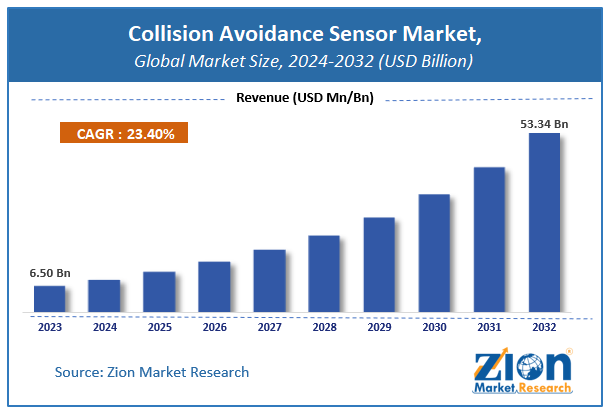
Global Collision Avoidance Sensor Market: Overview
Collision avoidance sensors are designed to detect obstruction in the path and lower the probability of accidents. It is a kind of safety system. They work on the principle of SONAR used in ships and submarines. They are widely used in aircraft, cars, and other automotive vehicles. A collision avoidance sensor has a processor and controller. The controllers help in getting tasks completed and control every component like various sensors and indicators. Sensors can detect obstacles and other automobiles in front and send a message to the controller to take the required actions.
Global Collision Avoidance Sensor Market: Growth Factors
Increased inclusion of collision avoidance sensors in supersonic jets & self-driving cars and surge in demand for such a system has boosted the growth of the global collision avoidance sensor market. Mergers and collaborations of defense and automotive sectors have led the innovations of advanced products coupled with collision avoidance sensors.
The demand for these sensors is anticipated to boost the global collision avoidance sensor market growth during the forecast period due to several factors like the government initiatives regarding the safety of the people, growing awareness for the society, and the increasing investments from the automotive sectors.
The surge in the sales and demand of the sport utility vehicles and high-end luxury automotives is anticipated to drive the growth of the market globally. Some of the prominent automotive manufacturers have started coupling the collision avoidance sensors with the market products to boost the market demand.
The integration of these collision avoidance sensors in commercial and passenger vehicles are expected to lower road accidents while facilitating protection to vehicle occupants. Strict government regulations and policies regarding the installation of safety features are anticipated to boost the global market growth.
Increasing research and development activities by automobile manufacturers propelled the growth of the global collision avoidance sensor market significantly during the forecast period.
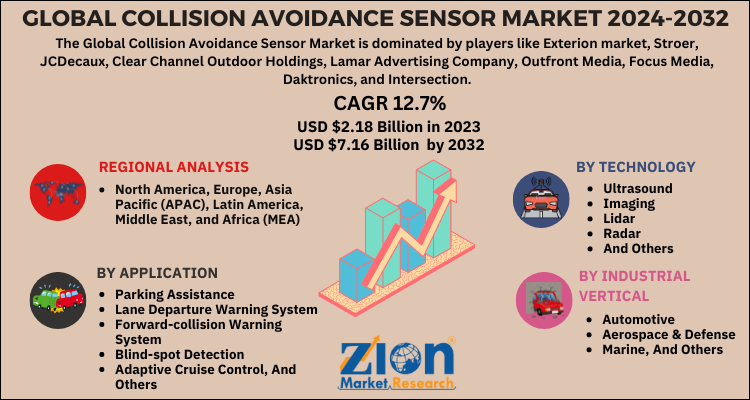
Global Collision Avoidance Sensor Market: Segmentation
The global collision avoidance sensor market can be segmented into technology, application, industrial vertical, and region.
By technology, the market can be segmented into ultrasound, imaging, LiDAR, radar, and others. Radars hold the largest market share in the global collision avoidance sensor market owing to the exact measurement of location and distance of the prominent obstacles. Infrared and vision cameras have a shorter and narrower field of view but they prove to be more helpful for classification and identification of hindrance.
By application, the market can be segmented into parking assistance, lane departure warning system, forward-collision warning system, blind-spot detection, adaptive cruise control, and others. The global collision avoidance sensor market is propelled by growing sales of advanced driver assistance systems. The adaptive cruise control segment holds hegemony over others due to the declining costs of camera and radar systems. The blind-spot detection and lane departure warning segments are expected to gain significant traction during the forecast period.
By industrial vertical, the market can be segmented into automotive, aerospace & defense, marine, and others.
Collision Avoidance Sensor Market: Report Scope
| Report Attributes | Report Details |
|---|---|
| Report Name | Collision Avoidance Sensor Market |
| Market Size in 2023 | USD 6.50 Billion |
| Market Forecast in 2032 | USD 53.34 Billion |
| Growth Rate | CAGR of 23.4% |
| Number of Pages | 219 |
| Key Companies Covered | ALSTOM, Honeywell, GENERAL ELECTRIC, Siemens, DENSO, Panasonic, Saab, Delphi Automotive, Autoliv, Robert Bosch, Continental AG, NXP Semiconductors, Murata Manufacturing Co.; Ltd, Texas Instruments, and Magna International Inc. |
| Segments Covered | By Technology, By Application, By Industrial Vertical And By Region |
| Regions Covered | North America, Europe, Asia Pacific (APAC), Latin America, Middle East, and Africa (MEA) |
| Base Year | 2023 |
| Historical Year | 2018 - 2022 |
| Forecast Year | 2024 - 2032 |
| Customization Scope | Avail customized purchase options to meet your exact research needs. Request For Customization |
Global Collision Avoidance Sensor Market: Regional analysis
Europe holds the largest market share in the global collision avoidance sensor market due to the strict government regulations and rules about road safety. In Europe, the manufacturers of passenger vehicles need to provide an autonomous smart braking solution as a part of safety rating standards.
North America is among the growing regions in the global collision avoidance sensor market due to the growing installation of smart safety systems in vehicles.
Asia Pacific is anticipated to witness significant growth during the forecast period owing to the surge in purchasing power of the consumer, growing per capita income of the people, growing sales of premium vehicles, rising standards of the people, rise in GDP, and growing government regulations.
Global Collision Avoidance Sensor Market: Competitive Players
Some of the significant players in the global collision avoidance sensor market are:
- ALSTOM
- Honeywell
- GENERAL ELECTRIC
- Siemens
- DENSO
- Panasonic
- Saab
- Delphi Automotive
- Autoliv
- Robert Bosch
- Continental AG
- NXP Semiconductors
- Murata Manufacturing Co.; Ltd
- Texas Instruments
- Magna International Inc.
The Global Collision Avoidance Sensor Market is segmented as follows:
By technology
- ultrasound
- imaging
- LiDAR
- radar
- and others
By application
- parking assistance
- lane departure warning system
- forward-collision warning system
- blind-spot detection
- adaptive cruise control, and others
By industrial vertical
- automotive
- aerospace & defense
- marine, and others
By Region
- North America
- The U.S.
- Canada
- Mexico
- Europe
- France
- The UK
- Spain
- Germany
- Italy
- Rest of Europe
- Asia Pacific
- China
- Japan
- India
- Australia
- South Korea
- Rest of Asia Pacific
- The Middle East & Africa
- Saudi Arabia
- UAE
- Egypt
- Kuwait
- South Africa
- Rest of the Middle East & Africa
- Latin America
- Brazil
- Argentina
- Rest of Latin America
What Reports Provides
- Full in-depth analysis of the parent market
- Important changes in market dynamics
- Segmentation details of the market
- Former, on-going, and projected market analysis in terms of volume and value
- Assessment of niche industry developments
- Market share analysis
- Key strategies of major players
- Emerging segments and regional markets
- Testimonials to companies in order to fortify their foothold in the market.
Table Of Content

FrequentlyAsked Questions
A collision avoidance sensor is a safety device that detects obstacles or vehicles nearby. It helps prevent accidents by warning the driver or automatically applying brakes.
The global Collision Avoidance Sensor market is expected to be driven by the Growth is driven by rising demand for ADAS, workplace safety, and automation in vehicles, drones, and industrial equipment. Stricter safety norms and advances in radar, lidar, and vision sensors boost adoption.
According to study, the global Collision Avoidance Sensor market size was worth around USD 6.50 Million in 2023 and is predicted to grow to around USD 53.34 Million By 2032.
The global Collision Avoidance Sensor market is expected to grow at a Compound Annual Growth Rate (CAGR) of around CAGR 23.4% during the forecast period from 2024-2032.
The global Collision Avoidance Sensor industry is projected to be challenged by Performance challenges in bad weather/low visibility; sensor fusion and calibration complexity; regulatory validation and liability concerns.
The ADAS adoption and stricter safety regulations; growth in industrial vehicles, drones, and marine systems; cost reduction via solid-state and integrated sensors will offer significant growth opportunities in the Collision Avoidance Sensor market.
Sensor fusion (radar/LiDAR/camera) for fewer false alarms; edge AI for real-time object classification; compact, low-power sensors for industrial vehicles are the emerging trends and innovations impacting the Collision Avoidance Sensor market.
The global Collision Avoidance Sensor market is expected to be led by APAC during the forecast period.
Some of the prominent players operating in the global Collision Avoidance Sensor market are; ALSTOM, Honeywell, GENERAL ELECTRIC, Siemens, DENSO, Panasonic, Saab, Delphi Automotive, Autoliv, Robert Bosch, Continental AG, NXP Semiconductors, Murata Manufacturing Co.; Ltd, Texas Instruments, and Magna International Inc. and others.
The report explores crucial aspects of the Collision Avoidance Sensor market, including a detailed discussion of existing growth factors and restraints, while also browsing future growth opportunities and challenges that impact the market.
HappyClients

