
Carbon Capture and Sequestration Market Trend, Share, Growth, Size and Forecast 2030

Carbon Capture and Sequestration Market By End-Use(Enhanced Oil Recovery (EOR), Dedicated Storage & Treatment), By Capture Source(Chemicals, Natural Gas Processing, Power Generation, Fertilizers Production, Other Capture Sources), and By Region: Global Industry Analysis, Size, Share, Growth, Trends, and Forecasts 2023-2030
| Market Size in 2022 | Market Forecast in 2030 | CAGR (in %) | Base Year |
|---|---|---|---|
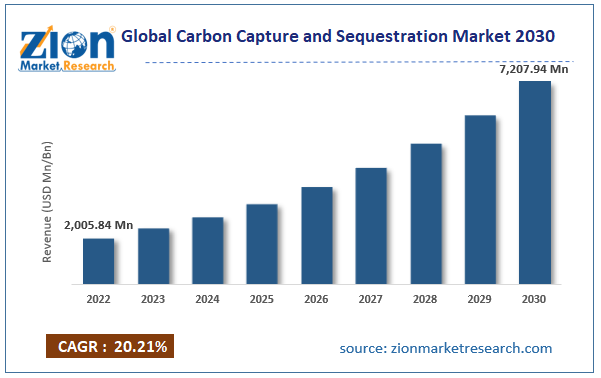
| USD 2,005.84 million | USD 7,207.94 million | 20.21% | 2022 |
Description
Global Carbon Capture and Sequestration Market: Insights
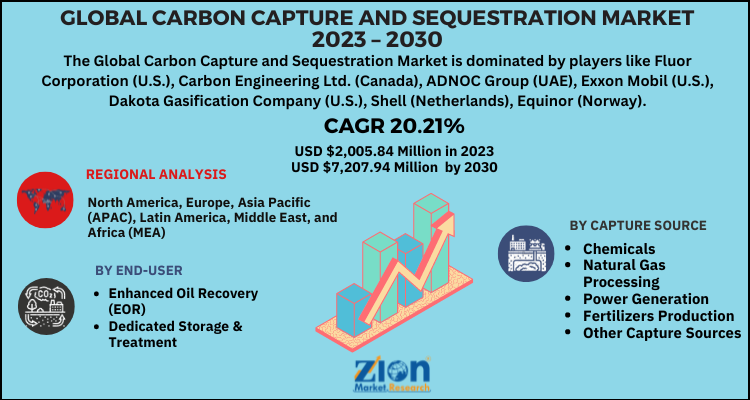
The global Carbon capture and sequestration market size was worth around USD 2,005.84 Million in 2022 and is predicted to grow to around USD 7,207.94 Million by 2030 with a compound annual growth rate (CAGR) of roughly 20.21% between 2023 and 2030.
Global Carbon Capture and Sequestration Market: Overview
Carbon capture and sequestration also known as carbon capture and storage is the process where waste carbon dioxide is captured from big point sources, which can include power plants of fossil fuels, is carried to a storage site, and are deposited in such a way that they do not enter into the atmosphere, usually an underground geological formation. The basic objective is preventing a large amount of carbon dioxide being emitted into the atmosphere which is normally from the use of fossil fuels in the generation of power from different industries.
Key Insights:
- As per the analysis shared by our research analyst, the global Carbon capture and sequestration market is estimated to grow annually at a CAGR of around 20.21% over the forecast period (2023-2030).
- In terms of revenue, the global Carbon capture and sequestration market size was valued at around USD 2,005.84 Million in 2022 and is projected to reach USD 7,207.94 Million by 2030 by 2030.
- The rising demand for minimally invasive surgery is expected to drive the Carbon capture and sequestration market over the forecast period.
- Based on the service, the capture segment is expected to capture the largest market share over the projected period.
- Based on the application, the agricultural segment is expected to capture the largest market share over the projected period.
- Based on region, North America is expected to dominate the market during the forecast period.
Global Carbon Capture and Sequestration Market: Growth Factors
Carbon capture is the best option for lowering the emissions of carbon to control the air pollution as it is a very cost effective method. This factor has positively affected the market growth of carbon capture and sequestration. The growing demand for extracting oil and gas from the low-permeability and unconventional reserves such as carbonate traps and tight stands are positively increasing the demand for the market. The carbon dioxide that is discharged during the stage of manufacturing is utilized by technologies thus anticipating growth prospects in the coming years. Thus the carbon applications for EOR will dominate the carbon capture and sequestration market. The factors that are hampering the market growth include the various regulatory problems and the low adoption rate owing to the high initial and operating costs.
The worldwide pandemic has arisen as the foremost health issue, halting virtually all activities across many industries. The COVID-19 pandemic has significantly impeded global economies and compelled numerous nations to implement lockdown measures in order to curb the spread of the virus. Although the resolution of this issue is expected to be prompt, long-term measures must be taken to address climate deterioration through decisive efforts.
Nevertheless, the primary challenge encountered by industry experts is the necessity of substantial capital expenditures (CAPEX) for establishing new carbon capture facilities. In addition, the sudden decline in global crude oil prices has negatively impacted the potential for enhancing hydrocarbon output through CO2-based enhanced oil recovery (EOR) initiatives. However, the financial stimulus packages implemented by different governments to help economic recovery, along with a favorable attitude towards reducing carbon emissions in industries, will enhance the stability of this sector.
Global Carbon Capture and Sequestration Market: Segmentation
The global carbon capture and sequestration market are segmented into service, application, and region. All the segments have been analyzed based on present and future trends and the market is estimated from 2023 to 2030.
On the basis of the service, the market is segregated into capture, sequestration, and transport. The capture segment is further sub-segmented based on the capture techniques which include oxy-fuel, pre-combustion, and post-combustion.
Based on the application, the global market is categorized into agricultural, EOR process, industrial, pressurized containers and healthcare.
Regionally, the market is diversified into North America, Asia-Pacific, Europe, South America, and Rest of the World.
Carbon Capture and Sequestration Market: Report Scope
| Report Attributes | Report Details |
|---|---|
| Report Name | Carbon Capture and Sequestration Market |
| Market Size in 2022 | USD 2,005.84 Million |
| Market Forecast in 2030 | USD 7,207.94 Million |
| Growth Rate | CAGR of 20.21% |
| Number of Pages | 198 |
| Key Companies Covered | Fluor Corporation (U.S.), Carbon Engineering Ltd. (Canada), ADNOC Group (UAE), Exxon Mobil (U.S.), Dakota Gasification Company (U.S.), Shell (Netherlands), Equinor (Norway), China National Petroleum Corporation (China), Linde (Ireland), BP (UK), Chevron (U.S.), Total (France) |
| Segments Covered | By End-Use, By Capture Source, and By Region |
| Regions Covered | North America, Europe, Asia Pacific (APAC), Latin America, Middle East, and Africa (MEA) |
| Base Year | 2022 |
| Historical Year | 2017 - 2021 |
| Forecast Year | 2023 - 2030 |
| Customization Scope | Avail customized purchase options to meet your exact research needs. Request For Customization |
Global Carbon Capture and Sequestration Market: Regional Analysis
The region that dominates the carbon capture and sequestration market is the North America. The US region has the largest market share in the global market. The European market for carbon capture and sequestration and also anticipates growing significantly in the coming years, owing to the supporting government regulations. The strategies for the energy portfolio and also the emission standards adopted by European Union nations will act as a favorable factor for the market growth. Nations such as UK, Netherlands, and Norway are making attractive investments in the carbon technology boosting the market growth. The Asia Pacific region is also contributing its share to the market growth owing to the growing manufacturing industries in the countries such as China, Japan, and India.
Global Carbon Capture and Sequestration Market: Competitive Players
The key market players in the carbon capture and sequestration market include
- Fluor Corporation (U.S.)
- Carbon Engineering Ltd. (Canada)
- ADNOC Group (UAE)
- Exxon Mobil (U.S.)
- Dakota Gasification Company (U.S.)
- Shell (Netherlands)
- Equinor (Norway)
- China National Petroleum Corporation (China)
- Linde (Ireland)
- BP (UK)
- Chevron (U.S.)
- Total (France)
Global Carbon Capture and Sequestration Market: Segment Analysis
By End-Use
- Enhanced Oil Recovery (EOR)
- Dedicated Storage & Treatment
By Capture Source
- Chemicals
- Natural Gas Processing
- Power Generation
- Fertilizers Production
- Other Capture Sources
By Region
- North America
- The U.S.
- Canada
- Mexico
- Europe
- France
- The UK
- Spain
- Germany
- Italy
- Rest of Europe
- Asia Pacific
- China
- Japan
- India
- Australia
- South Korea
- Rest of Asia Pacific
- The Middle East & Africa
- Saudi Arabia
- UAE
- Egypt
- Kuwait
- South Africa
- Rest of the Middle East & Africa
- Latin America
- Brazil
- Argentina
- Rest of Latin America
What Report Provides
- Full in-depth analysis of the parent market
- Important changes in market dynamics
- Segmentation details of the market
- Former, on-going, and projected market analysis in terms of volume and value
- Assessment of niche industry developments
- Market share analysis
- Key strategies of major players
- Emerging segments and regional markets
- Testimonials to companies in order to fortify their foothold in the market.
Table Of Content

FrequentlyAsked Questions
This technology captures carbon dioxide emissions. It stores CO2 to reduce climate impact
The global Carbon Capture and Sequestration market is expected to be driven by the decarbonization goals and climate regulations. Investments in industrial emission reduction support market expansion.
According to study, the global Carbon Capture and Sequestration market size was worth around USD 2,005.84 Million in 2022 and is predicted to grow to around USD 7,207.94 Million by 2030.
The global Carbon Capture and Sequestration market is expected to grow at a Compound Annual Growth Rate (CAGR) of around CAGR 20.21% during the forecast period from 2023-2030.
What are the major challenges restraining the growth of the Carbon Capture and Sequestration market?
The global Carbon Capture and Sequestration industry is projected to be challenged by Challenges include high capital costs and long project timelines.
The Opportunities include decarbonization mandates, industrial emissions control, government incentives, and climate targets will offer significant growth opportunities in the Carbon Capture and Sequestration market.
Post-combustion and direct air capture technologies; utilization pathways for captured CO2; policy-driven project expansion are the emerging trends and innovations impacting the Carbon Capture and Sequestration market.
The global Carbon Capture and Sequestration market is expected to be led by Europe during the forecast period.
Some of the prominent players operating in the global Carbon Capture and Sequestration market are; Fluor Corporation (U.S.), Carbon Engineering Ltd. (Canada), ADNOC Group (UAE), Exxon Mobil (U.S.), Dakota Gasification Company (U.S.), Shell (Netherlands), Equinor (Norway), China National Petroleum Corporation (China), Linde (Ireland), BP (UK), Chevron (U.S.), Total (France) and others.
The report explores crucial aspects of the Carbon Capture and Sequestration market, including a detailed discussion of existing growth factors and restraints, while also browsing future growth opportunities and challenges that impact the market.
HappyClients

