
Canine Orthopedics Market Size, Growth, Global Trends, Forecast 2034

Canine Orthopedics Market By Product (Implants and Instruments), By Application (TPLO, Trauma, TTA, Joint Replacement, and Others), By End Use (Hospitals & Clinics and Others), and Region - Global and Regional Industry Overview, Market Intelligence, Comprehensive Analysis, Historical Data, and Forecasts 2026 - 2034
| Market Size in 2025 | Market Forecast in 2034 | CAGR (in %) | Base Year |
|---|---|---|---|
| USD 456 Million | USD 950 Million | 8.5% | 2025 |
Canine Orthopedics Industry Perspective:
What will be the size of the global canine orthopedics market during the forecast period?
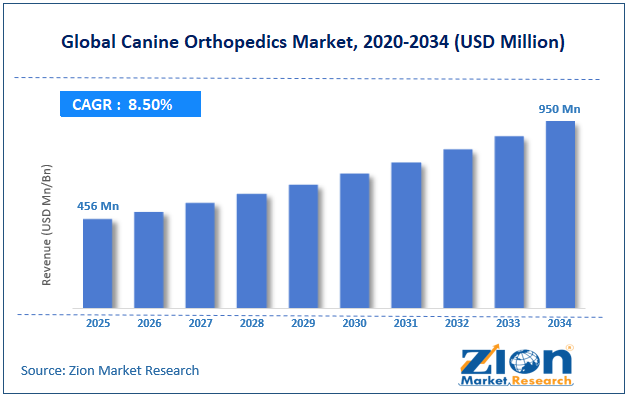
The global canine orthopedics market size was worth around USD 456 million in 2025 and is predicted to grow to around USD 950 million by 2034, with a compound annual growth rate (CAGR) of roughly 8.5% between 2026 and 2034.
 Request Free SampleRequest Free Sample
Key Insights
- As per the analysis shared by our research analyst, the global canine orthopedics market is estimated to grow annually at a CAGR of around 8.5% over the forecast period (2026-2034).
- In terms of revenue, the global canine orthopedics market size was valued at around USD 456 million in 2025 and is projected to reach USD 950 million by 2034.
- Growing canine obesity is expected to drive the canine orthopedics market.
- Based on the product, the implants segment dominates with a revenue share in 2025.
- Based on the application, the TPLO segment holds a majority of market share in 2025, at 29.3%.
- Based on the end use, the hospitals & clinics segment holds a majority market share in 2025.
- Based on region, North America dominates the canine orthopedics market with a revenue share of 54.5% in 2025.
Canine Orthopedics Market: Overview
Canine orthopedics is a division of veterinary medicine that studies and treats musculoskeletal abnormalities in domestic animals. Various orthopedic diseases and conditions affect dogs' bones, joints, ligaments, tendons, and muscles. Common problems include hip and elbow dysplasia, cranial cruciate ligament tears, fractures, patellar luxation, arthritis, and more. Veterinary healthcare professionals treat orthopedic diseases and disorders in dogs through surgery, physiotherapy, medication, and spaying/neutering. Radiology procedures, including X-rays, CT scans, or MRI, are also used for diagnosis. The main goal of canine orthopedics is to reduce pets’ pain, cure disease, improve function in affected areas, and restore animals’ quality of life.
Impact of the USA-Israel War on Iran on the Canine Orthopedics Market
The US-Israeli war with Iran is likely to negatively affect the Iranian pet orthopedics market because of disrupted supply chains, inflation, currency devaluation, and reduced consumer spending. Disruptions in the strategic Strait of Hormuz have driven up freight rates and complicated foreign trade, while Iran faces a shortage of medical supplies and equipment. As a result, the country faces growing difficulties obtaining orthopedic implants and prostheses, surgical instruments, veterinary drugs, diagnostic devices, and rehabilitation equipment. This will delay elective orthopedic procedures for pets and shift toward more affordable conservative treatments for fractures, joint diseases, and ligament injuries. Nevertheless, demand for veterinary orthopedics in Iran should remain, as veterinarians will still need to treat animals’ fractures and other orthopedic conditions.
Canine Orthopedics Market: Dynamics
Growth Drivers
How does the rising prevalence of orthopedic disorders drive the canine orthopedics market?
The rising prevalence of orthopedic diseases in dogs is a key driver of the canine orthopedics market, stimulating demand for orthopedic implants, surgeries, diagnostic imaging, and rehabilitation. According to the Dog Aging Project, supported by the National Institute on Aging, in 2025, 9367 dogs’ owners reported cases of canine osteoarthritis, cruciate, patellar, hip dysplasia, or another bone or orthopedic disorder. Among the reported cases, 33% of dogs were diagnosed with osteoarthritis, 18% with cruciate ligament rupture, 14% with patellar luxation, and 13% with hip dysplasia.
Additionally, a 2025 study revealed that 1.2% of 43517 US companion dogs suffer from intervertebral disc disease, with overweight dogs being particularly susceptible to the condition. Overall, the prevalence of these diseases among dogs is expected to drive demand for TPLO and other ligament surgeries, fracture repair, joint replacement, orthopedic implants, and pain-management modalities, and thus market growth.
Restraints
High cost of orthopedic procedures acts as a major restraint on the growth of the canine orthopedics industry
High prices for canine treatments significantly restrain growth in the canine orthopedics market. Orthopedic procedures in dogs are usually expensive and can include implants, specific surgeries, hospitalization, anesthesia, and post-surgery treatments. For instance, tibial plateau leveling osteotomy, total hip replacement, fracture repair surgery, and other procedures are often associated with high expenses. As a result, pet owners may avoid scheduling treatments and instead choose cheaper alternatives, reducing the use of canine orthopedic products. This is especially true in emerging countries, where pet healthcare coverage and insurance are limited.
Opportunities
How does the rising partnership to advance veterinary education offer a lucrative opportunity for the canine orthopedics market?
A rising number of collaborative partnerships between veterinary universities, animal health companies, professional associations, and veterinary hospitals to advance education and surgical training presents a lucrative opportunity for the canine orthopedics market. Such partnerships improve veterinarians' knowledge of advanced orthopedic diagnosis and procedures, including fracture fixation, cruciate ligament repair, arthroscopy, joint replacement, and minimally invasive surgery. Educational programs, workshops, fellowships, and hands-on training and demonstrations can improve surgeons' technical skills and boost their confidence in using sophisticated orthopedic implants, instruments, and technologies. These collaborations can also improve access to orthopedic care by transferring expertise to veterinarians in developing and emerging markets. Thus, improved education and training can lead to more qualified practitioners and greater pet owner awareness, resulting in better treatment outcomes and an increased addressable market for canine orthopedic procedures.
For instance, in July 2025, Movora, a global leader in veterinary orthopedic solutions, and the AO Foundation, a global leader in medical education and innovation, have signed a Memorandum of Understanding (MoU) to collaborate on advancing veterinary education beginning in 2026. Through this partnership, Movora will support a series of AO-led educational events across North America, Western Europe, and Japan. These courses, delivered independently by the AO, will focus on surgical principles and hands-on skills development in veterinary orthopedics. While the AO retains full control over course design and delivery, Movora will provide logistical and technical support, including workstations, equipment, and on-site personnel.
Challenges
Why does the low penetration of pet insurance pose a significant challenge to the growth of the canine orthopedics industry?
Low pet insurance penetration significantly constrains growth in the canine orthopedics market. Many orthopedic procedures have extremely high surgical, implant, diagnostic imaging, medication, and rehabilitation costs, which pet owners often must cover directly if their pet is not covered by insurance. This may reduce pet owners' willingness to pursue aggressive treatments, leading them to choose conservative management or delay procedures to afford the cost.
Additionally, limited pet insurance may impede the adoption of canine orthopedics products, including TPLO, fracture repair, arthroscopy, and total hip replacement procedures, constraining demand for advanced orthopedic implants and surgical instruments. As such, widespread adoption of comprehensive pet insurance plans can help promote growth in the canine orthopedics market.
Canine Orthopedics Market: Report Scope
| Report Attributes | Report Details |
|---|---|
| Report Name | Canine Orthopedics Market |
| Market Size in 2025 | USD 456 Million |
| Market Forecast in 2034 | USD 950 Million |
| Growth Rate | CAGR of 8.5% |
| Number of Pages | 227 |
| Key Companies Covered | B. Braun SE, Integra LifeSciences, DePuy Synthes (Johnson & Johnson), Movora (Vimian Group AB), AmerisourceBergen Corporation, Orthomed (UK) Ltd., Arthrex Inc. (Arthrex Vet Systems), Narang Medical Limited, Fusion Implants, Veterinary Instrumentation, BioMedtrix LLC, VetWelding AG, Cencora Inc., OrthoPets LLC, KYON AG, PH Orthcom, InVictos, and others. |
| Segments Covered | By Product, By Application, By End Use, and By Region |
| Regions Covered | North America, Europe, Asia Pacific (APAC), Latin America, Middle East, and Africa (MEA) |
| Base Year | 2025 |
| Historical Year | 2020 - 2024 |
| Forecast Year | 2026 - 2034 |
| Customization Scope | Avail customized purchase options to meet your exact research needs. Request For Customization |
Canine Orthopedics Market: Segmentation
Product Insights
Why does the implants segment hold a prominent position in the canine orthopedics market?
The implants segment dominates the market over the projected period. The growth is attributed to the increasing incidence of fractures, cranial cruciate ligament injuries, hip dysplasia, and other musculoskeletal disorders in dogs. Growing adoption of advanced procedures such as fracture fixation, TPLO, tibial tuberosity advancement (TTA), and joint replacement is increasing demand for plates, screws, pins, joint prostheses, and other orthopedic implants.
In addition, improvements in implant materials, including titanium and advanced polymers, are supporting the development of lightweight, biocompatible, and durable products that can improve surgical outcomes. Rising pet healthcare spending and owners' growing willingness to pursue surgical treatment for companion animals are further supporting implant adoption.
Application Insights
How does the TPLO segment capture the largest share in the canine orthopedics market?
The TPLO segment holds a 29.3% market share in 2025. This is primarily due to the increasing prevalence of cranial cruciate ligament (CCL) injuries in dogs. TPLO is widely used to stabilize the knee joint and restore mobility, particularly in active, large-breed, and overweight dogs. Growing awareness among pet owners of advanced surgical options, rising spending on companion-animal healthcare, and the increasing availability of veterinary orthopedic specialists are driving adoption of TPLO procedures.
End Use Insights
How does the hospitals & clinics segment capture the largest share in the canine orthopedics market?
The hospitals & clinics segment holds a majority of market share in 2025. Growth drivers for veterinary orthopedic devices include the increasing number of veterinary hospitals, specialty clinics, and referral centers that offer advanced orthopedic diagnosis and treatment. The increasing prevalence of cranial cruciate ligament injuries, fractures, hip dysplasia, osteoarthritis, and patellar luxation in companion animals is driving demand for specialized veterinary consultations, diagnostic imaging, orthopedic surgeries, and post-operative rehabilitation. Growing pet ownership and pet humanization trends are also driving demand for specialized veterinary services and spending on more advanced treatments.
More veterinary facilities offering advanced orthopedic treatments using digital radiography, CT, MRI, arthroscopy, advanced surgical systems, and other technologies are also contributing to growth in the veterinary orthopedics market.
Regional Insights
What factors drive the North America region in the canine orthopedics market?
North America dominates the canine orthopedics market with a revenue share of 54.5% in 2025. Growth is driven by the high prevalence of orthopedic disorders among dogs, rising pet healthcare spending, advanced veterinary infrastructure, and the strong presence of veterinary orthopedic manufacturers. Additionally, continued innovation and product development in the region will propel its growth. For instance, in March 2025, Vimian announced its expanded veterinary knee-surgery solutions for canine cranial cruciate ligament injuries, including TPLO, CBLO, and TTA procedures and associated orthopedic implants.
Moreover, the July 2025 agreement between Movora and Aesculap made Movora the exclusive distributor of Aesculap surgical power systems and accessories in the U.S. and Canada, improving access to advanced veterinary surgical technologies in the region.
Canine Orthopedics Market: Competitive Analysis
The global canine orthopedics market is dominated by players like:
- B. Braun SE
- Integra LifeSciences
- DePuy Synthes (Johnson & Johnson)
- Movora (Vimian Group AB)
- AmerisourceBergen Corporation
- Orthomed (UK) Ltd.
- Arthrex Inc. (Arthrex Vet Systems)
- Narang Medical Limited
- Fusion Implants
- Veterinary Instrumentation
- BioMedtrix LLC
- VetWelding AG
- Cencora Inc.
- OrthoPets LLC
- KYON AG
- PH Orthcom
- InVictos
The global canine orthopedics market is segmented as follows:
By Product
- Implants
- Instruments
By Application
- TPLO
- Trauma
- TTA
- Joint Replacement
- Others
By End Use
- Hospitals & Clinics
- Others
By Region
- North America
- The U.S.
- Canada
- Mexico
- Europe
- France
- The UK
- Spain
- Germany
- Italy
- Rest of Europe
- Asia Pacific
- China
- Japan
- India
- Australia
- South Korea
- Rest of Asia Pacific
- The Middle East & Africa
- Saudi Arabia
- UAE
- Egypt
- Kuwait
- South Africa
- Rest of the Middle East & Africa
- Latin America
- Brazil
- Argentina
- Rest of Latin America
Table Of Content
Methodology
FrequentlyAsked Questions
Canine orthopedics is a division of veterinary medicine that studies and treats musculoskeletal abnormalities in domestic animals. Various orthopedic diseases and conditions affect dogs' bones, joints, ligaments, tendons, and muscles.
The key growth drivers for the canine orthopedics market include the rising prevalence of orthopedic disorders in dogs, increasing pet ownership and pet humanization, and growing expenditure on companion-animal healthcare. Increasing cases of osteoarthritis, cranial cruciate ligament injuries, hip dysplasia, fractures, and other musculoskeletal conditions are driving demand for orthopedic surgeries, implants, and rehabilitation.
The major challenges restraining the canine orthopedics market include the high cost of orthopedic procedures and implants, limited availability of specialized veterinary surgeons, and low penetration of pet insurance. Expensive surgeries, diagnostic imaging, hospitalization, and rehabilitation can discourage pet owners from choosing advanced treatments.
Based on the product, the implants segment is expected to dominate the canine orthopedics market growth during the projected period.
The canine orthopedics market is being influenced by emerging trends such as the adoption of minimally invasive orthopedic procedures, 3D-printed and patient-specific implants, advanced imaging technologies, and improved rehabilitation solutions. Increasing use of 3D printing enables veterinarians to develop customized implants that better fit individual dogs, while technologies such as CT, MRI, and arthroscopy support more accurate diagnosis and treatment planning.
According to the report, the global canine orthopedics market size was worth around USD 456 million in 2025 and is predicted to grow to around USD 950 million by 2034.
The global canine orthopedics market is expected to grow at a CAGR of 8.5% during the forecast period.
The global canine orthopedics industry growth is expected to be led by North America over the forecast period.
The global canine orthopedics market is dominated by players like B. Braun SE, Integra LifeSciences, DePuy Synthes (Johnson & Johnson), Movora (Vimian Group AB), AmerisourceBergen Corporation, Orthomed (UK) Ltd., Arthrex, Inc. (Arthrex Vet Systems), Narang Medical Limited, Fusion Implants, Veterinary Instrumentation, BioMedtrix, LLC, VetWelding AG, Cencora, Inc., OrthoPets, LLC, KYON AG, PH Orthcom, and InVictos, among others.
The canine orthopedics market report covers the geographical market along with a comprehensive competitive landscape analysis. It also includes cash flow analysis, profit ratio analysis, market basket analysis, market attractiveness analysis, sentiment analysis, PESTLE analysis, trend analysis, SWOT analysis, trade area analysis, demand & supply analysis, Porter’s five forces analysis, and value chain analysis.

HappyClients

