
Botanical Flavors Market Growth, Size, Share, Trends, and Forecast 2032

Botanical Flavors Market By Extraction (leaves, barks, fruits, seeds, and others), By Form (solid, powder, and the liquid form), By Applications (personal care and the food and beverage industries) And By Region: - Global And Regional Industry Overview, Market Intelligence, Comprehensive Analysis, Historical Data, And Forecasts, 2024-2032
| Market Size in 2023 | Market Forecast in 2032 | Growth Rate (in %) | Base Year |
|---|---|---|---|
| USD 113.72 Billion | USD 213.30 Billion | CAGR at 7.36% | 2023 |
Description
What is the Botanical Flavors Market Size?
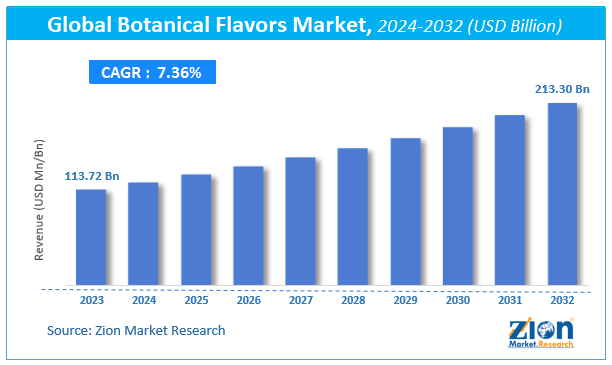
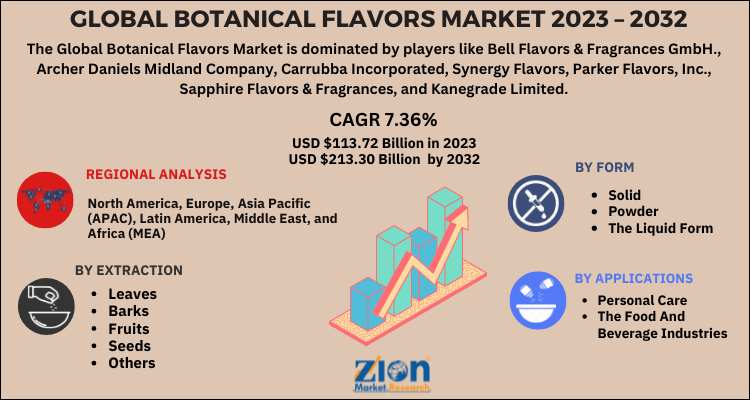
According to the report published by Zion Market Research, the global Botanical Flavors Market size was valued at USD 113.72 Billion in 2023 and is predicted to reach USD 213.30 Billion by the end of 2032. The market is expected to grow with a CAGR of 7.36% during the forecast period. The report analyzes the global Botanical Flavors Market’s growth drivers, restraints, and impact on demand during the forecast period. It will also help navigate and explore the arising opportunities in the Botanical Flavors Market industry.
Global Botanical Flavors Market: Overview
The naturally obtained extracts from the leaves, seeds, spices, fruits, flowers, and barks are known as botanical flavors. In the food and the beverage industry, the botanical flavors have a wide range of application in order to enhance the richness and the taste of the food products such as dairy, confectionery, bakery, savory and in the beverages products such as drinks and juices. The fact that most of the consumers are inclining more towards the naturally obtained food products will increase the demand for the botanical flavors.
Key Insights:
- As per the analysis shared by our research analyst, the botanical flavors market is anticipated to grow at a CAGR of 7.36% during the forecast period (2024-2032).
- The global botanical flavors market was estimated to be worth approximately USD 113.72 billion in 2023 and is projected to reach a value of USD 213.30 billion by 2032.
- The growth of the botanical flavors market is being driven by increasing demand from the food and beverage manufacturers owing to the reason that they use the botanical flavors as a functional ingredient and as natural ingredients in the food and beverage products.
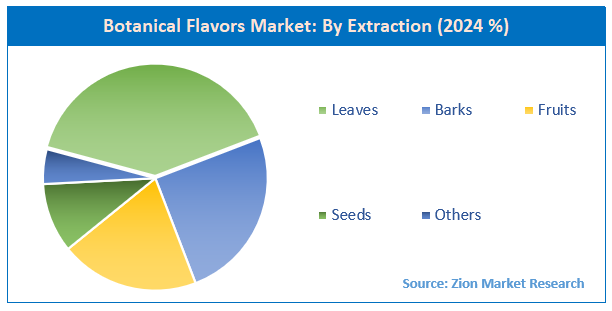
- Based on the extraction, the leaves segment is growing at a high rate and is projected to dominate the market.
- On the basis of form, the solid segment is projected to swipe the largest market share.
- In terms of applications, the personal care segment is expected to dominate the market.
- By region, North America is expected to dominate the global market during the forecast period.
Global Botanical Flavors Market: Segmentation
The global market for the botanical flavors is fragmented into extraction, form and applications.
Based on the Extraction, the global market is segregated into leaves, barks, fruits, seeds and others. The others segment is divided into roots and herbs. The segment that is leading the market is the fruits and the leaves.
Based on the Form, the market is categorized into solid, powder and the liquid form.
Based on the Application, the market is categorized into personal care and the food and beverage industries. The food industry is sub-categorized into dairy, confectionery, bakery and savory products. The beverage segment is sub-divided into the nonalcoholic and alcoholic industry.
Global Botanical Flavors Market: Growth Factors
The key factor that is driving the botanical flavors market is the increasing demand from the food and beverage manufacturers owing to the reason that they use the botanical flavors as a functional ingredient and as natural ingredients in the food and beverage products. There are wide applications of the botanical flavors in the beverage sector as the market players are offering an introduction to new beverages and this is made possible by using the botanical flavors to improve the flavors of the existing beverages. The botanical flavors consist of high nutritional values such as vitamin, protein, and other types of minerals. Owing to all these factors, the market for the botanical flavors will experience a significant growth in the future years. The increase in the inclination of the consumers towards natural products will also increase the demand of the market.
Recent Developments
- In February 2021, IFF completed its merger with DuPont Nutrition & Biosciences, creating a larger, diversified company with a strengthened footprint in food and nutrition ingredients.
- In May 2023, DSM and Firmenich completed their merger, creating DSM-Firmenich, a major player in flavors, fragrances, and nutrition with expanded capabilities in botanical and natural ingredient research.
- In April 2023, Givaudan acquired key portfolios of cosmetic ingredients from Amyris, reinforcing its leadership in biotech and sustainable beauty solutions.
- In June 2024, Givaudan launched its "House of Naturals" initiative, solidifying its commitment to natural ingredients and sustainable sourcing strategies.
- In May 2025, Roquette completed its acquisition of IFF Pharma Solutions, expanding its plant-based and excipient capabilities and linking it with a large nutraceutical portfolio.
Botanical Flavors Market : Report Scope
| Report Attributes | Report Details |
|---|---|
| Report Name | Botanical Flavors Market Research Report |
| Market Size in 2023 | USD 113.72 Billion |
| Market Forecast in 2032 | USD 213.30 Billion |
| Growth Rate | CAGR of 7.36% |
| Number of Pages | 201 |
| Key Companies Covered | Bell Flavors & Fragrances GmbH., Archer Daniels Midland Company, Carrubba Incorporated, Synergy Flavors, Parker Flavors, Inc., Sapphire Flavors & Fragrances, and Kanegrade Limited. |
| Segments Covered | By Extraction, By Form, By Applications and By Region |
| Regions Covered | North America, Europe, Asia Pacific (APAC), Latin America, Middle East, and Africa (MEA) |
| Base Year | 2023 |
| Historical Year | 2018 - 2022 |
| Forecast Year | 2024 - 2032 |
| Customization Scope | Avail customized purchase options to meet your exact research needs. Request For Customization |
Botanical Flavors Market Dynamics:
Key growth drivers
The botanical flavors market is experiencing robust growth driven by a significant shift in consumer preferences towards natural, healthy, and organic products. Consumers are increasingly seeking "clean label" products with ingredients they can recognize and trust, moving away from artificial additives and preservatives. This trend is particularly prominent in the food and beverage industry, where botanical flavors provide a way to enhance taste while aligning with health and wellness goals. The growing popularity of plant-based and vegan diets further propels demand, as botanical flavors offer authentic tastes for these products. Additionally, consumer willingness to experiment with unique and exotic flavor profiles is encouraging manufacturers to innovate with new and diverse botanical combinations.
Restraints
Despite the strong demand, the botanical flavors market faces several key restraints. One major challenge is the inherent variability and limited availability of raw botanical materials. Factors such as climate change, seasonal variations, and unpredictable crop yields can lead to supply chain disruptions and volatile pricing. This makes it difficult for manufacturers to ensure consistent quality and a steady supply of specific flavors. Furthermore, the cost of sourcing and extracting natural botanical flavors can be significantly higher than that of producing their synthetic counterparts, which can limit their use in a wider range of mass-market products.
Opportunities
The market is full of opportunities, particularly in the development of functional foods and beverages. Botanical ingredients are often associated with health benefits, such as being anti-inflammatory or rich in antioxidants, which allows them to be marketed not just for flavor but also for their functional properties. The integration of advanced technologies like AI and machine learning can help in the discovery and development of new botanical extracts and in optimizing flavor profiles. There is also a significant opportunity for market players to expand into emerging markets, where a growing middle class and increasing health consciousness are driving demand for premium and natural products.
Challenges
The botanical flavors market is also confronted with a number of challenges. A lack of standardized regulations and varying quality control measures across different regions can pose a significant challenge for global manufacturers. Ensuring the authenticity and purity of botanical extracts to prevent adulteration and counterfeit products is a constant struggle, which can erode consumer trust. The complex and time-consuming process of obtaining regulatory approval for new botanical ingredients can also be a barrier to market entry. Finally, the need for transparent and sustainable sourcing practices, while a market driver, also presents a logistical and ethical challenge for companies to ensure they are not negatively impacting local ecosystems and communities.
Global Botanical Flavors Market: Regional Analysis
According to the regional study, the global market for the botanical flavors is diversified into North America, Western Europe, the Middle East and Africa Eastern Europe, Asia Pacific, and Latin America. The regions that are dominating the botanical flavors market are Europe and North America. It is estimated that these regions will lead the market both in terms of value and volume in the coming years. The market in the Asia Pacific region is also growing at a moderate rate but will grow at a fast pace in the coming years.
Global Botanical Flavors Market: Competitive Players
The key market players that are involved in the botanical flavors market include :
- Bell Flavors & Fragrances GmbH.
- Archer Daniels Midland Company
- Carrubba Incorporated
- Synergy Flavors
- Parker Flavors, Inc.
- Sapphire Flavors & Fragrances
- Kanegrade Limited.
The Global Botanical Flavors Market is segmented as follows:
By Extraction
- Leaves
- Barks
- Fruits
- Seeds
- Others
By Form
- Solid
- Powder
- Liquid form
By Applications
- Personal care
- the food and beverage industries
By Region
- North America
- The U.S.
- Canada
- Mexico
- Europe
- France
- The UK
- Spain
- Germany
- Italy
- Rest of Europe
- Asia Pacific
- China
- Japan
- India
- Australia
- South Korea
- Rest of Asia Pacific
- The Middle East & Africa
- Saudi Arabia
- UAE
- Egypt
- Kuwait
- South Africa
- Rest of the Middle East & Africa
- Latin America
- Brazil
- Argentina
- Rest of Latin America
What Reports Provides
- Full in-depth analysis of the parent market
- Important changes in market dynamics
- Segmentation details of the market
- Former, on-going, and projected market analysis in terms of volume and value
- Assessment of niche industry developments
- Market share analysis
- Key strategies of major players
- Emerging segments and regional markets
- Testimonials to companies in order to fortify their foothold in the market.
Table Of Content

FrequentlyAsked Questions
Botanical flavors are natural flavor extracts derived from plants. They are used in food, beverages, and personal care products.
The global Botanical Flavors market is expected to be driven by the Driven by consumer preference for natural and clean-label ingredients, rising demand for plant-based beverages/foods, and growing premiumization in flavors. Expansion of functional drinks and wellness products boosts adoption.
According to study, the global Botanical Flavors market size was worth around USD 113.72 Billion in 2023 and is predicted to grow to around USD 213.30 Billion By 2032.
The global Botanical Flavors market is expected to grow at a Compound Annual Growth Rate (CAGR) of around CAGR 7.36% during the forecast period from 2024-2032.
The global Botanical Flavors industry is projected to be challenged by Key challenges include raw material supply variability, maintaining consistent taste profiles batch-to-batch, regulatory compliance for natural claims, and higher costs versus synthetic flavors.
Which application areas will offer significant growth opportunities in the Botanical Flavors market?
The Opportunities lie in rising clean-label demand, growth of natural beverages and functional foods, premiumization in taste experiences, and expanding use in plant-based and wellness products will offer significant growth opportunities in the Botanical Flavors market.
Natural extracts with clean-label positioning; fermentation and biotech-derived flavor molecules; regional/ethnic flavor innovation with improved stability in beverages are the emerging trends and innovations impacting the Botanical Flavors market.
The global Botanical Flavors market is expected to be led by Europe during the forecast period.
Some of the prominent players operating in the global Botanical Flavors market are; Bell Flavors & Fragrances GmbH., Archer Daniels Midland Company, Carrubba Incorporated, Synergy Flavors, Parker Flavors, Inc., Sapphire Flavors & Fragrances, and Kanegrade Limited. and others.
The report explores crucial aspects of the Botanical Flavors market, including a detailed discussion of existing growth factors and restraints, while also browsing future growth opportunities and challenges that impact the market.
HappyClients

