
Biodegradable Engine Oil Market Growth, Size, Share, Trends, and Forecast 2032

Biodegradable Engine Oil Market By Type (polyalkylene glycols, glass vegetable oils, synthetic esters, and others), By Application (transportation, agriculture, construction, and others) And By Region: - Global And Regional Industry Overview, Market Intelligence, Comprehensive Analysis, Historical Data, And Forecasts, 2024-2032
| Market Size in 2023 | Market Forecast in 2032 | Growth Rate (in %) | Base Year |
|---|---|---|---|
| USD 996.3 Million | USD 1,442.80 Million | CAGR at 4.20% | 2023 |
Description
How big is the Biodegradable Engine Oil Market?
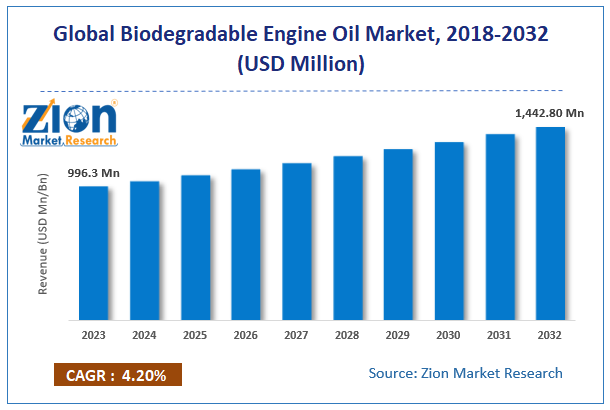
According to the report published by Zion Market Research, the global Biodegradable Engine Oil Market size was valued at USD 996.3 Million in 2023 and is predicted to reach USD 1,442.80 Million by the end of 2032. The market is expected to grow with a CAGR of 4.20% during the forecast period. The report analyzes the global Biodegradable Engine Oil Market’s growth drivers, restraints, and impact on demand during the forecast period. It will also help navigate and explore the arising opportunities in the Biodegradable Engine Oil Market industry.
Global Biodegradable Engine Oil Market: Overview
Biodegradable oil is the combination of selected biodegradable bases that includes synthetic esters, sunflower, rape, and vegetable oils. These are generally non-toxic and are special additives exhibiting desired properties. As compared to the traditional lubricants, the use of biodegradable engine oil is better for use owing to its high stability and high flash point.
Global Biodegradable Engine Oil Market: Growth Factors
The global biodegradable engine oil market is growing at a rapid rate. Major factors such as the high cost of petroleum-based products, increase in concerns of environmental pollution, and growing demand for biodegradable products due to growing concerns of carbon footprints are propelling the growth of the global market. Further, it is been reported that in North America nearly 2.5 billion gallons of lubricants are sold every year and around 60 percent of this is not accountable which ultimately ends up on the ground itself or in lakes, rivers, and groundwater. This leads to untold harm to the wildlife, fish, and environment.
Thus, the government as well as agriculture, forestry, and marine industry are taking major steps and spreading awareness regarding the use of biodegradable engine oil to maintain the environment and lower the dependency on mineral oils. All such factors coupled with the key advantages of biodegradable engine oils such as reduction in oil losses through evaporation, longer equipment life, high viscosity index, good lubricating properties, lower toxicity, and high level of biodegradability are spurring the demand for biodegradable engine oil. This is boosting the growth of the global biodegradable engine oil market. Moreover, the growing application of biodegradable engine oil in the construction and transportation sectors is also augmenting the growth of the global market.
Furthermore, rapidly growing industries and an increase in funding for the production of biodegradable engine oil will lead to lucrative opportunities for the growth of the global biodegradable engine oil market over the forecast period. However, owing to the insufficient oxidative stability, biodegradable oil needs to be modified or treated to ensure performance which increases the overall cost and this may hinder the growth of the global biodegradable engine oil market.
The majority of the sectors across the world are affected by the onset of the COVID-19 pandemic. The major consumer of biodegradable engine oil is the transportation sector which is severely hampered during the pandemic period. Similarly, the demand for oil and lubricants was decreased in other end-use industries owing to a temporary halt on production and transportation. This affected the growth of the global biodegradable engine oil market during the pandemic condition. However, with the relaxation in lockdown, the demand for biodegradable engine oil is estimated to surge for automobiles.

Global Biodegradable Engine Oil Market: Segmentation
The global biodegradable engine oil market is bifurcated based on type, application, and region.
Based on type, the global biodegradable engine oil market is categorized as polyalkylene glycols, glass vegetable oils, synthetic esters, and others.
Applications of biodegradable engine oil are segregated as transportation, agriculture, construction, and others. Among these applications, the transportation segment is expected to remain dominant over the forecast period.
Biodegradable Engine Oil Market : Report Scope
| Report Attributes | Report Details |
|---|---|
| Report Name | Biodegradable Engine Oil Market Research Report |
| Market Size in 2023 | USD 996.3 Million |
| Market Forecast in 2032 | USD 1,442.80 Million |
| Growth Rate | CAGR of 4.20% |
| Number of Pages | 196 |
| Key Companies Covered | Croda International Plc., BP, Condat, NANDAN PETROCHEM LTD., Exxon Mobil, FUCHS Group, Royal Dutch Shell, Renewable Lubricants, Repsol, and Total Lubricants. |
| Segments Covered | By Type, By Application and By Region |
| Regions Covered | North America, Europe, Asia Pacific (APAC), Latin America, Middle East, and Africa (MEA) |
| Base Year | 2023 |
| Historical Year | 2018 - 2022 |
| Forecast Year | 2024 - 2032 |
| Customization Scope | Avail customized purchase options to meet your exact research needs. Request For Customization |
Global Biodegradable Engine Oil Market: Regional Analysis
Europe is expected to remain the largest market for the biodegradable engine oil market during the forecast period. The demand for biodegradable engine oil is continuously increasing in Europe owing to the rapid growth of industries and growing emphasis on environmentally friendly products. Asia Pacific is also expected to contribute healthy revenue in the global biodegradable engine oil market during the forecast period. Some of the key factors such as a rapid expansion of industries in emerging countries such as India & China, growing construction industry, and increasing demand for lubricants in the agriculture sector are combinedly contributing to the healthy share of the market in this region. The demand for biodegradable engine oil is also significantly increasing in North America owing to fast development in the infrastructure and transport sector.
Global Biodegradable Engine Oil Market: Competitive Players
Some of the key players operating in the global biodegradable engine oil market include:
- Croda International Plc.
- BP
- Condat
- NANDAN PETROCHEM LTD.
- Exxon Mobil
- FUCHS Group
- Royal Dutch Shell
- Renewable Lubricants
- Repsol
- Total Lubricants.
The Global Biodegradable Engine Oil Market is segmented as follows:
By Type
- polyalkylene glycols
- glass vegetable oils
- synthetic esters
- and others
By Application
- transportation
- agriculture
- construction
- and others
By Region
- North America
- The U.S.
- Canada
- Mexico
- Europe
- France
- The UK
- Spain
- Germany
- Italy
- Rest of Europe
- Asia Pacific
- China
- Japan
- India
- Australia
- South Korea
- Rest of Asia Pacific
- The Middle East & Africa
- Saudi Arabia
- UAE
- Egypt
- Kuwait
- South Africa
- Rest of the Middle East & Africa
- Latin America
- Brazil
- Argentina
- Rest of Latin America
What Reports Provides
- Full in-depth analysis of the parent market
- Important changes in market dynamics
- Segmentation details of the market
- Former, on-going, and projected market analysis in terms of volume and value
- Assessment of niche industry developments
- Market share analysis
- Key strategies of major players
- Emerging segments and regional markets
- Testimonials to companies in order to fortify their foothold in the market.
Table Of Content

FrequentlyAsked Questions
Biodegradable engine oil is an eco-friendly lubricant that breaks down naturally. It reduces environmental pollution compared to conventional oils.
The global Biodegradable Engine Oil market is expected to be driven by the Driven by stricter environmental regulations, rising demand for eco-friendly lubricants, and increased awareness of soil and water pollution risks. Adoption in sensitive applications and industrial sustainability goals support growth.
According to study, the global Biodegradable Engine Oil market size was worth around USD 996.3 Million in 2023 and is predicted to grow to around USD 1,442.80 Million By 2032.
The global Biodegradable Engine Oil market is expected to grow at a Compound Annual Growth Rate (CAGR) of around CAGR 4.20% during the forecast period from 2024-2032.
The global Biodegradable Engine Oil industry is projected to be challenged by Challenges include higher pricing versus conventional oils, performance limitations under extreme conditions, and limited consumer awareness and distribution.
The Opportunities lie in stricter environmental regulations, growth in marine and forestry equipment use, and rising demand for sustainable lubricants in sensitive ecosystems will offer significant growth opportunities in the Biodegradable Engine Oil market.
Bio-based esters with improved oxidation stability; compatibility with modern engines and aftertreatment; lifecycle-carbon tracking and eco-certifications are the emerging trends and innovations impacting the Biodegradable Engine Oil market.
The global Biodegradable Engine Oil market is expected to be led by Europe during the forecast period.
Some of the prominent players operating in the global Biodegradable Engine Oil market are; Croda International Plc., BP, Condat, NANDAN PETROCHEM LTD., Exxon Mobil, FUCHS Group, Royal Dutch Shell, Renewable Lubricants, Repsol, and Total Lubricants. and others.
The report explores crucial aspects of the Biodegradable Engine Oil market, including a detailed discussion of existing growth factors and restraints, while also browsing future growth opportunities and challenges that impact the market.
HappyClients

