
Autonomic Systems Market Size, Share, Trends, Growth and Forecast 2034

Autonomic Systems Market By Type (Enterprise Software Application, Networking, IT Service Management, and Data Management), By Application (Telecom, Retail, Government, Healthcare, Information Technology, Banking, Financial Services & Insurance (BFSI), Retail, and Others), and By Region - Global and Regional Industry Overview, Market Intelligence, Comprehensive Analysis, Historical Data, and Forecasts 2025 - 2034
| Market Size in 2024 | Market Forecast in 2034 | CAGR (in %) | Base Year |
|---|---|---|---|
| USD 5.15 Billion | USD 14.58 Billion | 12.06% | 2024 |
Autonomic Systems Industry Perspective:
What is the anticipated size of the autonomic systems market during the projection period?
The global autonomic systems market size was worth around USD 5.15 billion in 2024 and is predicted to grow to around USD 14.58 billion by 2034 with a compound annual growth rate (CAGR) of roughly 12.06% between 2025 and 2034.
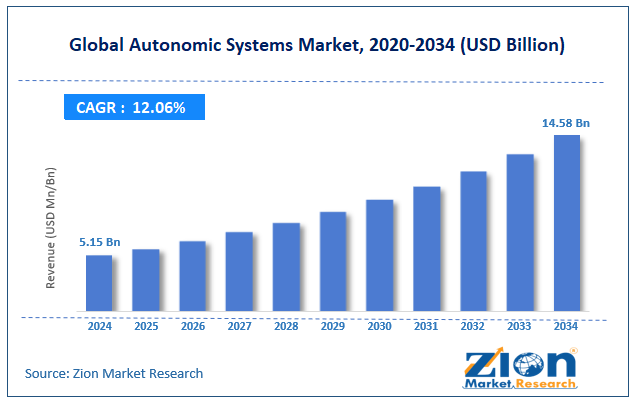
Autonomic Systems Market: Overview
Autonomic systems are next-generation computing technologies that are designed to manage themselves with minimal to zero human intervention. Autonomic computing was first launched by IBM in 2001 and, since then, has gained major growth momentum. The concept of autonomic systems deals with a range of self-managing properties mimicking the actions of the Autonomic Nervous System in humans. During the forecast period, the autonomic systems market is projected to be influenced by rising demand for self-driving vehicles in commercial and military applications.
In addition to this, smart factories and warehouses, and Artificial Intelligence (AI) & Machine Learning (ML) advancements will further help the region thrive. However, the high cost of investment, limited players, cybersecurity concerns, and ethical issues may limit market expansion trends in the coming years.
Key Insights:
- As per the analysis shared by our research analyst, the global autonomic systems market is estimated to grow annually at a CAGR of around 12.06% over the forecast period (2025-2034)
- In terms of revenue, the global autonomic systems market size was valued at around USD 5.15 billion in 2024 and is projected to reach USD 14.58 billion by 2034.
- The market is projected to grow at a significant rate due to rising investments in autonomous vehicles.
- Based on the type, the enterprise software application segment is growing at a high rate and will continue to dominate the global market, as per industry projections
- Based on the application, the information technology segment is anticipated to command the largest market share.
- Based on region, the Asia-Pacific is projected to dominate the global market during the forecast period.
Impact of the USA-Israel and Iran war on the Autonomic Systems Market:
The ongoing war between the USA, Israel, and Iran is projected to disrupt the supply chain of essential raw materials such as chips and servers. A surge in oil prices will result in increased implementation costs and reduced IT spending in the short term. During the forecast period, the war is expected to encourage more investments in military-grade and highly resilient autonomic systems with reduced scope for human help.
Autonomic Systems Market: Dynamics
Growth Drivers
How will autonomous vehicles influence growth in the autonomic systems market?
The global autonomic systems market is expected to grow due to rising investments in autonomous vehicles. According to market research, autonomic systems promote self-management in modern technologies. Autonomous vehicles such as self-driving cars do not require human assistance and can manage every operation on their own. For instance, autonomic vehicles (AVs) are designed to self-configurator depending on the environment.
Furthermore, AVs utilize information from different sources, such as sensors and cameras, to make informed safety decisions. Self-driving automotive can predict the most optimal path and adjust braking and steering to ensure optimized output. Autonomic systems thus form a crucial part of autonomous vehicles. During the forecast period, the AV industry is expected to reach over USD 1.1 trillion, creating growth scope for autonomic systems.
Rapid industrial automation is expected to work in favor of the industry players during the projection period
Next-generation industrial automation systems, such as smart manufacturing systems, Artificial Intelligence (AI)-powered robotics, and Industrial Internet of Things (IIoT), among others, are facilitated by autonomic systems. These technologies help enhance manufacturing capabilities, thus meeting escalating global demand. Smart warehouses and dark factories are some of the leading forms of automated industrial units delivering results with minimal assistance from humans. In the coming years, industrial automation is expected to reach new heights, subsequently influencing demand in the global autonomic systems market.
Restraints
Which limitations will affect the expansion of the autonomic systems market?
The global autonomic systems industry is expected to be restricted due to the high cost of development, implementation, and operations. Autonomic systems are cutting-edge technologies demanding high monetary and non-monetary investment. For instance, large-scale autonomic technologies can cost over USD 500,000 to USD 1 million in the development phase. Operational and maintenance expenses form a significant part of technology ownership, resulting in limited adoption across end markets.
Opportunities
Energy-efficient and sustainable autonomic systems to generate growth opportunities for the industry leaders
The global autonomic systems market is anticipated to experience new growth opportunities due to growing focus on achieving energy efficiency and promoting sustainability. Market players are working on developing autonomic systems that are not only energy efficient themselves but also promote optimization of energy consumption by other technologies. Furthermore, autonomic systems can be leveraged to reduce waste and improve resource management.
For instance, the Micro Energy Management System (μEMS) by Toshiba is designed to project energy demand and adjust power supply in real-time. Integration of renewable energy systems in grid infrastructure will promote energy security irrespective of geopolitical and environmental changes in the external environment.
How will advancements in military technologies shape the autonomic systems market?
Growing geopolitical tension worldwide has led to increased military expenditure across the globe. Countries are investing in upgrading existing military technologies to ensure national security and tackle regional and global threats. Military equipment designed using autonomic systems is emerging as a popular investment area as they are self-managing, thus delivering expected results without causing harm to human personnel in the military segment.
Challenges
Ethical and cybersecurity concerns to challenge market expansion over the forecast duration
The global autonomic systems industry is projected to be challenged by ethical and cybersecurity concerns. Lack of human control over autonomic systems has raised questions over accountability and risk of decision bias. Furthermore, autonomic systems are vulnerable to cyberattacks. In case of a successful attack, autonomic systems can be used to make harmful decisions, putting the lives of the general population at risk and disrupting critical infrastructure.
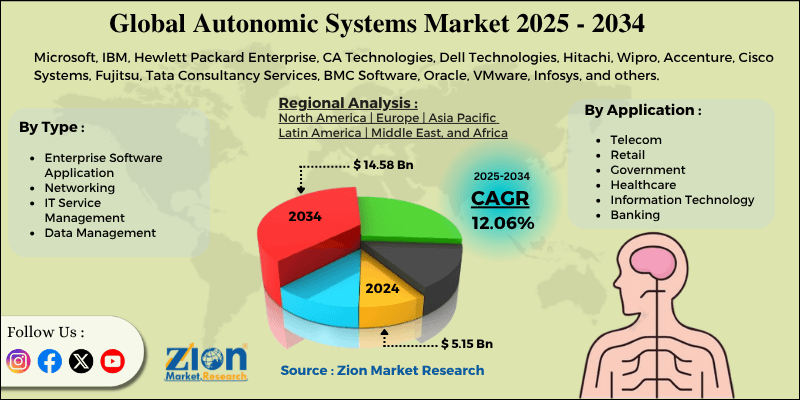
Autonomic Systems Market: Report Scope
| Report Attributes | Report Details |
|---|---|
| Report Name | Autonomic Systems Market |
| Market Size in 2024 | USD 5.15 Billion |
| Market Forecast in 2034 | USD 14.58 Billion |
| Growth Rate | CAGR of 12.06% |
| Number of Pages | 228 |
| Key Companies Covered | Microsoft, IBM, Hewlett Packard Enterprise, CA Technologies, Dell Technologies, Hitachi, Wipro, Accenture, Cisco Systems, Fujitsu, Tata Consultancy Services, BMC Software, Oracle, VMware, Infosys, and others. |
| Segments Covered | By Type, By Application, and By Region |
| Regions Covered | North America, Europe, Asia Pacific (APAC), Latin America, Middle East, and Africa (MEA) |
| Base Year | 2024 |
| Historical Year | 2019 - 2023 |
| Forecast Year | 2025 - 2034 |
| Customization Scope | Avail customized purchase options to meet your exact research needs. Request For Customization |
Autonomic Systems Market: Segmentation
The global autonomic systems market is segmented based on type, application, and region.
Why will the enterprise software application segment lead the autonomic systems industry revenue during the forecast period?
Based on type, the global market segments are enterprise software applications, networking, IT service management, and data management. In 2024, the highest growth was listed in the enterprise software application segment. It accounted for 45% of the global revenue in 2024 and is projected to grow at a CAGR of 13.41% during the forecast period. Autonomic systems powering enterprise software applications reduce manual work and optimize business processes, leading to segmental dominance.
Which will be the fastest-growing application during the forecast period in the autonomic systems market?
Based on application, the global industry is divided into telecom, retail, government, healthcare, information technology, banking, financial services & insurance (BFSI), and others. In 2024, the information technology segment was the highest revenue generator, contributing up to 30% of the global revenue. During the forecast period, it is expected to grow at a CAGR of 12.9%, driven by growing automation of the global IT infrastructure and demand for highly resilient systems with superior cyber defense capabilities.
Autonomic Systems Market: Regional Analysis
Which factors will influence growth in the North American autonomic systems market during the forecast period?
The global autonomic system market was led by North America in 2024. The region contributed up to 38.5% of the global revenue in 2024 and will grow at a steady CAGR of 14% during the forecast period. Growing military budget, presence of key providers of autonomic systems, and surging investments in research & development will aid regional expansion during the projection period. However, ongoing trade conflicts between the US and other nations may have a negative influence on the regional market growth trends.
Why will Asia-Pacific lead the autonomic systems market during the forecast period?
Asia-Pacific is set to emerge as the fastest-growing region in the autonomic systems market during the forecast period, growing at a CAGR of 18.02%. In 2024, the region accounted for 31% of the global revenue. Rapid industrialization, the emergence of dark factories, and accelerated industrial automation will work in favor of the regional players. Increased government support encouraging domestic development of autonomic systems will prove beneficial for the regional market leaders.
Autonomic Systems Market: Competitive Analysis
The global autonomic systems market is led by players like:
- Microsoft
- IBM
- Hewlett Packard Enterprise
- CA Technologies
- Dell Technologies
- Hitachi
- Wipro
- Accenture
- Cisco Systems
- Fujitsu
- Tata Consultancy Services
- BMC Software
- Oracle
- VMware
- Infosys
What are the latest key trends in the autonomic systems market?
Hyper autonomous systems
The ongoing efforts toward the development of hyper-autonomous technologies powered by next-generation AI are expected to reshape the autonomic systems market. Hyper autonomous systems aim to minimize the need for human intervention.
Enhanced cybersecurity features
Enhanced cybersecurity features are a major upward trend focusing on eliminating concerns over digital crimes and hacking. It includes the development of highly accurate and real-time automated threat detection, followed by an effective response process.
The global autonomic systems market is segmented as follows:
By Type
- Enterprise Software Application
- Networking
- IT Service Management
- Data Management
By Application
- Telecom
- Retail
- Government
- Healthcare
- Information Technology
- Banking
- Financial Services & Insurance (BFSI)
- Retail
- Others
By Region
- North America
- The U.S.
- Canada
- Mexico
- Europe
- France
- The UK
- Spain
- Germany
- Italy
- Rest of Europe
- Asia Pacific
- China
- Japan
- India
- Australia
- South Korea
- Rest of Asia Pacific
- The Middle East & Africa
- Saudi Arabia
- UAE
- Egypt
- Kuwait
- South Africa
- Rest of the Middle East & Africa
- Latin America
- Brazil
- Argentina
- Rest of Latin America
Table Of Content
Methodology
FrequentlyAsked Questions
Autonomic systems are next-generation computing technologies that are designed to manage themselves with minimal to zero human intervention.
The global autonomic systems market is expected to grow due to rising investments in autonomous vehicles.
According to study, the global autonomic systems market size was worth around USD 5.15 billion in 2024 and is predicted to grow to around USD 14.58 billion by 2034.
The CAGR value of autonomic systems market is expected to be around 12.06% during 2025-2034.
The global autonomic systems industry is projected to be challenged by ethical and cybersecurity concerns.
The autonomic systems market is projected to reach its potential between 2032-2033.
The global autonomic systems market has performed well so far and will offer similar trends in the coming years.
Asia-Pacific is set to emerge as the fastest-growing region in the autonomic systems market during the forecast period, growing at a CAGR of 18.02%.
The global autonomic systems market is led by players like Microsoft, IBM, Hewlett Packard Enterprise, CA Technologies, Dell Technologies, Hitachi, Wipro, Accenture, Cisco Systems, Fujitsu, Tata Consultancy Services, BMC Software, Oracle, VMware, and Infosys.
The report explores crucial aspects of the autonomic systems market including detailed discussion of existing growth factors and restraints while also browsing future growth opportunities and challenges that impact the market.

HappyClients

