
Artificial Intelligence In Marketing Market Size, Share, Analysis, Trends, Growth Report, 2032

Artificial Intelligence In Marketing Market - By Technology (Machine Learning, Context Awareness, NLP, and Computer Vision), By End-User (BFSI, Consumer Goods, Retail, Media & Entertainment, and Enterprises), and By Region - Global Industry Perspective, Comprehensive Analysis, and Forecast, 2024 - 2032
| Market Size in 2023 | Market Forecast in 2032 | CAGR (in %) | Base Year |
|---|---|---|---|
| USD 14.30 Billion | USD 109.27 Billion | 22.6% | 2023 |
Artificial Intelligence In Marketing Market Insights
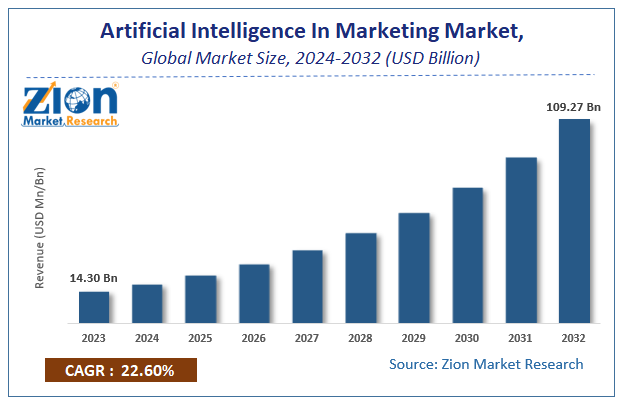
According to Zion Market Research, the global Artificial Intelligence In Marketing Market was worth USD 14.30 Billion in 2023. The market is forecast to reach USD 109.27 Billion by 2032, growing at a compound annual growth rate (CAGR) of 22.6% during the forecast period 2024-2032. The report offers a valuation and analysis of Artificial Intelligence In Marketing market on a global as well as regional level. The study offers a comprehensive assessment of the industry competition, limitations, sales estimates, avenues, current & emerging trends, and industry-validated market data. The report offers historical data from 2018 to 2022 along with a forecast from 2024 to 2032 based on value (USD Billion).
Artificial Intelligence in Marketing Market: Overview
Artificial intelligence is used in marketing activities for providing consumers with a personalized & digital experience. In addition to this, marketing activities make use of AI to facilitate automated decision-making processes including data collection, data analyzing, and monitoring the activities of targeted audiences on the web. Furthermore, AI is utilized for automating marketing activities, reducing errors in web promotions, raising ROIs, reducing operational costs, and improving business decision-making processes. Apparently, artificial intelligence assists marketers inaccurate sales forecasting, content generation, speech recognition, automated image detection, gaining customer insights, and ensuring maintaining of data privacy & quality. Citing an instance, Amazon makes use of AI for enhancing online shopping services & improving customer experiences.
Key Insights
- As per the analysis shared by our research analyst, the global Artificial Intelligence In Marketing Market is estimated to grow annually at a CAGR of around 22.6% over the forecast period (2024-2032).
- In terms of revenue, the global Artificial Intelligence In Marketing Market size was valued at around USD 14.30 billion in 2023 and is projected to reach USD 109.27 billion by 2032.
- Based on the End-User Industry, the enterprise sector holds the largest share of the AI in marketing market. Enterprises are utilizing AI for various applications, including virtual assistants, sales and marketing automation, analytics, and social media advertising.
- Based on the technology, the Machine learning dominates the AI in marketing market, attributed to its ability to collect and handle big data, along with performing complex calculations that enhance marketing strategies.
- Based on the Region, The North America leads the AI in marketing market, driven by the expansion of industries such as retail, BFSI, healthcare, and automotive. The presence of numerous well-known technology firms in the region contributes to its dominance.
Artificial Intelligence In Marketing Market: Dynamics
Key Growth Drivers
The artificial intelligence (AI) in marketing market is primarily driven by the increasing need for personalized customer experiences. AI-powered solutions analyze large volumes of data to provide actionable insights, enabling marketers to deliver targeted content and personalized recommendations. The growing adoption of AI-driven chatbots, virtual assistants, and predictive analytics tools further enhances customer engagement and retention. Additionally, the rapid expansion of e-commerce and digital platforms has accelerated the demand for AI in automating marketing processes, optimizing ad campaigns, and improving ROI. Continuous advancements in machine learning algorithms and the integration of AI with customer relationship management (CRM) systems also contribute to market growth.
Restraints
Despite the numerous advantages, the AI in marketing market faces challenges related to data privacy and security concerns. The increased use of AI requires access to vast amounts of personal data, raising concerns over how this data is collected, stored, and used. Regulatory frameworks, such as the General Data Protection Regulation (GDPR) and other data protection laws, impose strict guidelines on data management, limiting the scope of AI applications. Additionally, the high initial investment in AI technology and the need for skilled professionals to manage AI systems may hinder adoption, especially among small and medium-sized enterprises (SMEs).
Opportunities
The ongoing advancements in AI algorithms and the proliferation of cloud-based AI platforms present significant opportunities for the market. Businesses are increasingly leveraging AI for hyper-personalization, real-time decision-making, and predictive customer insights. The integration of AI with emerging technologies like augmented reality (AR) and virtual reality (VR) in marketing campaigns further enhances customer experiences, creating new growth avenues. Additionally, the growing adoption of AI-powered marketing automation tools by SMEs to optimize digital campaigns and streamline customer interactions offers immense market potential. Partnerships and collaborations between AI technology providers and marketing agencies are also driving innovation in AI-based marketing solutions.
Challenges
A key challenge in the AI in marketing market is the complexity of integrating AI solutions with existing marketing ecosystems. Many organizations struggle with data silos, inconsistent data quality, and lack of real-time data access, which hinder the effectiveness of AI-powered marketing initiatives. Additionally, ethical concerns related to AI-driven decision-making, bias in algorithms, and the potential misuse of AI technology pose reputational risks for companies. The rapid pace of technological advancements also means businesses must continually invest in upgrading their AI systems to remain competitive. Furthermore, the shortage of AI talent and the need for ongoing training and development present operational challenges for organizations seeking to implement AI-driven marketing strategies.
Artificial Intelligence In Marketing Market: Report Scope
| Report Attributes | Report Details |
|---|---|
| Report Name | Artificial Intelligence In Marketing Market |
| Market Size in 2023 | USD 14.30 Billion |
| Market Forecast in 2032 | USD 109.27 Billion |
| Growth Rate | CAGR of 22.6% |
| Number of Pages | 120 |
| Key Companies Covered | Oracle, Baidu, Albert Technologies, Sentient Technologies, Twitter, Zensed, Appier, Persado, Facebook, Micron, Intel Corporation, Amazon, and Salesforce |
| Segments Covered | By End-User, By Technology, And By Region |
| Regions Covered | North America, Europe, Asia Pacific (APAC), Latin America, Middle East, and Africa (MEA) |
| Base Year | 2023 |
| Historical Year | 2018 - 2022 |
| Forecast Year | 2024 - 2032 |
| Customization Scope | Avail customized purchase options to meet your exact research needs. Request For Customization |
Artificial Intelligence In Marketing Market: Segmentation
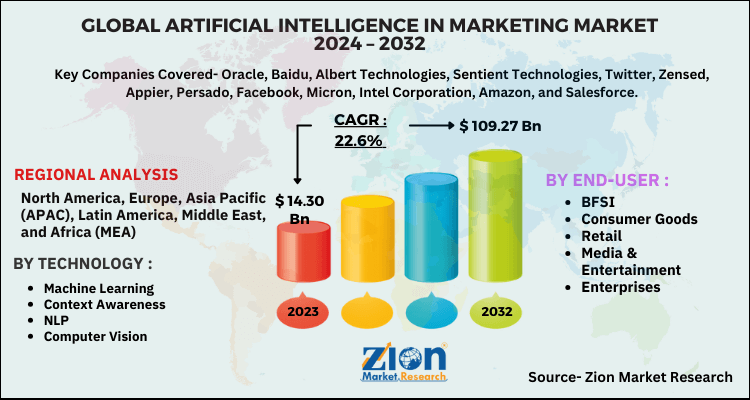
The study provides a decisive view of the Artificial Intelligence In Marketing Market by segmenting the market based on by end-user, by technology and by region. All the segments have been analyzed based on present and future trends and the market is estimated from 2024 to 2032.
By end-user, segment analysis includes BFSI, consumer goods, retail, media & entertainment, enterprises.
By technology, segment analysis includes machine learning, context awareness, NLP, computer vision.
The regional, segment includes the current and forecast demand for North America, Europe, Asia Pacific, Latin America, and the Middle East and Africa.
Artificial Intelligence in Marketing Market: Regional Landscape
North American Market To Retain Dominant Position Over 2024 – 2032
The growth of artificial intelligence in marketing market in North America over the assessment period can be attributed to the large-scale presence of tech giants in the countries such as Canada as well as the U.S. In addition to this, massive acceptance of new AI techniques by giant enterprises as well as small & medium-scale firms will catapult the growth of the regional market over the forecast timeframe.
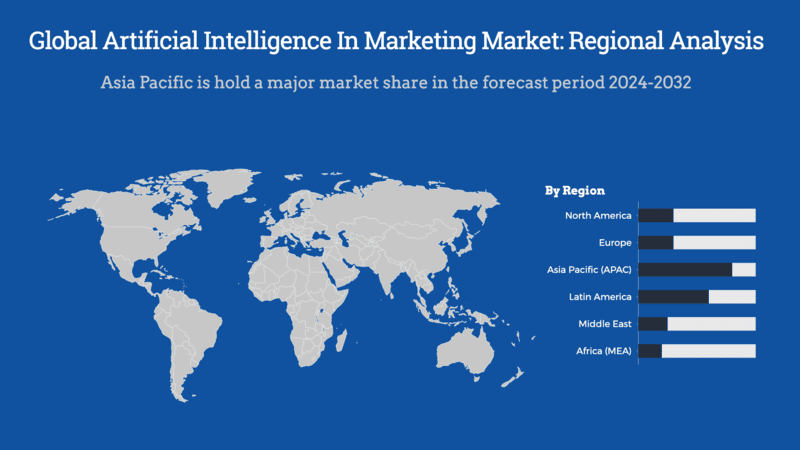
The Artificial Intelligence (AI) in Marketing market is experiencing significant growth across various regions, driven by technological advancements and the increasing demand for data-driven marketing strategies. Here's a regional analysis highlighting key trends and projections:
North America
North America stands at the forefront of AI adoption in marketing, with the United States leading due to its robust technological infrastructure and a high concentration of martech startups. The region's emphasis on data-driven decision-making and automation in marketing processes has accelerated the integration of AI technologies. Additionally, substantial investments in AI research and development are fostering continuous innovation, further propelling market growth.
Europe
European countries, including the UK, Germany, and France, are witnessing significant advancements in AI-driven marketing. The region's focus on personalized content delivery and customer engagement strategies has led to increased adoption of AI technologies. Businesses are leveraging AI-powered analytics to enhance marketing effectiveness, supported by a growing ecosystem of tech startups and favorable regulatory environments that encourage innovation.
Asia-Pacific
The Asia-Pacific region is experiencing rapid growth in AI adoption within the marketing sector, particularly in countries like China, Japan, South Korea, and India. Factors contributing to this growth include rapid digitalization, expanding e-commerce markets, and increasing smartphone and internet penetration. China's burgeoning AI industry and India's youthful, tech-savvy population are notable drivers, with businesses in these countries increasingly utilizing AI to enhance customer experiences and streamline marketing operations.
Latin America
In Latin America, countries such as Brazil and Mexico are beginning to embrace AI technologies in marketing to optimize digital campaigns and customer analytics. While the adoption rate is currently moderate, the growing recognition of AI's potential benefits suggests a positive trajectory for market expansion in the region.
Middle East and Africa
The Middle East and Africa are at nascent stages of AI integration in marketing. However, increasing interest in AI-powered tools for customer engagement and market analysis indicates potential for growth. As businesses in these regions explore AI applications, the market is expected to develop steadily.
Artificial Intelligence in Marketing Market: Competitive Landscape
Key players profiled in the study are:
- Oracle
- Baidu
- Albert Technologies
- Sentient Technologies
- Zensed
- Appier
- Persado
- Micron
- Intel Corporation
- Amazon
- Salesforce.
The global Artificial Intelligence In Marketing Market is segmented as follows:
By End-User:
- BFSI
- Consumer Goods
- Retail
- Media & Entertainment
- Enterprises
By Technology:
- Machine Learning
- Context Awareness
- NLP
- Computer Vision
By Region
- North America
- The U.S.
- Canada
- Europe
- France
- The UK
- Spain
- Germany
- Italy
- Rest of Europe
- Asia Pacific
- China
- Japan
- India
- South Korea
- Southeast Asia
- Rest of Asia Pacific
- Latin America
- Brazil
- Mexico
- Rest of Latin America
- Middle East & Africa
- GCC
- South Africa
- Rest of Middle East & Africa
Table Of Content
Methodology
FrequentlyAsked Questions

HappyClients

