
Global Architectural Coatings Market Size, Share, Trends, Growth 2032

Architectural Coatings Market By Resin Type (Alkyd and Acrylic), By Coating Type (Exterior and Interior), By Technology (Waterborne, Powder, and Solvent-borne), By Application (Residential and Non-residential), By User Type (Professional and DIY Users), and By Region - Global and Regional Industry Overview, Market Intelligence, Comprehensive Analysis, Historical Data, and Forecasts 2024 - 2032
| Market Size in 2023 | Market Forecast in 2032 | CAGR (in %) | Base Year |
|---|---|---|---|
| USD 72.23 Billion | USD 115.96 Billion | 5.4% | 2023 |
Architectural Coatings Industry Perspective
What will be the global architectural coatings market size during the forecast period?
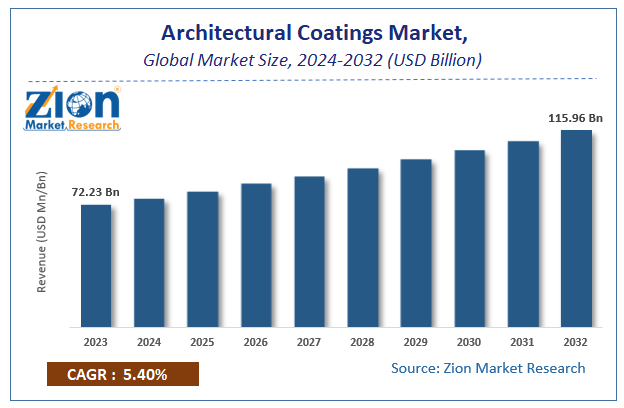
According to Zion Market Research, the global Architectural Coatings Market was worth USD 72.23 billion in 2023. The market is forecast to reach USD 115.96 billion by 2032, growing at a compound annual growth rate (CAGR) of 5.4% during the forecast period 2024-2032.
This report provides a comprehensive analysis of the growth drivers, restraints, and challenges shaping demand across the global architectural coatings market throughout the forecast period, while highlighting high-potential emerging opportunities within the industry.
Key Insights
- As per the analysis shared by our research analyst, the global architectural coatings market is estimated to grow annually at a CAGR of around 5.4% over the forecast period (2024-2032).
- In terms of revenue, the global architectural coatings market size was valued at around USD 72.23 billion in 2023 and is projected to reach USD 115.96 billion by 2032.
- The market is driven by an increase in residential construction, growing consciousness about maintaining a green environment that fuels demand for quality products and innovation, and stability in the economic and social status of populations in developing countries.
- Based on the resin type, the acrylic segment is widely preferred for its durability, weather resistance, and suitability for both interior and exterior applications that support broad market adoption.
- Based on the coating type, the interior coatings segment holds strong demand due to rising aesthetic preferences and interior design activities in residential and commercial spaces.
- Based on the technology, the waterborne coatings segment leads due to its eco-friendly profile, lower VOC emissions, and alignment with green construction trends that expand overall market acceptance.
- Based on the application, residential applications dominate through continuous construction and refurbishment activity that generates steady volume demand.
- Based on the user type, professional users account for a major share, as contractors and specialists drive large-scale application of protective and decorative coatings.
- By region, Asia Pacific is expected to amplify market growth due to the prominent rise in construction and refurbishment activities in countries such as China, India, Japan, Thailand, and Taiwan, supported by growing aesthetic sense and large-scale infrastructural spending.
Architectural Coatings Market: Overview
Architectural coatings are specialized paints, sealers, and varnishes applied to buildings and structures to provide protective, decorative, and durable finishes. They are extensively used for roof coatings, deck finishes, wall paints, and surface protection across interior and exterior applications. These coatings enhance appearance while delivering functional benefits such as weather resistance, corrosion prevention, and surface longevity on substrates including walls, ceilings, floors, metal components, and wooden surfaces.
Architectural Coatings Market: Growth Factors
What factors are accelerating demand for architectural coatings?
An increase in residential building construction has helped promote architectural coatings market trends. Growing consciousness about maintaining a green environment has culminated in massive demand for quality products, leading to product innovation, thereby further enlarging the architectural coatings business scope. Experts are of the view that the market has bright growth prospects due to stability witnessed in the economic & social status of the population in developing countries as well as third-world economies.
Apparently, the product is used for preventing rusting of metallic components of metal furniture, tanks, fences, and radiators. It has also been widely utilized in wall paintings, sculptures, and wooden flooring. Moreover, features such as high durability and eco-friendliness will have a favorable effect on the architectural coatings market. Additionally, the repair of sculptures and artifacts at heritage locations will amplify the growth curve of the architectural coatings market over the forthcoming time span.
Architectural Coatings Market: Restraints
What barriers are limiting market expansion?
Volatility in raw material prices and intense competition among coating manufacturers can moderate growth rates and pressure margins. Regulatory requirements related to VOC emissions and environmental compliance increase formulation and production costs, particularly for solvent-borne systems.
In mature markets, slower new-construction cycles may limit volume expansion, requiring greater reliance on renovation and specialty product segments to sustain growth.
Architectural Coatings Market: Report Scope
| Report Attributes | Report Details |
|---|---|
| Report Name | Architectural Coatings Market |
| Market Size in 2023 | USD 72.23 Billion |
| Market Forecast in 2032 | USD 115.96 Billion |
| Growth Rate | CAGR of 5.4% |
| Number of Pages | 250 |
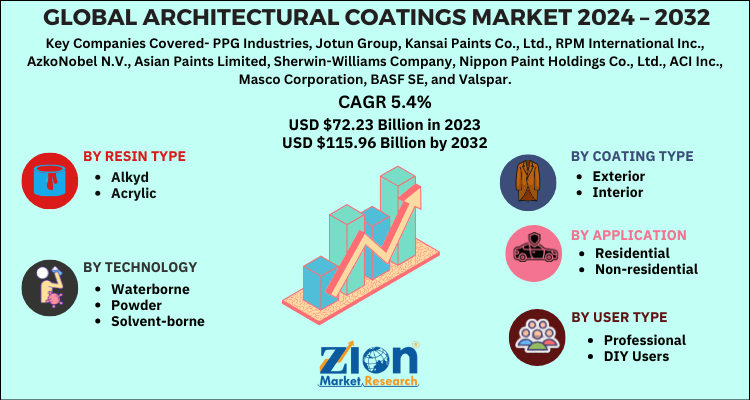
| Key Companies Covered | PPG Industries, Jotun Group, Kansai Paints Co., Ltd., RPM International Inc., AzkoNobel N.V., Asian Paints Limited, Sherwin-Williams Company, Nippon Paint Holdings Co., Ltd., ACI Inc., Masco Corporation, BASF SE, and Valspar |
| Segments Covered | By Resin Type, By Coating Type, By Technology, By Application, By User Type, and By Region |
| Regions Covered | North America, Europe, Asia Pacific (APAC), Latin America, Middle East, and Africa (MEA) |
| Base Year | 2023 |
| Historical Year | 2018 - 2022 |
| Forecast Year | 2024 - 2032 |
| Customization Scope | Avail customized purchase options to meet your exact research needs. Request For Customization |
Architectural Coatings Market: Segmentation
The architectural coatings market is segmented by resin type, coating type, technology, application, user type, and region. All the segments of the architectural coatings market have been analyzed based on present and future trends and the market is estimated from 2024 to 2032.
Based on Resin Type, the architectural coatings market is divided into alkyd and acrylic. Acrylic resins lead due to their excellent durability, weather resistance, color retention, and versatility for both interior and exterior applications, driving widespread adoption across residential and commercial projects. This dominance supports market growth by enabling high-performance formulations that meet modern aesthetic and protective requirements. Alkyd resins remain important for specific applications requiring strong adhesion and traditional performance characteristics, contributing as a complementary technology in certain decorative and protective uses.
Based on Coating Type, the architectural coatings market is divided into exterior and interior. Interior coatings hold strong demand driven by rising aesthetic preferences, interior design activities, and frequent renovation cycles in residential and commercial buildings. This segment supports market expansion through consistent volume and opportunities for decorative innovation. Exterior coatings form the second major category, delivering critical weather protection, UV resistance, and long-term durability that are essential for building envelope performance and overall market value.
Based on Technology, the architectural coatings market is divided into waterborne, powder, and solvent-borne. Waterborne technology leads because of its lower VOC emissions, eco-friendly profile, and alignment with green construction trends and regulatory preferences, thereby expanding overall market acceptance and volume. Solvent-borne systems retain relevance in applications requiring specific performance attributes, while powder coatings offer durable, low-waste options that support niche growth in architectural metal and specialty surfaces.
Based on Application, the architectural coatings market is divided into residential and non-residential. Residential applications dominate through continuous new construction and refurbishment activity that generates steady, high-volume demand for both decorative and protective coatings. Non-residential applications, encompassing commercial, institutional, and industrial buildings, form a significant secondary segment that drives demand for higher-performance and specialized coating solutions supporting long-term market diversification.
Based on User Type, the architectural coatings market is divided into professional and DIY users. Professional users account for a major share as contractors, painters, and specialists execute large-scale projects requiring consistent quality, technical support, and bulk supply, thereby anchoring overall market volume. DIY users represent a growing secondary segment supported by retail availability, easy-to-apply formulations, and rising homeowner interest in renovation and decorative projects that broaden market reach.
Architectural Coatings Market: Regional Analysis
Why will Asia Pacific continue to dominate the global market during the projection period?
Asia Pacific is expected to amplify the market growth rate throughout the forecast period. The Prominent rise in the number of construction and refurbishment activities in countries such as Japan, India, Thailand, Taiwan, and China will amplify the market growth rate in the Asia-Pacific zone. Additionally, the growing aesthetic sense among the people of the region has resulted in escalating demand for interior designing & beautification in residential and commercial sectors, thereby augmenting regional growth. Massive green construction trends and large-scale infrastructural spending observed in Asia-Pacific countries like Australia will expand the industry size.
An increase in the popularity of specialized coatings, along with a growing trend of using bio-based coatings, will exponentially increase the market size in Europe. UK, France, Spain, and Italy are expected to be the regional growth drivers of the European market. North America, being a mature market, will witness moderate growth over the estimated timeline.
Architectural Coatings Market: Competitive Players
A few of the main participants in the architectural coatings market are
- PPG Industries
- Jotun Group
- Kansai Paints Co., Ltd
- RPM International Inc.
- AzkoNobel N.V.
- Asian Paints Limited
- Sherwin-Williams Company
- Nippon Paint Holdings Co., Ltd
- ACI Inc
- Masco Corporation
- BASF SE
- Valspar
Segments Covered
This report segments the global architectural coatings Market into
By Resin Type
- Alkyd
- Acrylic
By Coating Type
- Exterior
- Interior
By Technology
- Waterborne
- Powder
- Solvent-borne
By Application
- Residential
- Non-residential
By User Type
- Professional
- DIY Users
By Region
- North America
- The U.S.
- Canada
- Mexico
- Europe
- France
- The UK
- Spain
- Germany
- Italy
- Rest of Europe
- Asia Pacific
- China
- Japan
- India
- Australia
- South Korea
- Rest of Asia Pacific
- The Middle East & Africa
- Saudi Arabia
- UAE
- Egypt
- Kuwait
- South Africa
- Rest of the Middle East & Africa
- Latin America
- Brazil
- Argentina
- Rest of Latin America
Table Of Content
Methodology
FrequentlyAsked Questions
Architectural coatings are coatings, including paints, sealers, and varnishes, that are applied to buildings and structures to increase durability, protect surfaces, and enhance their appearance. These coatings are employed for both interior and exterior applications, providing a protective and decorative layer to a diverse array of surfaces, such as the exteriors of structures, walls, ceilings, and floors.
The demand for architectural coatings to preserve and enhance building surfaces is driven by an increasing number of residential, commercial, and industrial construction projects and rapid urbanization.
According to Zion Market Research, the global Architectural Coatings Market was worth USD 72.23 Billion in 2023. The market is forecast to reach USD 115.96 Billion by 2032.
According to Zion Market Research, the global Architectural Coatings Market a compound annual growth rate (CAGR) of 5.4% during the forecast period 2024-2032.
Asia Pacific is expected to contribute notably and amplify market growth during the forecast period, driven by construction and refurbishment activity across key countries in the region.
A few of the main participants in the architectural coatings market are PPG Industries, Jotun Group, Kansai Paints Co., Ltd., RPM International Inc., AzkoNobel N.V., Asian Paints Limited, Sherwin-Williams Company, Nippon Paint Holdings Co., Ltd., ACI Inc., Masco Corporation, BASF SE, and Valspar.
The report provides a detailed examination of growth drivers, restraints, opportunities, and challenges, along with comprehensive segmentation analysis, regional insights, competitive landscape, and forward-looking forecasts for the architectural coatings market.

HappyClients

