
Global Aquatic Herbicides Market Size, Share, Analysis, Trends, Growth Report, 2034

Aquatic Herbicides Market by Type (Glyphosate, 2, 4-D, Imazapyr, and Others), by Method (Foliar and Submerged), and by Application (Agricultural Water, Recreational Water, and Fisheries): Global Industry Perspective, Comprehensive Analysis, and Forecast, 2025-2034
| Market Size in 2024 | Market Forecast in 2034 | CAGR (in %) | Base Year |
|---|---|---|---|
| USD 821 Million | USD 1,487 Million | 6.82% | 2024 |
How big is the aquatic herbicide market?
Zion Market Research has published a report on the global aquatic herbicides market, estimating its value at USD 821 million in 2024, with projections indicating that it will reach USD 1,487 million by 2034. The market is expected to expand at a compound annual growth rate (CAGR) of 6.82% over the forecast period 2025-2034.
The report explores the factors fueling market growth, the hitches that could hamper this expansion, and the opportunities that may arise in the aquatic herbicides industry. Additionally, it offers a detailed analysis of how these elements will affect market demand dynamics and market performance throughout the forecast period.
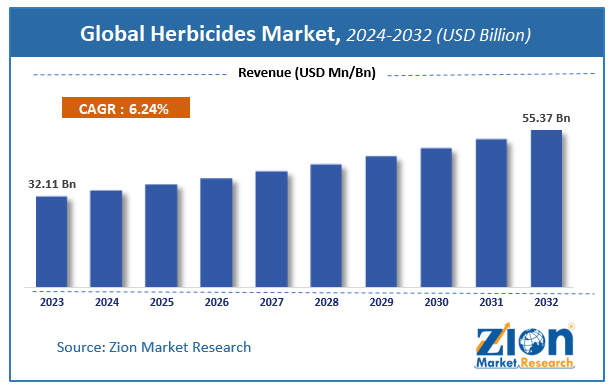
The report analyzes the global aquatic herbicides market drivers, restraints/challenges, and their effects on demand during the projection period. In addition, the report explores emerging opportunities in the aquatic herbicides industry.
The report covers a forecast and an analysis of the aquatic herbicides market on a global and regional level. The study provides historical data for 2019 and 2023, along with a forecast from 2025 to 2034 based on revenue (USD Million) and volume (Tons). The study includes drivers and restraints for the aquatic herbicides market, along with their impact on demand over the forecast period. Additionally, the report includes the study of opportunities available in the aquatic herbicides market on a global level.
The report provides a company market share analysis to give a broader overview of the key players in the market. In addition, the report also covers key strategic developments of the market, including acquisitions & mergers, new technology launches, agreements, partnerships, collaborations & joint ventures, research& development, and regional expansion of major participants involved in the market on a global and regional basis. Moreover, the study covers price trend analysis and product portfolios of various companies according to regions.
In order to give the users of this report a comprehensive view of the aquatic herbicides market, we have included a competitive landscape and an analysis of Porter’s Five Forces model for the market. The study encompasses a market attractiveness analysis, wherein all the segments are benchmarked based on their market size, growth rate, and general attractiveness.
Aquatic Herbicides Market: Overview
Herbicides are pesticides that are utilized for weed control purposes in farming, i.e., they are used to suppress or kill the unwanted plants. Aquatic herbicides are used to restrict the growth of weeds and other unwanted vegetation in water bodies. These herbicides are approved by the regulatory bodies and other organizations that solely focus on sustainability. There are mainly two types of aquatic herbicides elective and non-selective. Selective herbicides target specific weeds and restrict their growth without harming other aquatic vegetation and microorganisms. On the other hand, non-selective herbicides restrict the growth of all plants, including weeds.
Aquatic Herbicides Market: Growth Factors
The rising adoption of weed control is the primary factor that is likely to drive the global aquatic herbicides market growth in the future. Aquatic herbicides are utilized when long-lasting weed control becomes obligatory at low costs, coupled with fewer negative effects on aquatic life. The benefits of using aquatic herbicides include the introduction of weed-eating fish, insects, and other microorganisms. This, in turn, is anticipated to further fuel the aquatic herbicides market globally over the estimated timeframe. In addition, the expansion of aquaculture farms is expected to positively impact the aquatic herbicides market globally in the upcoming years. Aquaculture farmers are the end-users of aquatic herbicides. Furthermore, the growing inclination of organic farming among aquaculture farmers is projected to provide significant growth opportunities for the market. However, the time–consuming process of getting approval for the herbicides usage may hinder this market’s growth in the future.
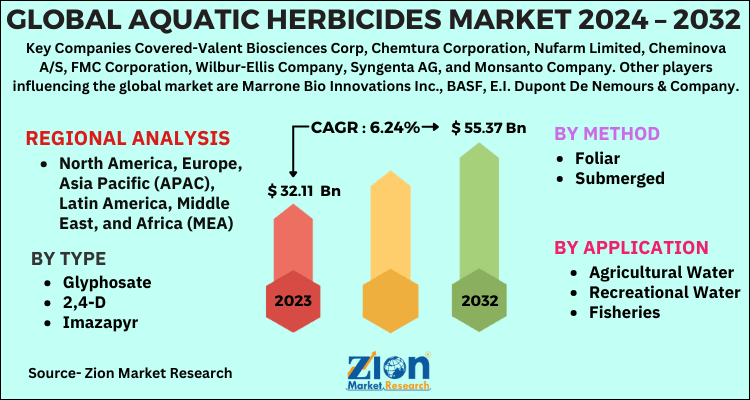
Aquatic Herbicides Market: Report Scope
| Report Attributes | Report Details |
|---|---|
| Report Name | Aquatic Herbicides Market |
| Market Size in 2024 | USD 821 Million |
| Market Forecast in 2034 | USD 1,487 Million |
| Growth Rate | CAGR of 6.82% |
| Number of Pages | 175 |
| Key Companies Covered | Albaugh, BASF SE, Land O'lakes, DOW Chemical, Lonza, Monsanto, Nufarm, Fluridone, Syngenta, Sanco Industries, and Others. |
| Segments Covered | By Type, By Method, By Application, and By Region |
| Regions Covered | North America, Europe, Asia Pacific (APAC), Latin America, and The Middle East and Africa (MEA) |
| Base Year | 2024 |
| Historical Year | 2019 to 2023 |
| Forecast Year | 2025 - 2034 |
| Customization Scope | Avail customized purchase options to meet your exact research needs. Request For Customization |
Aquatic Herbicides Market: Segmentation Analysis
The study provides a decisive view of the aquatic herbicides market by segmenting the market based on type, method, application, and region. All the segments have been analyzed based on present and future trends, and the market is estimated from 205 to 2034.
Based onType, the global market is divided into glyphosate, 2,4-D, imazapyr, and others. The glyphosate segment is projected to hold the dominant market share globally, owing to its cost-effectiveness and ability to provide long-lasting weed control.
In terms of Method, the global aquatic herbicides market is splits into foliar and submerged segments. The foliar method is expected to lead the market, as it offers superior weed coverage compared to submerged application.
On the basis of Application, the global aquatic herbicides market is segmented into agricultural water, recreational water, and fisheries. The fisheries segment is anticipated to be the largest over the forecast period. The growth is driven by the significant threat aquatic weeds pose to fish production by degrading water quality, making herbicide use essential in aquaculture operations.
Aquatic Herbicides Market: Regional Analysis
The regional segmentation includes the historical and forecast demand for North America, Europe, Asia Pacific, Latin America, and the Middle East & Africa. This segmentation includes the demand for the aquatic herbicides market based on all the segments in all the regions and countries.
North America accounted for the largest share of the global aquatic herbicides market in 2024 and is projected to maintain its dominant position in the coming years. This leadership stems from the concentration of major manufacturers operating at both global and regional scales, alongside increasing adoption of integrated weed management practices by aquaculture producers.
Meanwhile, the European market is anticipated to offer substantial growth opportunities during the forecast period. This growth is driven by rising usage of aquatic herbicides in both recreational and agricultural water bodies, as well as stringent regulations established by governmental and regulatory authorities.
Aquatic Herbicides Market: Competitive Analysis
Some key players operating in the global aquatic herbicides market include
- Albaugh
- BASF SE
- Land O'lakes
- DOW Chemical
- Lonza
- Monsanto
- Nufarm
- Fluridone
- Syngenta
- Sanco Industries
- among others.
This report segments the global aquatic herbicides market as follows:
By Type
- Glyphosate
- 2,4-D
- Imazapyr
- Others
By Method
- Foliar
- Submerged
By Application
- Agricultural Water
- Recreational Water
- Fisheries
By Region
- North America
- The U.S.
- Canada
- Mexico
- Europe
- France
- The UK
- Spain
- Germany
- Italy
- Rest of Europe
- Asia Pacific
- China
- Japan
- India
- Australia
- South Korea
- Rest of Asia Pacific
- The Middle East & Africa
- Saudi Arabia
- UAE
- Egypt
- Kuwait
- South Africa
- Rest of the Middle East & Africa
- Latin America
- Brazil
- Argentina
- Rest of Latin America
Table Of Content
Methodology
FrequentlyAsked Questions
Herbicides are a pesticide type that is utilized for weed control purposes in farming, i.e., they are used to suppress or kill the unwanted plants. Aquatic herbicides are used to restrict the growth of weeds and other unwanted vegetation in water bodies.
The rising adoption of weed control is the primary factor that is likely to drive the global aquatic herbicides market growth in the future. Aquatic herbicides are utilized when long-lasting weed control becomes obligatory at low costs coupled with less negative effects on aquatic life.
According to the report, the global aquatic herbicides market size was worth around USD 821 million in 2024 and is predicted to grow to around USD 1,487 million by 2034.
The global aquatic herbicides market is expected to grow at a CAGR of 6.82% during the forecast period.
Some key players operating in the global aquatic herbicides market include Albaugh, BASF SE, Land O' Lakes, DOW Chemical, Lonza, Monsanto, Nufarm, Fluridone, Syngenta, and Sanco Industries, among others.
The global aquatic herbicides market report covers the geographical market along with a comprehensive competitive landscape analysis. It also includes cash flow analysis, profit ratio analysis, market basket analysis, market attractiveness analysis, sentiment analysis, PESTEL analysis, trend analysis, SWOT analysis, trade area analysis, demand & supply analysis, Porter’s five force analysis, and value chain analysis.

HappyClients

