
Agricultural Lubricants Market Size, Share, Trends, Growth and Forecast 2032

Agricultural Lubricants Market - By Type (Synthetic Lubricants, Mineral Oil Lubricants, and Bio-Based Lubricants), By Application (Gear & Transmission, Engines, Greasing, Hydraulics, and Implements), And By Region - Global Industry Perspective, Comprehensive Analysis, and Forecast, 2024 - 2032
| Market Size in 2023 | Market Forecast in 2032 | CAGR (in %) | Base Year |
|---|---|---|---|
| USD 6.50 Billion | USD 9.70 Billion | 4.1% | 2023 |
Agricultural Lubricants Market Insights
Zion Market Research has published a report on the global Agricultural Lubricants Market, estimating its value at USD 6.50 Billion in 2023, with projections indicating that it will reach USD 9.70 Billion by 2032. The market is expected to expand at a compound annual growth rate (CAGR) of 4.1% over the forecast period 2024-2032.
The report explores the factors fueling market growth, the hitches that could hamper this expansion, and the opportunities that may arise in the Agricultural Lubricants Market industry. Additionally, it offers a detailed analysis of how these elements will affect market demand dynamics and market performance throughout the forecast period.
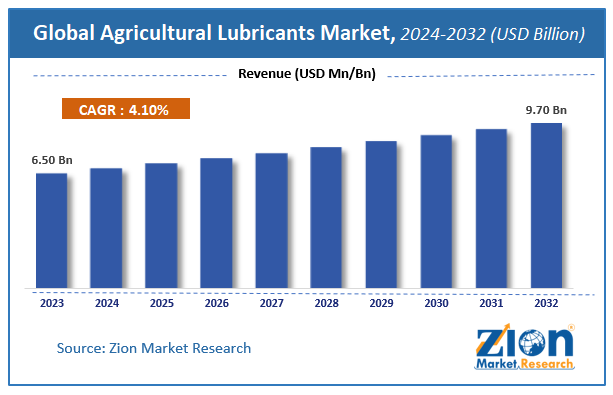
Agricultural Lubricants Market: Overview
Superior qualities of agricultural lubricants include lowering friction, preserving equipment longevity, and controlling temperature. They also help increase the tractor's and other agricultural equipment engines' dependability, efficiency, and lifespan. Tractors used for agricultural purposes typically utilize mineral-based transmission oils for lubrication because their engines require heavy lifting and frequent wear and tear, which reduces the machines' efficiency. Due to the growing use of farm tractors, rising economies such as China, India, Vietnam, and Brazil will see a surge in demand for agricultural lubricants.
The market for agricultural lubricants is facing competition from the rise of e-tractors. Electric-powered tractors, or "E-tractors," are gaining popularity in the agriculture industry since they are economical and environmentally friendly. Because e-tractors don't need conventional lubricants, there may be less of a need for them, which could have a detrimental effect on the market. Thus, it is expected that the introduction of electric tractors will present a hurdle to the market's growth for agricultural lubricants.
Agricultural Lubricants Market: Outlook
Agricultural lubricants are utilized in farming instruments including tractors, verge cutters, and combined harvesters. These products ensure smooth farming operations and bring comfort to the users of the equipment. Moreover, these lubricants also assist in increasing the longevity as well as the service span of the farming equipment. In addition to this, the use of agricultural lubricants has proven to be cost-efficient as it enhances equipment efficacy, thereby minimizing the use of fuel. Apart from this, the product also helps in reducing the cost incurred as a result of repairs as well as the cost of replacing the product. It reduces the downtime occurring due to equipment breakdown.
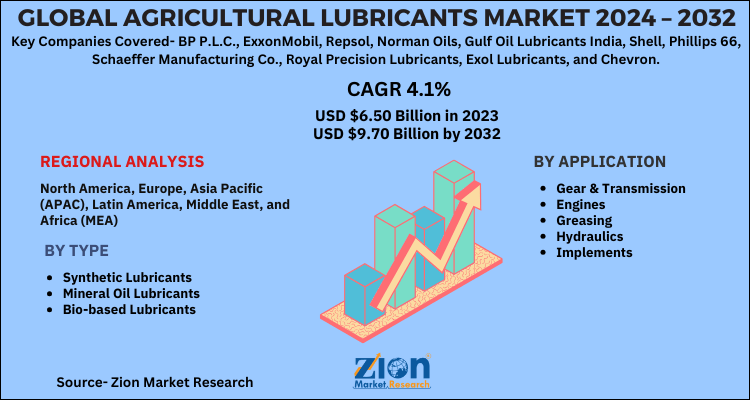
Agricultural Lubricants Market: Growth Factors
The surge in farm automation is slated to steer the expansion of the agricultural lubricants industry in the years ahead. The rise in the food demand arising as a result of the surging population will create massive demand for agricultural lubricants in the years ahead. Supportive government laws for procuring the product for obtaining better crop yield will steer the expansion of the agricultural lubricants market in the years ahead. A huge focus on automating the farming activities will expand of agricultural lubricants industry over the years to come. The ability of the product for reducing the wear & tear as well as the rusting of the farming equipment caused as a result of friction between the components of the equipment & oxidation will open lucrative growth avenues for the agricultural lubricants market in the forecasting years.
With the product facilitating the proficient operating of farming equipment, the market for agricultural lubricants is anticipated to gain traction over the years ahead. In addition to this, an increase in the requirement of agricultural lubricants in greasing, engines, and gear & transmission will create humungous popularity for the product globally. Nevertheless, high production costs are projected to put brakes on the agricultural lubricants market expansion over the years ahead. However, the growing demand for bio-degradable lubricants in farming activities will not only offset the market hindrances but will pave way for massive growth of the agricultural lubricants industry in the foreseeable future.
Agricultural Lubricants Market: Report Scope
| Report Attributes | Report Details |
|---|---|
| Report Name | Agricultural Lubricants Market |
| Market Size in 2023 | USD 6.50 Billion |
| Market Forecast in 2032 | USD 9.70 Billion |
| Growth Rate | CAGR of 4.1% |
| Number of Pages | 110 |
| Key Companies Covered | BP P.L.C., ExxonMobil, Repsol, Norman Oils, Gulf Oil Lubricants India, Shell, Phillips 66, Schaeffer Manufacturing Co., Royal Precision Lubricants, Exol Lubricants, and Chevron. |
| Segments Covered | By type, By application and By Region |
| Regions Covered | North America, Europe, Asia Pacific (APAC), Latin America, Middle East, and Africa (MEA) |
| Base Year | 2023 |
| Historical Year | 2018 - 2022 |
| Forecast Year | 2024 - 2032 |
| Customization Scope | Avail customized purchase options to meet your exact research needs. Request For Customization |
Asia Pacific To Contribute Notably Towards Overall Market Revenue By 2025
The growth of the agricultural lubricants market in the Zone over the forecast timeline is attributed to the main occupation of densely populated countries such as India and China agriculture. Apart from this, the massive need for high crop yield and the requirement for fulfilling the dietary needs of the regional population will prop up the expansion of the agricultural lubricants industry in the Asia Pacific zone. Swift urbanization and favorable government schemes promoting the use of agricultural lubricants will propel market trends.
Agricultural Lubricants Market: Competitive Landscape
Key players profiled in the report include -
- BP P.L.C.
- ExxonMobil
- Repsol
- Norman Oils
- Gulf Oil Lubricants India
- Shell
- Phillips 66
- Schaeffer Manufacturing Co.
- Royal Precision Lubricants
- Exol Lubricants
- Chevron.
The global agricultural lubricants market is segmented as follows:
By type:
- Synthetic Lubricants
- Mineral Oil Lubricants
- Bio-based Lubricants
By application:
- Gear & Transmission
- Engines
- Greasing
- Hydraulics
- Implements
By Region
- North America
- The U.S.
- Canada
- Mexico
- Europe
- France
- The UK
- Spain
- Germany
- Italy
- Rest of Europe
- Asia Pacific
- China
- Japan
- India
- Australia
- South Korea
- Rest of Asia Pacific
- The Middle East & Africa
- Saudi Arabia
- UAE
- Egypt
- Kuwait
- South Africa
- Rest of the Middle East & Africa
- Latin America
- Brazil
- Argentina
- Rest of Latin America
Table Of Content
Methodology
FrequentlyAsked Questions
Agricultural lubricants are oils and greases used in farming machinery. They reduce friction, wear, and equipment downtime
The global Agricultural Lubricants market is expected to be driven by the mechanization of agriculture, rising use of tractors and farm equipment, and demand for equipment efficiency. Growth in commercial farming supports market expansion.
According to study, the global Agricultural Lubricants market size was worth around USD 6.50 Billion in 2023 and is predicted to grow to around USD 9.70 Billion By 2032.
The global Agricultural Lubricants market is expected to grow at a Compound Annual Growth Rate (CAGR) of around CAGR 4.1% during the forecast period from 2024-2032.
The global Agricultural Lubricants industry is projected to be challenged by Challenges include seasonal demand variability, price sensitivity among farmers, and environmental regulations.
The Opportunities include mechanized farming growth, demand for bio-based lubricants, equipment longevity needs, and agricultural modernization will offer significant growth opportunities in the Agricultural Lubricants market.
Bio-based and biodegradable lubricant formulations; improved performance for modern farm machinery; demand driven by sustainable agriculture practices are the emerging trends and innovations impacting the Agricultural Lubricants market.
The global Agricultural Lubricants market is expected to be led by APAC during the forecast period.
Some of the prominent players operating in the global Agricultural Lubricants market are; BP P.L.C., ExxonMobil, Repsol, Norman Oils, Gulf Oil Lubricants India, Shell, Phillips 66, Schaeffer Manufacturing Co., Royal Precision Lubricants, Exol Lubricants, and Chevron. and others.
The report explores crucial aspects of the Agricultural Lubricants market, including a detailed discussion of existing growth factors and restraints, while also browsing future growth opportunities and challenges that impact the market.

HappyClients

