
Agricultural Chelates Market Size, Share, Trends, Growth 2032

Agricultural Chelates Market By Type (EDTA, EDDHA, DTPA, IDHA, and Others), By Crop Type (Cereals & Grains, Fruits & Vegetables, Oilseeds & Pulses, and Others), By Application (Soil Application, Seed Dressing, Foliar Sprays, Fertigation, and Others), and By Region: - Global and Regional Industry Overview, Market Intelligence, Comprehensive Analysis, Historical Data, and Forecasts 2024 - 2032
| Market Size in 2023 | Market Forecast in 2032 | CAGR (in %) | Base Year |
|---|---|---|---|
| USD 1027.01 Million | USD 1952.6 Million | 7.4% | 2023 |
Agricultural Chelates Industry Perspective
What will be the global Agricultural Chelates market size during the forecast period?
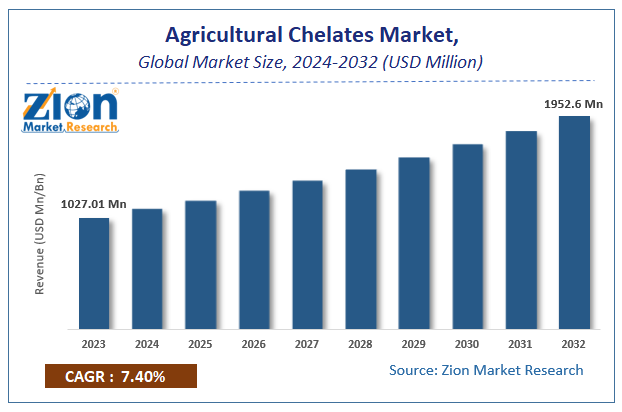
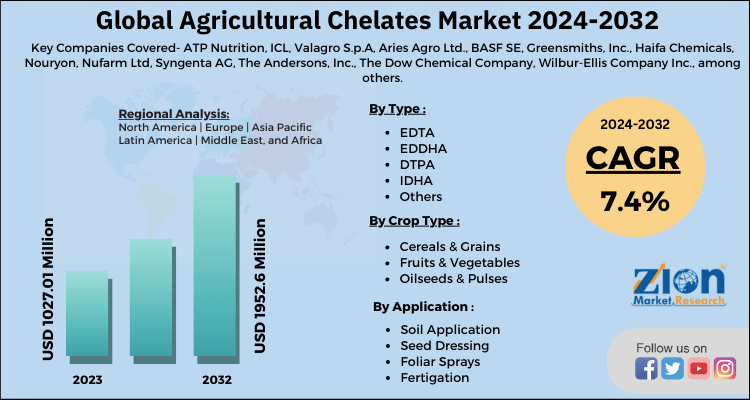
The global Agricultural Chelates market size was worth around USD 1027.01 Million in 2023 and is predicted to reach around USD 1952.6 Million by 2032, with a compound annual growth rate (CAGR) of roughly 7.40% between 2024 and 2032.
This report provides a comprehensive analysis of the growth drivers, restraints, and challenges shaping demand across the global Agricultural Chelates market throughout the forecast period, while highlighting high-potential emerging opportunities within the industry.
Agricultural Chelates Market: Overview
The substances used in fertilisers to increase the efficiency of agricultural fertilisers are agricultural chelates. The fertiliser solution applied to these chelates will increase the crop's yield. In agricultural applications, various types of agricultural chelates are used, such as EDTA, DTPA, and EDDHA, etc. These farm chelates can chelate micronutrient fertilisers such as iron, zinc, copper, manganese, and others. The use of these chelates will improve the performance and productivity of micronutrients. In agricultural applications, agricultural chelates are used depending on the type of crop, such as fruits & vegetables, oilseeds & pulses, and others.
Key Insights
- As per the analysis shared by our research analyst, the global Agricultural Chelates market is estimated to grow annually at a CAGR of around 7.40% over the forecast period (2024-2032).
- In terms of revenue, the global Agricultural Chelates market size was valued at around USD 1027.01 Million in 2023 and is projected to reach USD 1952.6 Million by 2032.
- The market is driven by increasing soil depletion due to demand for high-yielding crops, rising need for chelated iron and other micronutrients, and the requirement to improve nutrient efficiency and crop productivity.
- Based on the Type, the EDTA segment holds a leading position due to its versatility, stability, and effectiveness in delivering a wide range of micronutrients across diverse soil conditions.
- Based on the Crop Type, the Fruits & Vegetables segment dominated the market and is expected to retain its leading position
- Based on the Application, the Soil Application segment is growing at a high rate and is projected to dominate the global market.
- Based on region, Europe held the largest share of the market, driven by extensive agricultural areas including greenhouse cultivation in countries such as Spain and the Netherlands
Agricultural Chelates Market: Dynamics
Growth Drivers
What factors are accelerating the expansion of the Agricultural Chelates market?
Progressive depletion of soil nutrients caused by intensive cultivation and the continuous demand for higher crop yields are primary drivers of market growth. Farmers increasingly rely on chelated micronutrients to ensure efficient nutrient delivery and improved plant uptake, particularly for iron, zinc, copper, and manganese.
The rising global population and corresponding need for greater agricultural productivity further support demand. Agricultural chelates enhance fertilizer efficiency, improve crop quality, and help address deficiencies in challenging soil conditions, making them an essential input for modern farming systems.
Restraints
What factors are limiting the growth of the Agricultural Chelates market?
Accumulation of non-biodegradable chelates in soil can potentially damage soil health and crop performance over time, creating environmental concerns that may limit unrestricted use. High costs associated with certain specialty chelate formulations can also restrain adoption among cost-sensitive farmers, particularly in developing regions.
Limited awareness of proper application techniques and the need for specific soil testing to select the most suitable chelate type can further slow broader market penetration in some agricultural communities.
Global Agricultural Chelates Market: Segmentation
The Agricultural Chelates market is segmented by type, crop type, application, and region.
By Type, the market is divided into EDTA, EDDHA, DTPA, IDHA, and Others. EDTA holds a prominent position due to its broad versatility, chemical stability, and proven effectiveness in chelating multiple micronutrients such as iron, zinc, manganese, and copper across a wide range of soil conditions. This dominance supports overall market growth by providing a reliable, widely applicable solution that improves nutrient availability and crop performance.
Based on Crop type, the Agricultural Chelates market includes cereals & grains, fruits & vegetables, oilseeds & pulses, and others. Fruits & vegetables had the largest market share in 2023, and during the projected timeframe, it is still expected to retain its leading position. In the coming years, it is projected that there will be an increase in fruit and vegetable intake.
In terms of Application, the market is segmented into soil application, seed dressing, foliar sprays, fertigation, and others. Soil Application remains a widely used method for delivering micronutrients throughout the root zone and supporting sustained nutrient availability. Foliar Sprays hold strong importance for rapid correction of visible deficiencies and targeted nutrient delivery during critical growth stages.
Agricultural Chelates Market: Report Scope
| Report Attributes | Report Details |
|---|---|
| Report Name | Agricultural Chelates Market |
| Market Size in 2023 | USD 1027.01 Million |
| Market Forecast in 2032 | USD 1952.6 Million |
| Growth Rate | CAGR of 7.4% |
| Number of Pages | 230 |
| Key Companies Covered | ATP Nutrition, ICL, Valagro S.p.A., Aries Agro Ltd., BASF SE, Greensmiths, Inc., Haifa Chemicals, Nouryon, Nufarm Ltd., Syngenta AG, The Andersons, Inc., The Dow Chemical Company, Wilbur-Ellis Company Inc., among others |
| Segments Covered | By Type, By Crop Type, By Application, and By Region |
| Regions Covered | North America, Europe, Asia Pacific (APAC), Latin America, Middle East, and Africa (MEA) |
| Base Year | 2023 |
| Historical Year | 2018 - 2022 |
| Forecast Year | 2024 - 2032 |
| Customization Scope | Avail customized purchase options to meet your exact research needs. Request For Customization |
Agricultural Chelates Market: Regional Analysis
Why will Europe continue to dominate the global market during the projection period?
In terms of countries, Europe accounted for the largest share of the demand for agricultural chelates in 2023 and is expected to rule the market over the forecast period. Spain and the Netherlands have an expanded area of agriculture, including greenhouse cultivation, due to rising demand from European countries. There are also export demands from these countries for a wide variety of crops, such as pulses, vegetables, cereals, oilseeds and cash crops.
Advanced farming practices, focus on crop quality, and established use of specialty fertilizers contribute to sustained market leadership and influence technology and application trends across the global industry.
Global Agricultural Chelates Market: Competitive Players
Some main participants of the agricultural chelates market are
- ATP Nutrition
- ICL
- Valagro S.p.A
- Aries Agro Ltd.
- BASF SE
- Greensmiths, Inc
- Haifa Chemicals
- Nouryon
- Nufarm Ltd
- Syngenta AG
- The Andersons, Inc.
- The Dow Chemical Company
- Wilbur-Ellis Company Inc
The agricultural chelates market is segmented as follows:
By Type
- EDTA
- EDDHA
- DTPA
- IDHA
- Others
By Crop Type
- Cereals & Grains
- Fruits & Vegetables
- Oilseeds & Pulses
- Others
By Application
- Soil Application
- Seed Dressing
- Foliar Sprays
- Fertigation
- Others
By Region
- North America
- The U.S.
- Canada
- Mexico
- Europe
- France
- The UK
- Spain
- Germany
- Italy
- Rest of Europe
- Asia Pacific
- China
- Japan
- India
- Australia
- South Korea
- Rest of Asia Pacific
- The Middle East & Africa
- Saudi Arabia
- UAE
- Egypt
- Kuwait
- South Africa
- Rest of the Middle East & Africa
- Latin America
- Brazil
- Argentina
- Rest of Latin America
Table Of Content
Methodology
FrequentlyAsked Questions
Agricultural chelates are chemical compounds that are employed in agriculture to enhance the availability and assimilation of essential nutrients by plants. Chelates bind metal ions, including iron, zinc, magnesium, copper, and calcium, and prevent them from reacting with other elements in the soil. This could render them unavailable to plants. Chelation is particularly beneficial in soils that are impoverished or alkaline, as it increases the absorption of nutrients that may otherwise be insoluble and inaccessible.
As the Global population expands, there is a growing demand for increased agricultural productivity to satisfy the food supply. Crop yields and quality are improved by agricultural chelates, which increase nutrient efficiency.
According to a report from Zion Market Research, the Global Agricultural Chelates Market was valued at USD 1027.01 Million in 2023 and is projected to hit USD 1952.6 Million by 2032.
According to a report from Zion Market Research, the Global Agricultural Chelates Market a compound annual growth rate (CAGR) of 7.40% during the forecast period 2024-2032.
Europe accounted for the largest share of the agricultural chelates market and is expected to maintain a leading position over the forecast period.
Some main participants of the Agricultural Chelates market are ATP Nutrition, ICL, Valagro S.p.A, Aries Agro Ltd., BASF SE, Greensmiths, Inc., Haifa Chemicals, Nouryon, Nufarm Ltd, Syngenta AG, The Andersons, Inc., The Dow Chemical Company, Wilbur-Ellis Company Inc., among others.
The report explores crucial aspects of the Agricultural Chelates market, including a detailed discussion of existing growth factors and restraints, while also examining future growth opportunities and challenges that impact the market. It provides comprehensive segmentation analysis, regional insights, competitive landscape, and forecasts based on historical data.

HappyClients

