
Aeroderivative Gas Turbine Market Size, Share, Growth, Opportunities 2034

Aeroderivative Gas Turbine Market By Capacity (≤ 50 kW, > 50 to 500 kW, > 500 kW to 1 MW, > 1 to 30 MW, > 30 to 70 MW, and > 70 MW), By Technology (Combined Cycle and Open Cycle), By Application (Aviation, Marine, Power Plants, Process Plants, Oil & Gas, and Others), and By Region - Global and Regional Industry Overview, Market Intelligence, Comprehensive Analysis, Historical Data, and Forecasts 2026 - 2034-
| Market Size in 2025 | Market Forecast in 2034 | CAGR (in %) | Base Year |
|---|---|---|---|
| USD 3.90 Billion | USD 6.79 Billion | 6.32% | 2025 |
Aeroderivative Gas Turbine Industry Perspective:
What is the anticipated size of the aeroderivative gas turbine market during the projection period?
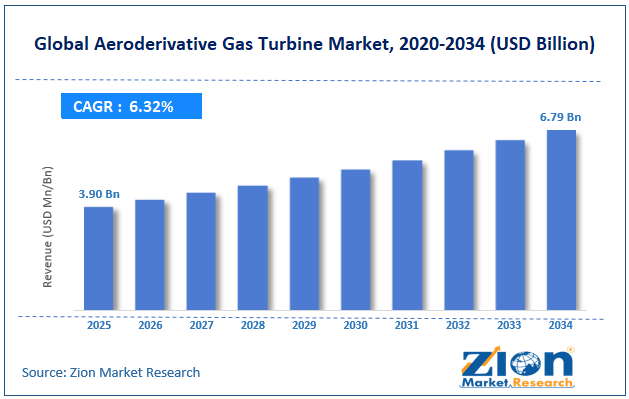
The global aeroderivative gas turbine market size was worth around USD 3.90 billion in 2025 and is predicted to grow to around USD 6.79 billion by 2034, with a compound annual growth rate (CAGR) of roughly 6.32% between 2026 and 2034.
Key Insights:
- As per the analysis shared by our research analyst, the global aeroderivative gas turbine market is estimated to grow annually at a CAGR of around 6.32% over the forecast period (2026-2034)
- In terms of revenue, the global aeroderivative gas turbine market size was valued at around USD 3.90 billion in 2025 and is projected to reach USD 6.79 billion, by 2034.
- The aeroderivative gas turbine market is projected to grow at a significant rate due to the increasing demand for clean energy and shift toward decentralized power generation systems.
- Based on capacity, the > 1 to 30 MW segment is growing at a high rate and will continue to dominate the global market as per industry projections.
- Based on the technology, the combined cycle segment is anticipated to command the largest market share.
- Based on the application, the power plants segment is expected to lead the market growth trends.
- Based on region, Asia-Pacific is projected to dominate the global market during the forecast period.
Aeroderivative Gas Turbine Market: Overview
An aeroderivative gas turbine is an electric power-generating system. Compared to industrial machines, aeroderivative gas turbines can start up, handle load, and shut down more quickly. The marine industry uses aeroderivative gas turbines to reduce the weight of power-generating infrastructure. These turbines are made of two elements: a free power turbine and an aircraft derivative gas generator. The latter produces power by delivering compressed, high-temperature gases. Unlike other generators, the generator is developed from a modified aircraft engine rather than built from scratch. During the forecast period, demand for aeroderivative gas turbines is projected to grow due to increasing demand for clean energy and a shift toward decentralized power generation systems. However, the high cost of initial investment, maintenance complexity, and sensitivity to the operating environment may affect market revenue in the long run.
Impact of the USA-Israel and Iran war on the Aeroderivative Gas Turbine Market:
The USA-Israel and Iran war has affected the aeroderivative gas turbine market in several ways. For instance, rising geopolitical conflict and energy-security concerns have increased demand for decentralized, flexible power generation. On the other hand, the war has increased fuel and transportation costs, ultimately affecting operational costs. During the forecast period, the war is anticipated to increase the use of aeroderivative gas turbines in critical infrastructure such as data centers and oil facilities.
Aeroderivative Gas Turbine Market: Dynamics
Growth Drivers
How will growing energy demand influence aeroderivative gas turbine market revenue?
The global aeroderivative gas turbine market is expected to be driven by the rising energy demand worldwide. Industrialization, commercialization, and urbanization are the main drivers of energy demand. Advancements in next-generation technologies such as Artificial Intelligence (AI), robotics, and 5G infrastructure have propelled energy consumption rates worldwide. According to the International Energy Agency (IEA), total data center electricity demand is expected to reach 945 TWh by 2030 as AI workloads grow. Conventional power generation is time-consuming, and there is a growing need for more flexible systems. Aeroderivative gas turbines use aircraft engines and can be installed in a limited time, influencing market growth trends.
Focus on energy optimization and integration with sustainable energy solutions to promote market revenue
Industries worldwide are focusing on reducing energy loss and optimizing power consumption patterns. Government initiatives, pressure from environmental agencies, and concerns about energy supply drive this shift. Aeroderivative gas turbines are exceptionally efficient in operations. Their lightweight design supports energy optimization. In addition, integrating renewable energy systems with solutions in the global aeroderivative gas turbine market will further create growth avenues for leaders. Aircraft engine-powered gas turbine systems can be used alongside renewable energy infrastructure to provide additional support during power fluctuations or intermittent renewable energy generation.
Restraints
Which factors will limit expansion of the aeroderivative gas turbine industry in the coming years?
The global aeroderivative gas turbine industry is projected to be restricted due to the high cost of initial investment and maintenance expenses. Although aeroderivative gas turbines are easy and quick to install and operate, their initial investment is significantly high because they use next-generation, aerospace-derived technologies. For instance, a 25 MW aeroderivative gas turbine can cost between USD 18 and USD 31 million. In addition, recurring operational and maintenance costs contribute to the overall expense of technology ownership.
Opportunities
Which latest advancements are driving opportunities for the aeroderivative gas turbine market?
The global aeroderivative gas turbine market is expected to generate growth opportunities due to ongoing technological advancements such as Artificial Intelligence (AI) & Machine Learning (ML)-based performance optimization, digital twins, hydrogen-capable combustion systems, and predictive maintenance, among others. GE Vernova, a leading market player, has launched its next-generation flexible power solution, the TM2500 DLE. It is a mobile aeroderivative gas turbine that can be used as a backup power generator during plant shutdowns, natural disasters, and grid instability.
In December 2025, FTAI Aviation Ltd launched FTAI Power. It is a new platform designed to convert CFM56 engines into power turbines for data centers globally. Hydrogen-capable combustion systems will open new growth avenues for the market leaders. These systems are designed to be less environmentally harmful because they produce lower carbon emissions and support decarbonization. GE Vernova has supplied 12 LM2500XPRESS aeroderivative gas turbines for the Brigalow Peaking Power Plant in Australia. The facility currently operates at up to 35% green hydrogen by volume, and the number is projected to reach 100% in the coming years.
Challenges
Fuel dependency and competition from alternative technologies challenge the aeroderivative gas turbine industry
The global aeroderivative gas turbine industry is expected to face challenges from higher fuel dependency and tough competition from alternative solutions such as solar and wind power plants. Aeroderivative gas turbines rely heavily on natural gas for operations/ volatility of gas prices and availability will affect industry decisions. Moreover, aeroderivative gas turbines are highly sensitive to the operating environment, thus raising questions about overall operational efficiency.
Aeroderivative Gas Turbine Market: Report Scope
| Report Attributes | Report Details |
|---|---|
| Report Name | Aeroderivative Gas Turbine Market |
| Market Size in 2025 | USD 3.90 Billion |
| Market Forecast in 2034 | USD 6.79 Billion |
| Growth Rate | CAGR of 6.32% |
| Number of Pages | 227 |
| Key Companies Covered | Rolls-Royce, Harbin Electric, MAN Energy Solutions, Baker Hughes, Vericor Power Systems, Mitsubishi Heavy Industries, Doosan Enerbility, GE Vernova, Ansaldo Energia, IHI Corporation, Kawasaki Heavy Industries, Capstone Green Energy, MTU Aero Engines, Solar Turbines, Siemens Energy, and others. |
| Segments Covered | By Capacity, By Technology, By Application, and By Region |
| Regions Covered | North America, Europe, Asia Pacific (APAC), Latin America, Middle East, and Africa (MEA) |
| Base Year | 2025 |
| Historical Year | 2020 - 2024 |
| Forecast Year | 2026 - 2034 |
| Customization Scope | Avail customized purchase options to meet your exact research needs. Request For Customization |
Aeroderivative Gas Turbine Market: Segmentation
The global aeroderivative gas turbine market is segmented based on capacity, technology, application, and region.
Why will the > 1 to 30 MW segment lead the aeroderivative gas turbine industry revenue during the forecast period?
Based on capacity, the global market segments are ≤ 50 kW, > 50 to 500 kW, > 500 kW to 1 MW, > 1 to 30 MW, > 30 to 70 MW, and > 70 MW. In 2025, the highest growth was listed in the > 1 to 30 MW segment. It accounted for 22.5% of the global revenue and will continue growing at a CAGR of 11.51% during the forecast period. Broader adoption of 1 to 30 MW aeroderivative gas turbines across growing industries such as power generation and oil & gas will drive segmental growth in the coming years.
Which will be the fastest-growing technology during the forecast period in the aeroderivative gas turbine market?
Based on technology, the global aeroderivative gas turbine industry is fragmented into combined cycle and open cycle. In 2025, the combined-cycle segment led market growth, accounting for 89% of global revenue. During the forecast period, it is expected to grow the fastest, with a strong CAGR of 11.52%. Combined cycle systems have higher efficiency. They are also more environmentally friendly because they produce lower emissions per unit of electricity. Steady integration with renewable energy will promote segmental growth.
Which factors drive demand in the power plants segment in the aeroderivative gas turbine industry?
Based on application, the global market divisions are aviation, marine, power plants, process plants, oil & gas, and others. In 2025, the power plants segment was the leading revenue generator, accounting for the majority of total market share. During the forecast period, it is expected to deliver similar results. Rising investments toward achieving grid stability, demand for flexible power systems, and growing energy consumption will propel segmental revenue in the coming years.
Aeroderivative Gas Turbine Market: Regional Analysis
Why will Asia-Pacific lead the aeroderivative gas turbine market in the coming years?
Asia-Pacific currently leads the global aeroderivative gas turbine market. In 2025, it accounted for the highest part of global revenue and will grow at a strong CAGR of 12.09% during the forecast period. Data center expansion, rapid industrialization, urbanization, and investments in cutting-edge technologies have driven energy requirements across Asia-Pacific. Regional governments are investing heavily in grid expansion and domestic turbine production, which will favor regional players.
How is North America expected to perform in the aeroderivative gas turbine market during the forecast period?
North America is expected to emerge as a strong player in the aeroderivative gas turbine market with a CAGR of 11.06% during the forecast period. In 2025, it accounted for the second-highest share of the total revenue. The presence of a dominating shale gas industry, investments in oil & gas infrastructure, and grid modernization are the leading regional market growth contributors. Moreover, ongoing decarbonization efforts and a focus on energy security may support future regional market growth.
Aeroderivative Gas Turbine Market: Competitive Analysis
The global aeroderivative gas turbine market is led by players like:
- Rolls-Royce
- Harbin Electric
- MAN Energy Solutions
- Baker Hughes
- Vericor Power Systems
- Mitsubishi Heavy Industries
- Doosan Enerbility
- GE Vernova
- Ansaldo Energia
- IHI Corporation
- Kawasaki Heavy Industries
- Capstone Green Energy
- MTU Aero Engines
- Solar Turbines
- Siemens Energy
What are the latest key trends in the aeroderivative gas turbine market?
Modular turbines
Market players are developing easily assembled aeroderivative gas turbines. Modular designs, such as the 95% factory-assembled M2500XPRESS by GE Vernova, will be particularly useful for emergency power needs and industrial facilities.
Improvements in fuel flexibility
Ongoing work toward enhancing gas turbine fuel flexibility can help reduce the burden on natural gas supplies. Researchers are studying aeroderivative gas turbines powered by naphtha, diesel, ethanol, and hydrogen blends to protect against evolving environmental regulations and fuel-price volatility.
The global aeroderivative gas turbine market is segmented as follows:
By Capacity
- ≤ 50 kW
- > 50 to 500 kW
- > 500 kW to 1 MW
- > 1 to 30 MW
- > 30 to 70 MW
- > 70 MW
By Technology
- Combined Cycle
- Open Cycle
By Application
- Aviation
- Marine
- Power Plants
- Process Plants
- Oil & Gas
- Others
By Region
- North America
- The U.S.
- Canada
- Mexico
- Europe
- France
- The UK
- Spain
- Germany
- Italy
- Rest of Europe
- Asia Pacific
- China
- Japan
- India
- Australia
- South Korea
- Rest of Asia Pacific
- The Middle East & Africa
- Saudi Arabia
- UAE
- Egypt
- Kuwait
- South Africa
- Rest of the Middle East & Africa
- Latin America
- Brazil
- Argentina
- Rest of Latin America
Table Of Content
Methodology
FrequentlyAsked Questions
An aeroderivative gas turbine is an electric power-generating system. Compared to industrial machines, aeroderivative gas turbines can start up, handle load, and shut down more quickly.
The global aeroderivative gas turbine market is expected to be driven by the rising energy demand worldwide.
According to study, the global aeroderivative gas turbine market size was worth around USD 3.90 billion in 2025 and is predicted to grow to around USD 6.79 billion by 2034.
The CAGR value of the aeroderivative gas turbine market is expected to be around 6.32% during 2026-2034.
The global aeroderivative gas turbine industry is anticipated to be challenged by higher fuel dependency and tough competition from alternative solutions such as solar and wind power plants.
Modular turbines and improvements in fuel flexibility are the emerging trends and innovations impacting the aeroderivative gas turbine market.
The global aeroderivative gas turbine market has performed well so far and will offer similar trends in the coming years.
Asia-Pacific will contribute notably towards the aeroderivative gas turbine market value.
The global aeroderivative gas turbine market is led by players like Rolls-Royce, Harbin Electric, MAN Energy Solutions, Baker Hughes, Vericor Power Systems, Mitsubishi Heavy Industries, Doosan Enerbility, GE Vernova, Ansaldo Energia, IHI Corporation, Kawasaki Heavy Industries, Capstone Green Energy, MTU Aero Engines, Solar Turbines, and Siemens Energy.

HappyClients

