
ABL and PBL Tubes Market Size, Share, Industry Trends 2034

ABL and PBL Tubes Market By Product Type (ABL Tubes and PBL Tubes), By Application (Cosmetics, Food, Pharmaceuticals, Industrial, and Others), By Material (Plastic, Laminates, Aluminum, and Others), By End-User (Personal Care, Food & Beverages, Healthcare, Industrial, and Others), and By Region - Global and Regional Industry Overview, Market Intelligence, Comprehensive Analysis, Historical Data, and Forecasts 2025 - 2034
| Market Size in 2024 | Market Forecast in 2034 | CAGR (in %) | Base Year |
|---|---|---|---|
| USD 5.6 Billion | USD 10.1 Billion | 6.1% | 2024 |
ABL and PBL Tubes Industry Prospective
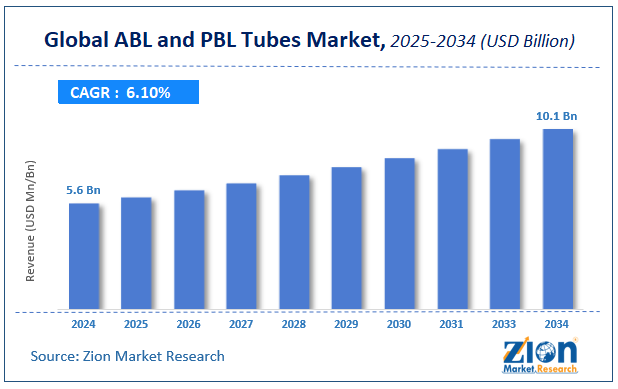
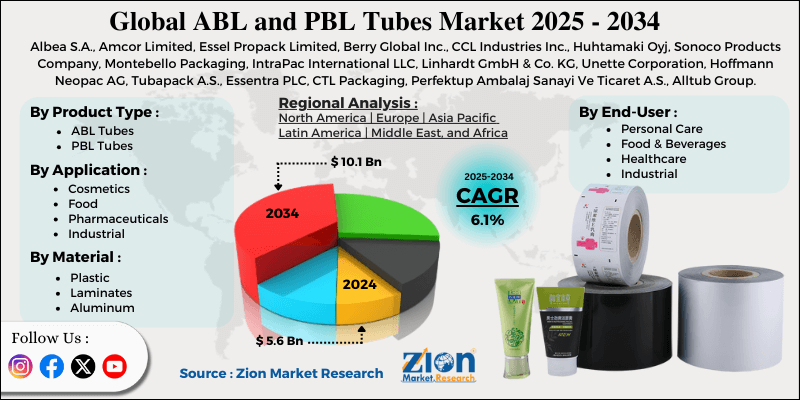
The global ABL and PBL tubes market size was worth around USD 5.6 billion in 2024 and is predicted to grow to around USD 10.1 billion by 2034, with a compound annual growth rate (CAGR) of roughly 6.1% between 2025 and 2034.
Key Insights
- As per the analysis shared by our research analyst, the global ABL and PBL Tubes market is estimated to grow annually at a CAGR of around 6.1% over the forecast period (2025-2034).
- In terms of revenue, the global ABL and PBL Tubes market size was valued at around USD 5.6 billion in 2024 and is projected to reach USD 10.1 billion by 2034.
- Increasing e-commerce is expected to drive the ABL and PBL Tubes market over the forecast period.
- Based on the product type, the ABL tubes segment is expected to capture the largest market share over the projected period.
- Based on the application, the cosmetics segment is expected to capture the largest market share over the projected period.
- Based on the material, the plastic segment is expected to capture the largest market share over the projected period.
- Based on the end-user, the personal care segment is expected to capture the largest market share over the projected period.
- Based on region, the Asia Pacific is expected to dominate the market during the forecast period.
ABL and PBL Tubes Market: Overview
Polyethylene and other plastics comprise ABL tubes. These layers do a great job of keeping out light, moisture, oxygen, and pathogens. This design keeps sensitive formulations such as creams, ointments, and gels stable, features high-quality printing, and can be folded to ensure even distribution. They let more oxygen and water vapor pass through than normal plastic tubes. PBL tubes also use an all-plastic laminate with an EVOH (ethylene-vinyl alcohol) or comparable barrier layer instead of aluminum. This is a good way to safeguard the environment without utilizing metal. These tubes are perfect for cosmetics and other products that require a high-end look because they can be formed, retain their shape, and be recycled.
Their barrier performance is good, but for highly sensitive materials, it can be worse than that of ABL. The ABL and PBL Tubes market is driven by several factors, such as growth in oral care and everyday FMCG, rising cosmetics & personal care products, convenience features and consumer-friendly use, and the rising consumer inclination towards convenient, aesthetically appealing packaging.
ABL and PBL Tubes Market Dynamics
Growth Drivers
How does the growing e-commerce sector propel the ABL and PBL tubes industry growth?
The ABL and PBL tubes market is growing rapidly as e-commerce expands. Brands need packaging that can handle sophisticated logistics, frequent handling, and shipment across vast distances. ABL and PBL tubes are very strong, don't leak, and prevent moisture, air, and dirt from entering, thereby reducing the risk of damage or returns during shipping. This is very significant for online sales. Also, these tubes are lightweight and take up little space, allowing online sellers to save on shipping costs while maintaining product quality. The growing focus on attractive, high-quality packaging for online product displays increases demand, especially for PBL tubes, which enable better printing and better looks. As more personal care, dental care, and pharmaceutical products are sold directly to consumers and online, the need for reliable, secure, and attractive tube packaging is driving the adoption of ABL and PBL tubes worldwide.
Restraints
How do hard-to-recycle multi-layer structures restrain market growth?
Hard-to-recycle multilayer structures are an enormous challenge to the growth of the ABL and PBL tube sectors. This is because these tubes are often manufactured with several bound components that are hard to separate using traditional recycling procedures. ABL tubes have plastic layers and an aluminum foil barrier, whereas many PBL tubes have plastic layers and barrier materials such as EVOH. This makes them less compatible with current mechanical recycling systems. Businesses and packaging suppliers are being forced to adopt recyclable-by-design and mono-material packaging solutions due to growing legal pressure, especially in Europe and other countries that prioritize sustainability.
This is making it hard for traditional laminated-tube designs. As a result, producers have to spend more money on redesigning materials, testing, and compliance. At the same time, some brand owners are gradually switching to other packaging types, which limits the overall development potential of the ABL and PBL tube market.
Opportunities
Will technological advancements offer a potential opportunity for the ABL and PBL tubes industry growth?
Technological advancements are a primary catalyst for expansion in the ABL and PBL tube markets, as ongoing advances in materials, manufacturing processes, and ornamental technologies enhance both functionality and sustainability. Better barrier technologies, such as improved aluminum foil structures in ABL tubes and EVOH and high-barrier plastic layers in PBL tubes, enable products to last longer while using less material overall. At the same time, improvements in tube extrusion, lamination, and digital printing make things seem better, brand more accurately, and make it easier to change designs quickly, which is very important for personal care and cosmetic companies.
Also, creating solutions that prioritize recyclability, such as downgauged laminates and recyclable or low-EVOH PBL frameworks, helps manufacturers meet evolving environmental criteria. These technical improvements work together to enhance operations, reduce waste, and encourage greater adoption of the brand, thereby sustaining growth in the ABL and PBL tube markets.
Challenges
Do volatility in raw materials and input costs pose a major challenge to the ABL and PBL tubes market expansion?
The variability of raw material and input costs is so high that the ABL and PBL tube markets are having difficulty growing. Prices for ABL tubes can vary widely, even though both ABL and PBL tubes are made from petrochemical-based polymers, such as polyethylene and EVOH, as well as unique barrier materials. The pricing of these inputs is affected by crude oil prices, energy costs, supply chain issues, and geopolitical factors. This makes it challenging for people who build tubes to anticipate how much it will cost to make their goods.
Changes in raw material prices reduce profit margins, complicate long-term pricing contracts, and increase costs for small and medium-sized firms. Brand owners may be more likely to adopt new package formats or be more sensitive to price adjustments as packaging costs rise, especially in FMCG markets where cost is a key concern. This means that the prices of raw materials and inputs are continually changing, making it challenging for ABL and PBL tubes to increase capacity, plan investments, and grow the market as a whole.
ABL and PBL Tubes Market : Report Scope
| Report Attributes | Report Details |
|---|---|
| Report Name | ABL and PBL Tubes Market Research Report |
| Market Size in 2024 | USD 5.6 Billion |
| Market Forecast in 2034 | USD 10.1 Billion |
| Growth Rate | CAGR of 6.1% |
| Number of Pages | 220 |
| Key Companies Covered | Albea S.A., Amcor Limited, Essel Propack Limited, Berry Global Inc., CCL Industries Inc., Huhtamaki Oyj, Sonoco Products Company, Montebello Packaging, IntraPac International LLC, Linhardt GmbH & Co. KG, Unette Corporation, Hoffmann Neopac AG, Tubapack A.S., Essentra PLC, CTL Packaging, Perfektup Ambalaj Sanayi Ve Ticaret A.S., Alltub Group, Pack-Tubes, Lageen Tubes Ltd., and Antilla Propack |
| Segments Covered | By Product Type, By Application, By Material, By End-User And By Region |
| Regions Covered | North America, Europe, Asia Pacific (APAC), Latin America, The Middle East and Africa (MEA) |
| Base Year | 2024 |
| Historical Year | 2019 to 2023 |
| Forecast Year | 2025 - 2034 |
| Customization Scope | Avail customized purchase options to meet your exact research needs. Request For Customization |
ABL and PBL Tubes Market: Segmentation
The global ABL and PBL tubes market is segmented based on product type, application, material, end-user and region.
By Product Type, the ABL tubes segment is growing at a CAGR of 6.1% over the forecast period. The pharmaceutical and personal care industries are using ABL in increasing numbers because it makes packaging that is tamper-proof, clean, and lasts longer. As customers demand more eco-friendly options, the industry is growing due to improvements in sustainability, such as recyclable materials and designs that are good for the environment. Technological advances in manufacturing, together with growth in growing markets like the Asia-Pacific, bring in more money by making products more useful and attractive.
By Application, the cosmetics segment is expected to hold the largest revenue share over the projected period. These tubes are popular in the cosmetics industry because they keep the product looking good while also preventing contamination. They can utilize ABL and PBL tubes to package a wide range of cosmetics, such as gels, lotions, and creams. The cosmetics packaging industry is moving forward because more and more people want high-quality and new packaging options. Manufacturers are focusing on developing unique designs and packaging that are environmentally friendly.
By Material, the plastic segment is expected to capture a substantial market share. Plastic is often used to make PBL tubes because it is flexible, light, and cheap. A beneficial aspect of plastic is that it can be easily molded into many shapes and sizes, which makes it easy to make packages that fit people's needs. Plastic tubes are more appealing in sectors such as cosmetics and personal care because they can feature bright colors and decorative elements.
By End-User, the personal care segment is expected to capture the largest revenue share over the projected period. More and more customers are choosing high-quality, protective packaging for their skincare and personal hygiene products. Active substances are less likely to be used in ABL and PBL tubes because these tubes shield them from moisture, air, and light. As more people move to cities in Asia-Pacific, especially India and China, and as discretionary incomes rise, the need for attractive, high-barrier tubes grows. Personal care brands that prioritize environmental sustainability are following trends that benefit the environment, such as offering PBL alternatives that are recyclable.
ABL and PBL Tubes Market: Regional Analysis
Asia Pacific is dominated to market
The Asia Pacific is expected to capture the largest market share, growing at a 6.2% CAGR during the analysis period. Countries like China, India, and Southeast Asia are becoming more urbanized, and their disposable incomes are rising. This is driving people to buy more personal care, cosmetics, and healthcare items, which are important end users of ABL/PBL tubes. These changes in demographics and the economy make more people want high-end, clean, and easy-to-use package formats. Also, the region's position as a major manufacturing hub for tube packaging is strengthened by its competitive manufacturing environment, driven by the availability of raw materials, lower labor costs, and higher production capacity. This has led both domestic and international packaging companies to expand their operations in the Asia Pacific.
ABL and PBL Tubes Market: Competitive Analysis
The global ABL and PBL Tubes market is dominated by players like
- Albea S A
- Amcor Limited
- Essel Propack Limited
- Berry Global Inc
- CCL Industries Inc
- Huhtamaki Oyj
- Sonoco Products Company
- Montebello Packaging
- IntraPac International LLC
- Linhardt GmbH & Co KG
- Unette Corporation
- Hoffmann Neopac AG
- Tubapack A S
- Essentra PLC
- CTL Packaging
- Perfektup Ambalaj Sanayi Ve Ticaret A S
- Alltub Group
- Pack-Tubes
- Lageen Tubes Ltd
- Antilla Propack
The global ABL and PBL Tubes market is segmented as follows:
By Product Type
- ABL Tubes
- PBL Tubes
By Application
- Cosmetics
- Food
- Pharmaceuticals
- Industrial
- Others
By Material
- Plastic
- Laminates
- Aluminum
- Others
By End-User
- Personal Care
- Food & Beverages
- Healthcare
- Industrial
- Others
By Region
- North America
- The U.S.
- Canada
- Europe
- France
- The UK
- Spain
- Germany
- Italy
- Rest of Europe
- Asia Pacific
- China
- Japan
- India
- South Korea
- Southeast Asia
- Rest of Asia Pacific
- Latin America
- Brazil
- Mexico
- Rest of Latin America
- Middle East & Africa
- GCC
- South Africa
- Rest of Middle East & Africa
Table Of Content
Methodology
FrequentlyAsked Questions

HappyClients

