

Global Personalized Medicine Market Set For Rapid Growth To Reach Around USD 1,048.22 Million By 2032
09-Apr-2024 | Zion Market Research
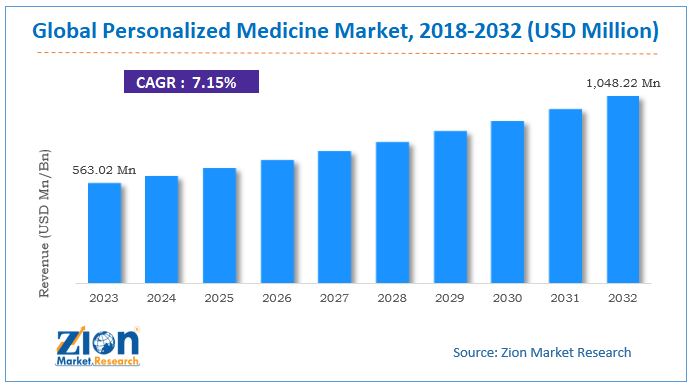
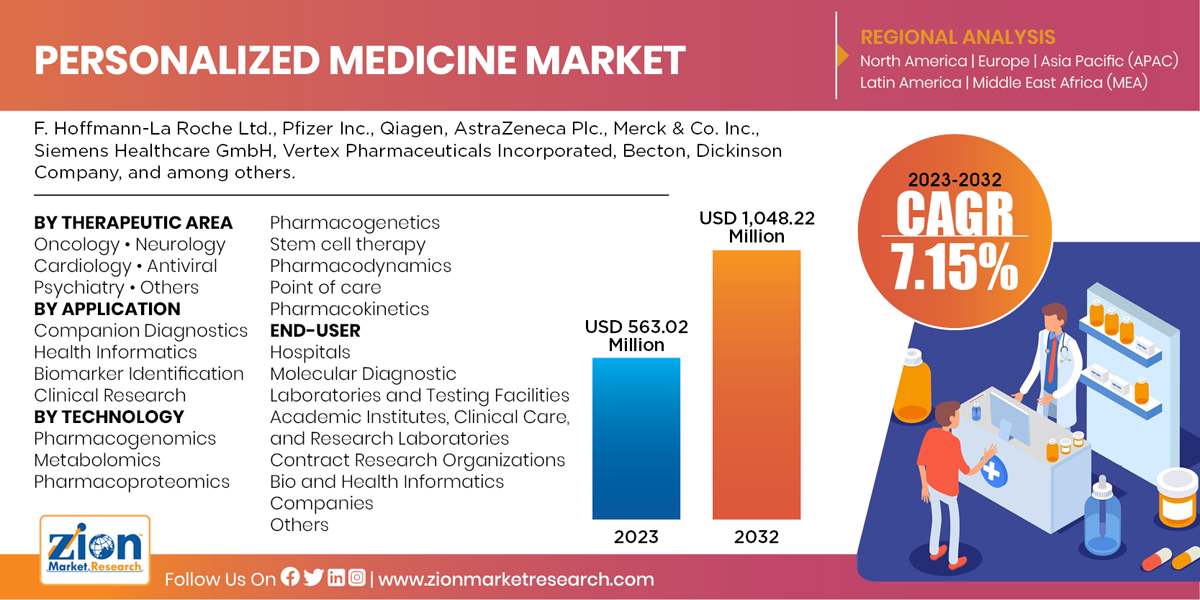
Zion Market Research has published a new report titled “Personalized Medicine Market By Therapeutic Area (Oncology, Neurology, Cardiology, Antiviral, Psychiatry, And Others), By Application (Companion Diagnostics, Health Informatics, Biomarker Identification, And Clinical Research Applications), By End-User (Hospitals, Molecular Diagnostic Laboratories And Testing Facilities, Academic Institutes, Clinical Care And Research Laboratories, Contract Research Organizations, Bio And Health Informatics Companies, And Others), By Technology (Pharmacogenomics, Metabolomics, Pharmacoproteomics, Pharmacogenetics, Stem Cell Therapy, Pharmacodynamics, Point Of Care, And Pharmacokinetics), And By Region - Global And Regional Industry Overview, Market Intelligence, Comprehensive Analysis, Historical Data, And Forecasts 2024–2032”. According to the report, the global personalized medicine market was valued at approximately USD 563.02 million in 2023 and is expected to generate revenue of around USD 1,048.22 million by 2032, growing at a CAGR of around 7.15% between 2024 and 2032.
Personalized medicines, also known as individualized medicines or precision medicines, is an evolving field used by physicians where diagnostic tests are performed to identify the biological markers. This helps in the identification of medical treatment that works best for an individual. Personalized healthcare can detect diseases at an early stage and helps in increasing the efficiency, quality, and accessibility. Personalized medicines enhance the healthcare system and increase the target approach that requires molecular information of a patient instead of sticking to a generic treatment. Personalized medicine is likely to reduce the burden of diseases by targeting treatment and prevention effectively. These medicines improve the ability to predict and differentiate the diagnosis of diseases, better therapy responses, reduced severity of illness, short timelines for product development, and increased success rates. These medicines reduce healthcare expenditures with a quick and reliable selection of effective therapy for patients and minimize the costs associated with inefficient treatment.
Browse the full "Personalized Medicine Market By Therapeutic Area (Oncology, Neurology, Cardiology, Antiviral, Psychiatry, And Others), By Application (Companion Diagnostics, Health Informatics, Biomarker Identification, And Clinical Research Applications), By End-User (Hospitals, Molecular Diagnostic Laboratories And Testing Facilities, Academic Institutes, Clinical Care And Research Laboratories, Contract Research Organizations, Bio And Health Informatics Companies, And Others), By Technology (Pharmacogenomics, Metabolomics, Pharmacoproteomics, Pharmacogenetics, Stem Cell Therapy, Pharmacodynamics, Point Of Care, And Pharmacokinetics), And By Region - Global And Regional Industry Overview, Market Intelligence, Comprehensive Analysis, Historical Data, And Forecasts 2024–2032" Report at https://www.zionmarketresearch.com/report/personalized-medicine-market
The global personalized medicine market is primarily driven by the rising healthcare expenditure, which, in turn, leads to the need for effective diagnosis and treatment procedure for cancer and other life-threatening diseases. Increased use of combination for diagnostics and development of companion diagnostics, next-generation sequencing, and retails clinics enhance this market’s growth. Increase in the adoption of next-generation sequencing by clinicians and growth in regulatory and reimbursement policies also support this market’s development. Introduction of novel drugs and the use of highly accurate and sensitive techniques for diagnosis are expected to increase the penetration rates of the personalized medicine market in the near future.
By therapeutic area, the personalized medicine market is segmented into oncology, neurology, cardiology, antiviral, psychiatry, and others. By application, this market is segmented into biomarker identification, clinical research, companion diagnostics, and health informatics. By end-user, this market is segmented into contract research organizations, hospitals, bio and health informatics companies, molecular diagnostic laboratories and testing facilities, academic institutes, clinical care, and research laboratories, and others. By technology, the personalized medicine market includes pharmacogenomics, metabolomics, pharmacoproteomics, pharmacogenetics, stem cell therapy, pharmacodynamics, pharmacokinetics, and point of care.
North America, Europe, Asia Pacific, Latin America, the Middle East, and Africa are the regional segments of the global personalized medicine market. North America is expected to remain the leading region over the forecast period, which would be closely followed by Europe. The Asia Pacific is likely to grow moderately and the Middle East and Africa, and Latin America are expected to show considerable growth over the forecast time period.
Some key players of the global personalized medicine market include F. Hoffmann-La Roche Ltd., Pfizer Inc., Qiagen, AstraZeneca Plc., Merck & Co., Inc., Siemens Healthcare GmbH, Vertex Pharmaceuticals Incorporated, and Becton, Dickinson, and Company, among others.
This report segments the global personalized medicine market as follows:
Global Personalized Medicine Market: Therapeutic Area Segment Analysis
- Oncology
- Neurology
- Cardiology
- Antiviral
- Psychiatry
- Others
Global Personalized Medicine Market: Application Segment Analysis
- Companion Diagnostics
- Health Informatics
- Biomarker Identification
- Clinical Research
Global Personalized Medicine Market: Technology Segment Analysis
- Pharmacogenomics
- Metabolomics
- Pharmacoproteomics
- Pharmacogenetics
- Stem cell therapy
- Pharmacodynamics
- Point of care
- Pharmacokinetics
Global Personalized Medicine Market: End-User Segment Analysis
- Hospitals
- Molecular Diagnostic Laboratories and Testing Facilities
- Academic Institutes, Clinical Care, and Research Laboratories
- Contract Research Organizations
- Bio and Health Informatics Companies
- Others
Global Personalized Medicine Market: Regional Segment Analysis
- North America
- The U.S.
- Europe
- UK
- France
- Germany
- Asia Pacific
- China
- Japan
- India
- Latin America
- Brazil
- The Middle East and Africa
About Us:
Zion Market Research is an obligated company. We create futuristic, cutting-edge, informative reports ranging from industry reports, the company reports to country reports. We provide our clients not only with market statistics unveiled by avowed private publishers and public organizations but also with vogue and newest industry reports along with pre-eminent and niche company profiles. Our database of market research reports comprises a wide variety of reports from cardinal industries. Our database is been updated constantly in order to fulfill our clients with prompt and direct online access to our database. Keeping in mind the client’s needs, we have included expert insights on global industries, products, and market trends in this database. Last but not the least, we make it our duty to ensure the success of clients connected to us—after all—if you do well, a little of the light shines on us.
Contact Us:
Zion Market Research
244 Fifth Avenue, Suite N202
New York, 10001, United States
Tel: +49-322 210 92714
USA/Canada Toll-Free No.1-855-465-4651
Email: sales@zionmarketresearch.com
Website: https://www.zionmarketresearch.com